
SHARE THIS ARTICLE
29 Sep 2026
Why Institutional Investors Are Betting Big on Tokenized Assets
Summary:
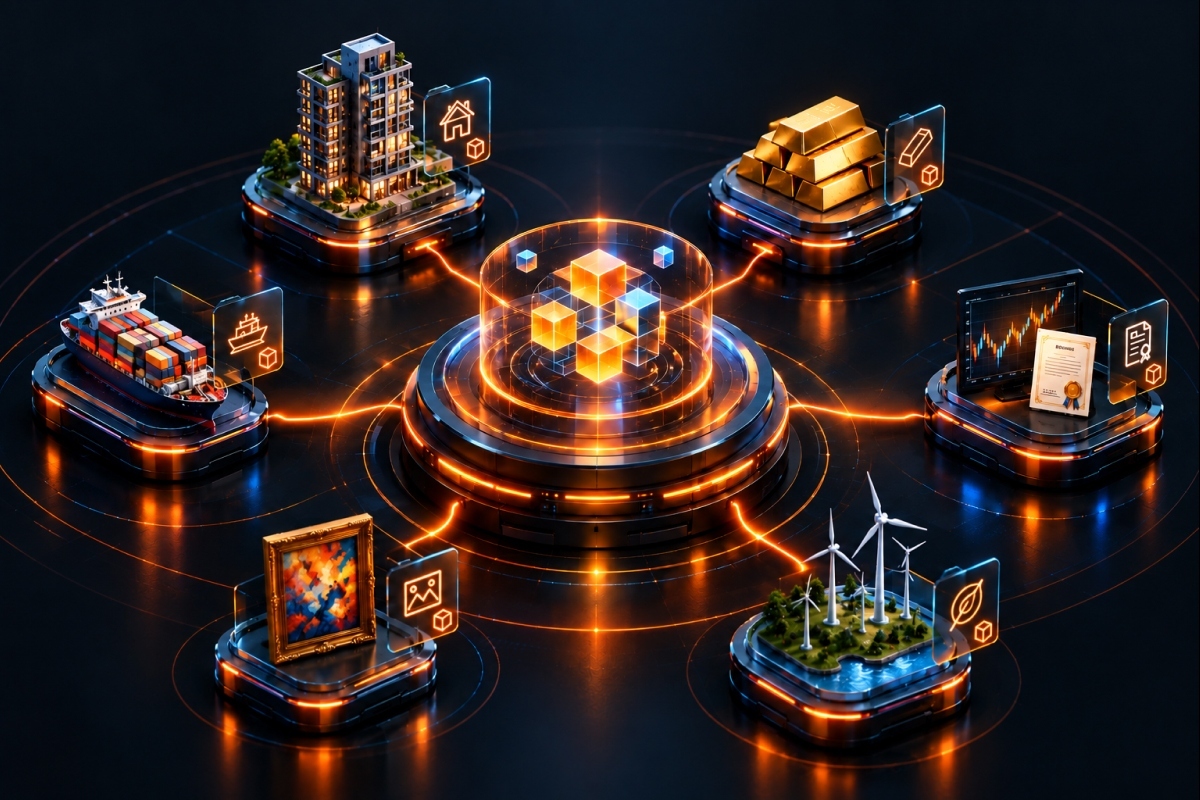
Institutional investors are moving beyond blockchain experimentation and exploring tokenization as financial-market infrastructure. Interest is being driven by faster settlement, programmable workflows, capital efficiency, and new distribution models, while regulation, custody, interoperability, liquidity, and legacy-system integration remain key challenges. As institutions move from pilots toward production, RWA tokenization development services can help translate asset structures, compliance requirements, and operational workflows into secure, scalable infrastructure.
What Are Tokenized Assets?
Tokenized assets are digital representations of ownership or economic rights associated with real-world or financial assets, recorded and transferred using blockchain infrastructure.
The underlying asset can remain within a traditional legal and custody structure. Tokenization changes how ownership records, transfers, settlement, and selected asset-servicing processes are represented and executed.
That distinction matters for institutional investors.
A tokenized Treasury fund, for example, does not eliminate the underlying securities, fund structure, custodian, regulatory requirements, or investor rights. Instead, blockchain infrastructure can provide another layer for representing and managing ownership.
This also separates tokenized assets from cryptocurrencies. A cryptocurrency is generally a digital-native asset, while a tokenized real-world asset represents an existing asset or legally defined economic claim.
The difference is increasingly important as financial institutions move toward regulated digital-asset infrastructure rather than treating blockchain solely as a speculative technology.
Why Are Institutional Investors Investing in Tokenized Assets?
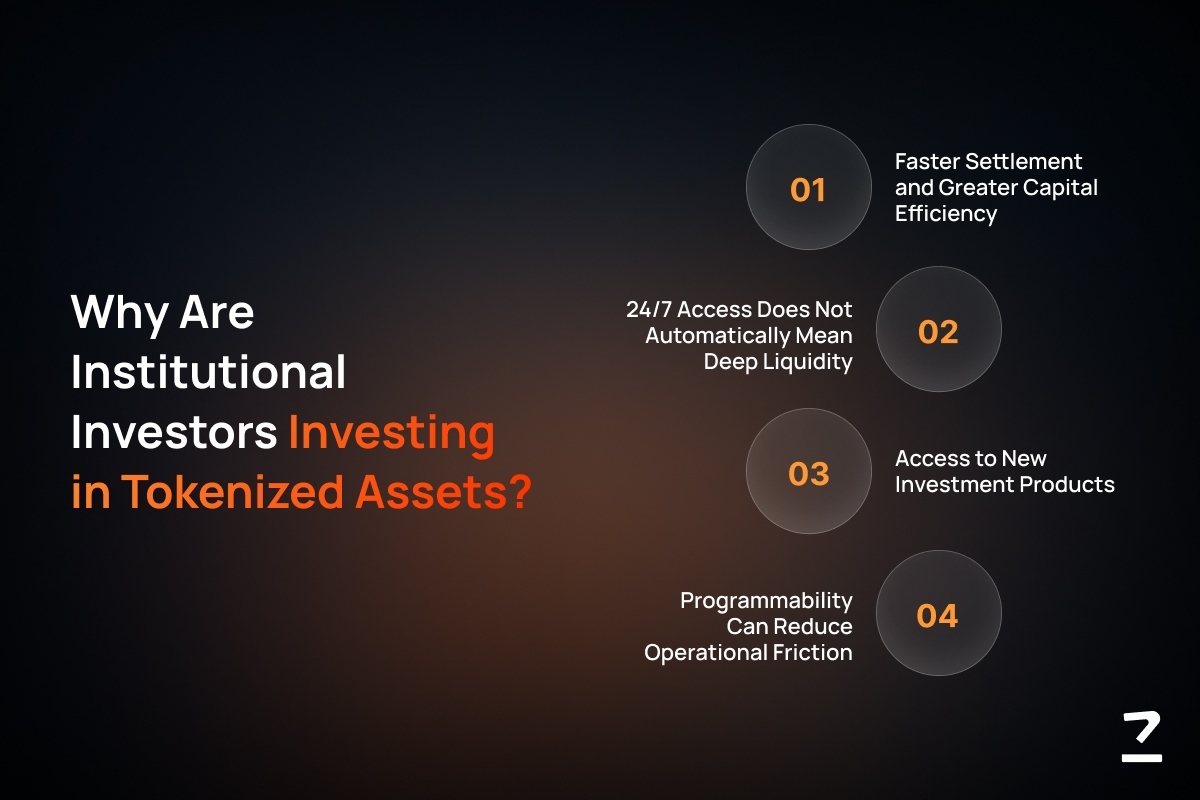
The institutional case for tokenization is increasingly tied to market infrastructure. J.P. Morgan reported in September 2026 that institutions are moving from pilot programs toward more scalable solutions, with liquidity, settlement, operational efficiency, regulatory development, and on-chain money becoming central to the transition. Several factors explain the growing interest.
Faster Settlement and Greater Capital Efficiency
Traditional financial transactions can involve multiple parties, databases, reconciliation processes, settlement windows, and intermediaries.
Tokenization can consolidate parts of this process onto shared blockchain infrastructure. Depending on the asset, legal structure, and settlement model, transactions can be executed and recorded much closer to real time.
For institutions, the significance is not simply that a transaction happens faster. Faster settlement can affect how quickly capital becomes available, how collateral moves between positions, and how much liquidity remains tied up during transaction cycles.
Coinbase identifies capital efficiency, near-instant settlement, composability, and 24/7 access among the major institutional attractions of tokenization.
24/7 Access Does Not Automatically Mean Deep Liquidity
Blockchain networks can operate continuously, creating the possibility of transfers and settlement outside traditional market hours.
This is particularly relevant for cross-border markets, collateral management, treasury operations, and digital investment products.
However, an important distinction is often missed: 24/7 transferability is not the same as 24/7 liquidity.
A tokenized security may be technically transferable at any time but still have limited buyers, restricted transfer eligibility, or no mature secondary market. Actual liquidity depends on market depth, investor participation, regulated trading venues, market makers, and the legal transferability of the asset.
This distinction is becoming increasingly important as institutional investors move from tokenization pilots to production infrastructure.
Access to New Investment Products
Tokenization can create new distribution and ownership models around assets such as:
-
U.S. Treasuries and money market funds
-
Private credit
-
Private equity
-
Bonds
-
Equities
-
Real estate
-
Commodities
-
Investment funds
The growth is already visible in market data. The market has also expanded beyond early Treasury-focused use cases. CoinGecko's 2026 RWA research recorded $19.32 billion in tokenized RWAs excluding stablecoins at the end of Q1, while subsequent market tracking shows continued growth across tokenized Treasuries, commodities, equities, ETFs, and private-market assets.
For institutions, these products can provide a way to combine familiar financial assets with programmable digital infrastructure.
Programmability Can Reduce Operational Friction
Smart contracts can encode predefined rules for transfers, eligibility, distributions, redemptions, and other asset lifecycle events.
For example, a permissioned token can prevent transfers to wallets that have not passed required eligibility checks. A tokenized fund can also use programmable workflows for distributions or corporate actions, depending on its legal and technical design.
The important limitation is that smart contracts automate rules; they do not replace legal agreements, custodians, fund administrators, regulators, or fiduciary responsibilities.
That is why institutional tokenization is fundamentally an infrastructure problem rather than simply a smart-contract development exercise.
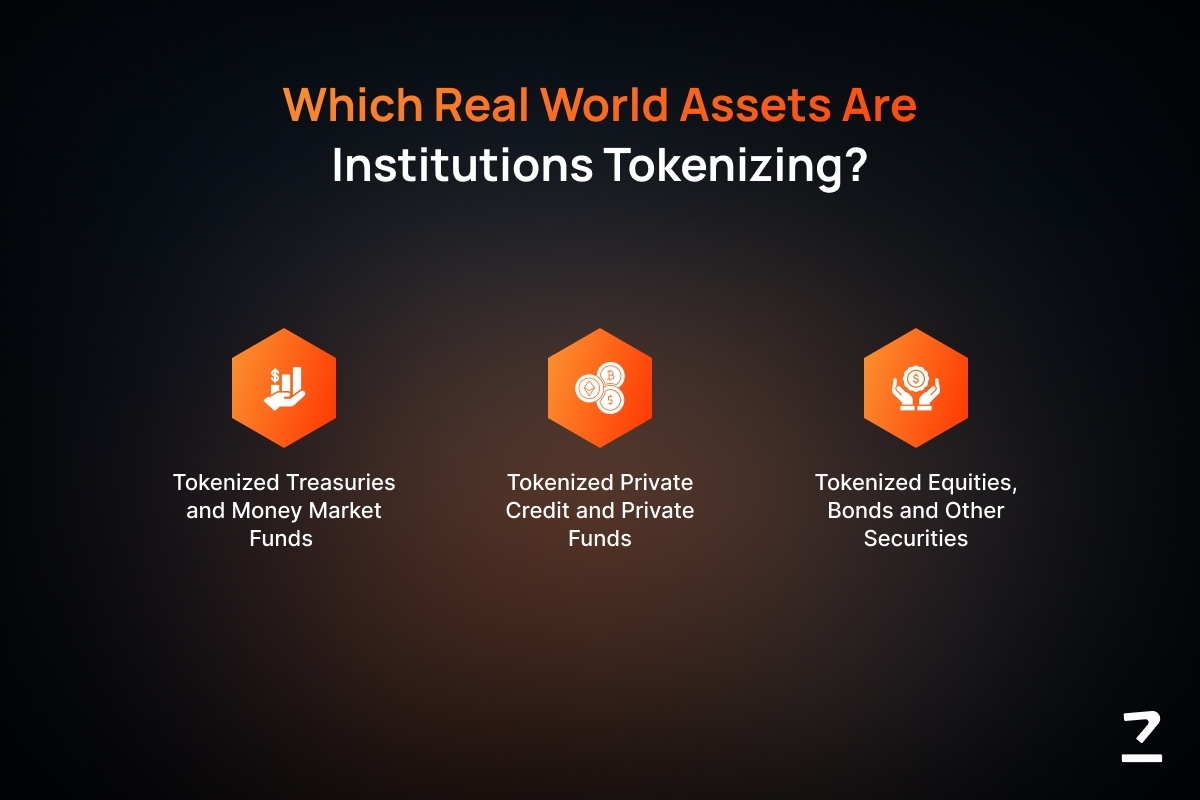
Which Real World Assets Are Institutions Tokenizing?
The institutional tokenization market is developing unevenly across asset classes.
Tokenized Treasuries and Money Market Funds
Treasuries and money market products have become important entry points because they combine familiar financial structures with demand for yield, liquidity, and more efficient settlement.
The institutional market already includes products from major asset managers and tokenization platforms.
BlackRock's BUIDL provides investors with a tokenized representation of its U.S. dollar fund, while Franklin Templeton's BENJI represents shares in its Franklin OnChain U.S. Government Money Fund. Ondo's OUSG provides exposure to short-term U.S. Treasuries through an on-chain structure.
These examples show how institutional tokenization is moving beyond blockchain experimentation into established financial products. The broader tokenized RWA market is currently tracked at approximately $8.4 billion in market capitalization on CoinGecko's dedicated tokenized RWA dashboard, although market-size estimates vary by methodology and asset coverage.
For institutions, these products also demonstrate why tokenization requires more than creating a blockchain token. Issuers still need appropriate fund structures, custody, investor eligibility, transfer controls, compliance processes, and asset servicing.
Tokenized Private Credit and Private Funds
Private credit is another area attracting attention because traditional private-market investments can involve lengthy settlement processes, limited transferability, and complex administration.
Tokenization can provide a digital representation of ownership or economic rights and potentially support more efficient distribution and servicing.
But tokenization does not eliminate the underlying credit risk or automatically create a liquid secondary market. Investors still need to evaluate the borrower, asset quality, valuation, duration, legal structure, and exit mechanisms.
Tokenized Equities, Bonds and Other Securities
The market is also expanding into tokenized stocks, ETFs, bonds, and other securities.
CoinGecko reported that tokenized stocks reached approximately $0.5 billion by the end of Q1 2026, while tokenized ETFs reached around $0.3 billion.
The broader direction is significant: tokenization is moving beyond a narrow Treasury use case toward a broader digital representation of financial instruments.
Tokenized Assets vs. Traditional Assets: What Actually Changes?
Tokenization does not fundamentally change the economic characteristics of an underlying asset. Instead, it can change the infrastructure used to represent, transfer, and service that asset.
|
Dimension |
Traditional infrastructure |
Tokenized infrastructure |
|
Ownership record |
Multiple institutional records |
Blockchain-based digital record |
|
Settlement |
Conventional settlement processes |
Potentially near-real-time on-chain settlement |
|
Availability |
Market and processing hours |
Potentially 24/7 |
|
Transfer rules |
External operational controls |
Can be encoded into smart contracts |
|
Reconciliation |
Multiple systems may require reconciliation |
Shared ledger can reduce duplication |
|
Liquidity |
Established market venues |
Depends on actual tokenized-market depth |
|
Compliance |
External workflows |
Some rules can be embedded into transactions |
|
Asset servicing |
Traditional intermediaries |
Traditional and blockchain-based systems can coexist |
The key point is: tokenization changes the rails, not the fundamental risk of the asset. A tokenized bond still carries credit and interest-rate risk. A tokenized property still depends on the underlying real estate. A tokenized fund still requires appropriate governance and investor protections.
What Is Holding Institutional Tokenization Back?
Institutional adoption is growing, but implementation remains complex.
Regulatory and Legal Uncertainty
Regulatory treatment determines who can issue, hold, transfer, and trade a tokenized asset.
Questions around securities classification, investor eligibility, ownership rights, transfer restrictions, custody, reporting, and cross-border distribution can materially affect platform architecture.
The Coinbase 2026 institutional survey found regulatory uncertainty was the most frequently cited barrier to investing in tokenized assets, identified by 67% of respondents.
Secondary-Market Liquidity
Tokenization can make an asset easier to transfer technically, but secondary-market liquidity still requires willing buyers and sellers.
This is particularly important for private assets. A tokenized private-credit position may be easier to represent and transfer, but the market still needs appropriate counterparties, trading infrastructure, regulatory permissions, and pricing mechanisms.
The same Coinbase/EY-Parthenon survey found insufficient secondary liquidity was cited by 38% of respondents as a hurdle.
Custody and Investor Protection
Institutional tokenization also introduces digital-asset considerations around wallets, private keys, custody models, transaction authorization, smart-contract security, and recovery procedures.
Institutions increasingly evaluate custody through the lens of regulatory compliance and security risk controls. In the 2026 Coinbase/EY-Parthenon survey, 66% cited regulatory compliance as a key factor in selecting a custodian.
For RWA platforms, custody also connects the blockchain representation to the underlying asset.
Legacy-System Integration and Interoperability
A tokenization platform rarely operates independently. It may need to integrate with:
-
KYC and AML providers
-
Custodians
-
Banks and payment rails
-
Fund administrators
-
Transfer agents
-
ERP and accounting systems
-
Oracle/data providers
-
Investor portals
-
Reporting systems
-
Secondary-market infrastructure
The Coinbase/EY-Parthenon research found integration challenges were cited by 59% of respondents as a barrier to tokenized-asset investment.
What Institutions Need to Build for RWA Tokenization
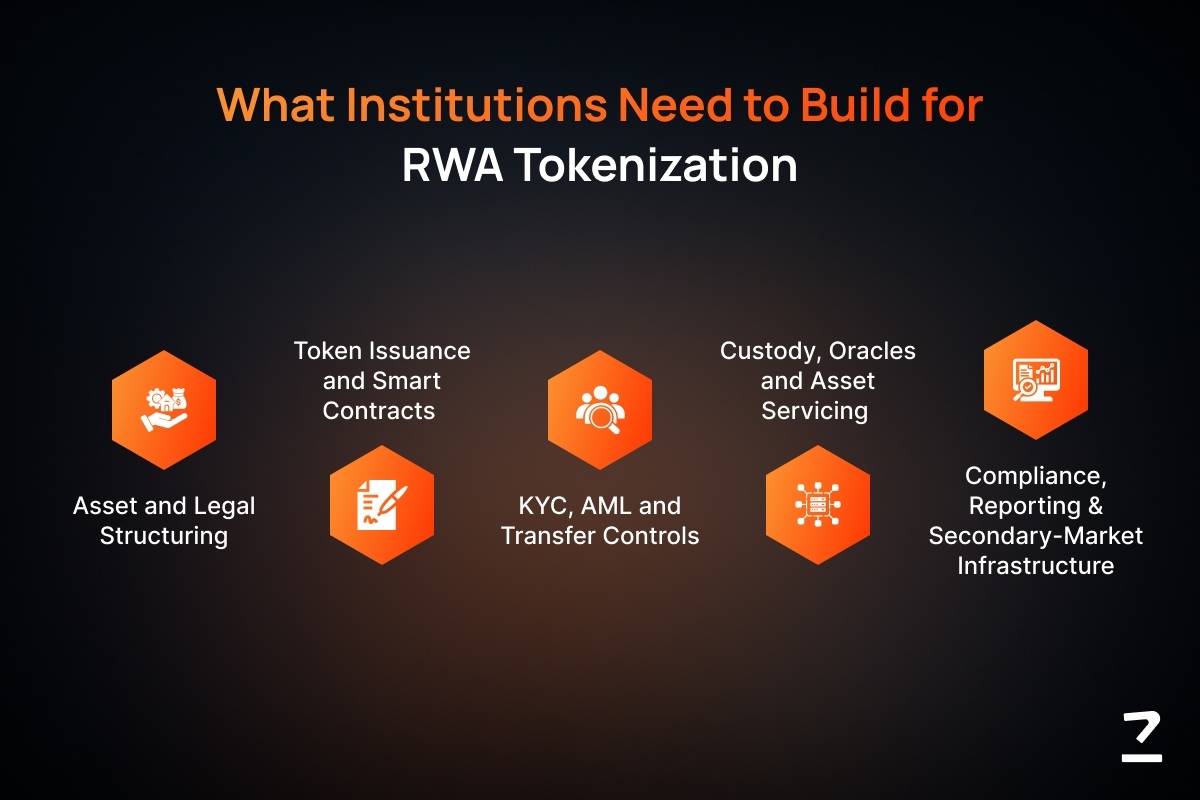
Moving from institutional interest to a production-ready tokenized asset requires several connected layers.
Asset and Legal Structuring
The first question is not which blockchain to use. It is what the token legally represents. The platform may need to connect the token with a fund share, SPV interest, debt claim, beneficial ownership right, or another legally defined structure.
Token Issuance and Smart Contracts
The tokenization layer manages functions such as issuance, transfers, redemption, pausing, and lifecycle events. For regulated assets, permissioned transfer logic and investor eligibility can be more important than simply creating a transferable token.
KYC, AML and Transfer Controls
Institutional RWA platforms need investor onboarding and compliance controls that can determine who is permitted to hold or transfer specific assets. This can include identity verification, jurisdiction restrictions, accreditation requirements, sanctions screening, wallet whitelisting, and transaction monitoring.
Custody, Oracles and Asset Servicing
The blockchain cannot independently verify that an off-chain asset still exists or that its valuation is accurate. Custody connects the token to the underlying asset, while oracle infrastructure can bring relevant external data on-chain.
Codezeros' recent analysis of custody and oracles makes this distinction particularly clear: the token is a claim connected to an off-chain asset, so the surrounding infrastructure determines whether that claim remains trustworthy.
Compliance, Reporting and Secondary-Market Infrastructure
A production platform may also require investor reporting, audit trails, corporate-action workflows, redemption mechanisms, liquidity integrations, and secondary-market connectivity. This is why RWA tokenization development is broader than smart-contract development.
From Institutional Interest to RWA Tokenization Infrastructure
The institutional opportunity is increasingly moving downstream. As more asset managers, financial institutions, fintechs, and enterprises explore tokenized assets, they need infrastructure capable of connecting:
Underlying asset → legal structure → token issuance → investor onboarding → compliance → custody → settlement → asset servicing → reporting → liquidity. This creates demand for RWA tokenization platforms rather than isolated token contracts.
A platform may need to support token lifecycle management, permissioned transfers, investor dashboards, compliance integrations, custody and oracles infrastructure and administrative controls.
For organizations moving from strategy to implementation, an RWA Tokenization Development Company can help translate the asset model and regulatory requirements into an application architecture.
Codezeros provides RWA Tokenization Development Services focused on building blockchain-based infrastructure for real-world assets, alongside its broader blockchain development offerings.
For teams that need specialized engineering capacity, the alternative is to hire RWA tokenization developers with experience spanning smart contracts, blockchain architecture, compliance workflows, and financial applications.
Build an Institutional-Grade RWA Tokenization Platform
Institutional tokenization is moving from a discussion about blockchain potential toward a practical question of financial infrastructure. The strongest opportunities are likely to emerge where tokenization solves a defined problem around settlement, liquidity management, asset distribution, collateral, or operational efficiency.
For organizations evaluating an RWA initiative, the critical step is designing the complete system around the asset. That means connecting legal structures, smart contracts, compliance, investor onboarding, custody, data, settlement, and future liquidity requirements.
Codezeros helps organizations evaluate and build RWA tokenization infrastructure around defined business and asset models. If you are planning an institutional tokenization initiative, explore our RWA Tokenization Development Services or discuss your requirements with the Codezeros blockchain team.
Build the infrastructure behind your tokenized asset strategy. Talk to the Codezeros team about your RWA project.
Post Author
Paritosh Mehta
As a distinguished blockchain expert at Codezeros, Paritosh contributes to the company's growth by leveraging his expertise in the field. His forward-thinking mindset and deep industry knowledge position Codezeros at the forefront of blockchain advancements.
Frequently Asked Questions
Frequently asked questions about this article.
Have an RWA Tokenization Project in Mind?
Discuss your asset, use case, and technical requirements with our tokenization experts. Get a clear view of the architecture, compliance, integrations, and development approach needed to take your project forward.
Blogs
Our Latest Blogs
Discover valuable industry insights and stay up-to-date with the latest updates by exploring our curated collection of recent blog posts.
Let us know your requirement
We know ideas matter, we are the product of one. We Provide Full Assistance In Your Business