

SHARE THIS ARTICLE
18 Sep 2026
Why Your Next Cross-Border Payment Might Already Be a Stablecoin (and You Won't Know It)

When a business sends money across borders, the experience usually looks simple. You pay in one currency. The recipient gets another. A payment provider handles everything in between.
But that middle layer is changing.
A stablecoin can now sit inside a cross-border payment flow without ever appearing in the customer interface. The user may still see a familiar balance, payment screen, and local currency payout. But what actually happens behind the scenes is that a blockchain infrastructure can handle part of the settlement process.
The customer still sees a conventional payment. The settlement layer tells a different story.
This is one reason stablecoins are becoming relevant to cross-border payments. Their role does not have to be about getting consumers to hold crypto. They can instead become an infrastructure component that moves value between institutions, payment providers, businesses, and markets.
The important question is therefore not whether your customers will suddenly start paying with stablecoins. It is whether the infrastructure processing their payments will start using them behind the scenes.
Stablecoins Are Moving From the Wallet to the Settlement Layer
A stablecoin can serve two very different purposes in a payment ecosystem. The first is consumer-facing. A user holds USDC, USDT, or another stablecoin and sends it directly to another wallet.
The second is infrastructure-focused. A financial service uses a stablecoin as an intermediate settlement asset while the sender and recipient continue dealing in fiat currencies. The second model is particularly interesting for cross-border payments.
Imagine a company in India paying a supplier in Europe. The company initiates the transaction in rupees through a familiar payment interface. The payment provider collects the funds and manages the currency conversion. Instead of relying entirely on traditional correspondent banking relationships to move value internationally, the provider could use a stablecoin to settle part of the transaction on-chain. The stablecoin is then converted into euros before the supplier receives the money.
The supplier does not necessarily need to know that a blockchain was involved. That distinction changes the engineering challenge. Building this type of infrastructure is not simply a matter of deploying a token contract. The architecture needs to connect blockchain settlement with fiat payment systems, liquidity providers, foreign-exchange conversion, compliance controls, custody, transaction monitoring, and local payout mechanisms.
For organizations exploring DeFi development solutions, that broader architecture matters. The blockchain is one component of the payment system rather than the entire product.
Stablecoins are therefore better understood as a potential settlement rail than as a replacement for the customer experience.
Why Cross-Border Payments Are a Natural Fit
International payments have to bridge financial systems that were not necessarily designed as one unified network.
A domestic payment can often remain inside a local clearing system. A cross-border transaction may involve correspondent banks, different payment standards, multiple currencies, compliance checks, and separate operating schedules.
The result can be a payment that is technically straightforward for the sender but operationally complex behind the scenes.
Blockchain settlement changes one part of that equation. A compatible blockchain can transfer a digital asset continuously rather than following the opening hours of a conventional banking network.
That can be useful when money needs to move across jurisdictions outside normal banking windows.
It does not, however, make the entire payment instant.
The sender may still need to pass compliance checks. The provider may need to source liquidity. The recipient's bank may have its own processing schedule. Converting the stablecoin into local currency can introduce another dependency.
This distinction is important.
A stablecoin transfer can settle quickly on-chain while the complete cross-border payment still takes longer. The practical benefit comes from identifying which part of the existing process is creating friction and determining whether blockchain settlement can improve that particular stage.
The IMF has identified faster and potentially cheaper cross-border payments as one of the possible benefits of stablecoins. At the same time, it notes that traditional infrastructure can also be improved and that stablecoins introduce their own risks around fragmentation, capital flows, and regulation.
That makes stablecoins less of a universal replacement and more of an additional infrastructure option.
What an Invisible Stablecoin Payment Actually Looks Like
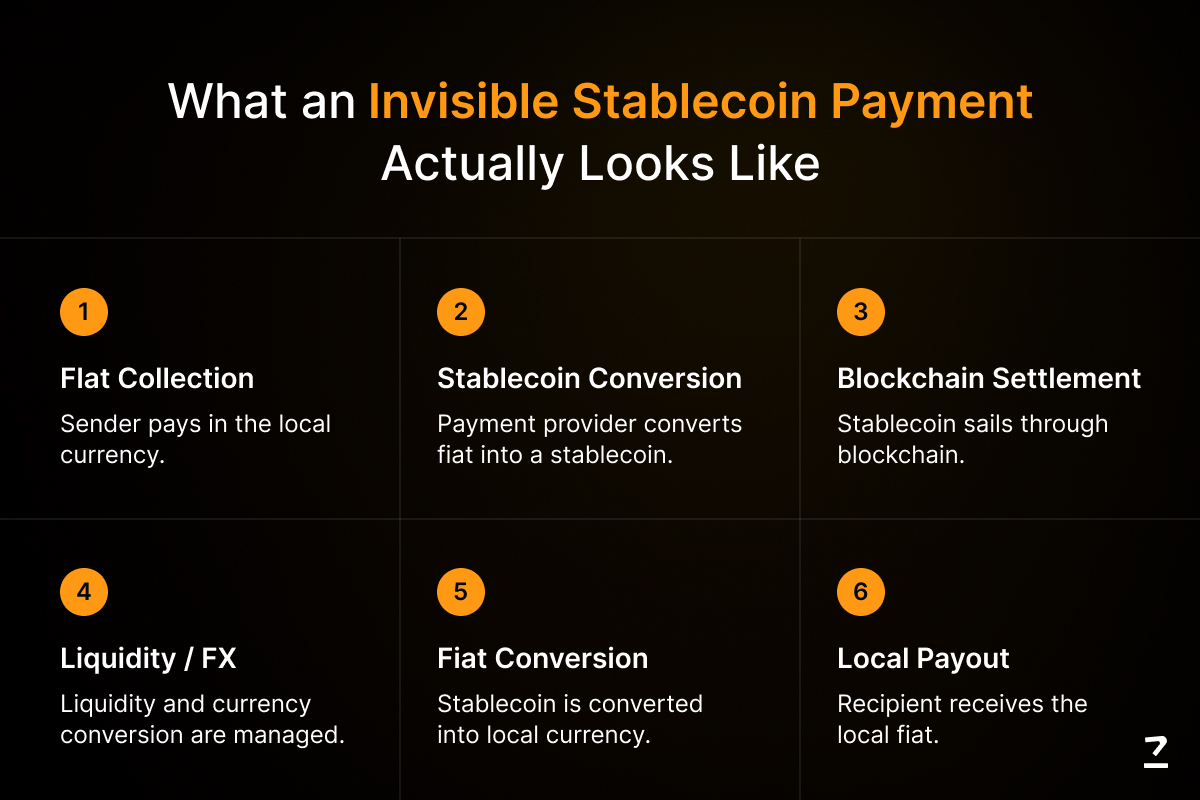
Here’s a step-by-step pointer to understand what actually happens behind the scenes.
Each stage has a different responsibility.
-
Fiat collection
The sender pays using an existing bank account, card, payment platform, or business payment system. The user does not necessarily interact with a blockchain wallet.
-
Stablecoin conversion
The payment provider converts the required amount into a supported stablecoin. The choice of asset depends on liquidity, jurisdiction, counterparty arrangements, and the payment corridor.
-
Blockchain settlement
The stablecoin moves from one controlled wallet to another. Smart contracts and blockchain infrastructure record the transaction and enforce the rules of the underlying asset.
-
Liquidity and FX management
The provider needs sufficient access to the destination currency. A fast blockchain transfer does not solve a shortage of local liquidity.
-
Fiat conversion
The stablecoin is exchanged for the recipient's currency through an appropriate off-ramp or liquidity provider.
-
Local payout
-
The recipient receives funds through a familiar local payment method.
-
The interesting part is that only the middle of this flow needs to be blockchain-based.
-
The customer can continue to experience a normal fiat transaction from beginning to end.
-
That is what makes the phrase "you won't know it" meaningful. The most commercially useful blockchain infrastructure may not always be the part customers directly see.
The Technology Stack Behind the Experience
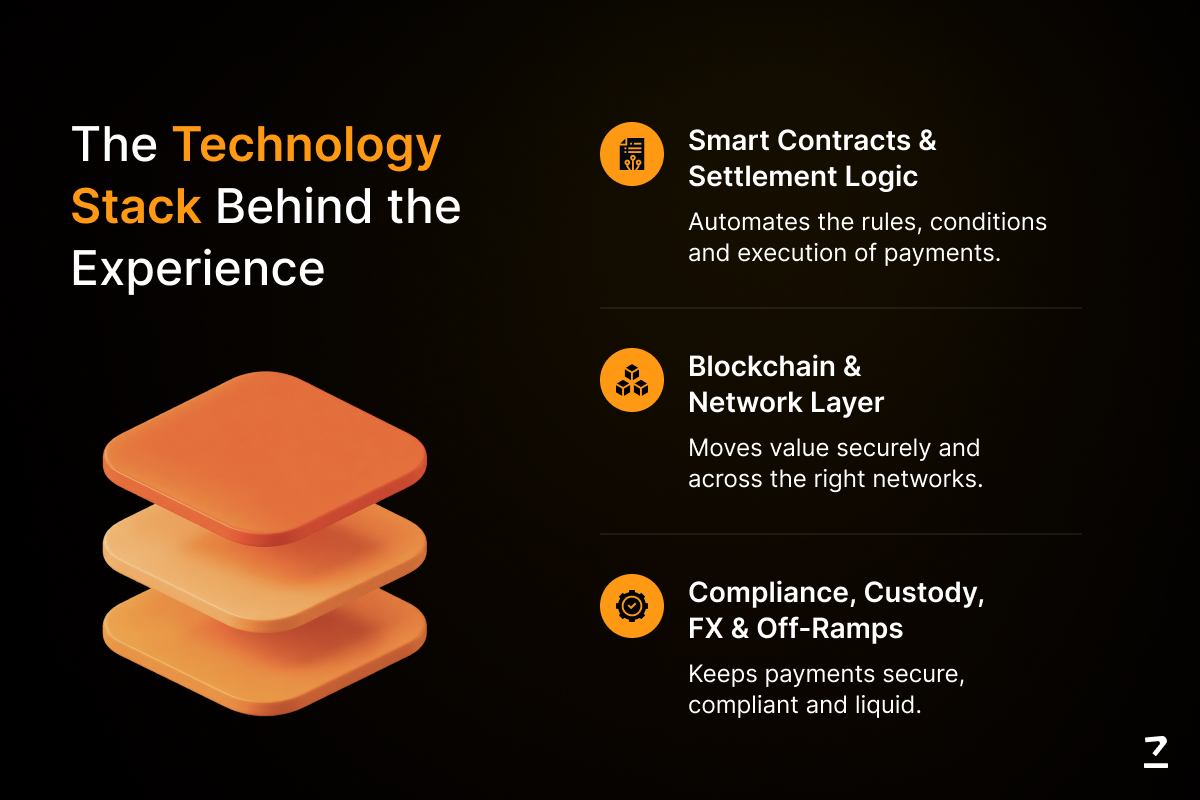
A stablecoin-based payment system needs more than a wallet and a blockchain connection.
-
Smart Contracts and Settlement Logic
Smart contracts can define how supported assets are transferred and how specific transaction conditions are enforced.
For a payment infrastructure provider, that could involve controlled transfers, transaction limits, authorization rules, settlement instructions, or interactions with other on-chain contracts.
The contract itself is only one layer. The surrounding application must determine when a transaction should happen, who can initiate it, what checks must occur first, and what happens when settlement fails.
This is where smart contract development becomes part of a larger financial architecture rather than an isolated coding exercise.
-
Blockchain and Network Selection
The network used for settlement affects the practical economics of the system.
Transaction costs matter. So does confirmation behaviour. Liquidity matters as well because a blockchain with strong technical characteristics is not automatically useful for a payment corridor if the required asset cannot be converted efficiently at the destination.
Interoperability is another consideration.
A provider may eventually need to work with more than one network or connect blockchain-based settlement to systems that were never designed to communicate with blockchains.
That makes architecture decisions more important than simply choosing the chain with the lowest transaction fee.
-
Compliance, Custody, and Off-Ramps
The blockchain transaction is only one part of a regulated payment flow.
The surrounding infrastructure may need customer verification, transaction monitoring, sanctions screening, wallet controls, record keeping, and jurisdiction-specific compliance processes.
Custody also matters. Someone has to control the private keys or use an appropriate custody arrangement. Operational procedures must account for failed transactions, compromised credentials, liquidity shortages, and other exceptional conditions.
Then comes the off-ramp.
A stablecoin is useful to the recipient only if it can ultimately become something the recipient can spend, hold, or transfer within the local financial system.
This is why the engineering problem extends well beyond the token.
Why Businesses May Prefer Stablecoins Without Exposing Them to Customers
A business does not necessarily need customers to understand blockchain for blockchain infrastructure to provide value. The strongest case may actually be the opposite. If the settlement layer becomes more efficient while the user interface stays familiar, a company can introduce new infrastructure without forcing customers to change how they pay.
There are several potential advantages.
Liquidity can move differently. A stablecoin can provide a digital representation of value that can be transferred between compatible wallets without requiring every movement to follow the same correspondent-banking path. Settlement can operate continuously. Blockchain networks are generally not constrained by traditional banking hours.
Payment logic can become programmable. Smart contracts can automate parts of settlement that would otherwise require manual coordination between systems. New payment models become possible. Businesses can combine blockchain settlement with APIs, automated treasury systems, digital wallets, and other financial infrastructure.
But these benefits should not be confused with guaranteed cost savings.
The BIS has specifically warned that on-ramp and off-ramp costs can make the total cost of a stablecoin-based cross-border transaction comparable to, or even higher than, a bank transfer.
The right question is therefore not "Are stablecoins cheaper?"
It is "Where does stablecoin settlement create an economic or operational advantage in this particular payment flow?"
The Catch: Stablecoins Don't Remove the Hard Parts
Stablecoins can simplify one part of a transaction while introducing new dependencies elsewhere.
The first issue is the stablecoin itself.
A stablecoin's ability to maintain its intended value depends on its design, reserves, issuer, redemption mechanisms, liquidity, and applicable regulatory framework. A stablecoin is not simply equivalent to cash because its risk profile depends on the structure supporting it.
The second issue is interoperability.
Different blockchains do not automatically behave like a single payment network. Assets can exist on multiple chains, while wallets, liquidity providers, bridges, and settlement systems may support different combinations.
The IMF has identified fragmentation as one of the structural concerns surrounding stablecoins. Different technical infrastructure, reserve structures, and regulatory approaches can create a fragmented ecosystem rather than one unified global rail.
The third issue is regulation.
Cross-border payments already operate within multiple legal and regulatory environments. Introducing a privately issued digital asset does not remove those obligations.
The fourth is liquidity.
Moving dollars digitally can be easily achieved via a stablecoin, but this doesn’t take away the fact that the recipient may need another local currency. Someone still needs to provide that liquidity and execute the conversion.
Finally, there is operational risk.
When it comes to payment infrastructure, there are multiple variables that need to be considered like failed transactions, compromised keys, network congestion, and reconciliation between on-chain and off-chain records
Payment infrastructure needs to account for incorrect addresses, failed transactions, compromised keys, unavailable liquidity, network congestion, smart contract vulnerabilities, and reconciliation between on-chain and off-chain records.
That is why serious stablecoin infrastructure cannot be designed around the blockchain transaction alone.
What This Means for the Next Generation of Payment Infrastructure
The most likely future is not a world where every international payment becomes a visible crypto transaction.
It is a more complicated system in which several types of infrastructure coexist.
Banks can continue providing accounts and fiat liquidity. Payment providers can manage customer relationships and local payouts. Blockchain networks can provide settlement infrastructure. Stablecoin issuers can provide digital representations of currencies. Smart contracts can automate specific financial workflows.
The customer may see none of this complexity. This is similar to how many internet services work today. A user does not need to understand the infrastructure underneath a transaction to benefit from it.
The same principle can apply to blockchain-based payments. Codezeros' broader blockchain work is relevant to this infrastructure-first view. Its public service offering includes enterprise blockchain development and blockchain solutions across multiple frameworks and use cases.
The important point is that payment architecture should begin with the business requirement rather than with the token. A company that needs faster settlement between internal entities may have a different architecture from a fintech building consumer remittances. A regulated financial institution may need a different approach again.
The blockchain network, stablecoin, custody model, smart contracts, APIs, and compliance layer should follow those requirements.
What This Means for the Future of Cross-Border Payments
Stablecoins do not need to replace the payment experience to change how cross-border money moves.
For businesses, the question is therefore less about whether customers will use stablecoins and more about whether stablecoin infrastructure can solve a specific settlement problem better than the existing alternative. The future is likely to be a hybrid model where banks, fintechs, blockchain networks, stablecoins, and local payment rails work together rather than operate as separate systems.
That makes the underlying architecture just as important as the stablecoin itself. The right network, smart contract logic, liquidity model, compliance controls, custody setup, and off-ramp determine how well the infrastructure can fit into an existing payment operation.
Post Author

Deep Shah
Explore Deep's insightful blog posts that help businesses stay ahead of the curve, explore new possibilities, and unlock the full potential of blockchain technology
Frequently Asked Questions
Frequently asked questions about this article.
A stablecoin can act as a digital settlement asset between payment providers, businesses, or financial institutions. In some models, it can be used to transfer value across a blockchain before being converted into the recipient's local currency.
Yes. A payment provider can potentially use stablecoins in the settlement layer while presenting customers with a conventional fiat payment experience. The customer pays in one currency and receives another, while the stablecoin is used between infrastructure providers or wallets during the transaction.
The blockchain transfer itself can settle quickly and operate continuously, but that does not guarantee a faster end-to-end payment. Compliance checks, foreign-exchange conversion, liquidity, and local payout systems can still create delays.
No. A business can potentially integrate existing blockchain networks and stablecoins into its payment infrastructure. Building a dedicated blockchain becomes a separate architectural decision that depends on requirements such as control, governance, privacy, interoperability, and transaction design.
Regulation depends on the jurisdiction, the stablecoin, and the activities being performed. Issuance, custody, exchange, payment services, and cross-border transfers can each raise different regulatory requirements.
The stack can include blockchain networks, smart contracts, wallets or custody infrastructure, APIs, payment integrations, compliance systems, transaction monitoring, liquidity providers, foreign-exchange services, and fiat on/off-ramps. The exact architecture depends on the payment model and jurisdictions involved.
More questions? Contact us.
Build the Infrastructure Behind Modern Cross-Border Payments
Stablecoins may not replace traditional payment systems outright. Their more immediate opportunity would be to become a part of the infrastructure that connects different currencies, institutions, and payment networks. For businesses exploring that model, the solution needs to connect blockchain settlement with existing financial systems while accounting for liquidity, compliance, smart contracts, and operational controls. Codezeros works across enterprise blockchain and smart contract development, with experience across multiple blockchain frameworks and decentralized applications.
Blogs
Our Latest Blogs
Discover valuable industry insights and stay up-to-date with the latest updates by exploring our curated collection of recent blog posts.

Let us know your requirement
We know ideas matter, we are the product of one. We Provide Full Assistance In Your Business