
SHARE THIS ARTICLE
29 Jun 2026
Common Security Risks in RWA Tokenization and How to Mitigate Them

The token isn't the asset. That single fact breaks most security assumptions teams carry over from DeFi into real-world asset tokenization.
In a standard DeFi protocol, the smart contract is the product. Audit the contract, secure the keys, and the system mostly holds.
With real-world assets, the on-chain token is only a claim on something off-chain: a bond in a custodian's vault, a loan on a borrower's balance sheet, a deed in a registry. The attack surface now spans legal documents, custodians, oracles, and human approval workflows that no Solidity audit was designed to inspect.
The numbers show why this matters. As of March 2026, the distributed RWA value reached $26.69B against $360.52B in represented assets, spread across 33 networks with nearly 700,000 holders.
This article breaks down security risks that actually cause losses, the real exploits behind them, and the mitigations that hold up in production. It's written for teams choosing an RWA tokenization development company, evaluating an audit, or building secure real world asset tokenization platforms in-house.
Why RWA Security Differs From DeFi Security
DeFi security looks contained. One codebase, one attack surface, one audit. RWA security looks contained until you trace where the value actually lives.
A tokenized Treasury fund depends on a custodian holding the bonds, a transfer agent recording shares, an oracle reporting NAV, and a compliance contract gating transfers. Each is a separate trust assumption.
The on-chain contract cannot independently verify that the custodian holds the asset, that the SPV is solvent, or that the legal claim is enforceable.
That is the reason RWA protocols need auditors who understand blockchain security, traditional finance, and regulatory compliance together. Solidity expertise alone misses the off-chain failure modes that now drive most losses.
The Five-Layer RWA Security Model
The industry now maps RWA risk across five layers. Each one can fail independently, and a failure at any layer can drain the whole system.
-
Physical asset layer — the underlying bond, property, or commodity and whether it actually exists and is properly held.
-
Legal framework layer — the SPV structure, title documentation, and whether courts recognize the token as evidence of ownership.
-
Operational layer — the human workflows: approvals, reconciliations, key management, and incident response.
-
Data/oracle layer — NAV feeds, proof-of-reserve attestations, and price oracles.
-
On-chain smart contract layer — mint/burn logic, access control, compliance hooks, upgrade paths.
Most teams audit only the fifth layer. The losses come from the other four. A strong RWA tokenization security architecture treats all five as part of the same threat model.
What Are the Biggest Security Risks in RWA Tokenization?
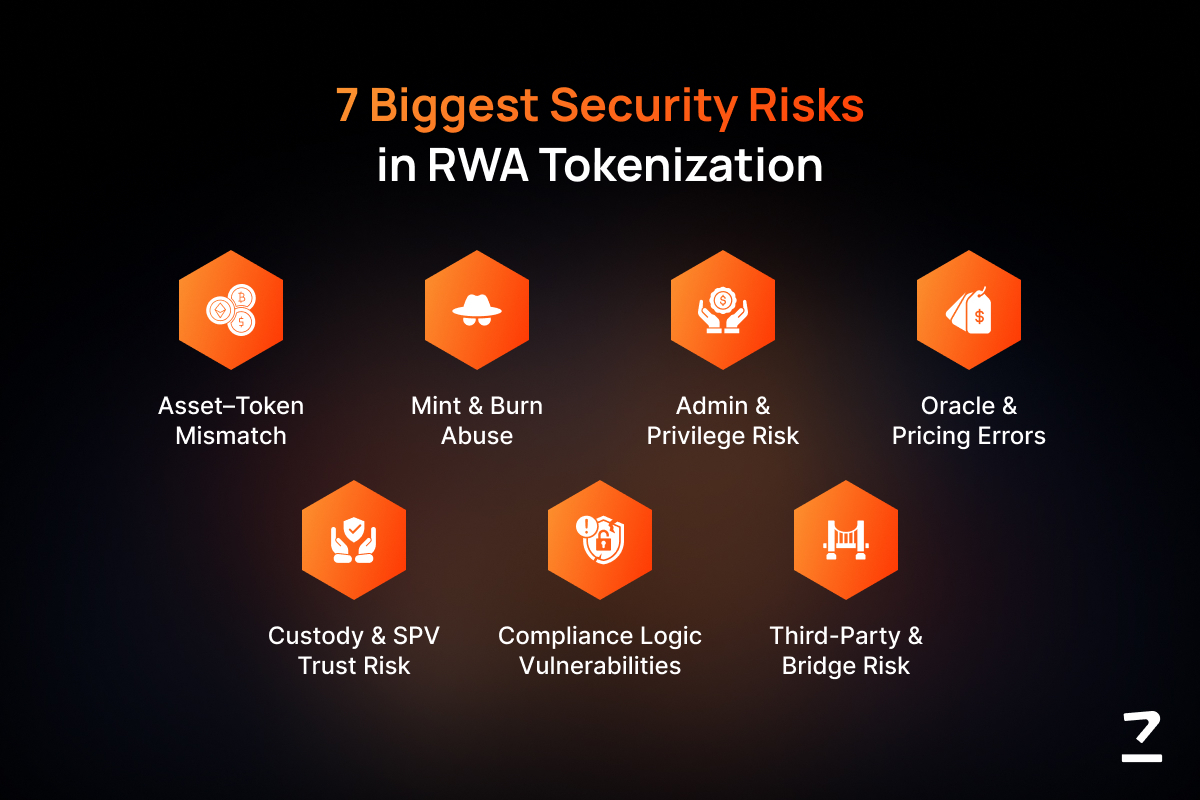
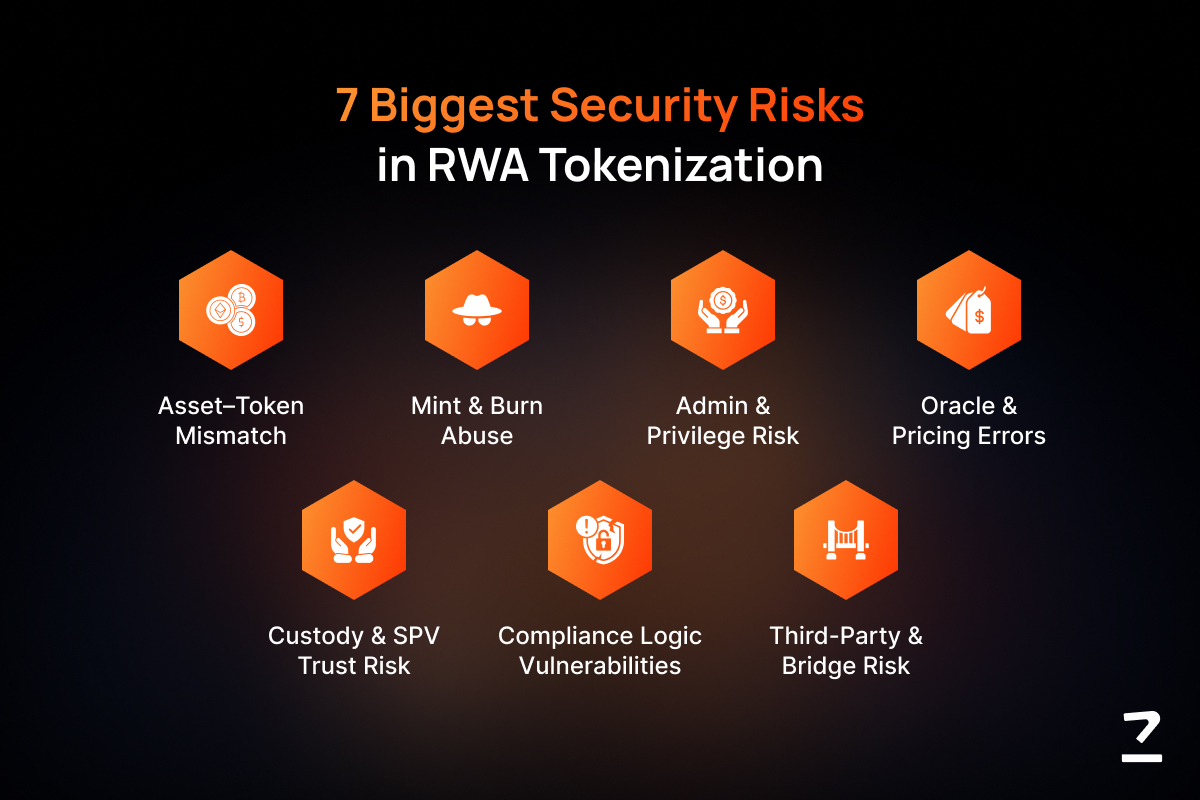
Seven risk categories account for nearly every documented RWA loss. Each one below pairs the failure mode with a real exploit.
1. Asset–Token Mismatch and Fraudulent Proof-of-Reserve
The most basic risk is deceptively simple: does token supply reliably map to the underlying asset? If a protocol claims 1,000 tokens back $1,000,000 in T-bills, what happens when 1,200 tokens exist against the same reserves?
Mismatch creeps in through mint/burn bugs, off-chain reserve movements that never hit the chain, or fraudulent proof-of-reserve attestations reporting collateral that doesn't exist. On-chain verification is only as trustworthy as the attestor feeding it. The contract has no way to independently confirm the custodian holds the asset.
2. Mint and Burn Abuse
Unauthorized issuance or redemption is the fastest path to catastrophic loss. Two exploits show the two distinct failure modes.
$8.5M restaking exploit (March 2025) — key compromise. An attacker compromised a deployer wallet's private key, then called upgradeToAndCall on a proxy contract to swap in a malicious implementation. Within minutes, $8.4 million in stablecoins drained, swapped to DAI, then converted to roughly 4,223 ETH. Root cause: a single key controlled upgrade privileges. No multisig, no timelock, no secondary approval.
$16M governance exploit (March 2024) — access control logic bug. An attacker acquired a small number of governance tokens, exploited a flawed voting-power threshold to escalate privilege, and minted 1 billion unauthorized tokens. No sophisticated technique was needed. Just a broken threshold that allowed privilege escalation with minimal holdings.
3. Privilege and Admin Key Risk
Admin keys, upgradeability, and emergency freeze controls are necessary in RWA protocols. Regulatory mandates and court orders demand them. Some audited protocols even include the ability for admins to seize user assets by design, to comply with law.
The problem is that every privileged function is a single point of failure. Knowing which centralization is required versus which is reckless is a judgment call that needs traditional finance knowledge, not just contract review. The March 2025 exploit was preventable with multisig upgrades, timelocks, and real-time alerts on admin role changes.
4. Oracle and Pricing Risk
Oracle misconfiguration is the single most exploited vulnerability in RWA-adjacent protocols. Two incidents show how a single bad feed cascades.
$1.78M oracle misconfiguration (February 2026). A governance proposal misconfigured an oracle wrapper on a Base deployment. The feed used the raw cbETH/ETH rate without multiplying by ETH/USD, reporting cbETH at about $1.12 instead of roughly $2,200. Liquidation bots drained over 1,096 cbETH within minutes. Monitoring caught it fast, but a five-day governance timelock blocked the fix while liquidations continued. The same protocol had three oracle incidents in six months, totaling over $7 million in bad debt.
$5.8M oracle manipulation (April 2025). On a Solana lending protocol, an attacker found a low-liquidity pair feeding the oracle, injected minimal capital to move the price, and borrowed against the inflated collateral. The bug had been flagged in a prior audit but never fixed properly before launch. The protocol had been live two weeks. The attacker later returned the funds for a 10% whitehat bounty.
For RWA specifically, oracle risk goes beyond price feeds. NAV calculations, proof-of-reserve attestations, and interest-rate feeds all behave like oracles. Some tokenized Treasury products set USD price daily through an off-chain oracle the protocol controls itself, which is a fundamentally different trust model than a decentralized feed.
5. Custody and SPV Trust Assumptions
The custodian holds the real asset. If the custodian is compromised, insolvent, or uncooperative, the token becomes a claim on nothing.
Most large programs use an SPV or custodian holding legal title off-chain, with the token representing a beneficial interest. Courts examine the contractual documentation and corporate structure, and whether applicable law recognizes the ledger entry as evidence of title. Without statutory recognition, the token functions as evidence of beneficial ownership, not the sole legal title.
The contract cannot verify SPV solvency or the enforceability of the claim. These are residual risks an auditor must flag explicitly. The top-rated protocols in this space earn their security posture mostly through institutional-grade custody, compliance, and transparency inherited from TradFi, not from contract architecture alone.
6. Compliance and Transfer Restriction Vulnerabilities
RWA tokens embed compliance logic directly in the contract: allowlists for KYC-verified addresses, blocklists for sanctioned wallets, jurisdiction checks for investor eligibility. This compliance-as-code layer creates an exploit surface DeFi-native auditors rarely evaluate.
ERC-3643 alone requires identity registries, compliance contracts, trusted issuer registries, and claim verification — each adding attack surface. The standard now has 78 institutional members in its association, including DTCC, Fireblocks, and Chainlink Labs, which signals how central this layer has become.
-
A broken allowlist locks legitimate holders out of their positions.
-
A bypassable restriction lets unverified parties acquire regulated securities.
-
A poorly built blocklist gets circumvented through an intermediary contract.
ERC-3643, ERC-7518, and ERC-1400 each encode compliance differently. Choosing the wrong standard, or implementing it incorrectly, is both a security risk and a regulatory liability.
7. Third-Party Dependency and Bridge Risk
RWA protocols depend on bridges, attestors, custodians, KYC providers, and transfer agents. Each dependency is a trust assumption and a failure point.
Bridge exploits remain one of the largest categories of crypto loss. When a token is bridged cross-chain, its security guarantee drops to the weakest link in the bridge's validation logic. With multi-chain deployments expanding across Base, Arbitrum, Solana, and Stellar, a single breach on a key chain or bridge can cascade across the ecosystem. Specialized RWA audits now cover APIs, oracles, custodial bridges, and IPFS data flows for authenticity, uptime, and fallback behavior.
How Do Custody and Oracle Risks Affect RWA Projects?
Custody risk and oracle risk attack different layers but produce the same outcome: a token that no longer represents what it claims.
-
Custody failure breaks the link between token and asset. The code keeps working while the backing disappears.
-
Oracle failure breaks the link between token and value. The backing exists, but the reported price is wrong, triggering wrongful liquidations or undercollateralized borrowing.
There's also operational risk sitting between them. Most damage in practice comes from monitoring blind spots and the gap between off-chain approval and on-chain action.
When a compliance officer approves a mint by email and a developer executes it manually, no on-chain record links the two. If the developer mints too much or to the wrong address, the error may not surface until a reconciliation runs days later.
Security Best Practices for RWA Tokenization Platforms
The risks above translate into a concrete set of controls. These are the RWA tokenization platform security best practices that hold up under real attack conditions.
Smart Contracts: Least Privilege and Separated Roles
No single key should hold more than one critical privilege. Separate minting, burning, pausing, upgrading, and allowlist management into distinct roles.
Then enforce these controls around it:
-
Put upgrades behind a timelock and multisig. Require a 48–72 hour delay and at least 3-of-5 approval. The March 2025 exploit happened because a single key enabled an instant malicious upgrade.
-
Add pause controls with documented playbooks. A pause() function is useless if nobody knows when to call it or who holds the key. Keep the pause key operationally available, not in 48-hour cold storage.
-
Enforce allowlists on-chain. Put transfer restrictions in the _beforeTokenTransfer hook, not a UI gate a direct contract call bypasses.
-
Test invariants with fuzzing. Total supply must equal the sum of balances and must not exceed collateral attestation. Use Foundry or Echidna. Audits of major Treasury protocols have caught broken rate-limiter invariants that created investor records tied to the zero address.
Oracles and Data Integrity
A single feed is a single point of failure. Aggregate from multiple sources and add circuit breakers that halt operations on extreme deviation. The code below would have caught the February 2026 misconfiguration.
-
Monitor staleness and deviation thresholds. One hour may be too long for volatile assets. Twenty-four hours can work for stable NAV feeds.
-
Use TWAP or volume-weighted pricing to resist the thin-market manipulation that drained the Solana protocol.
-
Document a safe fallback that pauses borrows or liquidations when the primary feed fails, and test it as rigorously as the primary path.
Custody and Reserves
-
Document the custody architecture publicly: who holds the asset, under what legal structure, and what happens in insolvency.
-
Protect every privileged wallet with multisig or MPC. Single-key wallets for mint or upgrade are unacceptable at any scale.
-
Publish proof-of-reserve attestations on a fixed cadence with enough detail for independent verification. Circuit breakers and independent audits must catch attestations that misreport reserves.
Operations
-
Ship real-time monitoring for mints, burns, upgrades, and large transfers using tools like OpenZeppelin Defender, Forta, or Tenderly.
-
Maintain an incident response plan covering key compromise, oracle failure, custodian insolvency, regulatory freeze, and bridge exploit. Run tabletop drills quarterly with engineering, compliance, legal, and operations.
-
Keep an immutable audit trail linking off-chain approvals to the on-chain transactions they authorize.
What Security Standards Should an Asset Tokenization Platform Follow?
There's no single standard that fits every asset. The right choice depends on where you put compliance logic and which jurisdictions accept your investors.
-
ERC-3643 (T-REX) — modular on-chain compliance with portable identity. Strong for cross-chain regulated securities.
-
ERC-1400 — partition-based security token standard for tranches and corporate actions.
-
ERC-7518 — dynamic compliant interoperable security tokens.
-
Solana Token-2022 — accounts frozen by default, with transfer hooks and a permanent delegate for issuer-forced transfers.
The hardest part of tokenization isn't minting. It's handling compliance, identity, transfer restrictions, sanctions, and corporate actions across jurisdictions and chains. Pick the standard before writing a line of code, because that one decision drives gas costs, upgradeability, and DeFi composability downstream.
Security Requirements by Asset Class
Different assets carry different primary risks. A team tokenizing Treasuries faces a different threat model than one tokenizing real estate.
-
Tokenized Treasuries and money market funds. Oracle risk is low because NAV is stable. Custody risk dominates. The audit question is whether the token reliably represents fund shares and whether redemption works under stress.
-
Private credit. Oracle risk is high because loan pricing is subjective and illiquid. Private credit holds roughly 58% of tokenized RWA market share, and asset–token mismatch risk rises because performance data flows from off-chain servicing systems.
-
Real estate. Legal linkage risk dominates. Enforceability of a token holder's claim depends on the SPV, the local land registry, and applicable law. Contract logic is simpler, but operational risk is higher since property management happens entirely off-chain.
Key Focus Areas in RWA Security Audits
Across published post-mortems, the same areas surface as critical in every serious RWA tokenization audit.
-
Privileged flows and upgrade paths. Trace every path that changes supply. Confirm each is behind a multisig and timelock with event emission. The 2024 governance exploit proves you must verify threshold logic, not just that modifiers exist.
-
Mint/burn and redemption logic. Stress-test partial redemptions, redemptions during pause, and redemptions with stale oracle data.
-
Allowlist and restriction enforcement. Attempt transfers to non-allowlisted addresses and through intermediary contracts. Confirm the compliance role is separated from mint and upgrade roles.
-
Oracle safety and fallback behavior. Verify each feed against its intended price derivation. Test what happens when the oracle returns zero, a negative value, or nothing.
-
Event emission and observability. Every state-changing privileged action must emit an event with enough data for monitoring tools to detect anomalies.
How to Choose an RWA Tokenization Development Firm
In-house teams can ship a working contract. They rarely cover all five security layers, because that requires blockchain engineers, finance specialists, and compliance experts in the same room.
When evaluating an RWA tokenization solution provider or deciding whether to hire RWA tokenization developers, judge them against concrete criteria:
-
Do they audit custody, legal, and operational layers — not just Solidity?
-
Can they implement ERC-3643, ERC-1400, and Token-2022 correctly for your jurisdictions?
-
Do they ship multisig, timelocks, circuit breakers, and monitoring by default?
-
Do they provide incident response playbooks and proof-of-reserve infrastructure?
-
Can they show audit reports and post-launch monitoring on prior projects?
That checklist separates a generic vendor from a real RWA tokenization technology partner.
The time to think about security is while writing your whitepaper, not before launch. A thorough audit costs a fraction of a single exploit measured in funds lost, trust destroyed, and regulatory scrutiny triggered. With consulting firms projecting a $2–4 trillion tokenized market by 2030, the incentive for attackers scales with the value moving on-chain.
Build Secure Real World Asset Tokenization Platforms With Codezeros
Codezeros builds institutional-grade RWA tokenization development solutions with security designed into every layer, not bolted on before launch. From smart contract security for RWA tokenization and compliance-standard implementation to custody architecture, oracle resilience, and audit-ready monitoring, our team delivers asset tokenization platform solutions that hold up in production.
If you're planning a launch or hardening an existing platform, talk to Codezeros about end-to-end RWA tokenization development services. Connect now and get a security review before your next mint, not after your first incident.
Post Author

Paritosh Mehta
As a distinguished blockchain expert at Codezeros, Paritosh contributes to the company's growth by leveraging his expertise in the field. His forward-thinking mindset and deep industry knowledge position Codezeros at the forefront of blockchain advancements.
Frequently Asked Questions
Frequently asked questions about this article.
Build a Secure RWA Tokenization Platform With Codezeros
Most tokenization projects audit the smart contract and call it secure. Codezeros secures all five layers, from custody architecture and oracle resilience to on-chain compliance logic and audit-ready monitoring. Talk to our team about smart contract security, regulatory standards, and launch readiness before your next mint, not after your first incident.
Blogs
Our Latest Blogs
Discover valuable industry insights and stay up-to-date with the latest updates by exploring our curated collection of recent blog posts.

Let us know your requirement
We know ideas matter, we are the product of one. We Provide Full Assistance In Your Business