

SHARE THIS ARTICLE
14 Sep 2026
Custodial vs. Non-Custodial Blockchain Bridge: Which Is Right for Your Project?
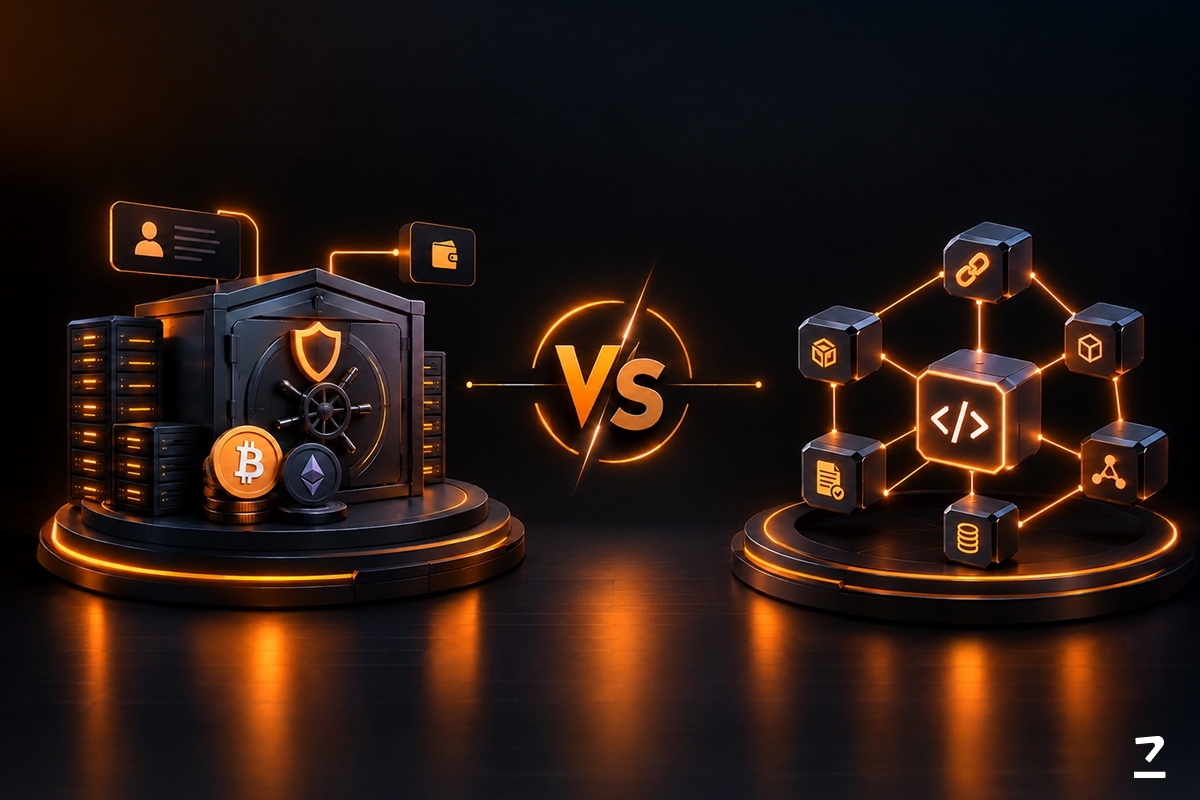
Blockchain bridges connect otherwise isolated networks so assets, messages and data can move across chains. But the architecture behind that connection determines who controls assets and how the destination chain decides that a cross-chain transaction is legitimate.
The choice between a custodial and non-custodial bridge is therefore not “centralized vs. decentralized.” It is a decision about where trust and risk reside.
Custodial bridges place asset control with a third party or controlled signer set, creating counterparty and key-management risks.
Non-custodial bridges use smart contracts and verification mechanisms to minimize reliance on an intermediary, but shift risk toward smart-contract code, validators, proofs, governance and underlying blockchain security.
For a blockchain project, the right model depends on its assets, supported chains, security assumptions, compliance requirements, user experience, governance and acceptable failure modes.
These factors should also guide the choice of Cross-Chain Bridge Development Services, ensuring the bridge architecture is designed around the project's specific requirements rather than a one-size-fits-all model.
What Is a Blockchain Bridge?
Blockchains operate as separate environments. Ethereum, Solana, Polygon, Avalanche and other networks have different consensus mechanisms, execution environments, transaction models and state. One blockchain cannot automatically verify what happened on another.
A blockchain bridge provides the infrastructure needed to connect these environments. According to Ethereum's documentation, bridges can facilitate the transfer of assets, information, arbitrary data and even smart-contract calls between chains. Common asset-transfer mechanisms include lock-and-mint, burn-and-mint and atomic swaps.
For example, suppose a user holds an asset on Ethereum but wants to use a compatible representation of that asset on another network. A bridge may lock the original asset on Ethereum and create a corresponding representation on the destination chain. When the user reverses the transaction, the destination representation may be burned and the original asset released.
The exact mechanism varies by bridge. This distinction matters because the bridge is not merely transporting an asset. It is establishing a claim that something happened on one blockchain and that another blockchain can safely act on that information.
Why Do Blockchain Projects Need Cross-Chain Interoperability?
Cross-chain interoperability can help:
-
Reach users across multiple blockchain ecosystems
-
Access fragmented liquidity
-
Deploy applications across different execution environments
-
Support multi-chain token strategies
-
Enable cross-chain DeFi and NFT applications
-
Exchange messages and application data between networks
-
Build products that are not restricted to one blockchain
For developers, the bridge architecture can become part of the product’s core security model rather than an isolated integration. That is why choosing the right bridge model requires more than comparing transaction fees or supported networks, it also means evaluating the technical expertise and security approach of a Cross-Chain Bridge Development Company.
Custodial vs. Non-Custodial Blockchain Bridge: The Core Difference
A custodial bridge relies on a third party, centralized operator, federation or controlled signer set to hold or authorize movement of assets. Users therefore trust that entity or group to secure funds and process legitimate transfers.
A non-custodial bridge uses smart contracts and a protocol-defined verification mechanism so that an intermediary does not have unilateral control over users' deposited assets.
However, “non-custodial” does not mean “trustless” in the absolute sense.
Users may still depend on smart-contract correctness, message verification, validators, relayers oracles, governance mechanisms and the security assumptions of the connected blockchains.
Ethereum describes bridge designs along a spectrum of trusted and trust-minimized systems, noting that many real-world bridges sit somewhere between the two extremes.
The better question for a blockchain project is: What does the bridge require users to trust and what happens if that component fails?
That question exposes the architectural difference far better than a simple centralized-versus-decentralized label.
How Do Custodial Bridges Work?
A custodial bridge can work like this:
User deposits assets → Custodian controls the deposited assets → Deposit is verified → Destination-side asset is issued or released → User receives the asset
The custodian may use centralized wallets, a multisignature arrangement, institutional custody infrastructure or another controlled signing mechanism.
The defining characteristic is that the user is relying on an external party to control or authorize access to the underlying assets.
Advantages of Custodial Bridges
Custodial models can make sense when operational control is an intentional product requirement.
Potential advantages include:
-
Simpler user experience
-
Centralized operational management
-
Greater ability to implement account-level controls
-
Potentially straightforward transaction recovery processes
-
A clearly identifiable operating entity
-
Easier implementation of certain compliance controls
This can be relevant for institutional products or platforms that already operate around a trusted intermediary. However, these benefits come from introducing an additional trust layer. They should not be confused with inherent security advantages.
Risks of Custodial Bridges
The primary risk is counterparty risk.
If an operator controls the assets, users depend on that operator's:
-
Private-key security
-
Internal controls
-
Signer management
-
Operational availability
-
Financial integrity
-
Governance
-
Compliance decisions
A compromised private key or compromised signer group can potentially affect a large pool of deposited assets. There is also censorship risk. A centralized operator may have the ability to freeze, delay or reject transactions.
Ethereum identifies custodial risk and censorship risk as additional concerns associated with trusted bridge designs. This does not make every custodial architecture unsuitable. It means that the project's trust model needs to explicitly accept and control these risks.
How Non-Custodial Bridges Work?
A non-custodial bridge might follow this process:
User interacts with source-chain contract → Source event is finalized → Verification mechanism confirms the event → Message is relayed → Destination contract validates the message → Asset is minted or released
Instead of giving a central operator direct custody of the source asset, the asset may remain locked in a smart contract. The destination contract then relies on a verification mechanism to determine whether the source-chain event is authentic.
Different bridges can use different mechanisms, including:
-
Light clients
-
Decentralized validator networks
-
Optimistic verification
-
Oracle networks
-
Cryptographic proofs
-
Zero-knowledge proofs
-
Relayer networks
-
Liquidity networks
Consequently, two bridges can both be described as non-custodial while having materially different security assumptions. Ethereum's bridge documentation makes this distinction important: bridge security depends heavily on who verifies cross-chain messages and whether that verification adds external trust assumptions.
Advantages of Non-Custodial Bridges
Non-custodial architectures can be attractive when self-custody and minimized intermediary trust are important product requirements.
Potential advantages include:
-
Reduced reliance on a central custodian
-
Greater transparency through on-chain execution
-
Stronger self-custody properties
-
Greater compatibility with permissionless DeFi
-
Reduced dependence on a single operating entity
-
Potentially stronger censorship resistance
The trade-off is that responsibility moves toward the protocol's technical architecture.
Risks of Non-Custodial Bridges
Removing a custodian does not remove risk.
Instead, the primary risk may shift toward:
-
Smart-contract vulnerabilities
-
Incorrect message verification
-
Validator compromise
-
Oracle failures
-
Relayer failures
-
Governance attacks
-
Upgrade-key compromise
-
Replay attacks
-
Chain reorganizations
-
Incorrect finality assumptions
-
Liquidity failures
A 2026 study published in Blockchain: Research and Applications analyzed 64 cross-chain bridges, including 31 exploits and four known bugs and identified 13 architectural components linked to eight vulnerability types. The findings show that bridge security is not limited to smart-contract code; it depends on how multiple architectural components interact and where trust and verification are placed. Read the study on ScienceDirect.
Custodial vs. Non-Custodial Blockchain Bridge: Quick Comparison
Here’s a quick look at how both blockchain bridge models differ in control, trust, security and use cases.
|
Factor |
Custodial Bridge |
Non-Custodial Bridge |
|
Asset control |
Controlled by a third party or signer group |
Controlled through smart contracts |
|
Trust |
Trust in the custodian |
Trust in code and verification mechanisms |
|
Primary risk |
Key compromise or counterparty failure |
Smart-contract or verification failure |
|
Transparency |
Depends on the operator |
Generally more transparent on-chain |
|
Censorship |
Higher potential for transaction restrictions |
Generally more censorship-resistant |
|
User experience |
Usually simpler |
Can require more user involvement |
|
Governance |
Centralized or federated |
Protocol- or community-governed |
|
Compliance |
Easier to implement centrally |
Depends on the architecture |
|
Upgrade control |
Controlled by operator/admins |
Controlled by governance or predefined mechanisms |
|
Best suited for |
Institutional or controlled environments |
DeFi and trust-minimized applications |
Security and Risk: Where Can Each Cross-Chain Bridge Model Fail?
Each cross-chain bridge model has different failure points, so security depends on understanding where control, verification and trust are concentrated.
Custodial Failure Areas
A custodial bridge can fail when the entity controlling assets or signing transactions is compromised.
Common failure scenarios include:
-
Private-key theft
-
Multisig compromise
-
Insider collusion
-
Unauthorized withdrawals
-
Operational outages
-
Withdrawal freezes
-
Malicious administrative actions
-
Regulatory or legal intervention
The concentration of control is the defining risk. If one entity or a small group can authorize movement of a large asset pool, compromising that authority can have systemic consequences.
Non-Custodial Failure Areas
Non-custodial systems have a different set of failure points. Attackers targeting a bridge can exploit vulnerabilities across its smart contracts, verification mechanisms, validators and supporting infrastructure.
Exploring how cross-chain bridges get hacked can help project teams identify these potential attack surfaces before deployment.
-
Smart-contract logic
-
Message-validation logic
-
Validator signatures
-
Oracle inputs
-
Relayer infrastructure
-
Governance contracts
-
Upgrade mechanisms
-
Chain finality assumptions
-
Cross-chain accounting
This is why a smart-contract audit alone does not establish that a bridge is secure. Research into bridge security identifies complex interactions between architectural components, while attack surfaces include compromised validator keys, forged messages, replay attacks, access-control failures, malicious upgrades oracle or RPC manipulation and cross-chain state inconsistencies.
Why Cross-Chain Security Requires More Than an Audit
A cross-chain bridge needs security controls across the entire message-delivery pipeline. Before deployment, teams should evaluate:
-
Smart-contract security
-
Key-management architecture
-
Message authentication
-
Validator independence
-
Relayer security
-
Oracle assumptions
-
Upgrade permissions
-
Rate limits
-
Emergency controls
-
Cross-chain accounting
-
Monitoring and anomaly detection
-
Incident-response procedures
The destination chain must have a reliable answer to one fundamental question: Did the claimed event actually happen on the source chain? If the answer can be falsified by compromising one component, that component becomes a critical trust assumption.
Which Bridge Model Fits Your Blockchain Project?
The appropriate architecture depends on the product's requirements.
Choose a Custodial Model When Control Is Intentional
A custodial model may be appropriate when:
-
A known organization needs direct operational control
-
Compliance requirements call for controlled custody
-
The product already relies on a trusted intermediary
-
Institutional users require an identifiable counterparty
-
Account-level restrictions are essential
-
The project prioritizes operational simplicity
The important point is that custody should be an explicit architectural decision rather than an accidental consequence of implementation.
Choose a Non-Custodial Model When Trust Minimization Is Core
A non-custodial model may be more appropriate when:
-
Self-custody is central to the product
-
Permissionless participation is required
-
DeFi composability matters
-
Censorship resistance is a product objective
-
Users should not depend on a single asset custodian
-
Cross-chain applications need protocol-level interoperability
But the team must be prepared to own the complexity of smart-contract and verification security.
Consider a Hybrid Architecture
The custodial/non-custodial distinction is not always binary. A project can combine different mechanisms for different requirements. For example, it may use smart-contract custody for assets while applying distributed verification, controlled governance, liquidity providers or institutional compliance layers around the broader system.
This is particularly relevant when a project has competing requirements around decentralization, regulatory controls, user experience and operational recovery. The architecture should therefore be designed around the project's actual trust boundaries.
What to Evaluate Before Building a Cross-Chain Bridge
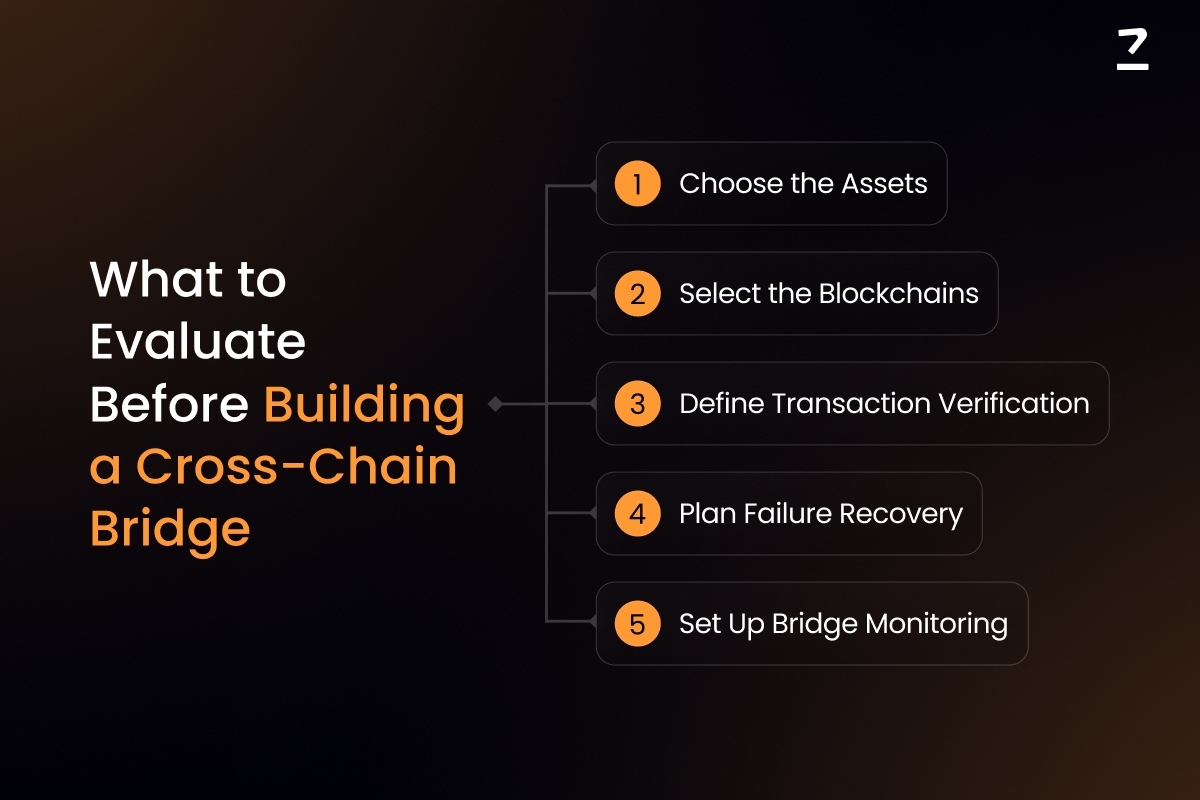
Before selecting a cross-chain bridge protocol, answer five groups of questions. Comparing established protocols such as LayerZero, Wormhole and Axelar can also help you understand how different interoperability architectures approach verification, security and supported networks.
See this comparison of LayerZero, Wormhole and Axelar for a deeper evaluation.
1. What Assets Will the Bridge Transfer?
Decide whether you need to transfer fungible tokens, stablecoins, NFTs, native assets, wrapped assets or cross-chain messages. The asset type determines the transfer mechanism, smart-contract design and liquidity requirements.
2. Which Blockchains Will the Bridge Connect?
Identify the source and destination networks and evaluate their EVM compatibility, consensus and finality models, transaction costs, smart-contract capabilities and infrastructure requirements. These factors determine whether the bridge can connect and operate reliably across the selected chains.
3. How Will the Bridge Verify Transactions?
Determine whether cross-chain transactions will be verified through validators, multisignature schemes, light clients or cryptographic and zero-knowledge proofs. The verification method directly affects the bridge's security and trust model.
4. How Will the Bridge Handle Failures?
Define what happens if a validator goes offline, a blockchain reorganizes, liquidity runs low or a smart contract is compromised. Establish upgrade controls, pause mechanisms and recovery procedures before the bridge goes live.
5. How Will You Monitor the Bridge After Launch?
Plan how you will detect unusual transfers, failed messages, supply discrepancies, validator issues, unauthorized upgrades and other abnormal activity. Continuous monitoring and an incident-response process are essential for maintaining bridge security.
The Future of Cross-Chain Bridge Architecture
The next phase of interoperability is moving beyond simple token wrapping. Cross-chain protocols increasingly need to support arbitrary messages, application instructions and more composable interoperability layers.
One example is ERC-7786, an Ethereum proposal defining an interface for smart contracts to send and receive cross-chain messages containing arbitrary data. The proposal aims to make different messaging protocols accessible through a common interface while reducing vendor lock-in.
This direction matters because developers may eventually design applications around interoperability interfaces rather than building tightly around one bridge provider.
Zero-knowledge proofs and other cryptographic verification mechanisms may also reduce certain external trust assumptions in suitable architectures. At the same time, newer approaches introduce their own engineering requirements and should not be treated as automatic security guarantees.
Liquidity-based and intent-based models are also changing the user experience by abstracting some of the underlying bridging mechanics.
The direction is clear: bridge architecture is evolving from simple asset movement toward cross-chain application infrastructure. That makes the original choice even more important.
Build the Right Cross-Chain Bridge Architecture With Codezeros
A cross-chain bridge is more than a connection between two blockchain networks. It is a security-critical infrastructure layer that determines who controls assets, how cross-chain events are verified and what happens when one part of the system fails.
Codezeros provides Cross-Chain Bridge Development Services for projects that need custom interoperability infrastructure, including token bridging, cross-chain messaging, DeFi and NFT interoperability and multi-chain ecosystem expansion.
Its current blockchain service portfolio includes Cross-Chain Bridge Development alongside smart-contract oracle, ZK-rollup, wallet and other blockchain development services.
For teams evaluating Cross-Chain Bridge Development Solutions, the right starting point is not simply choosing between a custodial and non-custodial label. It is defining the project's trust model, supported assets, connected networks, verification mechanism, security controls, governance and failure-response strategy.
Ready to build a cross-chain bridge? Contact us to discuss your project requirements.
Post Author

Paritosh Mehta
As a distinguished blockchain expert at Codezeros, Paritosh contributes to the company's growth by leveraging his expertise in the field. His forward-thinking mindset and deep industry knowledge position Codezeros at the forefront of blockchain advancements.
Frequently Asked Questions
Frequently asked questions about this article.
Ready to Design Your Cross-Chain Bridge?
Build the right blockchain bridge architecture for your assets, networks and security requirements with talented developers. Contact Codezeros team to design and develop tailored cross-chain bridge solutions built around their product goals.
Blogs
Our Latest Blogs
Discover valuable industry insights and stay up-to-date with the latest updates by exploring our curated collection of recent blog posts.



Let us know your requirement
We know ideas matter, we are the product of one. We Provide Full Assistance In Your Business