
SHARE THIS ARTICLE
25 Sep 2026
Order Book vs. AMM for Perpetual DEX Development: How to Choose the Right Model
Summary:
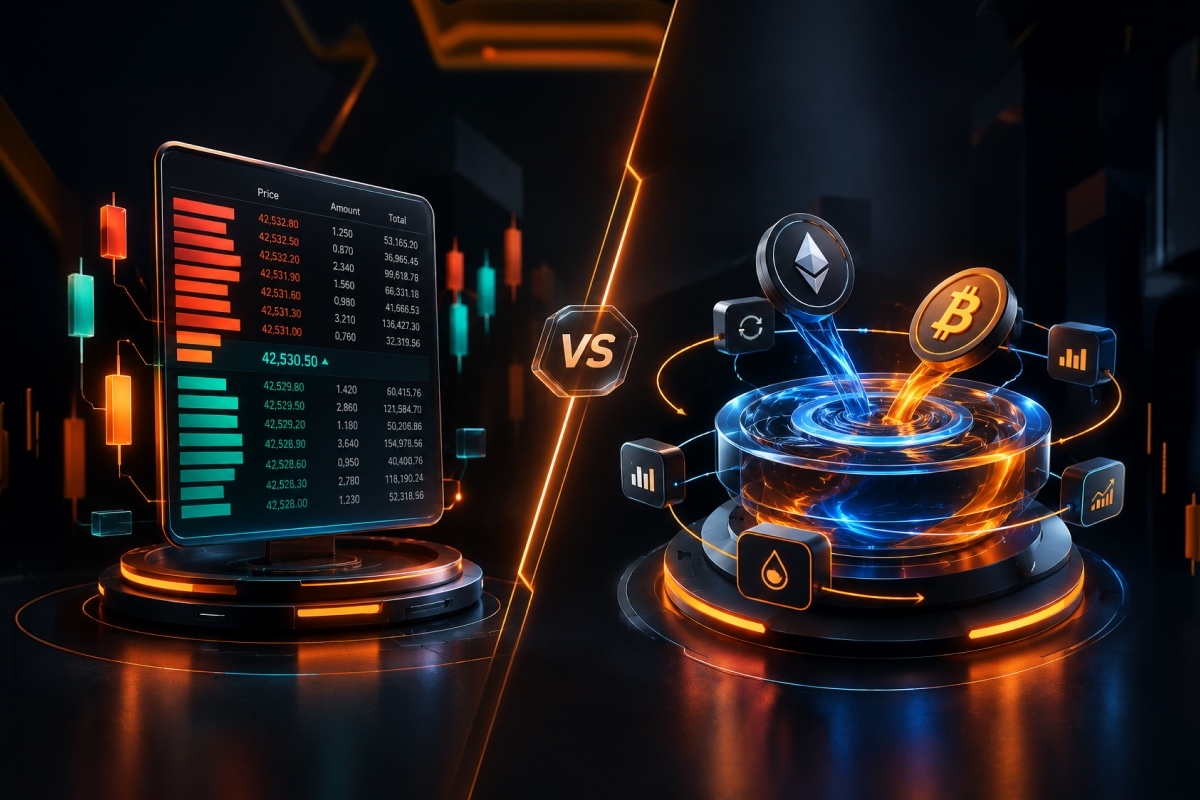
The choice between an order book and an AMM is one of the most consequential decisions in perpetual DEX development. It determines how trades are priced, where liquidity comes from, how large positions are executed, what infrastructure the protocol needs, and where market and liquidity risk ultimately sits.
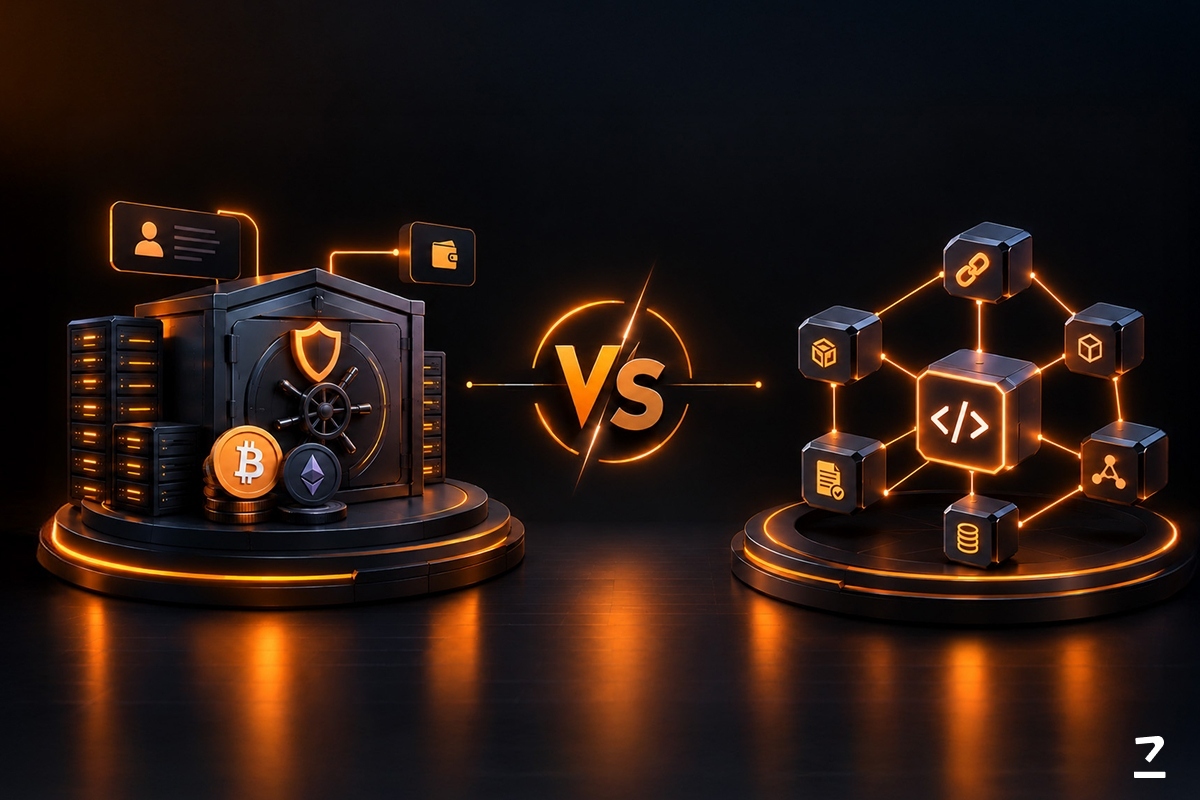
Order books use bids, asks, market makers, and matching logic to create an explicit market. AMM and oracle-based models use pools, vaults, pricing formulas, or external price feeds to facilitate positions without conventional order matching. Neither architecture is universally suitable for every perpetual market.
The more useful question for a protocol builder is: What execution and liquidity model best fits the traders, markets, risk framework, and infrastructure you intend to support?
The market is already large enough for this distinction to matter. DeFiLlama currently tracks more than $20 billion in 24-hour perpetual DEX volume and over $660 billion in 30-day volume, although these figures fluctuate continuously.
What Is a Perpetual DEX?
A perpetual DEX is a decentralized trading platform that lets users open leveraged long or short positions without an expiry date. Unlike spot swaps, perpetual markets need additional infrastructure for collateral, margin, funding, mark prices, liquidations, risk limits, and position accounting.
That makes market structure more important than it is for a simple token swap. A protocol can use an order book where traders interact through bids and asks. It can use a pool or oracle-based mechanism where positions interact with protocol liquidity. It can also combine multiple mechanisms.
For businesses evaluating Perpetual DEX Development Services, the architecture should therefore be selected before the trading interface is finalized. The execution model influences the matching engine, liquidity strategy, oracle requirements, risk engine, and even the blockchain infrastructure.
How Order Book Perpetual DEXs Work
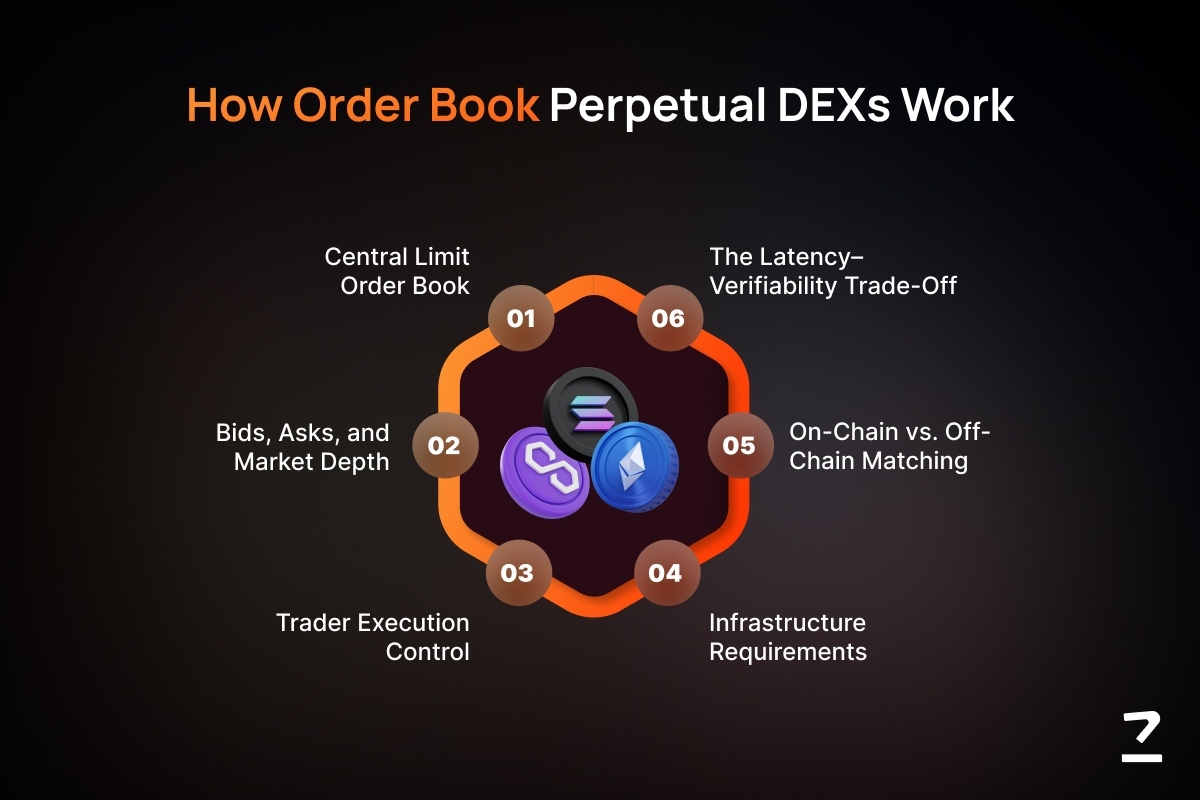
A central limit order book, or CLOB, maintains outstanding buy and sell orders at different price levels. Buyers submit bids, sellers submit asks, and trades occur when compatible orders are matched.
The highest bid and lowest ask establish the immediate market boundary, while the quantity available at different prices creates market depth.
This structure gives traders direct control over execution. They can use limit orders, manage entry prices, respond to visible liquidity, and implement strategies that depend on order-book conditions.
For perpetual DEXs targeting active or professional traders, that precision can be important.
However, an order book introduces substantial infrastructure requirements. The protocol needs reliable order sequencing, matching, cancellation, market-data distribution, settlement, liquidation logic, and protection against stale or manipulated market information.
There is also an important distinction between fully on-chain and hybrid implementations. Some architectures put matching activity directly on a blockchain or specialized execution environment, while others use an off-chain matching engine and settle resulting transactions on-chain.
That trade-off is central to perpetual DEX architecture: more onchain execution can improve verifiability, while specialized off-chain components can reduce latency and execution overhead.
How AMM and Oracle-Based Perpetual DEXs Work
An AMM replaces conventional order matching with programmable liquidity and a pricing mechanism. In a traditional constant-product AMM, for example, the relationship between reserves follows the familiar x × y = k model. Larger trades relative to available liquidity create greater price impact.
Modern AMMs have evolved considerably beyond that basic model.
Uniswap's concentrated-liquidity design allows liquidity providers to allocate capital within specific price ranges rather than across the entire curve. This can place more usable liquidity around active prices, although positions become inactive when the market moves outside their selected ranges.
Perpetual protocols can use yet another approach.
GMX, for example, uses oracle-based pricing and pool liquidity rather than a conventional order book. Its current documentation explains that price impact is calculated from changes in pool imbalance and is subject to market-specific caps.
This distinction matters. Calling every pool-based perpetual protocol a simple “AMM” can hide important architectural differences.
Order Book vs. AMM: Core Differences
|
Factor |
Order Book |
AMM / Pool-Based |
|
Price formation |
Bids and asks |
Formula, oracle, or pool mechanism |
|
Liquidity source |
Traders and market makers |
LPs, pools, vaults, or protocol liquidity |
|
Large-order execution |
Depends on executable book depth |
Depends on liquidity and pricing design |
|
Advanced orders |
Natural fit |
Requires additional execution logic |
|
Liquidity bootstrapping |
Often market-maker dependent |
Can be permissionless |
|
Infrastructure |
Matching and market-data systems |
Pool, pricing, and oracle systems |
|
Capital efficiency |
Can concentrate around market price |
Depends on pool design |
|
Main liquidity risk |
Thin books and maker withdrawal |
LP exposure, pool imbalance, or liquidity depletion |
|
UX |
Suited to active trading |
Often simpler for direct execution |
The distinction is therefore not simply “order book versus liquidity pool.” It is a difference in how the protocol creates executable liquidity and distributes market risk.
Liquidity and Large-Order Execution
For perpetual markets, total value locked is not the same as executable liquidity.
A protocol might hold substantial capital but still provide poor execution if that capital is unavailable around the relevant price or cannot absorb the required position size.
Order books make this relationship visible. Traders can inspect the bids and asks and estimate how much liquidity exists near the current price. A deep book can absorb larger market orders across multiple price levels.
The weakness is dependence on active liquidity providers. Market makers must continuously quote prices. During volatile conditions, liquidity can change quickly.
Pool-based systems approach the problem differently. Liquidity is committed to a predefined mechanism, which can make execution less dependent on individual market makers. But the protocol must carefully design how pool exposure, position imbalance, price impact, and risk limits interact.
This is why the architecture should be evaluated using executable liquidity, expected trade size, market volatility, and risk capacity, rather than TVL alone.
Price Discovery, Slippage, and Capital Efficiency
Order books allow price discovery through competitive bids and asks. Traders express what they are willing to pay or accept, and those intentions create the visible market.
AMMs use deterministic pricing mechanisms, while oracle-based perpetuals can reference external market prices. Arbitrageurs can help keep pool prices aligned with broader markets when internal and external prices diverge.
Execution costs also behave differently.
With an order book, price impact depends on available depth at each price level. A large order can consume several levels if there is insufficient liquidity near the market price.
With an AMM, price impact is linked to the liquidity curve and trade size. Concentrated liquidity can improve capital utilization around active ranges, but it also introduces range management. Uniswap's documentation notes that liquidity becomes inactive when price moves outside an LP's selected range.
For perpetual DEX development, this means capital efficiency should be considered together with liquidity management. Higher theoretical efficiency does not automatically translate into better execution if liquidity becomes inactive or fragmented.
Risk, Oracles, Funding, and Liquidations
The biggest architectural mistake is to evaluate a perpetual DEX only by its trading mechanism.
Perpetual contracts introduce leverage, which makes risk infrastructure equally important.
The protocol needs reliable reference prices for funding, margin calculations, and liquidations. A single manipulated trade should not be able to produce an artificial mark price that liquidates otherwise healthy positions.
A production architecture should therefore address:
-
index and oracle pricing;
-
mark-price methodology;
-
funding-rate calculations;
-
initial and maintenance margin;
-
liquidation thresholds;
-
partial or full liquidation;
-
insurance or loss-management mechanisms;
-
stale-feed detection;
-
oracle deviation controls;
-
extreme-volatility scenarios.
Codezeros perpetual DEX similarly identifies the matching engine, risk engine, oracle integration, liquidation logic, settlement, and liquidity as interconnected components rather than isolated features.
Development and Infrastructure Complexity
An order-book perpetual DEX generally has a larger execution infrastructure surface.
The build may require a matching engine, order management system, market-data layer, low-latency APIs, sequencing, settlement, maker connectivity, risk controls, and liquidation infrastructure.
An AMM or oracle-based perpetual DEX shifts that complexity toward liquidity contracts, pricing mechanisms, oracle systems, pool accounting, position management, and risk controls.
Neither approach eliminates complexity. It moves complexity to different parts of the system.
The underlying blockchain also matters. A high-frequency order-book environment has different throughput and latency requirements from a pool-based protocol. If the application needs specialized execution performance, a general-purpose chain may not provide the desired characteristics without additional architecture.
This is why “which model is cheaper to build?” is also an incomplete question. The more useful calculation includes development, security, infrastructure, liquidity bootstrapping, market-making requirements, oracle infrastructure, monitoring, and ongoing protocol operations.
What Modern Perpetual DEXs Are Building
The market increasingly shows that the binary AMM-versus-order-book framing is too narrow.
Hyperliquid is a major example of an order-book-centered perpetual trading environment. DeFiLlama currently records billions of dollars of daily perpetual volume on the protocol, illustrating the scale that an order-book-oriented architecture can support. For a deeper look at the infrastructure, trading engine, and key components involved, see our guide on how to launch a perpetual futures DEX like Hyperliquid.
GMX represents a different architecture, using oracle pricing and pool-based liquidity with explicit controls around price impact.
Dexlyn Labs is another useful example because it demonstrates why protocol classification needs precision. Its documentation describes a complete DeFi ecosystem containing a perpetual trading platform alongside a concentrated-liquidity DEX. Its CLMM architecture allows LPs to select custom price ranges.
This suggests a broader architectural spectrum: CLOB → hybrid order book → pool/oracle model → solver/RFQ mechanisms → multi-mechanism architecture
The right choice depends on what the protocol is optimizing for.
Which Architecture Fits Your Perpetual DEX?
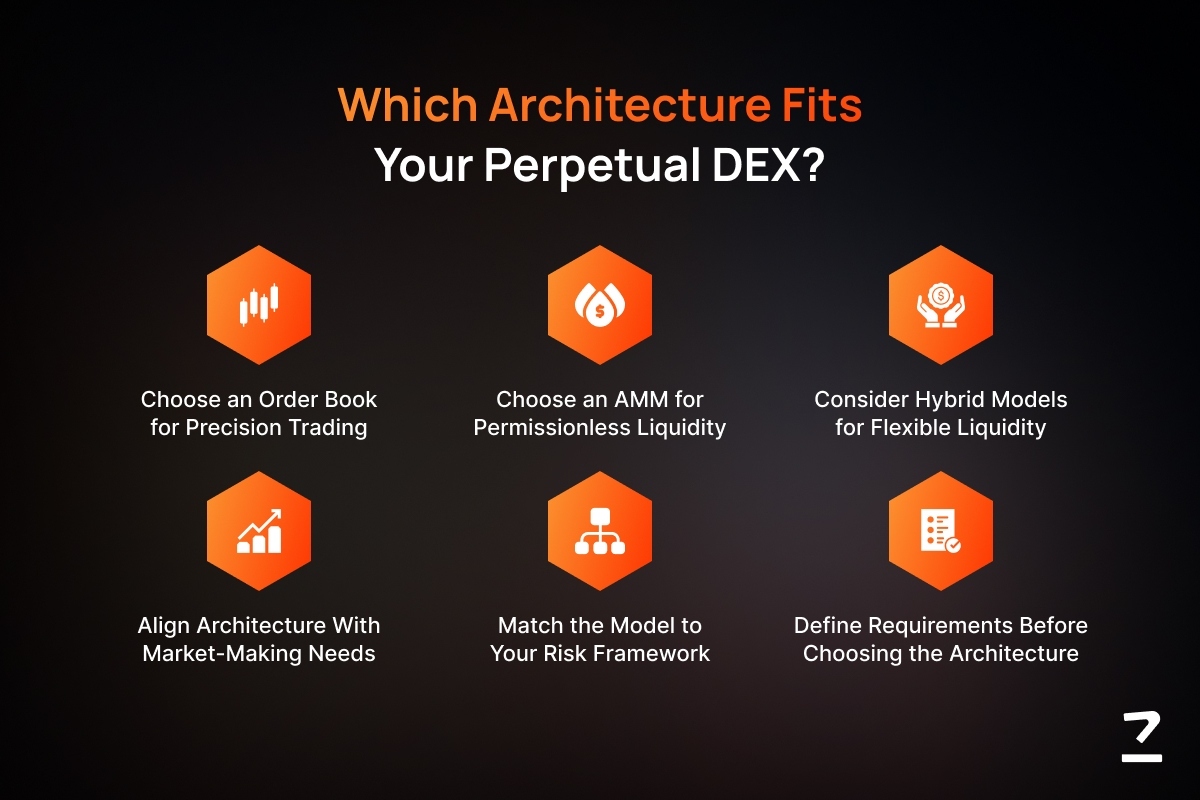
An order-book architecture can make sense when the target market consists of active traders, institutions, professional market makers, or users who need precise execution and advanced order types. It is particularly relevant when the business has a credible strategy for attracting and retaining market-making liquidity.
An AMM or oracle-based design can be appropriate when permissionless liquidity, simpler execution, or a pool-based risk model is central to the product. It can also be useful where conventional order-book liquidity would be difficult to bootstrap.
A hybrid model can make sense when the protocol needs visible order-book price discovery but wants an additional liquidity mechanism or backstop.
The key is to avoid choosing architecture because a competitor uses it. A protocol should first define its market and risk requirements and then select the mechanism that can support them.
A Practical Architecture Decision Framework
Before starting Perpetual DEX Development solutions, answer seven questions:
-
Who is the primary trader: retail, professional, institutional, or a combination?
-
What trade sizes must the platform support?
-
Where will initial and ongoing liquidity come from?
-
Who bears inventory or counterparty risk?
-
How will index, mark, and funding prices be calculated?
-
What happens when markets move sharply or liquidity disappears?
-
Can the selected blockchain and infrastructure support the required execution model?
A useful rule is simple: Choose the liquidity and risk model before choosing the matching mechanism.
The matching layer is only one part of a perpetual exchange. Its success depends on the systems surrounding it.
Perpetual DEX Development With Codezeros
For businesses evaluating a Perpetual DEX Development Company, architecture expertise matters as much as smart-contract development.
Codezeros lists Perpetual DEX Development among its blockchain services and has published technical material covering perpetual exchange architecture, including matching engines, risk systems, oracle integration, liquidation logic, settlement, and liquidity considerations.
The development scope can be shaped around the chosen market structure rather than forcing every project into the same technical stack. Depending on requirements, this can include order-book infrastructure, perpetual smart contracts, margin and funding systems, oracle integration, liquidation mechanisms, trading APIs, security testing, and deployment.
Businesses looking to hire Perpetual DEX Developers should evaluate whether the development team understands both blockchain engineering and exchange mechanics. A trading interface is only the visible layer; the risk engine, pricing infrastructure, execution logic, and liquidity model determine how the platform behaves when real capital enters the system.
Build a Perpetual DEX Around the Right Market Structure
The order book versus AMM debate is ultimately a question of market design, not a contest between two technologies.
Order books provide explicit liquidity and competitive price discovery. AMM and oracle-based models provide alternative ways to make liquidity programmable and accessible. Concentrated liquidity, hybrid mechanisms, specialized trading chains, and other designs continue to expand the available architecture choices.
For a new perpetual DEX, the strongest starting point is therefore not copying Hyperliquid, GMX, Dexlyn, or another protocol. It is defining the trader profile, market size, liquidity strategy, risk model, oracle requirements, execution expectations, and blockchain constraints first.
Then choose the architecture that can support those requirements at scale. Planning a custom perpetual trading platform? Connect with us to explore Perpetual DEX Development Services and to discuss the appropriate execution, liquidity, risk, and blockchain architecture for your project.
Post Author

Deep Shah
Explore Deep's insightful blog posts that help businesses stay ahead of the curve, explore new possibilities, and unlock the full potential of blockchain technology
Frequently Asked Questions
Frequently asked questions about this article.
Planning to build a custom perpetual DEX solution?
Work with a team that understands the architecture behind execution, liquidity, pricing, risk, and blockchain infrastructure. Explore Perpetual DEX Development Services with Codezeros and define the right market structure for your trading platform.
Blogs
Our Latest Blogs
Discover valuable industry insights and stay up-to-date with the latest updates by exploring our curated collection of recent blog posts.


Let us know your requirement
We know ideas matter, we are the product of one. We Provide Full Assistance In Your Business