SHARE THIS ARTICLE
- Copy link
03 Sep 2026
The Role of Custody and Oracles in Real-World Asset Tokenization
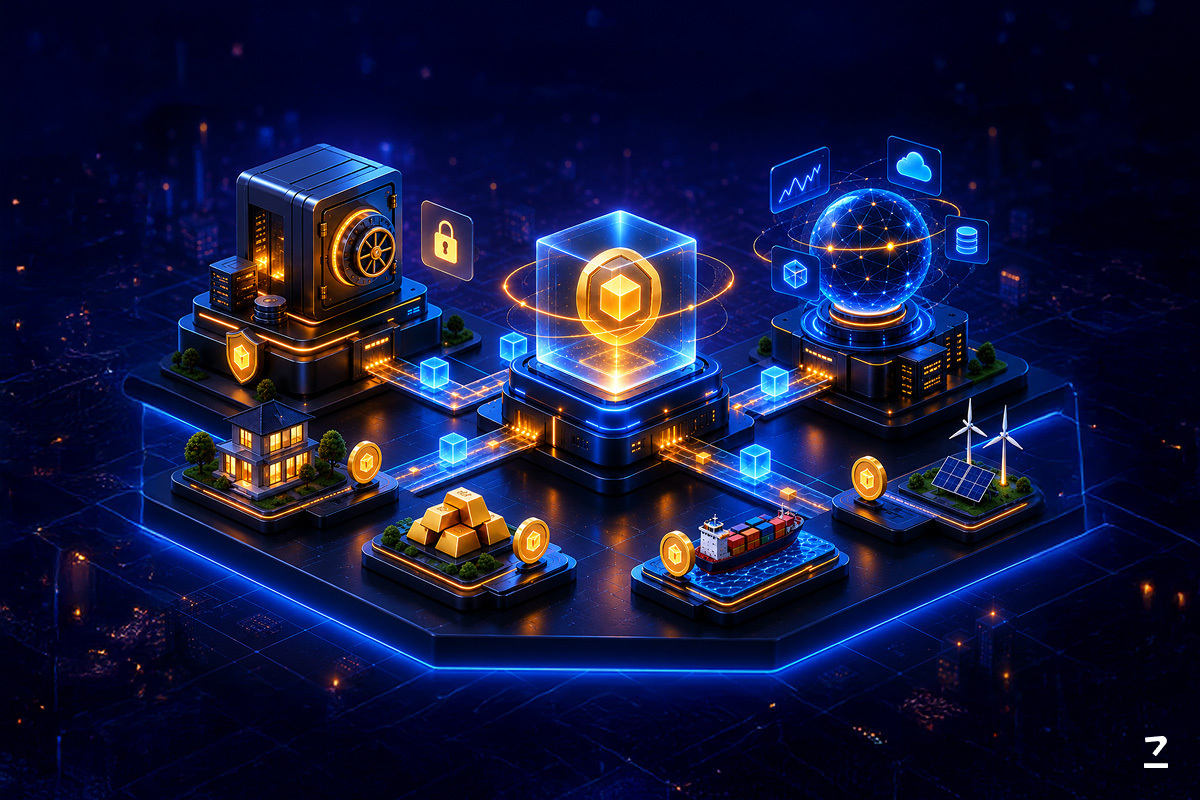
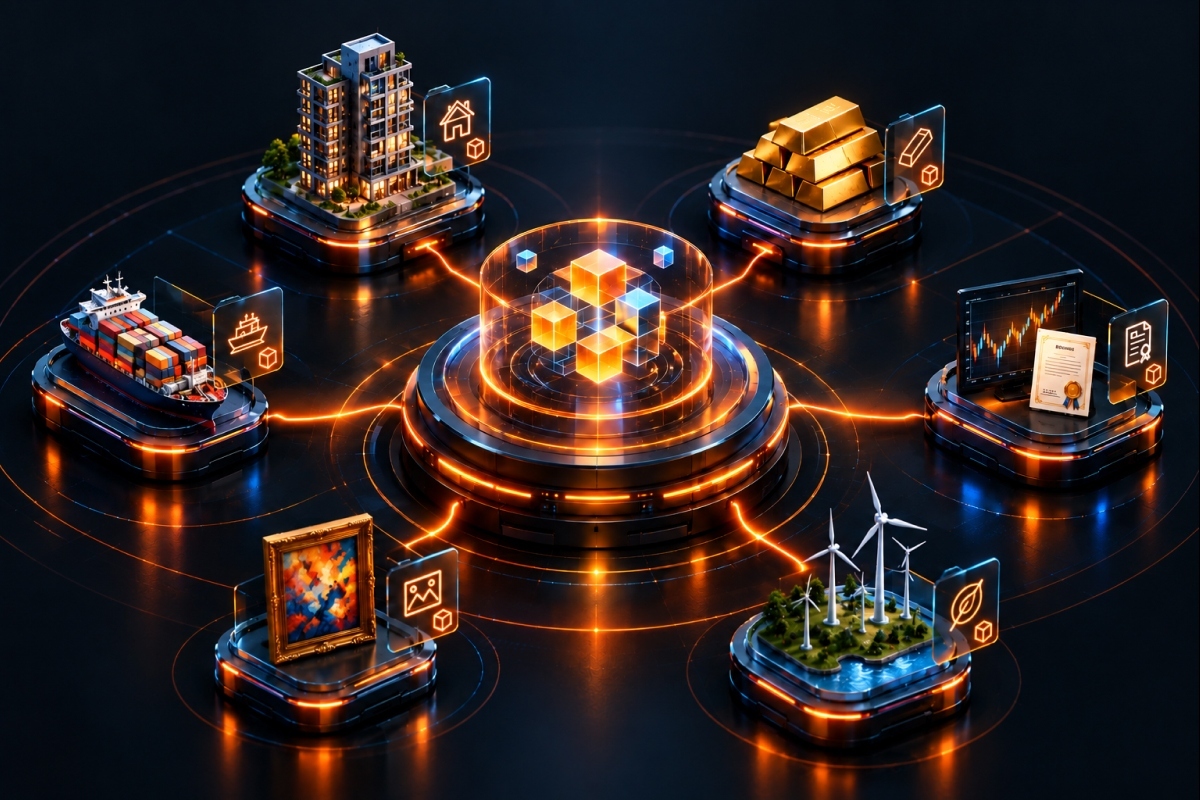
A tokenized bond, a tokenized building, a tokenized fund share none of these is the asset itself. Each is a claim, recorded on a blockchain, that something exists off-chain and belongs to whoever holds the token.
The smart contract enforcing that claim cannot walk into a vault and check. It cannot call a title registry. It cannot confirm that the custodian's balance sheet still matches what was promised at issuance.
That gap between what a blockchain can verify on its own and what it needs to know about the real world is exactly where custody and oracles sit. Get either one wrong and the token stops representing what it claims to represent, even while the code keeps executing perfectly.
This is why RWA tokenization development services must address more than token creation, bringing custody architecture, oracle integration, smart contracts and compliance controls together as one connected system.
Why a Token Is Only as Trustworthy as Its Infrastructure
Most explanations of real-world asset (RWA) tokenization treat custody and oracles as two separate footnotes: a paragraph on key management, a paragraph on price feeds, moving on. That framing misses what actually determines whether a tokenized asset holds up under scrutiny.
A useful way to think about it: custody establishes control and safekeeping. Oracles establish data integrity and ongoing state verification. Neither one, by itself, proves that a token is trustworthy.
A private credit fund can have a flawless custody structure a regulated trustee, a properly formed SPV, airtight legal documentation and still expose investors to risk if the oracle reporting loan performance and NAV is unreliable or infrequently updated.
Equally, a tokenized commodity can have a sophisticated, decentralized oracle network reporting gold prices with sub-second accuracy and it still means nothing if the underlying bullion was never properly secured or the reserve was never independently verified.
Regulators, institutional investors and auditors are converging on the same conclusion: due diligence on an RWA platform now has to examine both layers together, alongside the legal and smart contract architecture around them.
What Role Does Custody Play in Real-World Asset Tokenization?
Custody in RWA tokenization determines who legally holds, controls and safeguards the underlying asset, along with the private keys or wallet infrastructure that control the token representing it. It is the layer that makes the token something more than a database entry it ties the digital representation back to a real, legally recognized claim.
Asset Custody vs. Digital Asset Custody
These two terms get used interchangeably, but they cover different obligations.
Asset custody refers to safekeeping the underlying real-world asset a bond held by a transfer agent, real estate title recorded with a registry, or private credit receivables administered by a servicer. This custody arrangement typically predates tokenization and continues to operate under existing financial regulation.
Digital asset custody refers to protecting the cryptographic keys that control the token itself. Whoever holds the private key effectively controls the token, regardless of what the underlying legal documentation says. If those keys are lost, stolen, or mismanaged, the token can become unusable or transferable to the wrong party independent of whether the underlying asset is perfectly safe.
A tokenization platform treats these as two distinct custody problems requiring two distinct sets of controls, not one generic "custody" checkbox.
Who Holds the Underlying Asset When It's Tokenized?
In most institutional structures, the underlying asset sits with a qualified custodian, transfer agent, or special purpose vehicle (SPV), not with the token holder directly. The token represents a beneficial or economic interest in that asset, governed by the legal documentation tied to the SPV or trust structure.
This distinction matters in a default or insolvency scenario. Courts examine the contractual and corporate structure to determine whether a token functions as evidence of legal title or as evidence of beneficial ownership.
Without statutory recognition of on-chain records as legal title which varies significantly by jurisdiction the token typically functions as the latter. That has direct implications for how token holders are treated if the custodian or issuer fails.
Custody Models Used
A handful of custody approaches dominate current RWA deployments:
-
Qualified custodians: Regulated financial institutions authorized to hold client assets, often required by securities law for tokenized instruments that qualify as regulated securities.
-
Multi-party computation (MPC) custody: Splits private key material across multiple parties so no single party can unilaterally move assets, reducing single-point-of-failure risk without relying on a single institutional custodian.
-
SPV based custody: A legal entity holds the underlying asset and token holders gain economic exposure to that entity through the token, commonly used for private credit, real estate and fund structures.
-
Multisig wallet controls: Requiring multiple independent approvals before any privileged action minting, burning, or moving reserves executes, which materially reduces the risk of a single compromised key draining a token's backing.
The right model depends on the asset class, the target jurisdiction and whether the token is classified as a security. Treasury and fund tokens generally lean on regulated custodians; some commodity tokens combine physical vault custody with on-chain attestation.
Why Are Oracles Necessary for Real-World Asset Tokenization?
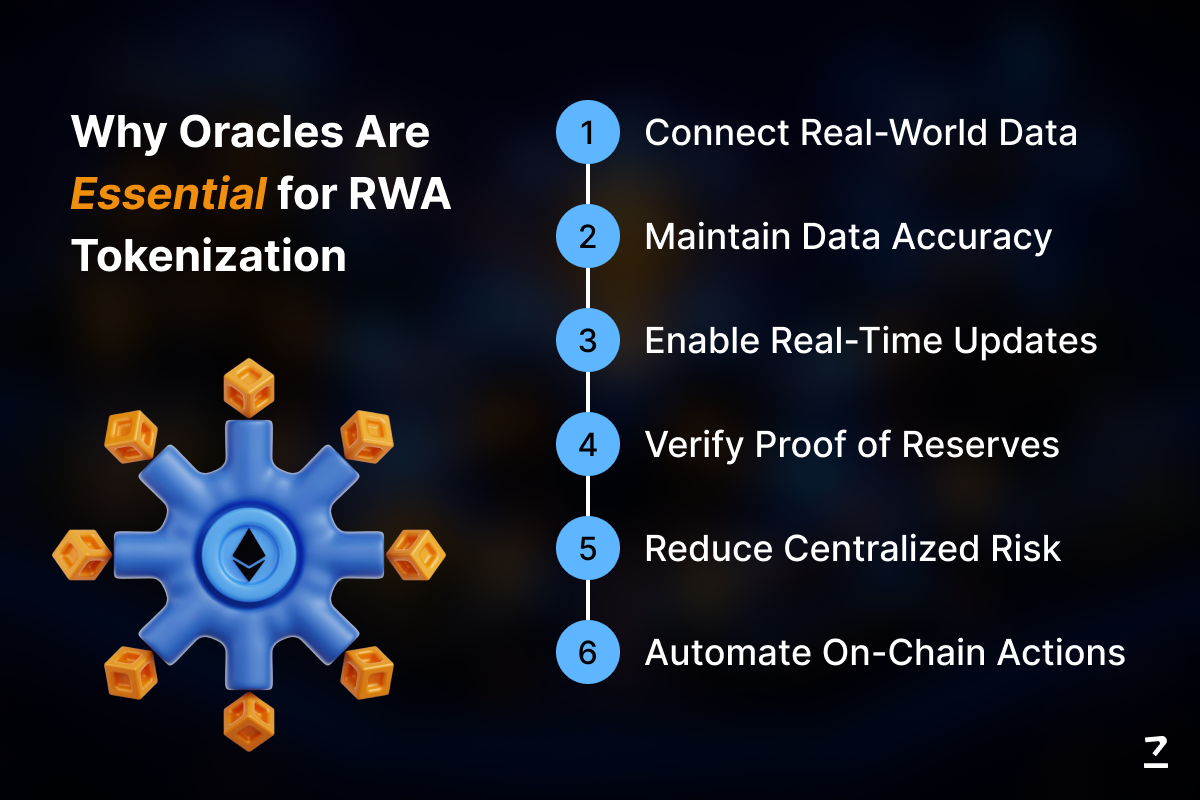
Oracles are necessary because blockchains are deliberately closed systems. A smart contract can verify wallet balances and execute logic within its own chain with complete certainty, but it has no native way to confirm a fact that exists outside that environment a property's current appraised value, a loan's repayment status, or whether a custodian's reported reserves actually match outstanding token supply. Oracles are the infrastructure that delivers that external information on-chain in a form smart contracts can act on.
The Oracle Problem
This challenge is widely known as the "oracle problem": how do you get external, real-world data onto a blockchain with enough reliability that a smart contract can act on it with the same confidence it has in its own on-chain state?
For a DeFi lending protocol, this mostly means price feeds. For a tokenized real-world asset, the scope is wider. The smart contract governing a tokenized fund, for instance, needs to know the current net asset value (NAV) to price subscriptions and redemptions accurately and it needs that figure to be genuinely current, not a stale snapshot from days earlier.
What Data an Oracle Should Deliver for a Tokenized Asset
The oracle layer in an RWA platform typically needs to deliver several distinct categories of information, not just a single price:
-
Asset valuation: Current market value of the underlying real estate, credit instrument, or commodity, updated on a cadence appropriate to how fast that value moves.
-
Proof of reserve: Confirmation that the real-world asset backing the token actually exists and that its quantity matches the outstanding token supply arguably the single most compliance-critical oracle function for asset-backed tokens.
-
NAV calculation: For tokenized funds, the current net asset value per share, driving subscription pricing and redemption calculations.
-
Corporate action triggers: Notification when an issuer declares a dividend, redemption offer, or restructuring, so the contract can execute the associated action.
-
Regulatory and compliance data: Updates to transfer restrictions, investor eligibility, or sanctions status feeding into the token's compliance logic.
Proof-of-reserve oracles deserve particular attention because they replace what used to be a periodic, manual process. Traditional reserve verification through an annual audit or quarterly attestation leaves a window sometimes months long during which a misrepresented reserve could go undetected.
Oracle-based attestation on a defined, frequent cycle narrows that window from months to days, giving investors and regulators a materially more current view of whether the token is still backed by what it claims.
Centralized vs. Decentralized Oracle Models
A single data provider submitting information directly to a smart contract reintroduces exactly the kind of centralized point of failure tokenization is meant to reduce. If that one provider reports incorrect data through error, outage, or manipulation the contract acts on it without any check.
Decentralized oracle networks address this by aggregating data from multiple independent node operators pulling from multiple underlying sources, then producing a consensus value.
That structure means many independent parties would need to be simultaneously wrong or compromised before the reported data is corrupted, which is a fundamentally different trust model than a single API call.
For institutional-grade tokenized assets Treasuries, funds, private credit this decentralized, multi-source approach has become close to a baseline expectation rather than an optional upgrade.
How Do Custody and Oracles Work Together in an RWA Ecosystem?
Custody and oracles solve two different problems that fail in two different ways and understanding the difference is what separates a genuinely resilient RWA platform from one that looks secure on paper.
A custody failure breaks the link between the token and the asset. The smart contract keeps functioning normally transfers execute, balances update while the actual backing behind those tokens is gone, compromised, or was never fully secured to begin with. The code has no way to detect this on its own.
An oracle failure breaks the link between the token and its reported value. The asset may still exist and be properly held, but the data the contract is acting on is wrong stale, manipulated, or misconfigured which can trigger incorrect redemption amounts, wrongful liquidations, or a completely inaccurate representation of the fund's health to investors making decisions in real time.
A well-designed platform treats these as complementary, not redundant, layers of verification. Custody proves the asset is real and properly held. Oracles prove the platform's on-chain representation of that asset's state is current and accurate.
A gap between off-chain custodial approval and on-chain execution for example, a compliance officer approving a mint by email with no on-chain record tying that approval to the transaction is where operational risk tends to concentrate, sitting exactly at the seam between these two layers.
What Are the Biggest Custody and Oracle Risks in RWA Tokenization?
Understanding the mechanics only matters if it translates into recognizing where things actually go wrong. The risk categories below account for some of the most significant risks in tokenized asset programs. For a broader look at smart contract vulnerabilities, oracle manipulation, private key exposure and other threats, explore our guide to common security risks in RWA tokenization and how to mitigate them.
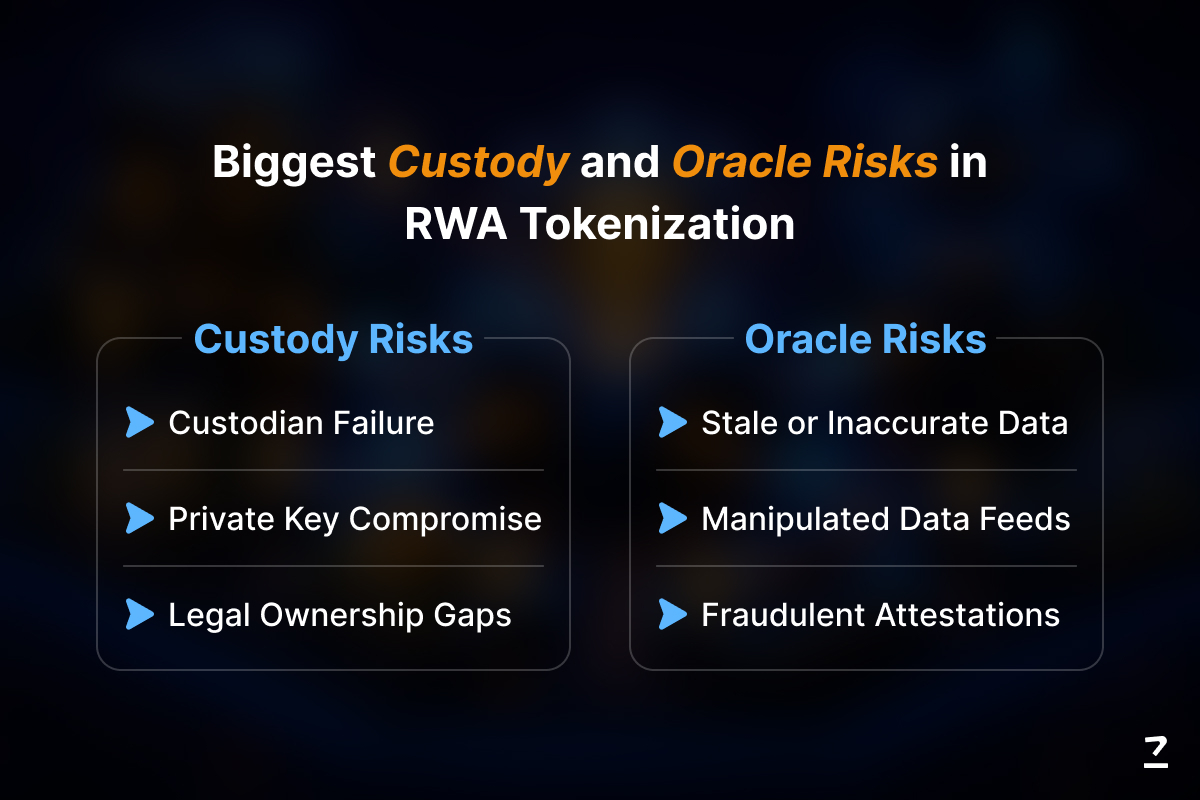
Custody-side risks:
-
Custodian insolvency or compromise. If the entity holding the underlying asset fails or is compromised, the token becomes a claim against an asset that may no longer be recoverable in the expected way.
-
Private key mismanagement. Single-key control over minting, burning, or reserve wallets is a well-documented failure point; several publicized exploits trace back to one compromised key controlling privileged functions with no multisig or timelock in place.
-
Legal enforceability gaps. Even with sound custody, if the applicable jurisdiction doesn't clearly recognize the token as evidence of a claim on the asset, token holders may have weaker recourse than the platform's marketing implies.
Oracle-side risks:
-
Stale or infrequently updated data. An oracle that updates too slowly for the asset class in question can cause a contract to act on an outdated valuation, particularly damaging for fast-moving prices or time-sensitive reserve checks.
-
Manipulated or misconfigured feeds. A thinly sourced or poorly configured price feed can be moved with relatively little capital and a misconfigured oracle wrapper has, in documented cases, reported prices off by orders of magnitude before anyone caught it.
-
Fraudulent attestations. On-chain verification is only as trustworthy as the party attesting to it a proof-of-reserve oracle faithfully reports whatever it's told, so the independence and rigor of the underlying attestation process matters as much as the oracle mechanism itself.
Where the two intersect: the most damaging failures are often operational rather than purely technical a mismatch between what was approved off-chain and what actually executed on-chain, discovered only during a reconciliation days or weeks later.
How Can Businesses Build a Trustworthy RWA Tokenization Platform?
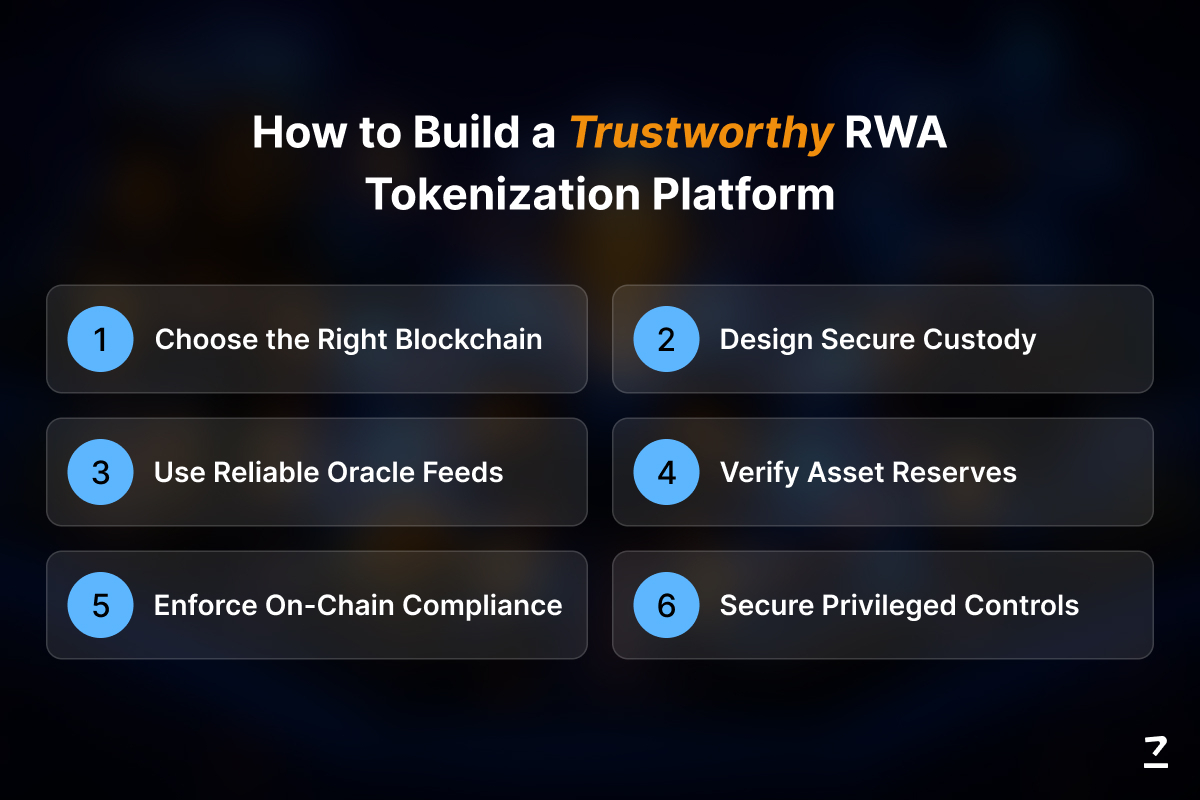
A trustworthy platform treats custody and oracle infrastructure as core architecture decisions made before development begins, not features bolted on after a smart contract is written. The underlying blockchain is another critical architectural decision, affecting scalability, transaction costs, privacy, interoperability and the broader infrastructure available for tokenized assets. Before selecting a network, see our guide to choosing the best blockchain for RWA tokenization platform development. In practice, that means evaluating a few concrete things early:
-
Custody architecture that matches the asset class. Regulated custodians or SPV structures for securities-classified assets; MPC or multisig wallet controls for the digital keys governing the token itself; clear, publicly documented answers to who holds what, under which legal structure and what happens in an insolvency scenario.
-
Multi-source, decentralized oracle feeds for valuation and NAV data, with defined staleness thresholds and circuit breakers that pause sensitive operations if a feed deviates beyond expected bounds.
-
Frequent, independently verified proof-of-reserve attestations rather than annual audits, so reserve status is visible on an ongoing basis rather than at a single point in time each year.
-
On-chain compliance logic investor allowlists, jurisdiction checks, transfer restrictions enforced at the contract level, separated from minting and upgrade privileges so no single role can bypass every safeguard at once.
-
Multisig and timelock controls on every privileged function, with real-time monitoring and a documented incident response plan covering key compromise, custodian issues and oracle failure.
This is the kind of infrastructure work that spans smart contract engineering, custody design and regulatory compliance together which is exactly why it benefits from a development partner who has actually built and secured all of these layers in production, not just written the token contract.
At Codezeros, this is the core of how we approach RWA tokenization development services: building custody architecture, oracle integration and compliance logic as a single connected system rather than three separate workstreams, so the platform holds up under real scrutiny from auditors, regulators and investors alike.
If your team is evaluating how to structure custody and oracle infrastructure for a tokenization project, or comparing RWA tokenization development partners on exactly these criteria, it's worth a conversation before the architecture is locked in.
Conclusion
A token is only as trustworthy as the infrastructure connecting it to the real-world asset behind it. Custody ensures the asset is properly held, while oracles ensure its on-chain data remains accurate and current.
For businesses building an RWA platform, these cannot be treated as separate afterthoughts. Smart contracts, custody, oracle integration and compliance must work together from the start.
At Codezeros, our RWA tokenization development bring these layers into one connected architecture. If you're evaluating a tokenization project or looking for an RWA tokenization development company, talk to our experts before locking in the architecture.
Post Author

Jay Kapoor
With a genuine love for all things blockchain, Jay is one of the Blockchain Enthusiasts and Consultants at Codezeros. With a fresh and innovative perspective on the world of blockchain, Jay provides strategic guidance and implementation support to clients across diverse industries and helps them unlock new opportunities.
Frequently Asked Questions
Frequently asked questions about this article.
Custody determines who legally holds and safeguards the underlying asset and who controls the private keys governing the token itself. It's the layer that ties a digital token back to a real, legally recognized claim without it, a token has nothing verifiable behind it.
Blockchains can't independently verify facts outside their own network. Oracles bring external data asset valuations, reserve status, NAV, corporate actions on-chain in a form smart contracts can reliably act on, closing the gap between what's true off-chain and what the contract believes.
Custody proves the asset is real and properly held; oracles prove the on-chain representation of that asset's current state is accurate and up to date. A platform needs both working correctly at the same time strong custody with unreliable data, or accurate data with weak custody, both undermine trust in the token.
A qualified custodian, transfer agent, or special purpose vehicle (SPV) holds the underlying asset directly, while the token represents a beneficial or economic interest governed by the associated legal documentation, not direct legal title in most jurisdictions.
It doesn't do so natively it relies on oracles to fetch and deliver that information from off-chain sources. Institutional platforms increasingly use decentralized oracle networks that aggregate data from multiple independent sources to reduce reliance on any single provider.
An oracle feed updates the on-chain reference value, which can trigger downstream actions depending on the platform's design re pricing for secondary market trades, updated NAV for fund redemptions, or in leveraged structures, collateral and liquidation calculations.
At minimum: current asset valuation, proof-of-reserve confirmation, NAV calculations for fund structures, corporate action triggers and relevant regulatory or compliance status updates each on a cadence appropriate to how quickly that data changes.
Asset custody covers safekeeping the physical or financial underlying asset (a bond, property title, or credit receivable). Digital asset custody covers protecting the private keys that control the token representing that asset on-chain. Both need to be secure independently.
On the custody side: custodian insolvency, single-key compromise and legal enforceability gaps. On the oracle side: stale data, manipulated or misconfigured feeds and fraudulent attestations. Many of the largest documented losses trace back to a gap between off-chain approval and on-chain execution.
By treating custody architecture and oracle integration as core design decisions from the start matching custody models to the asset class, using multi-source decentralized oracle feeds with circuit breakers, publishing frequent proof-of-reserve attestations and enforcing compliance logic on-chain with multisig controls on every privileged function.
More questions? Contact us.
Build a Trustworthy RWA Tokenization Platform
Planning to tokenize real-world assets? Codezeros helps businesses build secure RWA tokenization platforms with smart contracts, custody architecture, oracle integration and compliance controls designed as one connected system. Talk to our blockchain experts to define the right architecture for your tokenization project.
Blogs
Our Latest Blogs
Discover valuable industry insights and stay up-to-date with the latest updates by exploring our curated collection of recent blog posts.