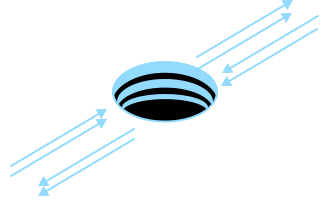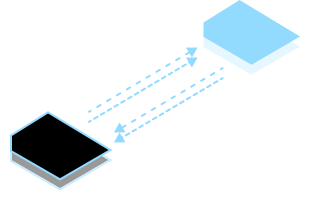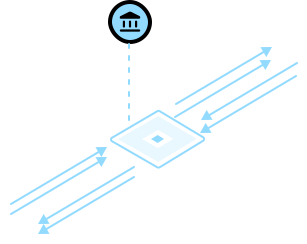

Trustless (Decentralized) Bridges
Rely entirely on smart contracts and distributed validator or oracle networks, ensuring maximum transparency, reduced risk, and no single point of failure. Ideal for advanced DeFi, Web3, NFT, and DAO projects.
Cross Chain Bridge ✦
Unlock secure cross-chain interoperability with production-grade bridge infrastructure designed for real asset movement across blockchain ecosystems. At Codezeros, we engineer cross-chain bridge development services that enable secure token, NFT, and data transfers across EVM and non-EVM networks while prioritizing protocol-level security, liquidity efficiency, and compliance readiness for enterprise-scale adoption.








Cross-chain bridge development services create the critical links between fragmented blockchain ecosystems, making the transfer of digital assets and information between different chains simple, secure, and efficient.
At Codezeros, our developers design, build, and deploy custom cross-chain bridge solutions that eliminate network silos and empower true utility, enabling liquidity movement, data exchange, and smart contract interoperability across all leading and emerging protocols.
Our cross-chain bridge development company delivers robust, flexible bridges for startups and enterprises, fitting use cases in finance, gaming, decentralized applications, and enterprise blockchain. Using next-gen protocols and strong compliance frameworks, we ensure bridges that are future-ready, scalable, and built for maximum real-world impact.
Services
We provide a comprehensive suite of cross-chain bridge development services tailored to your project's unique requirements, focusing on speed, reliability, and security.
Unified wallets for effortless management of coins/tokens from multiple blockchains.
Advanced platforms for buying, selling, and trading NFTs seamlessly across blockchains at optimal fees.
Decentralized protocols for asset swaps and crypto trading without the need to rely on centralized exchanges or constant wallet switching.
Protocols to lend, borrow, and earn from assets spanning multiple networks, boosting portfolio diversification and returns.
Integration for gaming dApps, token economies, and digital items that connect users to interoperable gameplay across all compatible chains.
Scalable bridge development for business processes, supply chain, healthcare, and regulated industries.
Fast-track your project with branded, ready-to-market bridge architectures fully customized for your needs.
How It Works
Our proven cross-chain bridge development methodology assures security, transparency, and user trust throughout the lifecycle of every transaction.
Assets/tokens are locked on the originating blockchain to prevent unauthorized use.
An equivalent tokenized asset is generated/minted on the destination blockchain.
When transferring assets back, mirrored assets are burned, maintaining a one-to-one balance and preventing duplication.
Network validators/relayers or a consortium (depending on model) verify that each operation matches protocol logic and compliance policy.
Users can utilize their assets on the destination chain once validation is completed with complete transparency across networks.
Types
Rely entirely on smart contracts and distributed validator or oracle networks, ensuring maximum transparency, reduced risk, and no single point of failure. Ideal for advanced DeFi, Web3, NFT, and DAO projects.
Operate via a trusted third party, central authority, or managed custodian, offering fast setup and KYC/AML compliance. Preferred for regulated enterprises and integrations requiring operational oversight.
Managed by a set of known, reputable validators who must reach consensus on every transfer, combining elements of security, reliability, and semi-decentralization for high-trust collaborations or consortiums.
Flexible solutions leveraging both decentralized protocols and trusted validation layers. Suitable for enterprises desiring a balance between compliance, speed, and decentralization.
Use multi-network liquidity pools and synchronized balances, enabling rapid swaps without lock-mint-burn steps; optimal for popular tokens and reducing latency.
Bridges that move native coins/tokens rather than wrapped or synthetic assets, providing higher security and user confidence.
Custom bridges built for particular use cases (e.g., decentralized identity, data sharing, cross-chain gaming, RWA tokenization).


Features
Our cross-chain bridge architecture is designed around security-first interoperability, enabling deterministic asset movement, cross-chain messaging, and multi-layer validation across decentralized networks.
Connect Ethereum, BNB Chain, Polygon, Solana, Avalanche, Cardano, and other leading blockchain networks with seamless interoperability.
Leverage multi-signature validation, decentralized consensus, threshold cryptography, and layered security protocols for secure asset transfers.
Enable secure transfer of tokens, NFTs, liquidity, and blockchain data across multiple ecosystems using optimized bridge mechanisms.
Support EVM and non-EVM compatibility, cross-chain messaging, smart contract communication, and multichain composability.
Ensure reliability through comprehensive QA testing, penetration testing, vulnerability assessments, and third-party smart contract audits.
Track bridge performance, transactions, validator activity, liquidity movement, and user operations through advanced dashboards.
Build high-performance bridge ecosystems with auto-scaling infrastructure, load balancing, and cloud-native deployment support.
Enable low-latency token swaps and liquidity movement across multiple blockchain networks with optimized routing logic.
Integrate KYC/AML workflows, audit trails, privacy controls, and enterprise-grade compliance mechanisms for regulated environments.
Launch fully branded cross-chain bridge platforms with customizable workflows, UI/UX, governance systems, and upgradeable modules.
Methods
Codezeros leverages multiple bridging and interoperability techniques to fit all technical stacks.
Enable direct peer-to-peer exchange of assets across different blockchains without intermediaries, reducing counterparty risk and improving trustless execution.
Employ a group of authorized validators or guardians who collectively confirm cross-chain transactions through consensus-based verification.
Use decentralized or semi-trusted relayers and oracle networks to transmit, verify, and synchronize cross-chain data securely between networks.
Implement stateless SPV (Simplified Payment Verification) or light client models to validate blockchain states without storing full chain data.
Use shared liquidity pools across chains to enable instant swaps and transfers without traditional lock-and-mint delays.
Support event-driven communication between smart contracts across multiple blockchains for executing complex multi-chain logic.
Enable interoperability between Layer-2 networks and mainchains using optimistic and zero-knowledge rollup-based bridging systems.
Combine decentralized validation with controlled governance layers to balance security, speed, and regulatory compliance.
Process
We drive your project from idea to mainnet launch with a structured, full-service approach.
We define business objectives, supported blockchains, asset types, user flows, and compliance requirements to establish a clear technical and functional roadmap.
We design the bridge architecture, selecting the appropriate model along with security and scalability frameworks.
Core bridge logic is built using audited smart contracts, integrated with blockchain networks, APIs, wallets, and supporting infrastructure.
We perform functional testing, stress testing, penetration testing, and third-party security audits, followed by testnet deployment and validation.
The solution is deployed across selected blockchains with full configuration, documentation, and production-ready infrastructure setup.
We provide continuous monitoring, performance optimization, incident response, upgrades, and compliance support for long-term reliability.

Bring your idea to life with our cross-chain bridge development services that help build safe, flexible, and affordable bridges that connect blockchain networks effortlessly.
Networks
At Codezeros, we build secure and scalable cross-chain bridges across leading Layer 1 and Layer 2 networks for seamless interoperability and asset transfer.
Our Binance bridge solutions enable seamless cross-chain transfers between BNB Chain and Ethereum by converting ERC-compatible tokens into BEP-compatible assets with high security and efficiency.
We develop Avalanche bridge infrastructure that connects Avalanche-native assets with Ethereum through secure relayer-based verification and cross-chain swap mechanisms.
Our Polygon bridge implementations support bi-directional token transfers between Polygon and Ethereum, ensuring low-cost, high-speed, and reliable transaction processing.
We enable token interoperability between Cardano and Ethereum ecosystems, supporting asset migration and cross-network expansion with improved scalability and reduced transaction overhead.
Our Solana bridge solutions connect Solana with both EVM and non-EVM networks, enabling efficient cross-chain asset transfers and broader ecosystem accessibility.
We implement Synapse-style cross-chain messaging and liquidity frameworks that allow DeFi applications to interact across multiple blockchains with enhanced flexibility and composability.

Benefits
Our cross-chain bridge development services deliver key business and technical advantages across secure, scalable multichain ecosystems.
Enable faster entry into multiple blockchain ecosystems by removing interoperability barriers and expanding global liquidity access.
Optimize asset utilization across chains, enabling seamless movement of funds for trading, staking, lending, and DeFi participation.
Minimize transaction fees and dependency on intermediaries through efficient cross-chain settlement mechanisms.
Support growing transaction volumes and user demand with scalable infrastructure and optimized cross-chain architecture.
Deliver smooth, unified interactions across multiple blockchains with simplified asset management and transfer flows.
Ensure multi-layer protection using cryptographic validation, decentralized consensus, and continuous monitoring systems.
Incorporate compliance mechanisms such as KYC/AML workflows and audit-ready transaction tracking for enterprise use cases.
Enable rapid deployment of multichain applications across DeFi, NFT, GameFi, and enterprise blockchain environments.

Tech Stack
A robust, security-focused tech stack built to enable fast, reliable, and interoperable cross-chain bridge development across modern blockchain ecosystems.
Platforms
Our cross-chain bridge development services support a wide range of blockchain-driven platforms, enabling seamless interoperability across diverse Web3 and enterprise use cases.
WHY US
Choose Codezeros to hire cross-chain bridge developers who combine global vision, technical precision, and practical business value.
Years of hands-on experience, specialized in custom cross-chain bridge development for every major use case, sector, and business size.
Recognized among the best cross-chain bridge development companies with 150+ projects delivered globally.
Choose rapid white-label deployment or bespoke, fully customized architectures designed for your growth.
Certified to ISO 27001, GDPR-ready, SOC2 audited, and aligned with global best practices for security and privacy.
From discovery to launch and beyond, we cover all phases: consulting, design, development, audits, maintenance, and growth.
24/7 technical assistance, proactive monitoring, and future-proofing as networks and standards evolve.
Clear, upfront cost models and flexible engagement to suit your budget - no hidden fees, just results.
Case studies
Discover how we have powered successful cross-chain projects for DeFi startups, global fintech brands, NFT ecosystems, and major enterprises. Our case studies show tangible ROI, cross-network scale, and UI-driven innovation through outstanding cross-chain bridge technology.
Get clear answers to the most common questions about cross-chain bridge development, architecture, security, and implementation.
Cross-chain bridge development involves building infrastructure that enables assets, tokens, NFTs, liquidity, or data to move between otherwise separate blockchain networks. The bridge architecture can use mechanisms such as lock-and-mint, liquidity pools, atomic swaps, relayers, or cross-chain messaging depending on the project’s requirements.
The right architecture depends on the blockchain networks involved, asset types, transaction volume, liquidity requirements, trust assumptions, security model, and compliance needs. Codezeros can develop trustless, trusted, federated, hybrid, liquidity pool-based, native asset, and application-specific bridge architectures based on these requirements.
Yes. A cross-chain bridge can be designed to connect EVM and non-EVM ecosystems, although the implementation approach varies based on each network’s architecture and technical requirements. Codezeros supports interoperability across EVM and non-EVM networks and lists ecosystems including Ethereum, BNB Chain, Polygon, Solana, Avalanche, and Cardano.
A production-grade bridge should use multiple layers of protection, including secure smart contracts, decentralized or threshold-based validation, multisignature controls where appropriate, rigorous testing, monitoring, and independent security assessments. Codezeros’ stated approach includes vulnerability assessments, penetration testing, stress testing, smart contract audits, and continuous monitoring.
The bridge must maintain a verifiable relationship between assets on the source and destination networks. Depending on the architecture, mechanisms such as lock-and-mint-and-burn flows, liquidity pool accounting, native asset transfers, and validator or cryptographic verification can help maintain accurate cross-chain asset representation.
The appropriate protocol depends on the required chains, messaging capabilities, security assumptions, and application architecture. Codezeros lists interoperability technologies such as LayerZero, Wormhole, Axelar, Hyperlane, and Cosmos IBC, along with decentralized oracle networks and custom relayer frameworks.
Yes. Cross-chain infrastructure can enable smart contracts on different networks to communicate and trigger actions across chains in addition to transferring assets. This can support use cases such as multichain DeFi, cross-chain governance, gaming, data exchange, and other interoperable Web3 applications.
Yes. Codezeros lists RWA tokenization, enterprise data sharing, supply chain, healthcare, cross-border payments, and other enterprise use cases among its supported applications. Its solutions can incorporate features such as KYC/AML workflows, audit trails, privacy controls, and compliance-oriented mechanisms, while specific legal and regulatory requirements must be assessed according to the applicable jurisdiction and business model.
A custom cross-chain bridge is designed and developed around a project’s specific technical architecture, business logic, governance, security requirements, and supported networks. A white-label bridge provides a faster starting solution that can be branded and customized with required workflows, UI/UX, governance systems, and modules.
The development cost depends on factors such as the number of blockchain networks, bridge architecture, asset types, interoperability protocol, smart contract complexity, liquidity mechanisms, security requirements, compliance features, and third-party integrations. A multi-chain bridge connecting EVM and non-EVM networks with advanced validation and enterprise requirements will typically involve greater development complexity than a narrowly scoped implementation.
The timeline depends on the number of supported networks, architecture complexity, security model, integration requirements, testing scope, audit process, and mainnet deployment strategy. Codezeros follows a development process covering discovery, architecture design, smart contract development, integration, testing, security audits, testnet validation, deployment, and post-launch monitoring, so the timeline should be determined after evaluating the project’s scope.
Codezeros is a cross-chain bridge development company offering custom and white-label bridge solutions for EVM and non-EVM blockchain ecosystems. Its capabilities include multiple bridge architectures, cross-chain asset transfers, interoperability protocols, security testing and audits, enterprise-focused compliance mechanisms, and ongoing monitoring and support.
Yes. Codezeros offers application-specific cross-chain bridge development and lists use cases including DeFi, NFT marketplaces, GameFi, wallets, exchanges, lending platforms, RWA tokenization, supply chain, healthcare, cross-border payments, and enterprise applications. The bridge architecture, supported networks, asset transfer model, validation mechanism, and integrations can be tailored to the project’s specific requirements.
Have more questions? Contact us.

Consult us to know how Codezeros can future-proof your blockchain project with secure, high-performance, and scalable cross-chain bridge development solutions.