SHARE THIS ARTICLE
- Copy link
05 Jun 2026
How to Build an RWA Tokenization MVP in 90 Days (Architecture Breakdown)

Executive Summary:
An RWA tokenization MVP is not just a smart contract project. It is a regulated asset infrastructure product that connects legal ownership, investor onboarding, custody, compliance, asset servicing, payments, data feeds, and blockchain-based token lifecycle management. As demand for RWA tokenization development services grows, businesses are looking for faster ways to validate tokenized asset models without building a full-scale platform from day one.
In 2026, tokenized real-world assets are moving from pilots to production-grade financial systems. Market data shows total RWA value of about $33.65B with more than 824,000 holders. But the hardest part is not minting a token. It is building compliance, identity, transfer restrictions, sanctions controls, corporate actions, custody, and investor trust into the architecture from day one.
A realistic 90-day MVP should focus on one asset class, one jurisdictional model, one primary blockchain, and a narrow but investor-ready feature set. The goal is not to build a full exchange, multi-chain liquidity network, or institutional-grade asset servicing suite in the first release. The goal is to validate demand, prove legal and technical feasibility, onboard verified investors, tokenize a real asset, manage compliant transfers, and prepare for audit, scale, and secondary liquidity.
This guide breaks down the RWA tokenization MVP development roadmap and architecture for founders, CTOs, product owners, financial institutions, and enterprise teams evaluating how to build an investor-ready MVP in 90 days.
Why RWA Tokenization Matters in 2026
Real-world asset tokenization converts ownership rights or economic claims in assets like real estate, private credit, treasuries, commodities, invoices, funds, carbon credits, or private equity into blockchain-based tokens.
For enterprises, this creates four practical benefits:
-
Fractional ownership: Lower entry barriers for investors.
-
Faster settlement: Smart contracts reduce manual transfer friction.
-
Programmable compliance: Transfer rules can be enforced before transactions execute.
-
Global distribution: Verified investors can access assets across digital channels.
But 2026 is different from earlier tokenization cycles. The market has moved beyond “let’s mint a token” experiments. Institutional buyers now care about:
-
Legal enforceability
-
Custody and asset servicing
-
KYC/AML workflows
-
Transfer agent processes
-
On-chain compliance
-
Auditability
-
Secondary liquidity readiness
-
Interoperability with custody, banking, and DeFi infrastructure
Recent industry research also shows why architecture matters. One 2026 tokenization standards report notes that tokenized T-bill deposits on Morpho fell 92%, while tokenized gold grew 7x over the same period. That shift shows RWA adoption is not static. Asset demand changes with market conditions, which means platforms need modular infrastructure, not rigid MVPs.
This is why choosing an experienced RWA Tokenization Development Company or internal team with strong legal-tech, fintech, and blockchain architecture experience is critical.
What an RWA Tokenization MVP Should Include
An MVP should prove the platform can tokenize, issue, manage, and transfer a real asset under defined compliance rules.
A practical MVP includes:
| MVP Component | Purpose |
| Asset onboarding module | Register the asset, documents, valuation, issuer details, and legal structure |
| Investor onboarding | KYC, AML, accreditation, wallet linking, and eligibility checks |
| Token smart contract | Mint, burn, pause, transfer, and manage token lifecycle |
| Compliance engine | Enforce whitelisting, jurisdiction rules, lockups, and investor limits |
| Issuer dashboard | Manage assets, investors, documents, issuance, and distributions |
| Investor dashboard | View offerings, holdings, documents, transactions, and income events |
| Custody model | Define how the underlying asset is held and linked to token ownership |
| Payment rails | Support fiat, stablecoin, or hybrid subscription workflows |
| Oracle/data layer | Feed valuation, NAV, rental income, interest, or asset status updates |
| Security controls |
RBAC, audit logs, key management, monitoring, and test coverage |
This is the baseline for a compliance-ready RWA tokenization platform architecture. The MVP should be narrow, but real. A demo token with no legal wrapper, no investor eligibility logic, and no custody model will not satisfy enterprise buyers or financial institutions.
What Your MVP Should Not Include on Day One
Many RWA projects fail because they try to build a full capital market system in the first version.
Avoid adding these too early:
-
Multi-chain deployment across 5+ networks
-
Public secondary marketplace
-
Complex DeFi integrations
-
Cross-border retail investor access
-
Fully automated corporate actions
-
Tokenized asset baskets
-
DAO governance for regulated securities
-
Advanced derivatives or leverage features
-
Native mobile apps, unless required
-
Multiple asset classes in one MVP
Your first goal is trust, not feature volume.
A strong MVP should answer:
-
Can the asset be legally tokenized?
-
Can verified investors subscribe?
-
Can tokens represent defined economic rights?
-
Can transfers be restricted by compliance rules?
-
Can the issuer manage lifecycle events?
-
Can the system pass technical and legal due diligence?
If yes, you have a foundation for an enterprise-grade real-world asset tokenization platform development.
RWA Tokenization MVP Architecture Explained
Here is the architecture of RWA tokenization platform explained in practical layers:
Investor / Issuer / Admin Interfaces
↓
Frontend Application Layer
↓
Backend API & Business Logic Layer
↓
Compliance, Identity, and KYC/AML Layer
↓
Asset Registry + Document Management
↓
Payments, Custody, and Banking Integrations
↓
Oracle / NAV / Asset Data Layer
↓
Smart Contract Layer
↓
Blockchain Network
↓
Monitoring, Audit, Security, and Reporting Layer
A production-ready MVP is hybrid. Some actions belong on-chain. Others should stay off-chain due to privacy, regulation, cost, or operational flexibility.
For example:
-
Token balances and transfer events can be on-chain.
-
KYC documents should remain off-chain.
-
Compliance proofs can be referenced on-chain.
-
Asset documents can be stored securely off-chain with hash verification.
-
NAV updates can be pushed through an oracle layer.
-
Investor identity can be linked to wallets without exposing sensitive data publicly.
This hybrid design is what separates serious asset tokenization platform development solutions from simple token launch scripts.
Asset Selection, Legal Wrapper, and Custody Model
Choose One Asset Class First
The fastest path to a 90-day MVP is choosing one asset type with clear ownership records and manageable compliance needs.
Common MVP-friendly asset classes include:
-
Tokenized real estate
-
Private credit
-
Revenue-generating commercial property
-
Invoice receivables
-
Treasury-backed products
-
Commodities with custodian support
-
Fund interests for qualified investors
For many startups, tokenized real estate is attractive because the value proposition is easy to understand: fractional ownership, rental yield, and lower investment barriers. For financial institutions, private credit or fund interests may be more relevant because they already have issuer, custody, and investor relationships.
Define the Legal Wrapper
Tokens rarely represent direct ownership of a physical asset without legal structuring. Common models include:
-
SPV shares
-
Fund units
-
Trust interests
-
Debt notes
-
Revenue participation rights
-
Beneficial ownership claims
-
Contractual rights to income or redemption
The legal wrapper defines what the token actually represents.
A token might represent:
-
Equity in an SPV that owns real estate
-
A debt claim against a borrower
-
A fund share
-
A right to income distributions
-
A redeemable claim against a custodied commodity
This must be defined before smart contract development begins.
Define Custody
Custody answers one key question: who holds or controls the underlying asset?
For physical assets, this may involve:
-
Licensed custodians
-
Trustees
-
Escrow agents
-
Property managers
-
Transfer agents
-
Fund administrators
-
SPVs with legal ownership
For financial assets, it may involve:
-
Broker-dealers
-
Qualified custodians
-
Fund administrators
-
Regulated transfer agents
-
Banking partners
Your MVP should document the custody model clearly in the issuer dashboard and investor disclosures.
On-Chain vs Off-Chain Architecture
A mature RWA MVP does not put everything on-chain. It puts the right things on-chain.
| Layer | On-Chain | Off-Chain |
| Token balances | Yes | Synced index |
| Transfers | Yes | Monitored |
| KYC documents | No | Secure storage |
| Investor identity | Partial | Full KYC profile |
| Compliance status | Yes, as flags/claims | Full rule engine |
| Asset documents | Hash only | Document vault |
| NAV/valuation | Oracle updates | Calculation engine |
| Payments | Stablecoin on-chain if used | Fiat rails, bank transfers |
| Corporate actions | Event triggers | Admin workflow and records |
| Reporting | Transaction logs | Full reports and exports |
This keeps the system compliant, scalable, and privacy-aware.
A good RWA tokenization development company will help you avoid two extremes:
-
Putting too much on-chain, which creates privacy and upgrade issues
-
Keeping too much off-chain, which weakens transparency and automation
The goal is balance.
Smart Contract Architecture for Asset Tokenization Platform MVPs
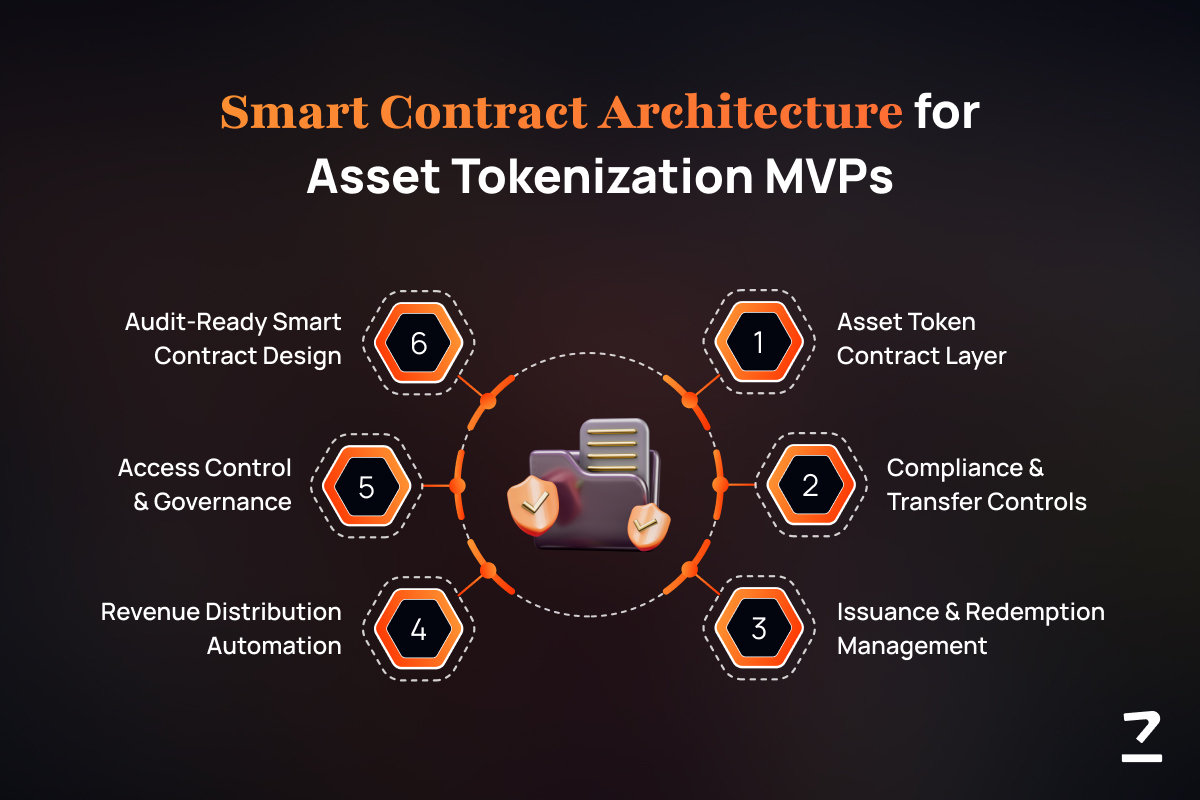
The smart contract architecture for asset tokenization platform development should be modular.
Core contracts may include:
This represents the tokenized asset. Depending on the asset type, standards may include:
-
ERC-20 for fungible fractional ownership
-
ERC-721 for unique asset representations
-
ERC-1155 for semi-fungible assets
-
ERC-1400 or ERC-3643-style patterns for permissioned securities
-
Restricted ERC-20 with allowlist checks
For many regulated MVPs, a restricted ERC-20 or permissioned token model is more practical than a fully open token.
2. Compliance Registry
This contract or linked module checks whether a wallet can hold or transfer tokens.
It may include:
-
Wallet whitelist status
-
Investor category
-
Jurisdiction rules
-
Holding limits
-
Lockup periods
-
Accreditation status
-
Sanctions flags
-
Transfer pause controls
3. Issuance and Redemption Contract
This handles minting, burning, subscriptions, redemptions, and supply updates.
4. Distribution Contract
This manages yield, dividends, rent, interest, or revenue sharing if included in the MVP.
For a first MVP, distributions can be semi-automated with admin approval. Full automation can come later.
5. Upgradeability and Access Control
Smart contracts should include:
-
Role-based access control
-
Pausable functions
-
Emergency stop
-
Upgrade pattern where appropriate
-
Multisig governance
-
Event logging
-
Audit-friendly structure
Do not over-engineer contracts. Keep them clear, testable, and audit-ready.
Compliance Layer in RWA Tokenization Platform Design
The compliance layer in RWA tokenization platform design is the core of the MVP.
It should answer:
-
Who can invest?
-
Who can hold tokens?
-
Who can receive tokens?
-
What jurisdictions are restricted?
-
What investor limits apply?
-
Are transfers allowed during lockup?
-
Can tokens be force-transferred under legal order?
-
Can wallets be frozen?
-
How are sanctions handled?
-
How are regulatory reports generated?
Identity, KYC, and AML
Investor onboarding should include:
-
Account registration
-
Identity verification
-
Document collection
-
AML screening
-
Accreditation or investor classification
-
Wallet connection
-
Wallet ownership verification
-
Wallet whitelisting
-
Subscription approval
For enterprise and institutional MVPs, wallet-based access alone is not enough. You need investor-level records that can map multiple wallets to one verified investor.
Transfer Restrictions
A tokenized security or regulated asset cannot usually move freely like a meme token.
Transfer restrictions may include:
-
Only verified wallets can receive tokens
-
U.S. persons excluded or included based on offering type
-
Accredited investors only
-
Lockup periods
-
Maximum holder count
-
Minimum holding period
-
Sanctions-based restrictions
-
Issuer approval for secondary transfers
These rules should run before token transfer execution.
Oracle, NAV, Wallet, Payments, and Dashboard Layers
Oracle and NAV/Data Integration
RWAs depend on off-chain data. Your MVP may need feeds for:
-
Asset valuation
-
NAV
-
Rental income
-
Interest accrual
-
Commodity price
-
Loan performance
-
Payment status
-
Property occupancy
-
Asset insurance status
-
Redemption price
For an MVP, do not build a complex oracle network unless required. Start with an admin-approved data update flow, then evolve toward automated oracle integration.
Wallet Architecture
Your platform should support:
-
MetaMask or WalletConnect for Web3 users
-
Custodial wallet option for non-crypto investors
-
Institutional custody integration for enterprise buyers
-
Wallet whitelisting
-
Wallet recovery processes
-
Multisig for issuer/admin roles
For financial institutions, custody integrations are often more important than consumer wallet support.
Investor Dashboard
The investor dashboard should be simple but complete.
Include:
-
Available offerings
-
Investment documents
-
Subscription status
-
Token holdings
-
Transaction history
-
Income distributions
-
KYC status
-
Wallet status
-
Redemption requests
-
Tax/reporting downloads if needed
Admin and Issuer Workflows
Issuer workflows matter as much as investor UX.
Include:
-
Asset creation
-
Document uploads
-
Investor approval
-
Token minting
-
Cap table view
-
Transfer approvals
-
Distribution setup
-
Redemption management
-
Compliance reports
-
Audit logs
-
Emergency pause controls
A strong admin layer reduces operational risk after launch.
Security Model, Audit Readiness, and Scalability
Security must be designed from day one.
Your MVP should include:
-
Smart contract unit tests
-
Integration tests
-
API security
-
Encryption for sensitive data
-
RBAC for admins
-
Multisig for critical functions
-
Secrets management
-
Activity logs
-
Monitoring alerts
-
Rate limiting
-
Backup and recovery plan
-
Penetration testing
-
Smart contract audit readiness
Chain Selection
The tech stack for RWA tokenization development in 2026 often depends on compliance, cost, liquidity, and ecosystem maturity.
Common blockchain options:
| Chain Type | Best For | Trade-Off |
| Ethereum | Institutional trust, liquidity, security | Higher fees |
| Polygon | Lower-cost EVM MVPs | Less prestige than Ethereum mainnet |
| Arbitrum/Base/Optimism | Scalable EVM deployment | Bridge and ecosystem considerations |
| Avalanche | Enterprise and subnet options | Requires ecosystem fit |
| Solana | High throughput | Different programming model |
| Permissioned chain | Bank-grade controlled environments | Less open liquidity |
For most MVPs, an EVM-compatible chain is the fastest path due to tooling, talent, audit support, and token standard maturity.
Upgradeability
Upgradeability is essential because legal, compliance, and business rules change.
Use:
- Modular contracts
- Upgradeable proxy only where justified
- Clear admin roles
- Timelocks for major upgrades
- Versioned APIs
- Configurable compliance modules
- Separate compliance logic from core token logic where possible
Do not lock yourself into a rigid contract model that requires full redeployment for every regulatory update.
90-Day RWA Tokenization MVP Roadmap
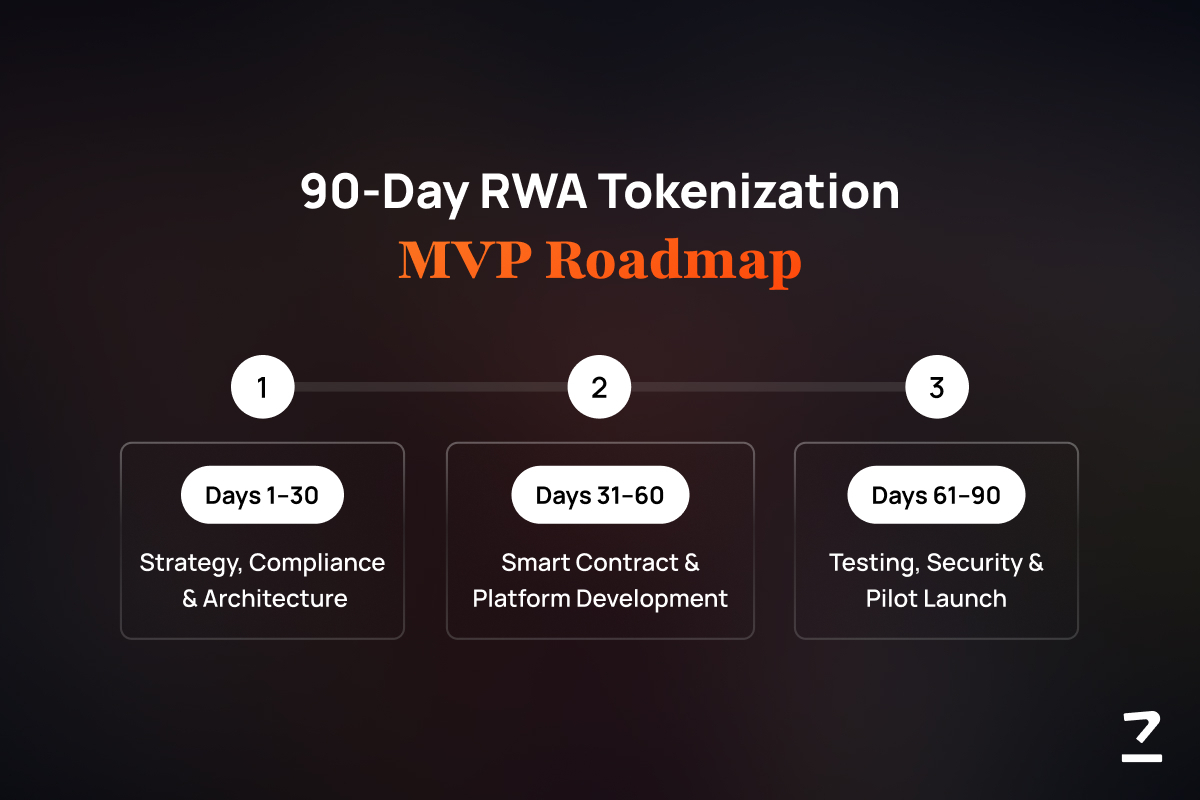
Here is a practical phased roadmap.
Days 1–30: Strategy, Legal-Tech Design, and Architecture
Focus: clarity before code.
Key activities:
-
Select one asset class
-
Define investor type
-
Choose jurisdiction assumptions
-
Define legal wrapper
-
Define custody model
-
Map token rights
-
Choose blockchain
-
Select token standard
-
Design compliance rules
-
Create product requirements
-
Finalize MVP scope
-
Design system architecture
-
Select KYC/AML provider
-
Define payment flow
-
Prepare security model
Deliverables:
-
MVP requirements document
-
Legal-tech workflow map
-
Architecture diagram
-
Token model
-
Compliance rule matrix
-
Development sprint plan
Days 31–60: Core Platform and Smart Contract Development
Focus: build the core system.
Key activities:
-
Develop token smart contracts
-
Build compliance registry
-
Create issuance workflows
-
Build backend APIs
-
Integrate KYC/AML
-
Build asset onboarding module
-
Create investor dashboard
-
Create admin dashboard
-
Build wallet connection
-
Implement payment confirmation flow
-
Add document management
-
Implement audit logs
-
Start contract testing
Deliverables:
-
Working smart contracts on testnet
-
Investor onboarding flow
-
Admin asset management
-
KYC/wallet whitelist flow
-
Token mint/transfer/burn flow
-
Initial frontend and backend
Days 61–90: Testing, Security, Pilot Launch, and Investor Readiness
Focus: make it usable, secure, and launch-ready.
Key activities:
-
End-to-end testing
-
Smart contract test coverage
-
Security review
-
Penetration testing
-
Compliance workflow testing
-
Data/NAV update testing
-
Payment and issuance testing
-
Role-based access testing
-
Pilot investor onboarding
-
Testnet demo
-
Mainnet deployment planning
-
Internal audit checklist
-
Launch documentation
Deliverables:
-
MVP release candidate
-
Audit-ready contract package
-
Test reports
-
Admin training
-
Investor onboarding guide
-
Production deployment plan
-
Pilot launch
This is the fastest realistic way to build a secure MVP without cutting corners.
Cost Drivers and Failure Points in RWA Tokenization MVP Development
Understanding the key cost factors and common implementation risks helps organizations build compliant, scalable, and investment-ready RWA tokenization platforms more efficiently.
Cost to Build RWA Tokenization Platform MVP
The cost to build RWA tokenization platform MVP depends on scope, jurisdiction, integrations, and audit depth.
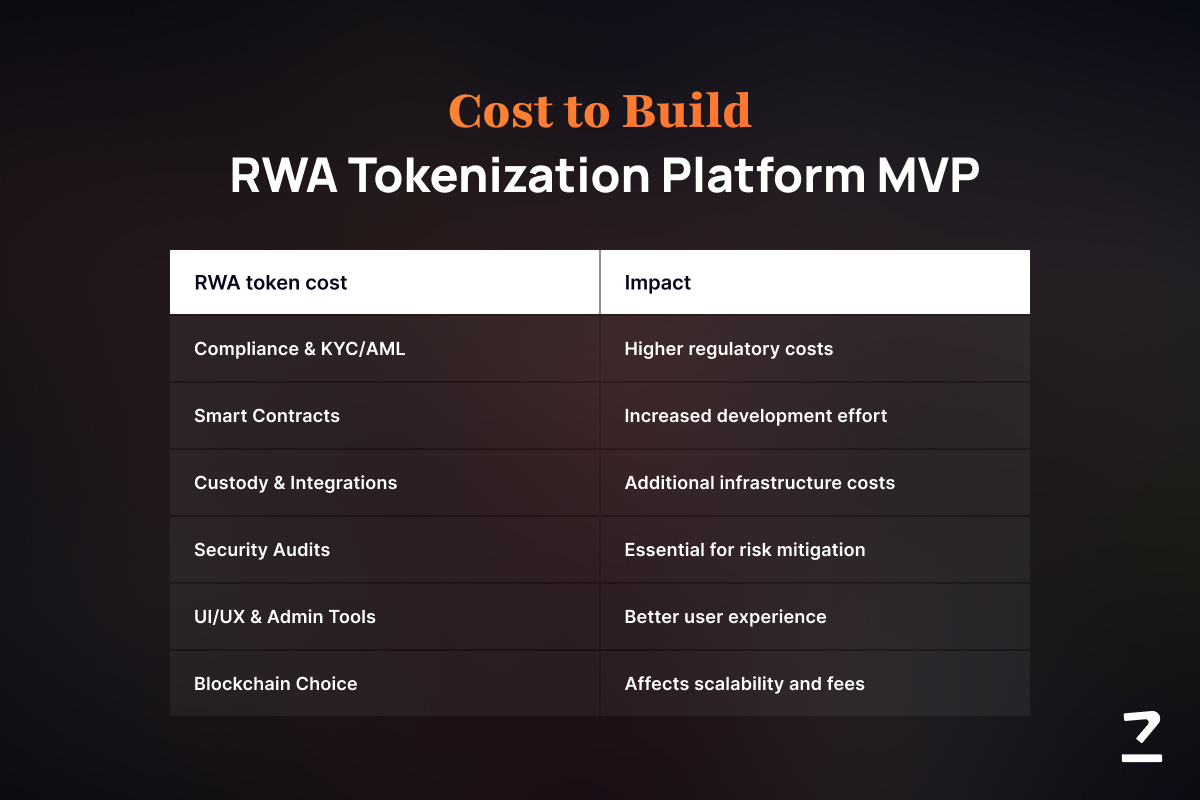
Main cost drivers include:
-
Asset type complexity
-
Legal wrapper requirements
-
Number of user roles
-
KYC/AML integration
-
Token standard complexity
-
Payment rails
-
Custody integrations
-
Oracle/NAV design
-
Admin workflow depth
-
Security audit
-
UI/UX quality
-
Chain and infrastructure choice
-
Reporting requirements
A simple proof-of-concept costs far less than a regulated MVP. But for enterprise buyers, a low-cost demo without compliance is rarely useful.
Common Failure Points
Most RWA MVPs fail because of:
-
Unclear legal rights
-
Weak custody model
-
No transfer restrictions
-
Poor investor onboarding
-
Overly complex smart contracts
-
Multi-chain scope creep
-
No audit plan
-
Manual admin chaos
-
No asset servicing workflow
-
Treating tokenization as a token launch instead of infrastructure
The fix is simple: start narrow, build correctly, and design for upgradeability.
Build vs Partner: How to Choose the Right Route
You can build in-house, partner with an RWA tokenization solution provider, or use a hybrid model.
| Option | Best For | Risk |
| In-house | Teams with blockchain, fintech, compliance, and security talent | Slow hiring and knowledge gaps |
| External partner | Fast MVP launch with proven architecture | Vendor quality varies |
| Hybrid | Enterprises that want speed plus long-term control | Requires clear ownership model |
You should consider partnering if you need to:
-
Hire RWA tokenization developers for MVP development
-
Move from concept to MVP in 90 days
-
Build regulated workflows
-
Create secure smart contracts
-
Integrate KYC/AML
-
Design token lifecycle management
-
Avoid avoidable architecture mistakes
Look for a secure RWA tokenization architecture development company with real experience in blockchain engineering, fintech systems, asset tokenization, compliance workflows, and enterprise-grade product delivery.
Build a Compliance-Ready RWA Tokenization MVP with Codezeros
If you are evaluating RWA Tokenization Development Services, Codezeros can help you move from idea to investor-ready MVP with a clear architecture, secure smart contracts, and compliance-first platform workflows.
As an RWA Tokenization Development Company, Codezeros focuses on practical execution, not generic token launches. Our team helps founders, enterprises, financial institutions, and innovation teams design and build tokenization platforms that support real asset onboarding, investor verification, permissioned transfers, custody workflows, smart contract security, issuer dashboards, and scalable token lifecycle management.
Whether you need a custom RWA tokenization development firm for tokenized real estate, private credit, fund units, commodities, or institutional tokenization infrastructure, Codezeros can help you define the right MVP scope and build a platform that is ready for pilots, audits, and future scale.
Planning to build an investor-ready RWA tokenization platform? Contact us to accelerate your MVP launch with end-to-end expertise, from architecture and compliance planning to deployment and post-launch support..
Post Author

Jay Kapoor
With a genuine love for all things blockchain, Jay is one of the Blockchain Enthusiasts and Consultants at Codezeros. With a fresh and innovative perspective on the world of blockchain, Jay provides strategic guidance and implementation support to clients across diverse industries and helps them unlock new opportunities.
Frequently Asked Questions
Frequently asked questions about this article.
An RWA tokenization MVP is a minimum viable platform that lets issuers tokenize a real-world asset, onboard verified investors, issue tokens, enforce transfer rules, and manage asset lifecycle workflows.
Yes, if the scope is focused on one asset class, one jurisdictional model, one primary blockchain, and essential compliance, investor, issuer, and smart contract workflows.
It should include asset onboarding, legal wrapper mapping, investor KYC/AML, wallet whitelisting, smart contracts, compliance rules, issuer dashboard, investor dashboard, payment flow, and security controls.
Avoid multi-chain deployment, public secondary trading, complex DeFi integrations, multiple asset classes, DAO governance, and fully automated corporate actions in the first release.
Real estate, private credit, fund interests, invoices, treasuries, commodities, and revenue-generating assets are common MVP candidates when ownership and valuation are clear.
EVM-compatible chains like Ethereum, Polygon, Arbitrum, Base, and Avalanche are common choices due to tooling, standards, developer availability, and audit support.
Compliance works through KYC/AML, investor classification, wallet whitelisting, jurisdiction rules, transfer restrictions, sanctions screening, holding limits, and audit logs.
Many MVPs use restricted ERC-20, ERC-1400-inspired, or ERC-3643-style permissioned token models, depending on the asset type and compliance needs.
The biggest risks are unclear legal rights, weak custody structure, missing compliance logic, insecure smart contracts, poor investor onboarding, and excessive MVP scope.
Build in-house if you already have blockchain, compliance, fintech, and security expertise. Partner with an experienced provider if you need speed, architecture depth, and lower execution risk.
More questions? Contact us.
Launch Your RWA MVP with Confidence
Partner with Codezeros to design and build a secure, compliance-ready RWA tokenization MVP in 90 days, from architecture and smart contracts to investor onboarding, asset workflows, and scalable platform development.
Blogs
Our Latest Blogs
Discover valuable industry insights and stay up-to-date with the latest updates by exploring our curated collection of recent blog posts.