SHARE THIS ARTICLE
- Copy link
22 Apr 2026
Real Estate Tokenization Explained: Benefits, Risks, and Investment Opportunities
The global real estate market, valued at $393 trillion, is at a historic turning point. For decades, property ownership has been constrained by high capital requirements, geographic limitations, and slow, opaque transaction processes. Real estate tokenization, the process of converting property rights into blockchain-based digital tokens, is redefining how investors access, own, and trade real estate assets. By enabling fractional ownership, automated income distribution, and faster secondary market liquidity, tokenization opens opportunities that were previously limited to institutional investors.
Surveys from EY-Parthenon and Coinbase indicate that 76% of institutional firms plan to invest in tokenized assets by year-end. Enterprise initiatives like BlackRock’s $500 million tokenization partnership with Securitize, Dubai’s five-minute villa sale across 169 global investors, and Singapore’s MAS Project Guardian sandbox demonstrate operational readiness and global appetite. Meanwhile, India’s SEBI is creating frameworks for fractional micro-ownership, potentially unlocking access for millions of retail investors.
Executing these projects successfully requires specialized expertise. A Token Development Company ensures that token architecture, smart contract automation, and compliance mechanisms are robust, secure, and scalable, enabling both institutional and retail participation without compromising regulatory requirements.
Despite growing interest, many investors still lack a clear understanding of the mechanics, risks, and regulatory landscape of tokenized real estate. This guide bridges that gap, explaining how tokenization works, the benefits and risks, and how to evaluate whether digital real estate tokens align with your investment strategy. Understanding this emerging asset class is critical for investors and developers looking to capitalize on the next frontier of property investment.
What is Real Estate Tokenization?
At its core, real estate tokenization refers to the representation of ownership rights in a physical property as digital tokens on a blockchain. Unlike a conventional deed recorded in a centralized registry, tokenization encodes property rights, revenue entitlements, and transfer mechanics into cryptographically secured units that can be purchased, held, and traded.
This transformation enables fractional ownership, breaking a high‑value asset like a commercial building into hundreds, thousands, or even millions of discrete on‑chain units. Each token corresponds to a proportional stake in the property’s economics, whether rental income, appreciation, or sale proceeds.
Two architectural elements are critical:
-
Blockchain Verification. Every token’s provenance, transfer history, and conditions are recorded immutably. This enables trustless verification by counterparties and regulators.
-
Smart Contract Automation. Tokens are not merely digital receipts; they carry programmable logic that can automate income distribution, enforce compliance rules, and facilitate secondary market executions without manual reconciliation.
In practice, tokenization is a multi‑layered proposition, blending legal regimes with technology and market access frameworks.
How Real Estate Tokenization Works?
Real estate tokenization is not a single technology but a stack of integrated components ranging from legal formation to marketplace execution.
Layer 1: Legal Structures
The first step is structuring the asset in a way that tokenization is legally sound. Special Purpose Vehicles (SPVs) or trusts are often used to hold title to the property. Investors do not own the building directly; they own interests in the SPV that holds it. This protects the asset from operational liabilities and aligns with securities regulation frameworks. Securities lawyers and regulatory consultants must review documentation so that tokens comply with local laws, anti‑money‑laundering (AML) rules, and know‑your‑customer (KYC) standards. Legal alignment underpins the enforceability of on‑chain rights in off‑chain courts.
Layer 2: Blockchain Infrastructure and Token Standards
Choice of blockchain influences compliance, interoperability, and institutional adoption. Ethereum and its layer‑2 networks (Optimism, Polygon) remain dominant due to mature tooling, but permissioned ledgers are gaining traction for regulated products.
Token standards define how tokens behave. ERC‑20 is widely supported for fungible assets, but enhanced standards like ERC‑1400/1410 enable on‑chain compliance features such as transfer restrictions, regulatory hooks, and whitelisting integrated with legal requirements.
Tokenization Blockchain Services help issuers select the right ledger, implement compliance triggers at the protocol level, and integrate blockchain with existing property management systems.
Layer 3: Smart Contracts and Automated Income Distribution
Smart contracts encode the distribution logic for income streams like rent, interest, or dividends. These contracts can automatically execute daily, monthly, or quarterly disbursements to token holders based on predefined rules. This automation reduces reconciliation costs, eliminates manual errors, and frees administrators from repetitive tasks while improving investor experience.
Layer 4: Compliance & Custody Standards
Regulated custody, whether on‑chain in self‑custody wallets or via institutional custodians, is essential. Compliance mechanisms must continuously verify holders against regulatory criteria. AML/KYC checks, sanctions screening, and credential verification must integrate with both the token contract and the platform’s onboarding flows. Layered compliance must be embedded throughout the stack at inception.
Layer 5: Secondary Markets and Liquidity Mechanisms
True liquidity comes from trading venues—decentralized exchanges (DEXs), security token exchanges, or regulated alternative trading systems (ATS). Liquidity providers, market makers, and automated order books support price discovery. Settlement finality must be calibrated with regulatory standards to avoid disputes.
Optimally designed secondary markets improve price transparency and allow holders to exit positions without multi‑week wait periods typical of private real estate deals.
Top Benefits of Real Estate Tokenization for Investors
Real estate tokenization unlocks a suite of structural advantages not fully achievable in legacy markets.
Lower Barriers to Entry
Fractional ownership breaks expensive assets into bite‑sized units. Retail investors can access commercial properties, multi‑family complexes, and institutional office parks with capital that would otherwise only qualify for REITs or savings. This inclusion expands the investor base and democratizes access to real assets historically limited to high‑net‑worth or institutional capital.
Enhanced Liquidity & Faster Exits
Token holders benefit from secondary trading without navigating manual transfer agents or protracted escrow periods. Liquidity events that once took weeks are now possible in minutes on regulated trading venues. This fluidity realigns real estate with investors’ expectations shaped by modern markets.
Global Market Access
Blockchain is borderless by design. Investors from Singapore, Dubai, London, or Mumbai can participate without opening local brokerage accounts, subject to compliance checks and regulatory permissions. This democratized access expands pools of capital beyond domestic boundaries and enables higher demand aggregation.
Transparent Ownership & Security
Immutable ledgers eradicate ambiguity in ownership records, liens, and encumbrances. Auditable transaction histories reduce disputes and enhance trust among counterparties. Transparency also cuts due diligence costs by making historical transaction data readily verifiable.
Automated Income Distribution
Programmable dividend logic removes manual bottlenecks. Holding patterns such as revenue waterfalls, priority returns, or pro‑rata distributions can be embedded directly into smart contracts, ensuring timely and error‑free payouts.
Portfolio Diversification
Investors can curate a diversified collection of property types like industrial, residential, and mixed‑use without concentrating capital in a single asset. This dynamic allocation is akin to equities or debt but backed by tangible collateral.
Reduced Transaction Costs
Automation cuts intermediaries like transfer agents, escrow services, and manual reconciliation teams. Smart contract execution reduces overhead, and transparent pricing cuts spreads typically absorbed by brokers.
Risks and Challenges in Tokenized Real Estate
While the benefits are real, risks remain and must be evaluated rigorously.
Liquidity Risk
Secondary markets for tokenized real estate are nascent. Thin order books or low trading volumes can widen spreads and delay exits, especially in niche assets or smaller platforms. Liquidity risk is structural, and investors must assess marketplace depth not only in smart contract capability.
Regulatory Risk by Jurisdiction
Token offerings may be treated as securities in many countries. Jurisdictional inconsistency can complicate cross‑border participation, impose withholding requirements, or affect transferability. Regulatory clarity today is uneven: what’s permitted in the UAE might be restricted in the U.S., and vice versa.
Smart Contract Vulnerabilities
Code bugs, oracle failures, or logic exploits can compromise contracts. Even audited code can fail if external dependencies break or if governance loopholes are exploited. Security protocols and regular audits, not one‑time reviews, are required.
Valuation and Market Price Uncertainty
Token prices reflect supply and demand dynamics that may diverge from fundamental asset valuations. Overreliance on on‑chain price feeds or novice market maker algorithms can distort fair value. Investors must separate price signals from intrinsic asset worth.
Custody & Settlement Risk
Custodial failures, whether self‑custody mistakes or institutional custody breaches, can result in asset loss. Proper multi‑factor custody, compliant custodians, and insurance layers are mandatory.
Tax Treatment Ambiguity
Taxation of gains, income, and cross‑border repatriation remains unsettled in many regions. Tokenized real estate often straddles securities, property, and digital asset tax regimes, complicating reporting.
Platform Insolvency Risk
Platforms that issue or trade tokens introduce counterparty risk. Insolvency, mismanagement, or fraud at the platform level can freeze liquidity or jeopardize assets.
Tokenized Real Estate vs Traditional Alternatives
Investors comparing real-world tokenized assets with legacy products should weigh fundamental differences:
Real Estate Investment Trusts (REITs) are pooled investment vehicles traded publicly or privately; they provide liquidity and diversification but often embed higher fees and limited control.
Direct Ownership offers control and tax advantages in some jurisdictions, but illiquidity, high entry costs, and management burdens are significant.
Tokenized Assets can combine liquidity, fractional access, and transparent ownership, but bring execution, regulatory, and market structure risks.
Below is a comparative snapshot:
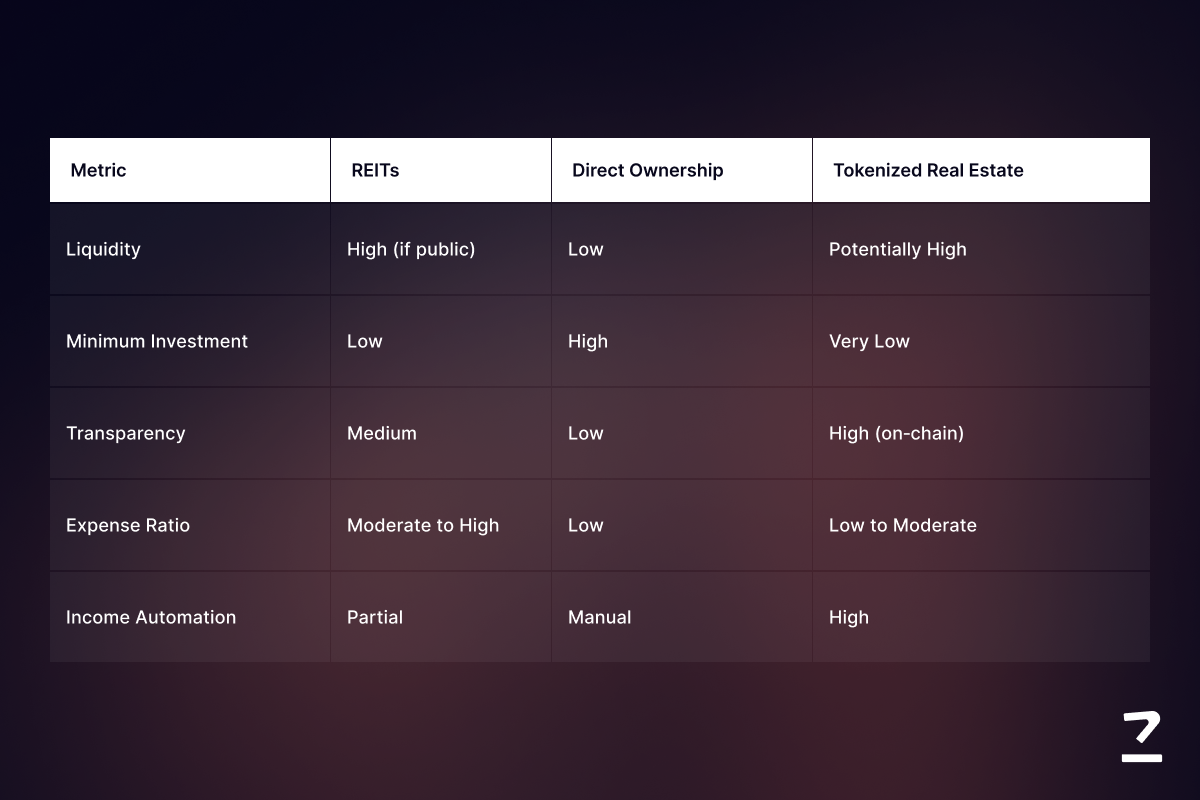
Tokenization introduces structural efficiency without giving up the underlying security of property, but it requires new risk frameworks.
Global Regulatory Landscape in 2026
United States: The SEC treats tokens with economic rights as securities. Platforms must register offerings or qualify for exemptions. Retail participation faces limits tied to accredited status and disclosure requirements.
European Union: MiCA is in force, and European Asset Tokenization Services (EATS) and European Markets in Tokens (EMT) frameworks are enabling standardized offerings with harmonized disclosures and passporting across member states.
Singapore: MAS maintains the Project Guardian sandbox for compliant digital asset offerings, mandating clear investor safeguards and AML/KYC integration.
UAE/Dubai: VARA licenses token service providers, including exchanges and custodians, and Dubai’s free zone structures support compliant secondary trading and institutional participation.
India: SEBI is evolving frameworks around Alternative Investment Funds (AIFs) and fractional micro‑ownership vehicles, though full clarity on tokenized assets is emerging rather than being settled.
Regulatory posture influences not just issuance legality but investor rights, transferability, and taxation.
Evaluating Tokenization Platforms: Investor’s 10‑Point Checklist
Selecting a platform is a strategic decision. Key evaluation criteria include:
-
Licensing & Compliance: Does the platform hold licenses for offering and trading securities? Are AML/KYC regimes robust?
-
Custody Solutions: Are assets held in regulated custodians with insurance layers?
-
Liquidity Mechanisms: Are there market makers, active order books, or partnership venues?
-
Fee Structure: Are fees transparent and aligned with investor value?
-
Asset Quality: Are the underlying properties appraised, audited, and legally encumbered?
-
Track Record: Does the team have experience with real estate, blockchain, and regulatory compliance?
-
Smart Contract Audits: Are contracts continuously reviewed by reputable auditors?
-
Insurance: Is there coverage for custody failures, smart contract exploits, and operational risks?
-
Customer Support: Are investor queries handled by trained professionals?
-
Exit Strategy: Are clear procedures defined for secondary trading and redemption?
Practical examples with platform metrics matter because not all solutions labeled “tokenized” deliver genuine liquidity or enforceable ownership rights.
Case Studies: Real-World Successes and Lessons Learned
The theoretical benefits of tokenization are compelling, but market adoption and measurable performance are equally important. Case studies illustrate how institutional and retail investors are engaging with tokenized real estate.
BlackRock $500M Tokenization Deal: In early 2025, BlackRock partnered with a blockchain platform to tokenize $500M in U.S. office and multifamily properties. Fractional ownership enabled qualified investors to access institutional-grade assets previously limited to accredited investors. The deal demonstrated liquidity potential: secondary market trades were executed within days rather than months, and automated distribution of rental income improved investor experience.
Dubai Villa 5-Minute Sellout: A luxury villa in Dubai was fully tokenized and sold on a regulated secondary platform. Within five minutes, 100% of tokens were purchased by a mix of local and international investors. The success highlighted both global demand and the impact of smart contract-driven automation for compliance, payment collection, and ownership recording.
Elevated Returns: St. Regis Aspen: Fractional tokenization of the St. Regis Aspen resort enabled investors to acquire high-end hospitality assets with a smaller capital outlay. Rental income was distributed via smart contracts quarterly, and secondary market activity showed robust liquidity. Platforms learned that combining tokenomics incentives with transparent reporting encourages investor confidence and repeat engagement.
Scalability depends on platform maturity, tokenomics alignment, and regulatory compliance. ROI is closely linked to the quality of underlying assets and the effectiveness of secondary markets. Platforms without professional token development and advisory services struggle to maintain liquidity and investor trust.
Common Mistakes Investors Make with Tokenized Real Estate
Despite the innovation, novice investors frequently make mistakes:
-
Treating Tokens Like Stocks: Real estate tokens carry asset-backed value, but liquidity and price dynamics differ. Unlike equities, secondary markets are thin, and valuation signals may lag.
-
Ignoring Jurisdictional Rules: Cross-border token ownership is subject to local securities laws, KYC/AML mandates, and tax regimes. Investors bypassing legal review risk asset freezes or fines.
-
Platform Concentration: Relying on a single platform exposes investors to operational and insolvency risk. Diversifying across licensed platforms mitigates counterparty exposure.
-
Overlooking Hidden Costs and Tax Liability: Fees, maintenance, and tax reporting obligations vary. Ignoring these can erode net returns and create compliance issues.
Avoiding these mistakes requires a disciplined evaluation process, including professional consultation with expert tokenomics services providers to ensure compliance, security, and efficiency.
The Future of Real Estate Tokenization
Real estate tokenization is poised for transformative innovations:
ESG-linked Tokenization: Properties meeting ESG standards will attract sustainability-focused investors. Smart contracts can encode carbon reduction or energy efficiency metrics into token value propositions.
AI-driven Property Valuations: AI algorithms can provide continuous, data-driven asset valuations to support transparent pricing and automated reporting, reducing reliance on traditional appraisals.
Cross-Border Fractional Ownership: Investors in Asia, Europe, and the Middle East can pool capital globally, enabling faster capital deployment and access to premium assets otherwise inaccessible.
Market Projections: Analysts predict tokenized real estate adoption could capture a multi-billion-dollar segment of the global property market by 2030, driven by institutional and retail participation alike. Liquidity, transparency, and cost efficiency remain the core drivers.
Navigating the Tokenized Real Estate Landscape with Codezeros!
Tokenized real estate is no longer experimental; it represents a new frontier for investors and developers seeking liquidity, transparency, and global capital access. For investors, benefits include lower barriers to entry, faster liquidity, automated income, and portfolio diversification.
Navigating risks like regulatory, technical, and operational demands requires professional support. A trusted Token Development Company ensures technical integrity, regulatory alignment, and platform scalability.
2026 is a pivotal year: the convergence of AI-enabled valuations, ESG-focused investment, and cross-border fractional ownership signals that tokenized real estate is moving from niche experiment to mainstream asset class. Platforms and investors that embrace this transformation strategically, leveraging expert tokenomics and blockchain development services, will capture first-mover advantages in an evolving global market.
Contact us to learn about these best practices, and stakeholders can confidently participate in the tokenized real estate ecosystem, maximizing returns, minimizing risk, and pioneering a new standard for property investment in the digital age.
Post Author

Deep Shah
Explore Deep's insightful blog posts that help businesses stay ahead of the curve, explore new possibilities, and unlock the full potential of blockchain technology
Frequently Asked Questions
Frequently asked questions about this article.
Tokenization converts property ownership into digital tokens on a blockchain, enabling fractional ownership, automated income distribution, and secondary market trading.
Fractional token units allow investors to start with minimal investment amounts while accessing institutional-grade assets.
When issued through SPVs or compliant trusts and structured by licensed platforms, tokenized properties are legally enforceable in most jurisdictions.
Key risks include liquidity constraints, regulatory ambiguity, smart contract vulnerabilities, and valuation uncertainty.
Taxation varies: some jurisdictions treat tokens as securities, others as property. Consulting local tax experts is essential.
Currently, regulated markets like the U.S. (SEC-compliant), Singapore (MAS sandbox), UAE/Dubai (VARA licensed), and EU countries under MiCA offer the clearest frameworks.
They create secure smart contracts, integrate compliance mechanisms, support secondary markets, and optimize token economics to ensure liquidity and investor confidence.
Yes, smart contract automation ensures the timely distribution of rental or revenue income, but platform risk and asset quality must be considered.
More questions? Contact us.
Start Your Real Estate Tokenization Journey Today
Unlock the full potential of tokenized real estate with expert guidance and strategic insights. Partner with a trusted token development company to design secure, compliant, and scalable token solutions. Access global markets, automate income distribution, and diversify your portfolio with confidence. Maximize returns, minimize risk, and be at the forefront of the next frontier in property investment. Start transforming your real estate strategy today.
Blogs
Our Latest Blogs
Discover valuable industry insights and stay up-to-date with the latest updates by exploring our curated collection of recent blog posts.