

SHARE THIS ARTICLE
22 Jun 2026
How to Build a Multi-Chain Crypto Wallet for Enterprise Applications

Summary: Enterprise digital asset management has crossed a turning point. As stated by Fortune Business Insights, the global crypto wallet market is valued at $14.84 billion in 2026 and is projected to reach $98.57 billion by 2034, growing at a CAGR of 26.7%.
For fintech companies, exchanges, Web3 platforms, and enterprises managing digital assets at scale, a single-chain wallet is no longer enough. Organizations need infrastructure that spans Ethereum, Bitcoin, Solana, Polygon, Layer 2 networks, and emerging chains all within one secure, auditable, and operationally sound platform.
This guide walks through exactly how to build a multi-chain crypto wallet for enterprise applications: from architecture decisions and custody models to compliance, security, cost, and what to look for in a wallet development company.
What you will learn:
-
The core architecture and custody models behind enterprise-grade multi-chain wallets
-
Which blockchain networks to support and why interoperability matters
-
The essential features, security practices, and compliance requirements enterprises cannot skip
-
A realistic step-by-step development process with cost and timeline context
What Is a Multi-Chain Crypto Wallet?
A multi-chain crypto wallet is a digital asset management platform that connects to multiple blockchain networks through a single interface. Rather than maintaining separate wallets for Bitcoin, Ethereum, Solana, or BNB Chain, users and organizations interact with all supported networks from one dashboard.
For enterprises, this is more than a convenience feature. A blockchain cryptocurrency wallet platform built for institutional use must handle large transaction volumes, enforce approval policies, support compliance workflows, and integrate with existing treasury and reporting systems. The wallet becomes an operational infrastructure, not just a storage tool.
Enterprise wallet architecture typically combines a unified key management layer, chain-specific node connectivity, a policy engine for transaction controls, and a compliance module that satisfies regulatory requirements across jurisdictions.
Why Enterprises Need Multi-Chain Wallet Infrastructure Now
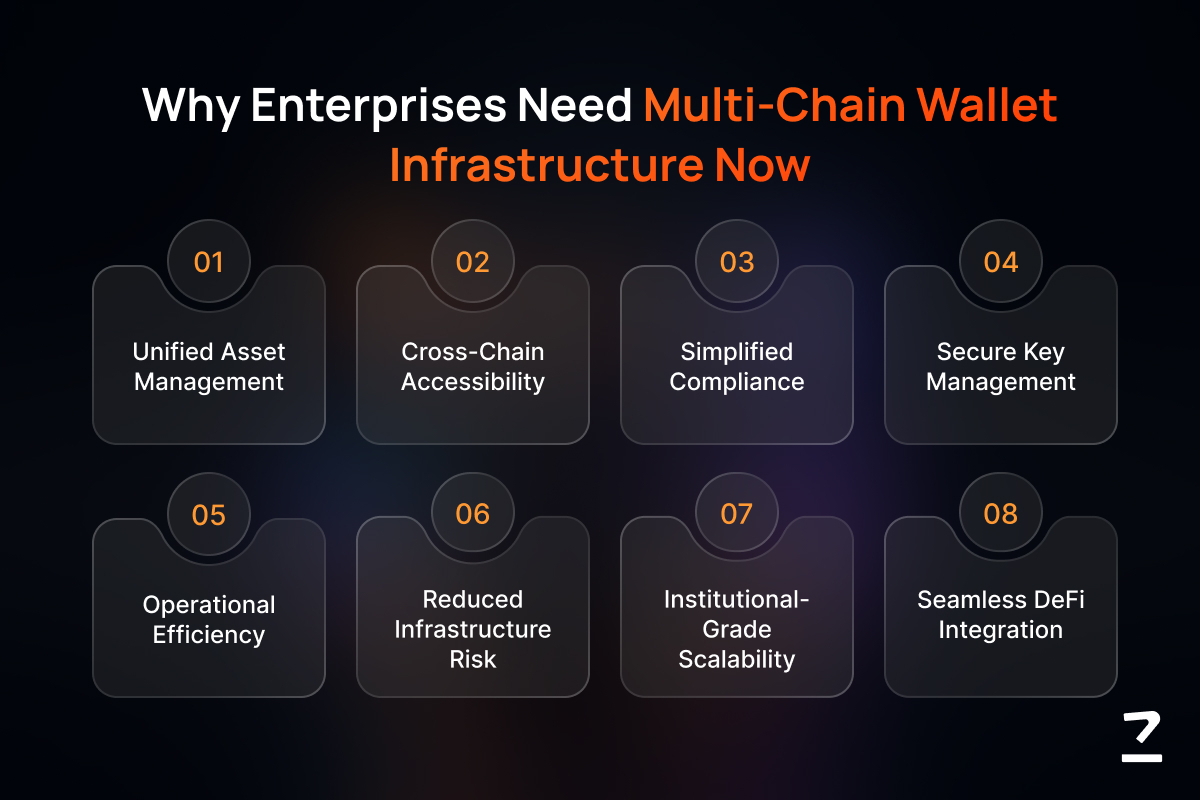
The multi-chain reality is not theoretical. Digital assets are distributed across dozens of active networks. An exchange might custody assets on Ethereum, process stablecoin settlements on Polygon, run token operations on Solana, and interact with DeFi protocols on multiple Layer 2 chains simultaneously.
Handling this across separate systems creates serious operational risk. Key management becomes fragmented, audit trails break down, and compliance reporting turns into a manual exercise. A unified blockchain cryptocurrency wallet platform solves all of this at the infrastructure level.
Beyond operational efficiency, multi-chain wallet infrastructure is now a competitive requirement. Institutional clients, DeFi platforms, tokenized asset issuers, and Web3 applications expect wallet solutions that meet them where their assets already live. Organizations that cannot offer seamless cross-chain asset management will find themselves losing ground to those that can.
Custody Models: Custodial, Non-Custodial, MPC, and Multi-Signature
Choosing the right custody model is the most consequential architectural decision in enterprise wallet development. There is no universally correct answer the right model depends on your regulatory context, operational structure, and risk tolerance.
Custodial Wallets
In a custodial wallet model, the wallet provider or platform holds and manages private keys on behalf of users. This simplifies the user experience and allows for account recovery, but it introduces a single point of trust and potential regulatory liability. Many centralized exchanges use this model.
Non-Custodial Wallets
A non-custodial wallet gives users or organizations full control over their private keys. No third party can access funds without the key holder's authorization. This model aligns with self-sovereignty principles and reduces counterparty risk, but it places the full burden of key management on the enterprise. Seed phrase loss equals permanent asset loss.
MPC (Multi-Party Computation) Wallets
MPC wallet development is increasingly the preferred model for institutional use. Instead of a single private key that can be stolen or lost, MPC distributes signing authority across multiple parties. No single participant ever holds the complete key. Transactions require a threshold of parties to cooperate to sign, making compromise significantly harder without sacrificing operational speed. This approach is central to enterprise crypto custody solutions at scale.
Multi-Signature Wallets
Multi-signature wallet development requires multiple pre-authorized parties to approve transactions before execution. It is a well-established security pattern for treasury operations, where a transaction might need CFO approval plus a treasury manager before funds move. Multi-sig wallets provide clear audit trails and are well-suited for governance-heavy workflows, though they introduce latency compared to MPC.
Many enterprise blockchain wallet solutions combine MPC for signing infrastructure with multi-signature policy layers for governance giving organizations both speed and control.
Core Architecture of an Enterprise Multi-Chain Wallet
A production-grade enterprise wallet is not a single application. It is an interconnected set of components, each serving a distinct function within the broader wallet orchestration system.
Key architectural layers include:
-
Signing Infrastructure: Manages private key material using MPC, HSMs (Hardware Security Modules), or secure enclaves. This is the security foundation.
-
Node Infrastructure: Maintains or connects to dedicated nodes for each supported blockchain. Node reliability directly affects transaction confirmation speed and data accuracy.
-
API Gateway: Exposes wallet functionality to internal systems, external dApps, and third-party integrations through secure, authenticated endpoints.
-
Policy Engine: Enforces transaction rules spend limits, approval workflows, whitelist addresses, and role-based access control. This is what makes a wallet enterprise-ready.
-
Compliance Module: Integrates KYC/AML screening, transaction monitoring, sanctions checking, and regulatory reporting. This layer connects to providers like Chainalysis or Elliptic for on-chain analytics.
-
Admin and Analytics Dashboard: Gives operations teams full visibility into wallet activity, user permissions, transaction history, and portfolio performance across all chains.
-
Disaster Recovery System: Ensures that signing credentials and wallet state can be recovered in the event of infrastructure failure without exposing keys.
Each layer needs to be designed with both security and operational continuity in mind from day one.
Blockchain Network Selection and Interoperability
Deciding which blockchain networks your wallet supports is a strategic choice, not just a technical one. Every network added increases the complexity of node management, signing logic, and testing scope.
Commonly supported networks in enterprise multi-chain wallets:
-
Ethereum the dominant smart contract platform with the widest DeFi and token ecosystem
-
Bitcoin essential for institutional custody and treasury operations
-
Solana high throughput, low fees; important for payments and high-frequency applications
-
BNB Chain strong retail and DeFi user base
-
Polygon and other EVM-compatible chains easier to integrate because they share Ethereum's smart contract standards
-
Layer 2 networks (Arbitrum, Optimism, Base) increasingly important for cost-efficient transaction execution
EVM-compatible chains share the same address format and smart contract logic, which reduces integration overhead significantly. Non-EVM chains like Bitcoin and Solana require dedicated signing and node infrastructure, which adds development time but opens access to critical networks.
Cross-chain asset management also requires careful consideration of bridging infrastructure. Cross-chain bridges introduce smart contract risk, so enterprise wallets should implement bridge transaction monitoring and limit which bridges are whitelisted for use.
Must-Have Features for Enterprise Crypto Wallets
When evaluating what to build, enterprise decision-makers often underestimate how different a business wallet is from a consumer application. The following features are not optional they define whether a wallet can operate at institutional standards.
Core Enterprise Wallet Features:
-
Role-Based Access Control (RBAC): Define granular permissions for traders, treasury managers, compliance officers, and administrators
-
Multi-Signature and Approval Workflows: Require multiple authorized parties to sign large or sensitive transactions
-
Transaction Policy Engine: Set automated rules for spend limits, destination whitelisting, and time-based restrictions
-
KYC/AML Integration: Screen counterparties against sanctions lists and flag suspicious activity in real time
-
Audit Trails and Reporting: Immutable logs of all wallet activity, exportable for regulatory reporting
-
Portfolio and Analytics Dashboard: Real-time visibility into holdings, valuations, and transaction history across all supported chains
-
Cold and Warm Wallet Tiers: Segregate active operational funds from long-term holdings with different security configurations
-
Account Abstraction Support: Simplify user interactions on EVM chains with smart contract wallets and programmable transaction logic
-
DeFi Protocol Access: Enable direct interaction with decentralized exchanges, lending protocols, and staking without leaving the wallet interface
-
Hardware Security Module (HSM) Integration: Secure key storage meeting institutional custody standards
-
Multi-Currency and Token Support: Handle ERC-20, SPL, BEP-20, and native tokens without custom workarounds
-
Disaster Recovery and Key Backup Protocols: Documented and tested procedures for wallet recovery without key exposure
Security Best Practices for Multi-Chain Wallet Development
Security is where enterprise multi-chain wallets succeed or fail. A vulnerability in signing infrastructure, smart contract logic, or API access controls can result in catastrophic, irreversible losses.
Non-negotiable security practices:
-
Independent Smart Contract Audits: All on-chain logic must be reviewed by third-party security firms before deployment
-
Penetration Testing: Simulate real-world attacks on API endpoints, admin interfaces, and signing infrastructure
-
Encrypted Key Storage: Private key material must never exist in plaintext at any point in its lifecycle
-
Two-Factor and Biometric Authentication: Combine authentication factors for all administrative access
-
Transaction Simulation Before Execution: Simulate outcomes before signing to detect anomalies and prevent accidental or malicious transfers
-
Anomaly Detection and Transaction Monitoring: Integrate on-chain analytics to flag unusual patterns in real time
-
Secure Development Lifecycle (SDL): Code reviews, dependency scanning, and security testing at every stage of development
-
Incident Response Plan: Define clear escalation paths, communication protocols, and rollback procedures
The attack surface of a multi-chain wallet grows with every additional network supported. Consistent security standards must apply across all chains, not just the primary one.
Step-by-Step Multi-Chain Crypto Wallet Development Process
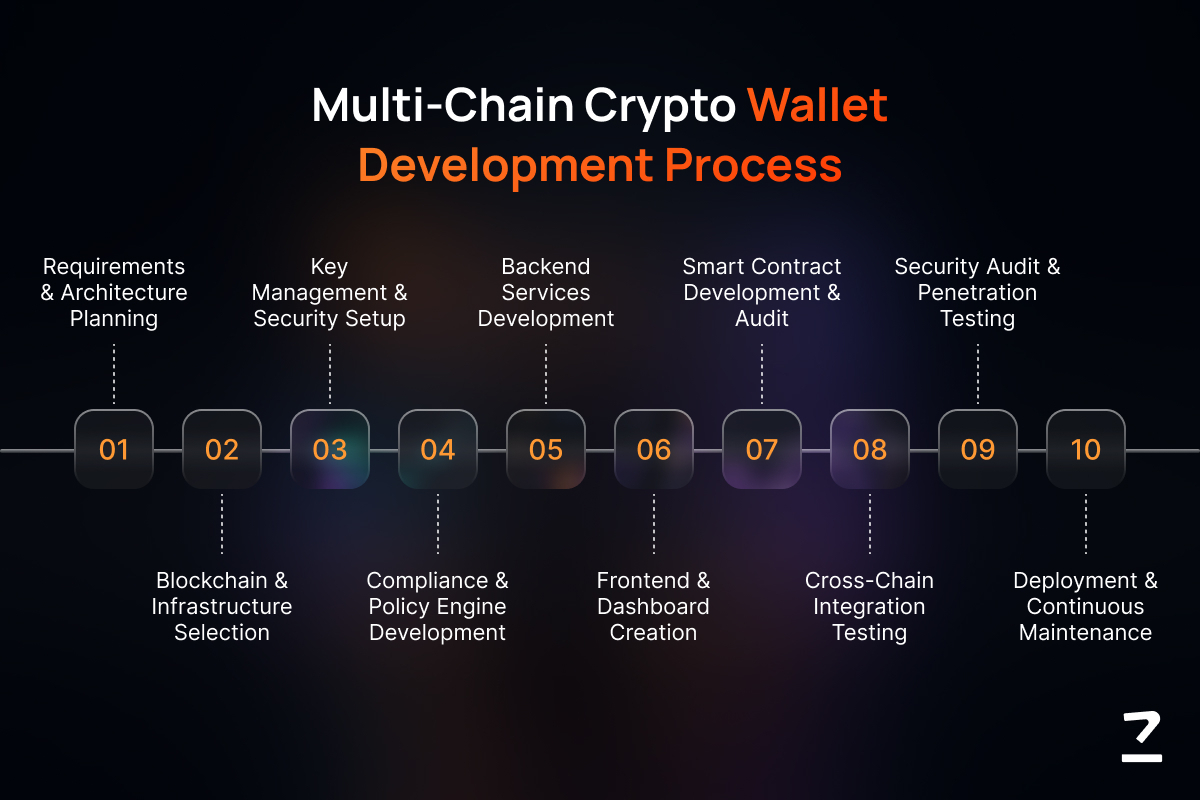
Building a production-ready enterprise multi-chain wallet requires a structured process. Rushing any phase introduces technical debt and security risk that is expensive to fix later.
Step 1: Requirements Definition and Architecture Planning
Map out supported chains, custody model, compliance requirements, integration points, and user types. Document the full feature scope before writing a line of code.
Step 2: Select Blockchain Networks and Infrastructure Approach
Decide between self-hosted nodes, third-party node providers (like Alchemy or Infura), or a hybrid model. Define the API and SDK stack Web3.js, Ethers.js, or chain-specific SDKs.
Step 3: Design Signing and Key Management Infrastructure
Implement MPC, HSM integration, or multi-sig depending on your custody model. This component requires the most rigorous security engineering and should never be built quickly.
Step 4: Build the Policy Engine and Compliance Module
Develop transaction approval workflows, RBAC, spend limits, and KYC/AML integrations. Connect to transaction monitoring providers for on-chain analytics.
Step 5: Develop Backend Services
Build out blockchain node connectors, transaction processors, event listeners, and data storage. Design for high availability and horizontal scaling.
Step 6: Build Frontend and Admin Interface
Develop the user-facing wallet UI and the operations dashboard. Prioritize clarity, speed, and role-appropriate information hierarchy.
Step 7: Smart Contract Development and Audit
For EVM chains, write and deploy smart contract wallet logic. Engage a specialist firm for formal audit before any mainnet deployment.
Step 8: Integration Testing Across All Chains
Test every supported network under realistic transaction loads. Simulate failure scenarios for node outages, rejected transactions, and key recovery.
Step 9: Security Audit and Penetration Testing
Commission independent audits of the full system not just smart contracts. Remediate all critical and high-severity findings before launch.
Step 10: Staged Deployment and Ongoing Maintenance
Deploy to testnet, then limited mainnet, then full production. Establish a clear maintenance roadmap with protocol upgrade monitoring, security patches, and feature releases.
Multi-Chain Crypto Wallet Development Timeline and Cost Drivers
The cost and timeline to build a multi-chain crypto wallet vary based on feature scope, security architecture, blockchain coverage, compliance requirements, and delivery model.
For a standard multi-chain crypto wallet in 2026, development typically costs between $40,000 and $100,000, with an estimated timeline of 8–16 weeks. However, if the wallet is built for enterprise-grade use cases with MPC, multi-signature approvals, advanced compliance workflows, admin controls, and institutional security layers, the budget and timeline can increase substantially.
Primary cost drivers include:
-
Number of supported blockchain networks
-
Feature set and product complexity
-
Custody model complexity, including MPC or multi-signature implementation
-
Compliance and KYC/AML integration depth
-
Smart contract scope and external audit requirements
-
Infrastructure choices, such as self-hosted nodes or managed providers
-
Security testing, audit remediation, and monitoring setup
-
Team location and development model
-
Post-launch maintenance and protocol upgrade support
These figures are best treated as benchmarks, not fixed prices. Working with an experienced Wallet Development Company early in the planning stage helps define scope accurately, reduce rework, and align the solution with enterprise security and compliance expectations.
Common Mistakes Enterprises Make Wallet During Development
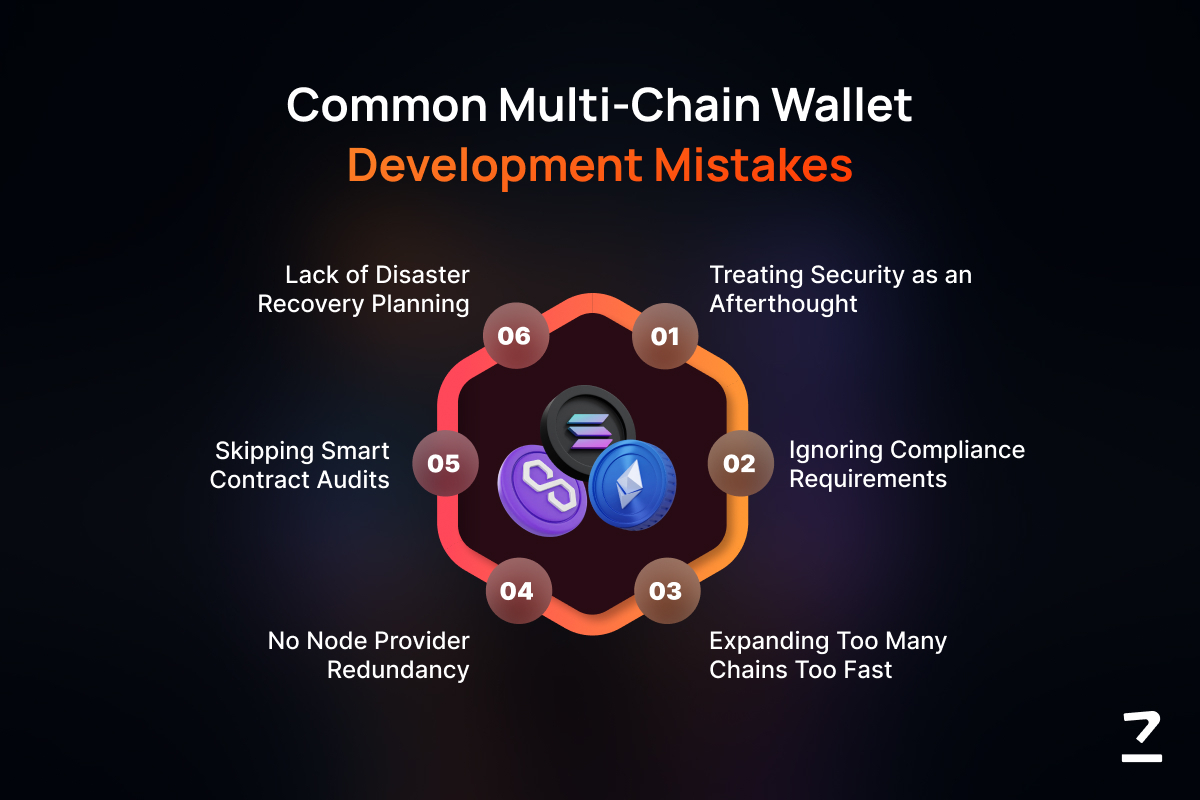
Understanding what goes wrong in enterprise wallet projects saves significant time and money.
-
Treating security as a phase, not a principle. Security that is retrofitted after development is far less effective than security built into every layer from the start.
-
Underestimating compliance complexity. KYC/AML requirements differ by jurisdiction. Building this in later almost always requires rearchitecting core workflows.
-
Choosing too many chains too soon. Starting with five well-supported chains and a solid architecture is more valuable than twelve chains with fragile node infrastructure.
-
Using shared node providers without redundancy. A single third-party node provider outage should not take down your entire wallet. Build for redundancy.
-
Skipping formal smart contract audits to save cost. The cost of an audit is a fraction of the cost of a post-launch exploit.
-
Building without a disaster recovery plan. Key material recovery and business continuity planning must be tested before go-live, not designed after a failure.
How to Choose a Wallet Development Partner
Selecting a cryptocurrency wallet development company for an enterprise project is not the same as hiring a general software agency. The stakes both financial and reputational aspects, are considerably higher.
Evaluate partners on these criteria:
-
Demonstrated blockchain experience: Review actual delivered projects, not just claimed capabilities. Ask for case studies with specifics.
-
Security engineering depth: Confirm the team has in-house expertise in cryptographic key management, smart contract security, and secure API design.
-
Compliance and regulatory knowledge: Enterprise wallets need developers who understand AML frameworks, data privacy requirements, and institutional custody standards.
-
Architecture transparency: A strong partner explains their approach clearly and helps you understand the tradeoffs, not just the deliverables.
-
Post-launch support commitment: Protocol upgrades, security patches, and regulatory changes require ongoing maintenance. Confirm this is part of the engagement.
-
Communication and delivery process: Enterprise projects run for months. A partner with structured delivery, clear milestones, and transparent reporting reduces risk significantly.
Engaging a blockchain crypto wallet consulting service before committing to full development helps validate your requirements and identify architectural risks early. This initial investment frequently prevents expensive redesigns later.
Partner with Codezeros for Enterprise Blockchain Wallet Solutions
Codezeros is a purpose-built blockchain wallet development company focused on enterprise-grade digital asset infrastructure. Our team brings deep expertise in multi-chain wallet architecture, MPC and multi-signature signing systems, compliance integration, and institutional security engineering.
We work with exchanges, fintech platforms, Web3 startups, and digital asset businesses to design and deliver custom cryptocurrency wallet development services that match their operational requirements, not off-the-shelf templates adapted under pressure.
Our approach starts with architecture, not just code. As a blockchain crypto wallet consulting service, we engage your team at the requirements stage to define the right custody model, compliance architecture, and technical stack before development begins. This reduces rework, controls cost, and delivers a production system your organization can rely on.
If you are evaluating enterprise crypto wallet development services or planning a multi-chain wallet infrastructure build, we are ready to help you define the roadmap.
Connect us to talk about your enterprise wallet project. Let us review your requirements and propose a secure, scalable architecture that fits your business.
Post Author

Deep Shah
Explore Deep's insightful blog posts that help businesses stay ahead of the curve, explore new possibilities, and unlock the full potential of blockchain technology
Frequently Asked Questions
Frequently asked questions about this article.
Build a Secure Multi-Chain Wallet With Codezeros
Looking for reliable wallet development services for your enterprise, fintech platform, or Web3 product? Codezeros helps you plan and build secure, scalable multi-chain wallet infrastructure with the right architecture, custody model, compliance workflows, and security-first execution.
Blogs
Our Latest Blogs
Discover valuable industry insights and stay up-to-date with the latest updates by exploring our curated collection of recent blog posts.


Let us know your requirement
We know ideas matter, we are the product of one. We Provide Full Assistance In Your Business