

SHARE THIS ARTICLE
28 May 2026
How Much Does It Cost to Build a Real Estate Tokenization Platform in 2026?

Executive Summary
In 2026, real estate tokenization has evolved from a blockchain proof of concept into a regulated solution powering institutional asset management, REIT operations, and large-scale property syndication. As compliance standards mature and institutional participation accelerates, platform buyers face greater scrutiny around legal risk, operational resilience, and technical trustworthiness.
The cost to build a real estate tokenization platform is no longer a theoretical discussion; it is a practical question of regulatory scope, feature depth, and institutional-grade security requirements. This expert analysis draws on firsthand insights, industry cost benchmarks, and recent regulatory updates to unpack true pricing drivers.
Leaders evaluating token development services will find a holistic view of infrastructure options, cost frameworks, feature requirements, and the operational realities involved in launching or acquiring a compliant, scalable real estate asset platform in today’s institutional market.
The Real Estate Tokenization Opportunity in 2026
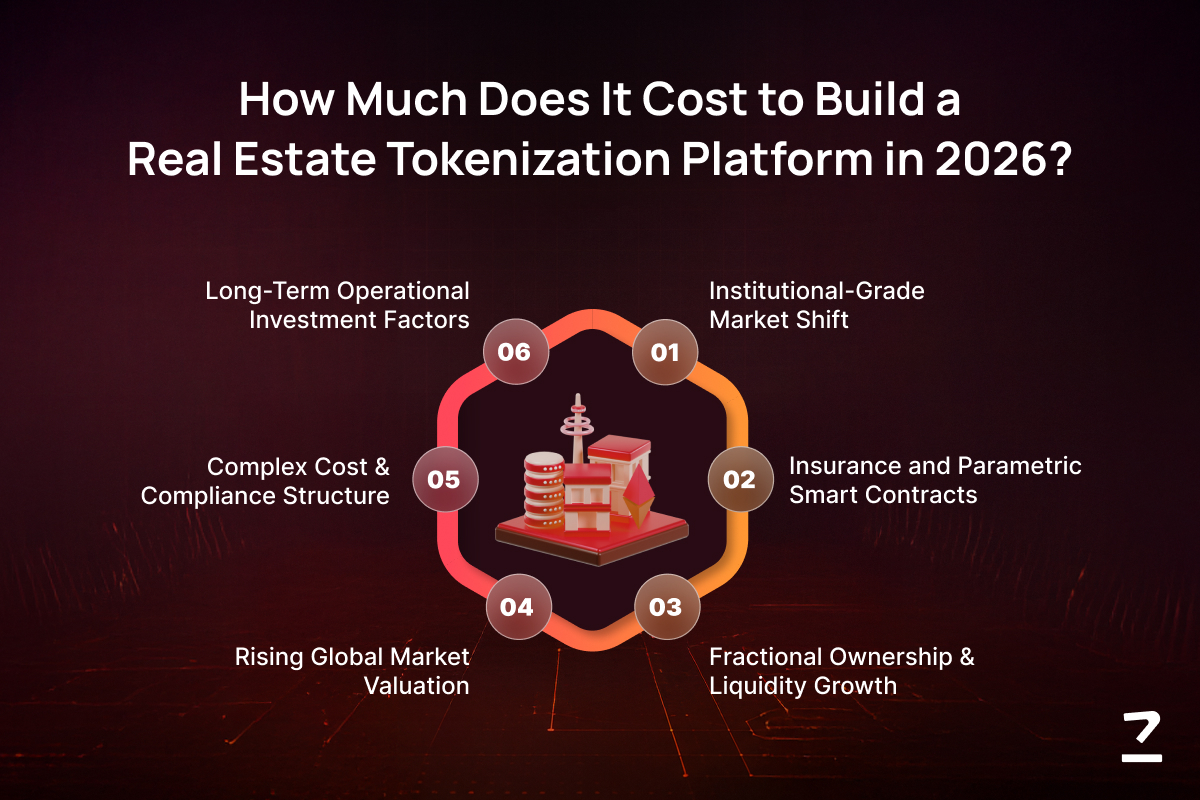
In 2026, real estate tokenization has rapidly transitioned from a nascent blockchain experiment to an institutional-grade financial product reshaping global asset management. The sector is not defined by ambitious pilots; it is now characterized by regulated deployments, institutional capital inflows, and frameworks like EU MiCA, SEC, and MAS actively shaping compliance standards.
Asset managers, REITs, and global investment firms are accelerating adoption to tap trillions in new liquidity and fractionalize commercial property portfolios. This transformation brings not only significant opportunities but also immediate pressure to navigate complex legal regimes, address deep due diligence demands, and deliver bulletproof technical infrastructure.
Understanding the real estate tokenization platform development cost is now a boardroom priority driven by regulatory scrutiny, operational resilience, and the need for compliant, investment-grade token solutions backed by industry best practices and live project benchmarks worldwide.
Real estate tokenization platform development transforms physical properties into blockchain-based digital assets. This process enables fractional ownership, enhanced liquidity, and 24/7 global trading capabilities.
In 2025, the global tokenization market was valued between $2.5 and $3.5 billion. However, industry projections indicate explosive growth, with the market expected to reach $16 to $18 trillion by 2030. This represents a compound annual growth rate of 19.8%, driven by institutional adoption and regulatory clarity through frameworks like the EU's MiCA and updated U.S. SEC guidelines.
When evaluating token development companies for real estate tokenization, institutional buyers and project sponsors must look far past just software engineering costs.
The true cost to build and operate a real estate tokenization platform arises from a complex matrix of factors, including multi-jurisdictional compliance frameworks, secure custodial infrastructure for asset-backed token management, integrated secondary market liquidity mechanisms, robust investor onboarding (KYC/AML) workflows, and scalable cap table automation.
Decision-makers also need to analyze long-term operational expenditures like ongoing regulatory updates, audit cycles, compliance monitoring, and investor support systems which often add 30-50% to the initial build budget. High-performing, institutional-grade platforms require a holistic infrastructure that seamlessly supports regulatory reporting, stablecoin settlement, cap table transparency, and continuous custody/security monitoring.
Thus, capital allocation and risk assessment must be driven by a comprehensive due diligence approach that evaluates not only code quality, but also the full spectrum of compliance architecture, operational scalability, and resilience to regulatory and technical change.
Real Estate Tokenization Platform Cost Breakdown: Expert Benchmarks & Feature-Wise Pricing Framework
To accurately estimate the development cost of a real estate tokenization platform in 2026, it’s essential to use a granular, feature-level cost-modeling framework.
The following analysis provides a comprehensive breakdown of expenses across major architectural components: core feature sets, blockchain protocol selection, compliance and legal infrastructure, security requirements, third-party integrations, and ongoing operational factors.
This approach equips institutional buyers and project sponsors with the necessary insights to make informed, risk-aware decisions when budgeting for platform build-out and long-term scalability.
Blockchain Infrastructure and Smart Contract Implementation
Smart contracts act as the digital engine of your platform. They automate token issuance, enforce ownership transfers, and manage profit distributions without requiring manual intermediaries.
The smart contract development cost for tokenization typically ranges from $8,000 to $25,000 for standard ERC-20 or ERC-1400 implementations. If you require advanced modular architecture where token issuance, dividend distribution, and property management are separated for easier upgrades, initial development may cost between $15,000 and $30,000.
Deploying on cost-efficient Layer 2 networks like Polygon or Binance Smart Chain adds $10,000 to $20,000 to the setup cost but reduces ongoing transaction fees by up to 90% compared to the Ethereum mainnet.
Compliance and Legal Framework Requirements
RWA tokenization development services are generally classified as securities. Therefore, navigating real estate tokenization compliance costs is non-negotiable. Compliance infrastructure typically consumes 20% to 30% of total platform budgets.
-
Automated KYC/AML Integration: $3,000 to $10,000 for AI-driven identity verification systems.
-
Initial Legal Consultation and Structuring: $15,000 to $30,000 to navigate local securities laws.
-
Multi-Jurisdiction Support: Targeting the U.S., EU, and Asia simultaneously can increase compliance costs by over 50%.
-
Ongoing Reporting Systems: $5,000 to $10,000 for automated compliance monitoring tools.
User Interface and Integration Development
A high-performing property tokenization platform development project demands an intuitive front-end experience. Investor dashboards, administrative control panels, and seamless wallet connectivity dictate user adoption.
Basic, template-driven interfaces cost between $5,000 and $10,000. Custom enterprise interfaces with advanced analytics cost $20,000 to $40,000.
You must also budget for essential third-party integrations:
-
Fiat Payment Gateways (e.g., Stripe): $5,000 to $10,000
-
Blockchain Wallet Connectivity: $3,000 to $7,000
-
Digital Identity Providers: $5,000 to $8,000
Security Infrastructure and Testing Protocols
Security represents 10% to 15% of the total blockchain real estate platform development cost. The catastrophic losses seen in historical blockchain exploits highlight the necessity of professional security auditing.
A thorough smart contract security audit ranges from $5,000 to $15,000. Penetration testing adds another $5,000 to $10,000, while infrastructure hardening (server security and DDoS protection) requires $3,000 to $8,000. These investments provide essential investor confidence and satisfy regulatory mandates.
Tokenization Platform Cost Comparison: Custom Development vs. White Label vs. STO Scripts Making the Right Choice
When evaluating real estate tokenization platform development, buyers typically weigh three architectural strategies like custom development, white-label platforms, and STO script-based solutions.
Each presents distinct trade-offs in total cost, compliance flexibility, scalability, speed to market, and long-term control. Understanding how these options align with your regulatory footprint, technical ambitions, and operational priorities is essential to making an informed investment that balances initial outlay, future adaptability, and sustainable platform ownership.
Custom Development: Complete Control
A custom real estate tokenization platform provides ultimate flexibility and intellectual property ownership. This approach requires an investment of $100,000 to $300,000+ and takes 6 to 12 months to deploy. It perfectly suits enterprise real estate tokenization solutions that require unique features, complex DeFi integrations, or proprietary compliance logic.
White Label Solutions: Rapid Deployment
A white label real estate tokenization platform offers pre-built, compliance-ready infrastructure. Costs typically range from $25,000 to $50,000, with a fast 1 to 3 month market entry timeline. While branding customization has boundaries, this method delivers proven, pre-audited smart contracts and cuts development costs by 40% to 60%.
STO Script Solutions: Entry-Level Testing
For startups validating market demand, STO scripts offer an economical entry point starting between $10,000 and $25,000. Deployment happens in weeks. However, scalability limits and basic feature sets make this approach better suited for proof-of-concept pilots rather than long-term commercial operations.
Hidden and Underestimated Costs in Real Estate Tokenization Platform Development and Operations
A significant source of budget overruns in real estate tokenization platforms stems from hidden and underestimated costs. Many projects encounter unexpected expenses not accounted for in initial build estimates—including regulatory updates, audit cycles, cloud infrastructure, and operational overhead.
From an expert perspective, total cost of ownership must be modeled holistically, factoring in post-launch compliance maintenance, security updates, support obligations, and scaling costs. Failure to look beyond up-front development often leads to funding gaps and operational setbacks.
Both founders and enterprise sponsors are strongly advised to pressure-test cost models and budget for the 30% to 50% overhead that post-launch realities inevitably bring.
Blockchain Transaction and Infrastructure Expenses
Platform operators must account for server hosting, cloud infrastructure, and database management, which total $4,500 to $18,000 annually. Furthermore, network updates or protocol hard forks require node adaptation, costing $2,000 to $5,000 per major update.
Ongoing Maintenance and Platform Updates
Annual maintenance demands roughly 10% to 20% of your initial development investment. This includes security patches ($3,000 to $8,000), smart contract audits for new features ($5,000 to $15,000), and compliance adaptations ($10,000 to $20,000) as regulations like MiCA Phase 2 take effect.
Security and Insurance Contingencies
Even robust token development services face unforeseen contingencies. Maintaining redundancy setups for disaster recovery, executing emergency smart contract patching, and paying insurance premiums for tokenized asset coverage adds $4,000 to $10,000 to your annual operational budget.
Real Estate Tokenization Platform Pricing Model: Revenue and ROI Strategies
Understanding the cost breakdown for real estate tokenization platform development is only half the equation. You must also evaluate revenue generation.
Transaction and Listing Fees
Platforms generally charge 1% to 2% transaction fees on secondary market trades. Additionally, property listing fees range from $5,000 to $20,000 per tokenized asset. For a platform managing $1 million in assets under management, transaction and asset management fees create a stable, recurring cash flow.
ROI Projections
-
Basic MVP platforms: 18 to 24 months to break even.
-
Mid-tier platforms: 12 to 18 months, assuming 5 to 10 active tokenized properties.
-
Enterprise platforms: 12 to 15 months, heavily reliant on institutional partnerships and high trading volumes.
Actionable Cost Optimization Strategies and Deployment Planning for Real Estate Tokenization Platforms in 2026
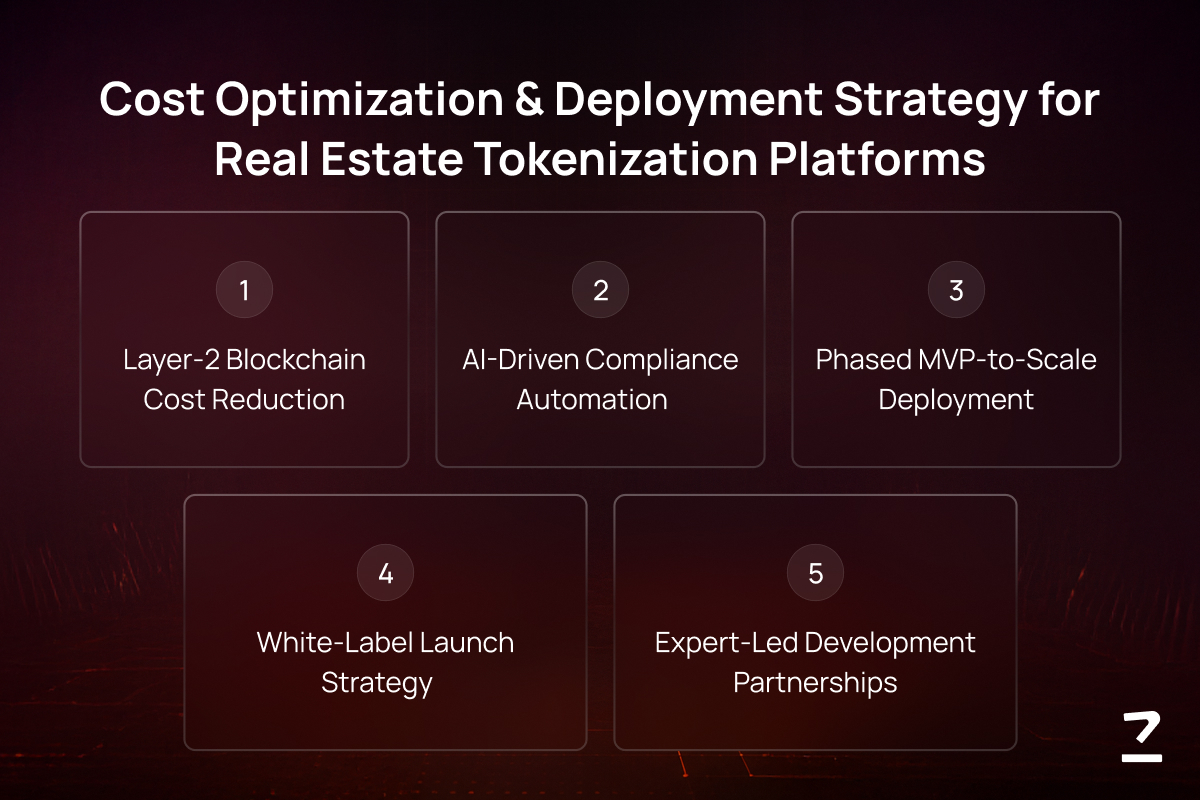
The following roadmap outlines actionable strategies to reduce real estate tokenization platform development costs while maintaining regulatory compliance, robust security, and long-term scalability. These practical recommendations are designed to help decision-makers allocate resources efficiently, avoid common budgetary pitfalls, and achieve project objectives without compromising on quality or resilience.
-
Use Layer-2 Networks: Launch on Polygon or Arbitrum to compress transaction and deployment costs by 15% to 20% compared to traditional Ethereum builds.
-
Leverage AI Tools: Implement AI-assisted compliance tools to reduce manual KYC review overhead.
-
Phase Your Deployment: Start with a white-label MVP to prove market fit, then reinvest initial revenues into custom feature development.
-
Partner with Experts: Work with an experienced token development company like Codezeros to avoid trial-and-error delays.
ERC-3643 vs. ERC-1400: Which Smart Contract Standard Is Best for Real Estate Tokenization?
In 2026, both ERC-3643 and ERC-1400 are widely adopted smart contract standards for real estate tokenization, but they address compliance, transfer controls, and platform interoperability with notable differences.
ERC-3643 is engineered with integrated on-chain compliance modules, enabling dynamic regulatory rule-setting, granular transfer restrictions based on real-time KYC and regional frameworks, and seamless interoperability across multi-chain tokenization platforms—a key advantage for enterprises operating in highly regulated or multi-jurisdictional environments.
In contrast, ERC-1400 provides robust modularity and foundational support for security tokens but is less flexible when it comes to real-time regulatory logic updates or automated whitelist management. For institutional buyers building regulated real-world asset (RWA) platforms, ERC-3643 offers a future-proof, compliance-native foundation, while ERC-1400 remains a proven choice for projects with well-defined investor bases and static compliance requirements.
Deciding between them ultimately depends on the complexity of your compliance workflows, your secondary market ambitions, and your need for automated jurisdictional controls as part of evolving regulatory obligations.
Cost Comparison by Blockchain: Ethereum vs. Polygon vs. BSC vs. Private Networks
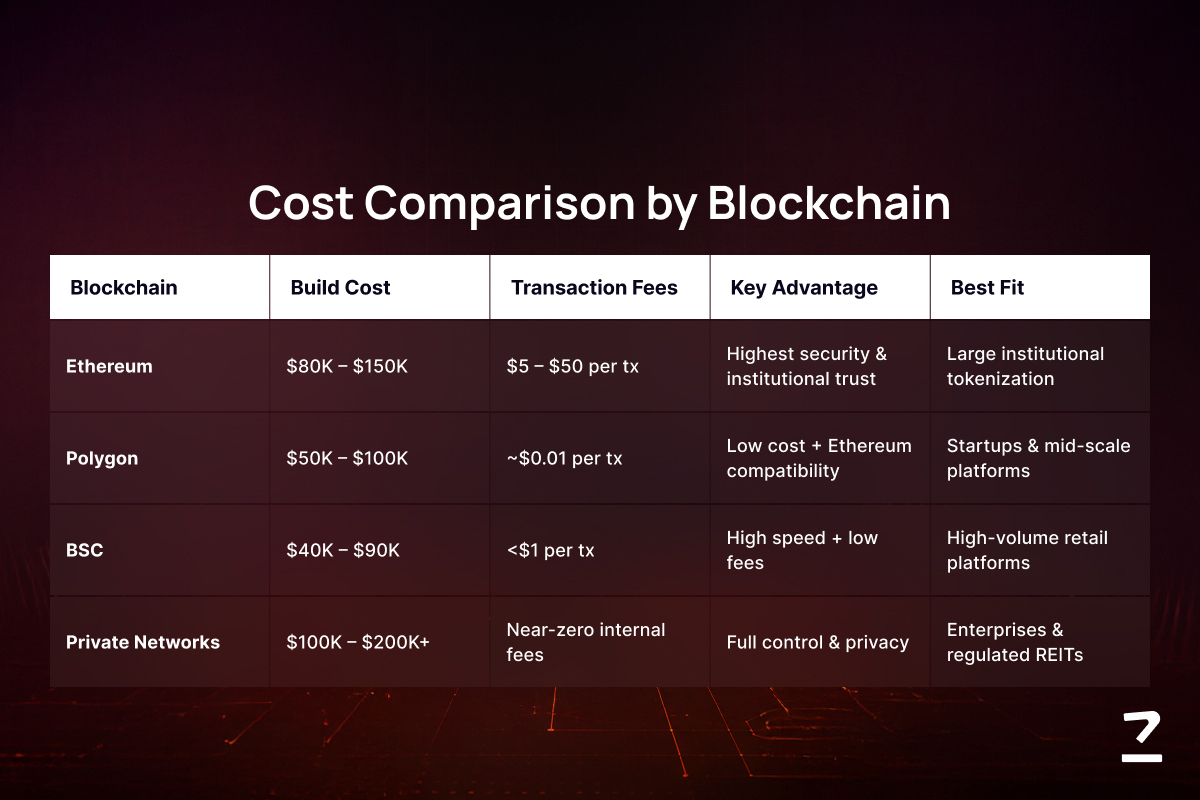
In 2026, the choice of blockchain network dramatically shapes total platform cost, compliance options, and long-term scalability for real estate tokenization projects. Ethereum remains the institutional benchmark for security and compliance, but its high development costs (often $80,000–$150,000) and elevated transaction fees ($5–$50 per trade) can constrain retail adoption and high-frequency trading.
Polygon, as a leading Layer-2 Ethereum-compatible solution, sharply reduces both initial build costs (typically $50,000–$100,000) and transaction fees (as low as $0.01), offering rapid settlement and strong scalability, making it the preferred network for startups and mid-sized platforms seeking cost efficiency without sacrificing ecosystem trust.
Binance Smart Chain (BSC) delivers even lower average transaction costs and development complexity—with network fees averaging under $1—while supporting fast issuance cycles and high throughput, though its compliance tooling and institutional track record may lag behind Ethereum for highly regulated deployments.
Private or permissioned blockchains (e.g., Hyperledger Fabric) provide maximum regulatory control, privacy, and customizable governance, serving large enterprises or cross-border REITs with defined investor rosters, but often demand $100,000–$200,000+ in specialized development and maintenance, and may face integration barriers with public liquidity venues.
Ultimately, Ethereum leads for institutional-grade tokenization where compliance and ecosystem depth are critical; Polygon and BSC offer scalability and economic efficiency for next-gen property marketplaces; and permissioned solutions fit organizations prioritizing privacy, multi-region compliance, and bespoke governance at scale.
Team Composition, Hourly Rate Benchmarks, and Delivery Model Impact on Platform Cost
Team composition plays a pivotal role in shaping the cost and risk profile of real estate tokenization platform development in 2026. A typical high-performing project requires a multidisciplinary team including blockchain developers (smart contract and protocol specialists), backend and frontend engineers, UI/UX designers, QA experts for thorough testing, DevOps professionals for secure deployment and scaling, compliance specialists to architect regulatory flows, and legal advisors for jurisdictional analysis and investor protection.
Cost and delivery risk also vary based on whether you choose offshore, nearshore, or in-house team models. Offshore development (such as teams in India or Eastern Europe) can reduce hourly rates by 30–50%, but may introduce risks around communication, code quality, and regulatory expertise.
Nearshore models offer closer time zone alignment with moderate cost savings and often stronger oversight. In-house teams provide the highest levels of institutional knowledge, ongoing support, and control over IP, but command premium rates and require greater upfront investment in recruitment and long-term retention.
For institutional buyers or larger projects, a blended model—combining global engineering resources with local compliance and legal experts—often achieves both budget efficiency and regulatory confidence, while mitigating execution risk across critical platform milestones.
Get Your Custom Real Estate Tokenization Platform Cost Estimate or MVP Roadmap
The real estate tokenization platform development cost in 2026 spans a wide spectrum, from $15,000 MVP validations to $300,000+ custom enterprise ecosystems. Success in this rapidly expanding market requires strategic alignment between your budget, regulatory mandates, and business objectives.
Building a compliant, secure platform demands comprehensive financial planning that accounts for smart contract development, advanced security audits, and hidden maintenance expenses. White-label solutions present a highly efficient route for rapid market entry, while custom builds offer the proprietary control needed for global scale. By partnering with an expert token development company and prioritizing regulatory compliance from day one, you position your business to lead the transformation of global property investment.
If you are evaluating a real estate tokenization platform for your organization—or seeking clarity on overall ROI, architecture, or regulatory requirements—our team is available to provide a custom cost estimate, tailored MVP roadmap, or technical architecture consultation.
Connect us to receive a detailed assessment mapped to your business needs, deployment priorities, and compliance obligations.
Post Author

Paritosh Mehta
As a distinguished blockchain expert at Codezeros, Paritosh contributes to the company's growth by leveraging his expertise in the field. His forward-thinking mindset and deep industry knowledge position Codezeros at the forefront of blockchain advancements.
Frequently Asked Questions
Frequently asked questions about this article.
Get a Custom Real Estate Tokenization Platform Cost Estimate
Planning to launch a secure and compliant real estate tokenization platform in 2026? Our blockchain and RWA specialists help enterprises, REITs, startups, and asset managers estimate development costs, define compliance architecture, and build scalable tokenization ecosystems tailored to institutional standards. From ERC-3643 smart contracts and KYC/AML integration to marketplace infrastructure and multi-chain deployment, we deliver end-to-end tokenization solutions aligned with your business model, regulatory requirements, and growth roadmap. Connect with our experts to receive a customized cost estimate, MVP strategy, and technical consultation for your tokenized real estate platform.
Blogs
Our Latest Blogs
Discover valuable industry insights and stay up-to-date with the latest updates by exploring our curated collection of recent blog posts.


Let us know your requirement
We know ideas matter, we are the product of one. We Provide Full Assistance In Your Business