

SHARE THIS ARTICLE
03 Jul 2026
How Cross-Chain Development Is Revolutionizing DeFi and NFTs
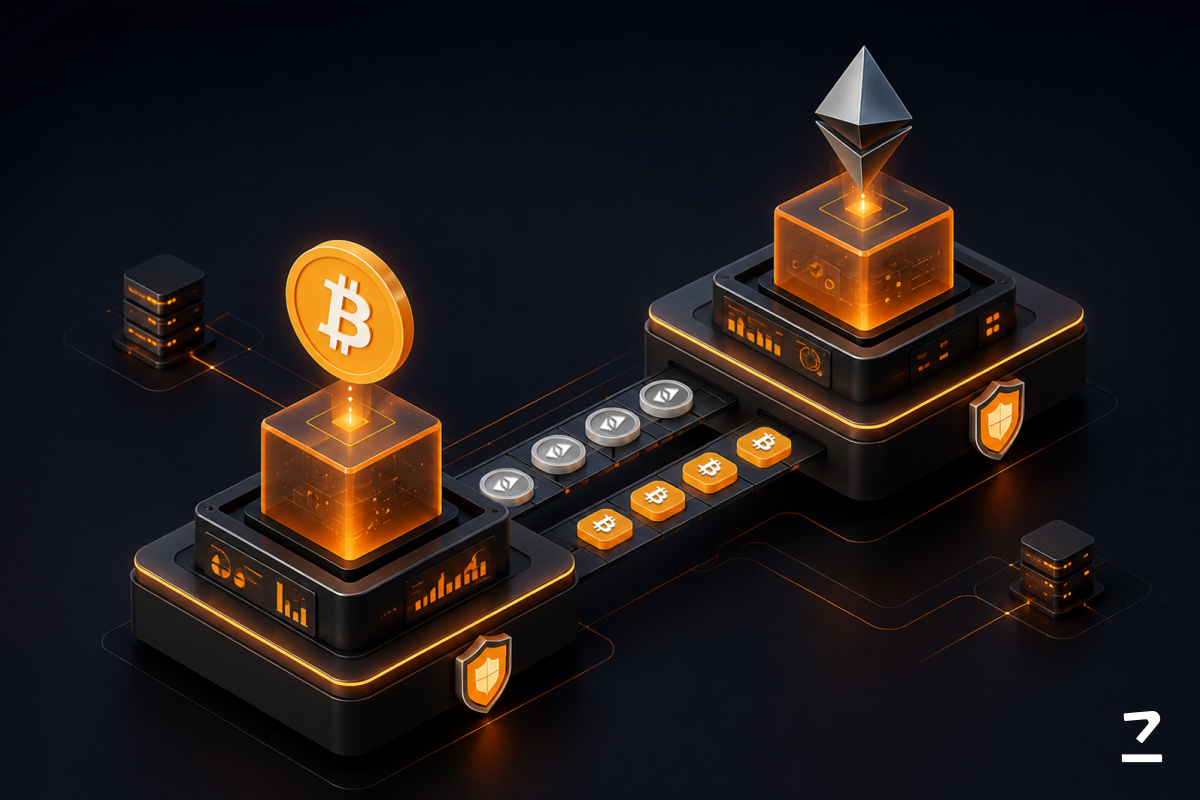
Summary: Single-chain DeFi and NFT projects hit a wall the moment liquidity fragments and gas costs spike. Cross-chain development connects isolated blockchains so assets, data, and users move freely across Ethereum, Solana, Avalanche, Polygon, and BNB Chain. This guide breaks down how cross-chain bridges, DeFi protocols, and NFTs actually work in production, backed by market data and real migrations.
Why Single-Chain DeFi and NFTs Break at Scale
A single-chain dApp looks clean in a demo. Then real usage hits, and three problems surface at once.
Ethereum dominated early DeFi and NFTs, but that dominance came with congestion and high gas fees. Newer chains like Solana, Avalanche, Polygon, and BNB Chain each offer better speed or lower cost. The catch: they lived in isolation. Assets minted on one chain could not move to another without friction.
That isolation creates three concrete failures:
-
Liquidity fragmentation: Capital sits locked inside one chain, so traders face higher slippage and thinner pools.
-
Gas cost pressure: Heavy on-chain activity on Ethereum pushes fees up, pricing out smaller users and creators.
-
Audience ceilings: An NFT collection on one chain can only reach users who already hold that chain's wallet.
Most DeFi applications still confine users to one blockchain. That limits asset transfer, restricts service access, and forces people to juggle multiple wallets. The result is a worse experience and a smaller market for every project built that way.
That is why interoperability stopped being a nice-to-have. It became the structural fix for problems that single-chain design cannot solve on its own.
What Cross-Chain Development Actually Solves
Cross-chain development connects blockchain networks so they can communicate and exchange value. Instead of treating each chain as a walled garden, it builds the rails between them.
The payoff is specific, not abstract:
-
Multi-chain liquidity pools let assets flow between chains, tapping deeper liquidity and reducing slippage on every trade.
-
Asset portability lets a user buy an NFT on Ethereum and display it in a Solana-based metaverse.
-
Broader service access lets users reach lending, staking, and trading products across multiple blockchains from one interface.
-
Distributed market power lowers any single chain's hegemony and supports fair competition between ecosystems.
For creators, this changes the math. In a single-chain system, gas prices and limited tooling stifled output. With cross-chain compatibility, a creator can mint on a low-cost chain and distribute to collectors across several networks without repeating work. A music artist can mint on Tezos for its sustainability profile while keeping the same asset tradable on Ethereum for liquidity.
This is the core of blockchain interoperability. It widens reach, deepens liquidity, and removes the manual wallet-switching that pushes non-technical users away.
How Cross-Chain Bridges Work: Three Models
Cross-chain bridges are the connective tissue. They verify transactions and keep ownership records consistent across networks. Blockchains cannot natively talk to each other, so a cross-chain messaging protocol carries the instructions between them.
There are three working models for moving an asset across chains:
-
Burn-and-mint: The owner burns the asset on the source chain, removing it from that blockchain. An equivalent asset is then minted on the destination chain. The process runs in both directions.
-
Lock-and-mint: The owner locks the asset in a smart contract on the source chain, and an equivalent asset is minted on the destination chain. Burning the new asset unlocks the original.
-
Lock-and-unlock: The same collection is minted on multiple chains. Locking an asset on one chain unlocks the equivalent on another, so only one instance stays active at a time.
Each model relies on a messaging layer to signal what happened. The protocols carrying that signal include:
-
Wormhole, LayerZero, and Axelar for general asset and data transfer across chains.
-
Chainlink CCIP for security-focused cross-chain messaging, built on the same oracle infrastructure that has secured trillions in DeFi value.
-
Inter-Blockchain Communication (IBC) for chains in the Cosmos ecosystem.
Wrapped tokens and hash time-locked contracts (HTLC) also play a role in cross chain bridge development services. Wrapped tokens represent an asset from one chain on another. HTLCs power atomic swaps, where either both parties get their assets or neither does.
The model you choose shapes your security profile and your user experience. Picking wrong creates either custody risk or a clunky transfer flow.
Cross-Chain NFTs: From Theory to Real Migrations
An NFT is implemented by a smart contract, and a smart contract lives on a single blockchain. That fact ties every NFT to one chain by default. A cross-chain NFT breaks that tie, existing across multiple blockchains while preserving ownership.
The clearest real-world example is the Y00ts migration. In March 2023, the collection moved from Solana to Polygon. By March 30, 2023, 77% of Y00ts NFTs had been bridged to Polygon, leaving 23% still on Solana. That gap matters: a project cannot unilaterally move all its NFTs because each owner must bridge individually.
Once you have secure cross-chain messaging, new NFT use cases open up:
-
Universal NFTs: Users access the same NFT on whichever blockchain they prefer, with the underlying chain abstracted away.
-
Cross-chain NFTFi: A lending platform lets users post NFT collateral on one chain and borrow an asset on another. Tokenized real-world assets, like real estate NFTs, could back loans across chains.
-
Cross-chain games: Players log in with a wallet on any chain and trigger in-game actions on another, removing a major UX barrier for Web3 gaming.
NFT marketplace interoperability is the connecting thread. Wallets like MetaMask now support multiple chains, and NFT aggregators give users one dashboard to manage assets across networks. The friction that kept NFTs locked to one chain is being engineered out.
Cross-Chain DeFi Features That Matter
Cross-chain DeFi extends past simple transfers. It rebuilds financial products so they span multiple blockchains at once.
These are the features driving adoption:
-
Atomic swaps: Users exchange tokens across chains directly, with no centralized intermediary. HTLCs guarantee both sides complete or the swap cancels, removing counterparty risk.
-
Multi-chain yield farming: Users provide liquidity across several chains, using bridges to chase higher yields. Yield aggregators reallocate funds to the most profitable pools automatically.
-
Cross-chain lending and borrowing: Aave and Compound are expanding to let users deposit on one chain and borrow against it on another, improving capital efficiency.
-
Interoperable stablecoins: Stablecoins designed to operate across chains act as the primary settlement and bridging asset, providing stability in volatile markets.
Decentralized exchanges (DEXs) like Thorchain and Uniswap use liquidity pools and automated market maker (AMM) models to support cross-chain swaps. Interoperability protocols like Polkadot and Cosmos provide the infrastructure underneath.
This is what distributed risk management looks like in practice. Spreading assets and transactions across chains reduces single points of failure and enables strategies like multi-chain wallet collateralization. The trade-off is added complexity in state tracking and verification, which is exactly where architecture decisions decide whether a system survives production.
The Market Data Behind the Shift
Cross-chain adoption is not a forecast built on hope. The numbers show clear, measured growth.
-
The cross-chain NFT market is projected to grow from USD 0.3 billion in 2025 to USD 5.4 billion by 2035, a 33.5% CAGR.
-
The broader DeFi market is projected to surpass USD 1 trillion by 2035, growing at a CAGR above 27%.
-
Cross-chain bridges alone are projected to hold a 50% share of the blockchain interoperability market by 2035, driven by institutional capital moving across fragmented chains.
The growth splits into two phases. From 2025 to 2030, the cross-chain NFT market is expected to rise from USD 0.3 billion to USD 1.2 billion, accounting for 46.7% of the decade's growth. From 2030 to 2035, it adds another USD 3.9 billion, with enterprise and institutional involvement accelerating.
Atomic swaps lead the type segment at roughly 45% share, and retail investors account for around 60% of application share. Demand is strongest in Asia Pacific, Europe, and North America, with China and India posting the highest country-level CAGRs.
Institutional adoption is the signal worth watching. Banking and financial institutions are expected to hold a 30% share of the cross-network market, focused on compliance and secure settlement of tokenized real-world assets. When institutions move, interoperability stops being optional infrastructure.
Security Realities You Cannot Ignore
Cross-chain bridges look like plumbing until they get exploited. Then they become headline news.
Bridges have historically suffered from poor security. In 2022 alone, more than USD 2.6 billion in value was exploited from bridges. Yet demand stayed steady, shown by USD 7 billion-plus in monthly bridge volume. The problem was never demand. It was middleware reliability.
An NFT bridge and a fungible token bridge share the same core risk, because both pass data messages that control token movement between chains. A weak messaging layer compromises everything built on top of it.
Practical security measures address this directly:
-
Chainlink CCIP uses the same node operators and consensus technology that have secured more than USD 12 trillion in DeFi value, turning a risk-heavy vertical into a more reliable one.
-
Multi-signature wallets require multiple keys to authorize a transaction, so one compromised key does not drain funds.
-
Decentralized oracles verify the state of assets on both chains before a transfer settles.
-
Regular security audits and static analysis tools like Slither and Mythril catch reentrancy, integer overflow, and gas limit issues before deployment.
Security is the line between a working bridge and a drained one. That is the reason serious projects treat audits, key management, and consensus design as non-negotiable, not afterthoughts.
Smart Contract Architecture for Cross-Chain Systems
Cross-chain smart contracts fail in ways single-chain contracts never do. The state must remain consistent across networks, and a missed message can break the entire flow.
Sound architecture handles this with a few deliberate choices:
-
Modular design keeps contracts easy to update and maintain, so new features can be integrated without a rewrite.
-
Interoperability standards like ERC-721x and ERC-1155 support multi-chain capability for NFTs and multi-token contracts.
-
Oracle integration through Chainlink provides verified off-chain and cross-chain data, including price feeds for lending and trading.
-
Event logging and error handling track transactions and let failed operations revert safely.
-
Rollback mechanisms restore a previous state if a cross-chain transaction fails midway.
A two-step transfer flow underpins most of this. The asset locks on the source chain, then mints or releases on the destination chain, with event listeners confirming each step. A state machine tracks the status across both networks to prevent double-spending.
Gas optimization belongs in the design phase, not after launch. Minimizing storage operations, using mappings instead of arrays, and batching transactions all reduce costs for your users. Get this right early, because rewriting contract architecture after deployment is slow and risky.
Layer 2 Integration for Scalability
Cross-chain transfers help breadth. Layer 2 solutions help depth. You usually need both.
Layer 2 processes transactions off-chain while inheriting the security of the main blockchain. That cuts costs and raises throughput without abandoning the base layer's guarantees. Two approaches lead here:
-
Optimistic Rollups assume transactions are valid by default and only run computation if challenged.
-
zk-Rollups use zero-knowledge proofs to validate transactions, offering faster finality.
Pairing Layer 2 scaling with cross-chain messaging is the modular blockchain architecture pattern gaining ground. Instead of one monolithic chain trying to do everything, you compose specialized layers: a base layer for security, a Layer 2 for throughput, and a messaging layer for cross-chain connectivity.
This is how Web3 infrastructure moves from expensive and slow to fast and affordable. For data-heavy use cases like gaming and multi-chain dApps, that difference decides whether the product is usable at scale.
Why You Need a Specialized Cross-Chain Bridge Development Company
Cross-chain development sounds straightforward until you account for messaging security, state consistency, oracle integration, multi-sig key management, and audits across multiple networks at once. Most generalist teams underestimate how these pieces interact. The USD 2.6 billion in 2022 bridge exploits is what the underestimation costs.
A specialized Cross-Chain Bridge Development Company brings the specific expertise these systems demand:
-
Selecting the right bridge model (burn-and-mint, lock-and-mint, or lock-and-unlock) for your use case.
-
Integrating proven messaging protocols like Chainlink CCIP, LayerZero, Axelar, or IBC.
-
Implementing multi-signature wallets, decentralized oracles, and consensus mechanisms that hold up under attack.
-
Building modular smart contracts with ERC-721x and ERC-1155 support, plus rollback and error handling.
-
Running formal verification, static analysis, and third-party audits before mainnet deployment.
When you evaluate Cross-Chain Bridge Development Services, check for production track record, security audit history, and DAO governance experience. Demos are easy. Systems that survive real volume and adversarial conditions are not.
Build Cross-Chain Infrastructure With Codezeros
Codezeros builds cross-chain infrastructure with security, interoperability, and scalability treated as requirements, not features. If you want to hire cross-chain bridge developers who understand both the architecture and the threat model, our team designs, audits, and ships multi-chain systems that connect Ethereum, Solana, Avalanche, Polygon, and BNB Chain.
Ready to build a bridge that holds up in production? Get in touch with us to learn more about our Cross-Chain Bridge Development Services and get a system designed for security and scale from day one.
Post Author

Paritosh Mehta
As a distinguished blockchain expert at Codezeros, Paritosh contributes to the company's growth by leveraging his expertise in the field. His forward-thinking mindset and deep industry knowledge position Codezeros at the forefront of blockchain advancements.
Frequently Asked Questions
Frequently asked questions about this article.
Build Secure Cross-Chain Solutions
Fragmented liquidity and isolated chains are limiting your Web3 product’s growth. With production-grade cross-chain architecture, you can unify assets, improve capital efficiency, and expand reach across multiple ecosystems without compromising security. Partner with experts who design interoperable DeFi and NFT systems built for real-world volume, audits, and long-term scalability.
Blogs
Our Latest Blogs
Discover valuable industry insights and stay up-to-date with the latest updates by exploring our curated collection of recent blog posts.



Let us know your requirement
We know ideas matter, we are the product of one. We Provide Full Assistance In Your Business