

SHARE THIS ARTICLE
06 Aug 2026
Real-World Use Cases of AI in Smart Contract Auditing
An audit team can receive a repository that appears complete and still lack the context needed for a proper security review.
The code may contain proxy contracts and inherited libraries. The deployment setup may sit in another folder. The product note may explain the user journey but leave out the permission model. Before anyone starts testing a suspected vulnerability, the reviewer needs to know where value moves, who can change protocol settings, and how an upgrade reaches mainnet.
That early work takes time. AI smart contract auditing helps shorten it by tracing contract relationships, grouping related modules, and highlighting privileged paths that deserve attention. It gives the audit team a clearer route into the codebase.
The real risk often sits beyond one function. A withdrawal path may look clean until an oracle delay changes the state around it. An admin check may look narrow until the same role controls an upgrade function. AI for smart contract security helps reviewers investigate those connections. It does not replace the work of proving whether a path can be exploited.
Where AI Fits in a Real Smart Contract Audit Workflow
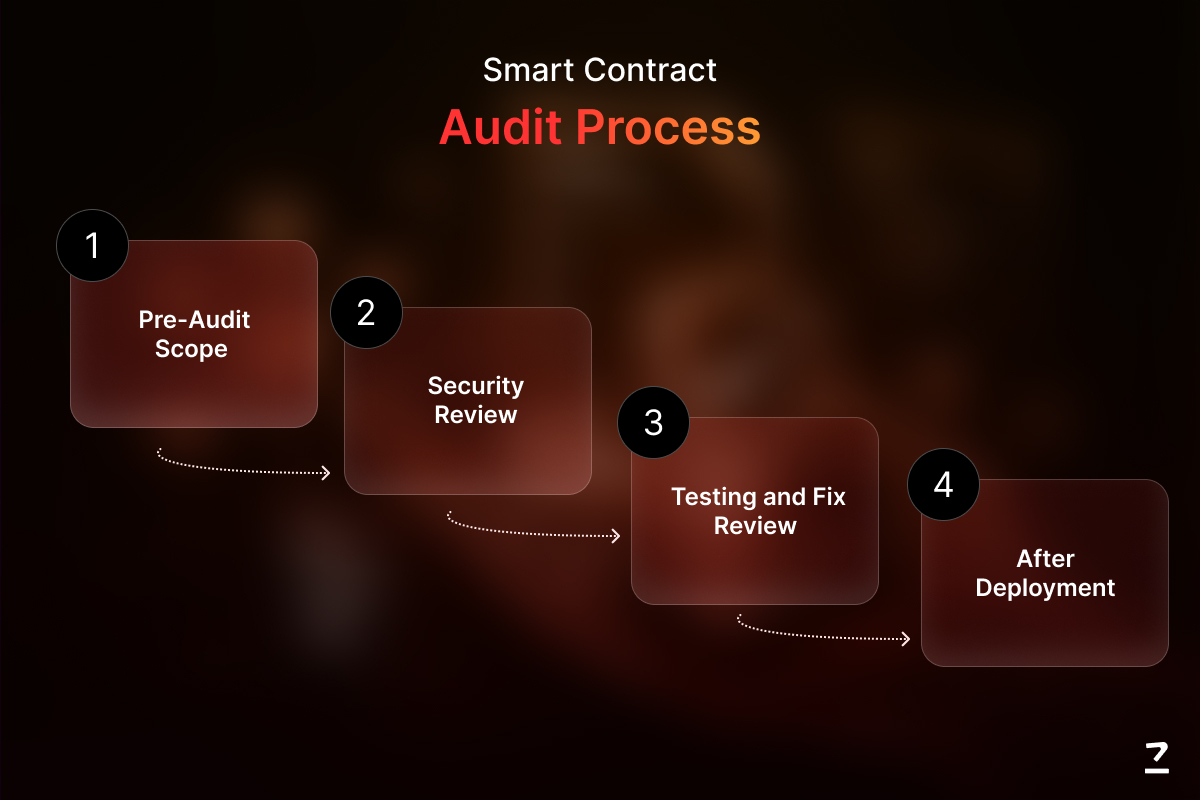
A proper audit starts before a scanner runs.
The team needs the commit in scope. They also need deployed addresses, architecture notes, admin roles, external dependencies, test coverage, and planned changes. Those details show the reviewer what the code is meant to do and what part of the system is exposed by the release.
The review then moves through pre-audit assessment, vulnerability scanning, manual code review, security testing, reporting, fix validation, and post-audit support. Codezeros follows this same process through its Smart Contract Auditing Services.
AI smart contract auditing can support several stages of that process. It can make the repository easier to navigate. It can cluster scanner findings and compare a new release against the last approved version. It can also suggest test paths around sensitive functions.
Automated smart contract auditing is useful when it removes repetitive effort. The deeper questions still need context. Why does a liquidation rule work this way? Which multisig controls the emergency role? What happens when an oracle update arrives late? These answers are rarely visible in a scan report.
For a wider view of static analysis, fuzzing, formal verification, and runtime monitoring, read our guide to smart contract auditing techniques.
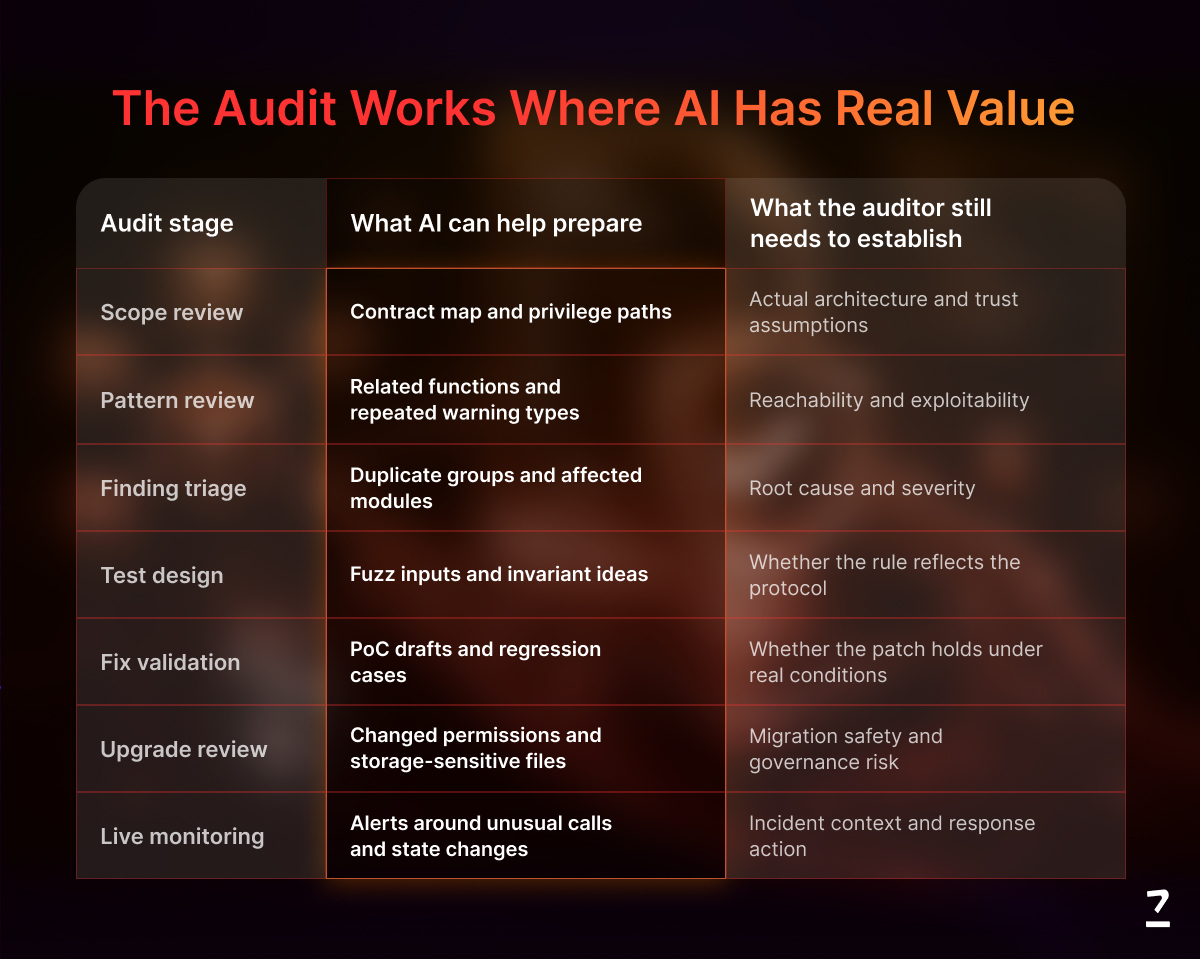
The Audit Works Where AI Has Real Value
The useful outcome is not a message saying that the contract is secure.
It is a better map of the codebase. It is a cleaner finding queue. It is a test case the team had not thought of. It is a release diff that directs attention to the right contract.
1. Mapping the Codebase Before Manual Review
A repository can look straightforward until the dependencies are traced.
A lending protocol may include collateral contracts, liquidation logic, price adapters, treasury controls, governance modules, and proxy contracts. Some code may be inherited. A deployment script may control more risk than the contract that users interact with every day.
AI-powered smart contract auditing can build an early map of those moving parts. It can show which contracts call each other. It can surface functions that move assets or change risk parameters. It can also help reviewers identify where admin authority sits.
That makes the first review pass more focused.
Take a function that changes a liquidation threshold. The access modifier is only one part of the review. The auditor also needs to check who owns the role, whether a timelock applies, how open positions respond, and how the price feed affects the result.
The map gets the reviewer to those questions faster. The audit still depends on the answers.
2. Finding Repeated Weak Patterns Across the Repository
Code gets copied. Old mistakes move with it.
A project may have several withdrawal functions written at different times. Some may follow the expected checks-effects-interactions flow. One may make an external call before internal state changes. Another may rely on an older role check that was never updated.
Smart contract vulnerability detection helps the audit team find every version of that pattern. Similar functions can be grouped together so the reviewer sees the wider issue instead of treating each alert as a separate discovery.
This matters in protocols that have grown through new pools, token types, governance actions, and feature releases. Repetition is easy to miss when the codebase is large.
A flagged pattern is not yet a confirmed vulnerability. One path may be unreachable. Another may have a compensating control elsewhere in the call flow. The auditor needs to trace execution through the protocol before assigning severity.
3. Cleaning Up the Finding Queue
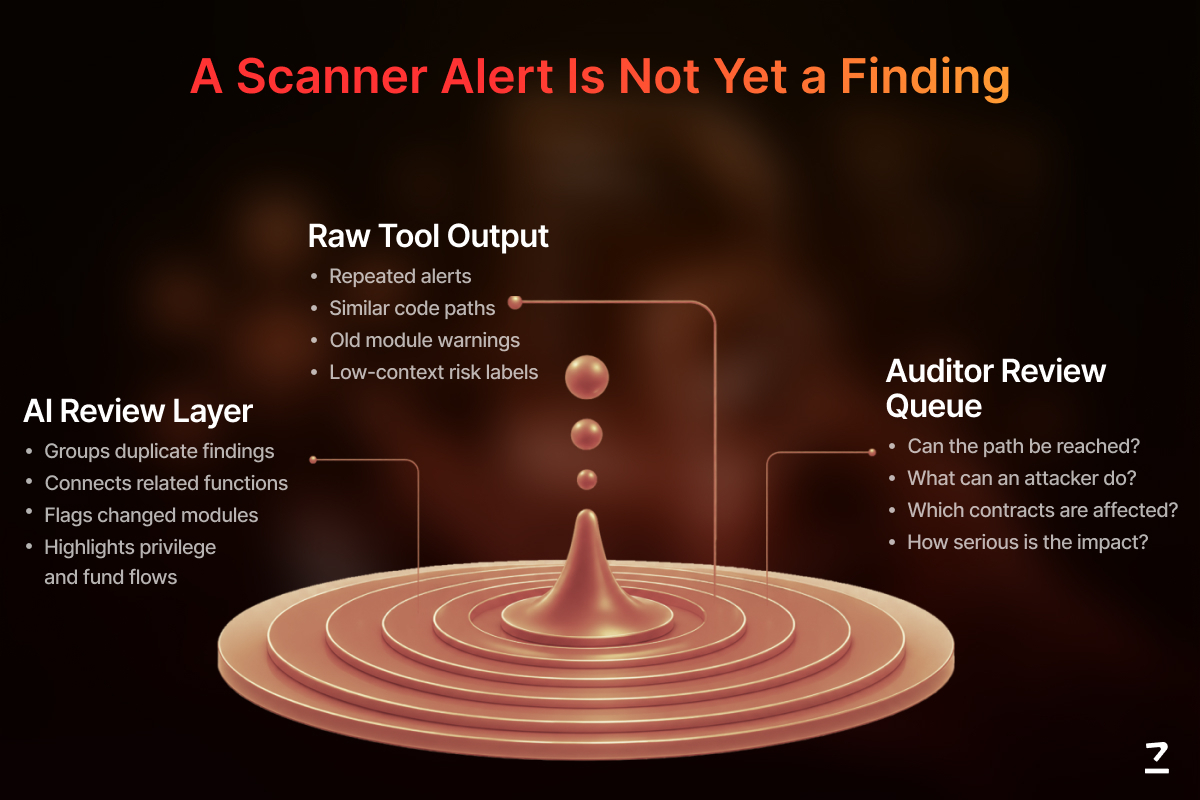
A long scanner report can slow an audit down.
Some findings point to the same root cause. Some affect modules outside the release. Others look minor until they touch an oracle, a treasury route, or a function with upgrade authority.
This is where automated smart contract auditing can make a real difference. It can group duplicate alerts, link findings to recent code changes, and bring sensitive functions higher in the review queue.
The team gets a better order of work. It spends less time reopening the same warning across several files.
A score from a tool is only a starting point. A high-severity label means little if an attacker cannot reach the code. A low-priority issue may become serious when it changes a permission or affects user funds.
4. Building Better Fuzz and Invariant Tests
The strongest tests are built around conditions that must always hold.
A vesting contract should not release more tokens than the schedule allows. A bridge should not accept the same message twice. A vault should not let a user withdraw more than their recorded balance.
These rules are easy to state. Testing them across changing contract states is harder.
AI-powered smart contract auditing can help expand the test plan. It can suggest boundary cases, repeat-call sequences, timing checks, and regression tests after a fix. For a vesting contract, the review may cover partial claims, repeated withdrawals, beneficiary changes, and calls made close to a schedule boundary.
Foundry supports invariant testing against randomized sequences of function calls. It checks the defined invariant after each call in the sequence. That makes it useful for finding failures that appear only after several state changes.
The test still depends on the rule being correct. A weak invariant can pass while the protocol remains exposed.
5. Drafting Proofs of Concept and Checking Fixes
A finding becomes easier to address when the development team can reproduce it.
A proof of concept shows the setup, the call sequence, and the impact. It gives the developer a clear starting point. It also gives the auditor a reliable path for testing the remediation.
AI smart contract auditing can help produce the first version of that test. It can draft a Foundry-style scaffold from an auditor’s notes and suggest the contract interactions needed to reach the issue. Research on PoCo shows how agentic systems can generate executable proof-of-concept drafts from vulnerability descriptions in a controlled audit setting.
The draft still needs to run against the right setup. It may assume a balance that does not exist. It may miss a role check. It may depend on a state that cannot occur after deployment.
The same caution applies to fixes. A patch may close the visible path and affect storage, accounting, or role handling elsewhere. The repaired logic needs a regression test and another review pass.
6. Reviewing Upgrade Diffs Before Release
A small code change can alter the behaviour of a live protocol.
A new initializer may affect a proxy deployment. A storage change may create a migration problem. A revised access modifier may change who controls an emergency function. A new oracle adapter can affect a wider part of the system than the diff suggests.
Automated smart contract auditing helps reviewers isolate the changes that need attention. It can flag new external calls, altered permissions, changed dependencies, and files that touch storage-sensitive logic.
That gives the audit team a tighter release scope.
The next step still involves direct review. The team needs to check the proxy setup, the initializer, the storage layout, the migration script, the governance authority, and the rollback plan. An upgrade is safe only when the changed code and the deployment path have both been examined.
7. Monitoring the Contract After Mainnet Launch
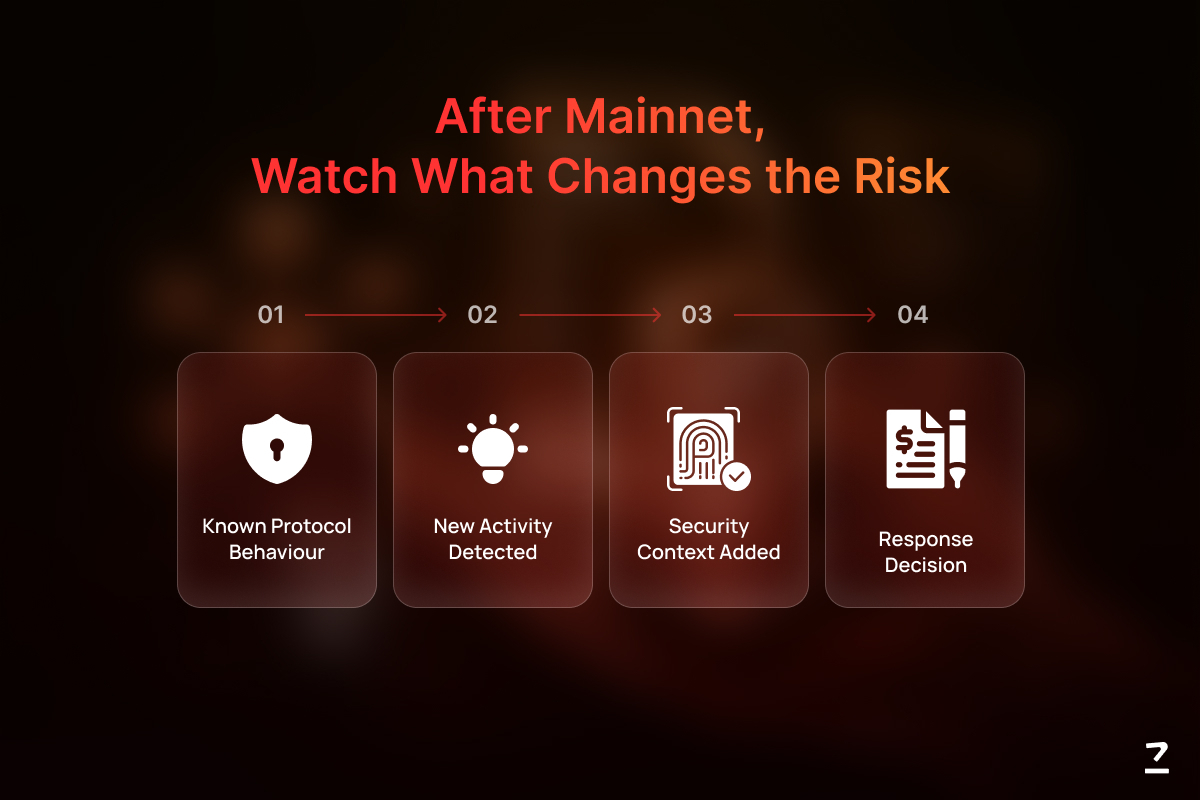
Once the protocol is live, the code is no longer the only source of evidence.
Treasury wallets move assets. Governance proposals execute. Price feeds update. Privileged roles call functions that may not appear in normal user activity. Large positions open and close under market pressure.
AI for smart contract security can help surface activity that falls outside the expected pattern. It may flag an unusual call from a guardian wallet, an unexpected transfer route, or abnormal gas use around a sensitive function.
Smart contract vulnerability detection also has a role after deployment. The focus shifts from source-code patterns to transaction behaviour, permission use, and state changes that deserve investigation.
The response process needs to be ready before the alert arrives. The team should know who receives the alert, who validates it, who can pause the protocol, and what evidence must be retained if the event becomes an incident.
Where AI Tools Lose Context
Language models can produce a credible explanation for a problem that is not real.
A model may spot a familiar pattern and describe it as a vulnerability without seeing the condition that makes the path harmless. It may miss a weakness that appears across several contracts after a specific sequence of actions. The difficult cases often involve governance timing, oracle assumptions, and economic logic.
A recent benchmark found that LLM-based smart contract analysis can be influenced by identifier names and other lexical cues. It also reported a high frequency of false positives where models relied on those surface signals instead of deeper program semantics.
Consider a protocol with a collateral threshold, a delayed oracle update, and a liquidation function. Each part may look sound in isolation. The problem may emerge only when the three interact during a volatile market event. Price feeds need the same level of scrutiny as contract code. For protocols that depend on external data, see our guide to Web3 oracles and the risks that sit between off-chain inputs and on-chain execution.
There is also a data handling question. Before sending unreleased code, deployment scripts, architecture documents, or incident notes to an external model, the team needs to know where that information is processed and retained.
AI-powered smart contract auditing works best when the audit team controls the scope, source material, validation process, and final sign-off.
How to Choose Smart Contract Audit Services
The best time to speak with an audit provider is before the release becomes urgent.
Bring the current branch, architecture diagram, and deployment model into the conversation early. Explain the assets at risk. Explain which roles hold authority. Explain what is changing and when the release is expected.
Good smart contract audit services should ask for that context before they discuss tools.
Ask these questions:
-
What material do you need before the review begins?
-
How do you separate tool output from confirmed findings?
-
Who reviews business logic and cross-contract behaviour?
-
How are fuzzing, invariants, and proof-of-concept tests used?
-
Will the audit team verify fixes before mainnet release?
-
What support is available after the report?
-
How is unreleased code handled during the engagement?
These questions help qualify the engagement. The project team gets a clearer view of its exposure. The audit team gets the context needed to review the release properly.
Codezeros brings together pre-audit assessment, vulnerability scanning, manual code review, security testing, reporting, and post-audit support through its smart contract audit services.
Post Author

Deep Shah
Explore Deep's insightful blog posts that help businesses stay ahead of the curve, explore new possibilities, and unlock the full potential of blockchain technology
Frequently Asked Questions
Frequently asked questions about this article.
Preparing for a Launch or Upgrade?
AI smart contract auditing can make the review process faster to navigate. It helps the team understand the codebase, prepare stronger tests, and focus attention on the release changes that matter. A serious audit still rests on evidence. It needs a clear scope, the right documentation, and reviewers who can trace risk through the full protocol. Codezeros provides smart contract audit services for teams preparing a mainnet launch, major upgrade, bridge release, or high-value protocol change.
Blogs
Our Latest Blogs
Discover valuable industry insights and stay up-to-date with the latest updates by exploring our curated collection of recent blog posts.


Let us know your requirement
We know ideas matter, we are the product of one. We Provide Full Assistance In Your Business