
SHARE THIS ARTICLE
23 Feb 2026
The Role of Web3 Oracles in Connecting Smart Contracts to Real-World Data

Smart contracts usually feature as the foundation of Web3 innovation. They guarantee automated implementation, avoidance of trust and transparency among the decentralized systems. Even though they are sophisticated, smart contracts are limited by a basic fact that they cannot access the real world data on their own.
Blockchains are purposeful and separate. The nodes are required to always come to the same conclusion in the course of performing a transaction, and so they cannot communicate directly with dynamic external systems such as APIs, databases, or IoT devices. This is an architectural limitation that does not allow smart contracts to react to a real world event such as asset price fluctuations, delivery notification, weather, or a regulatory event.
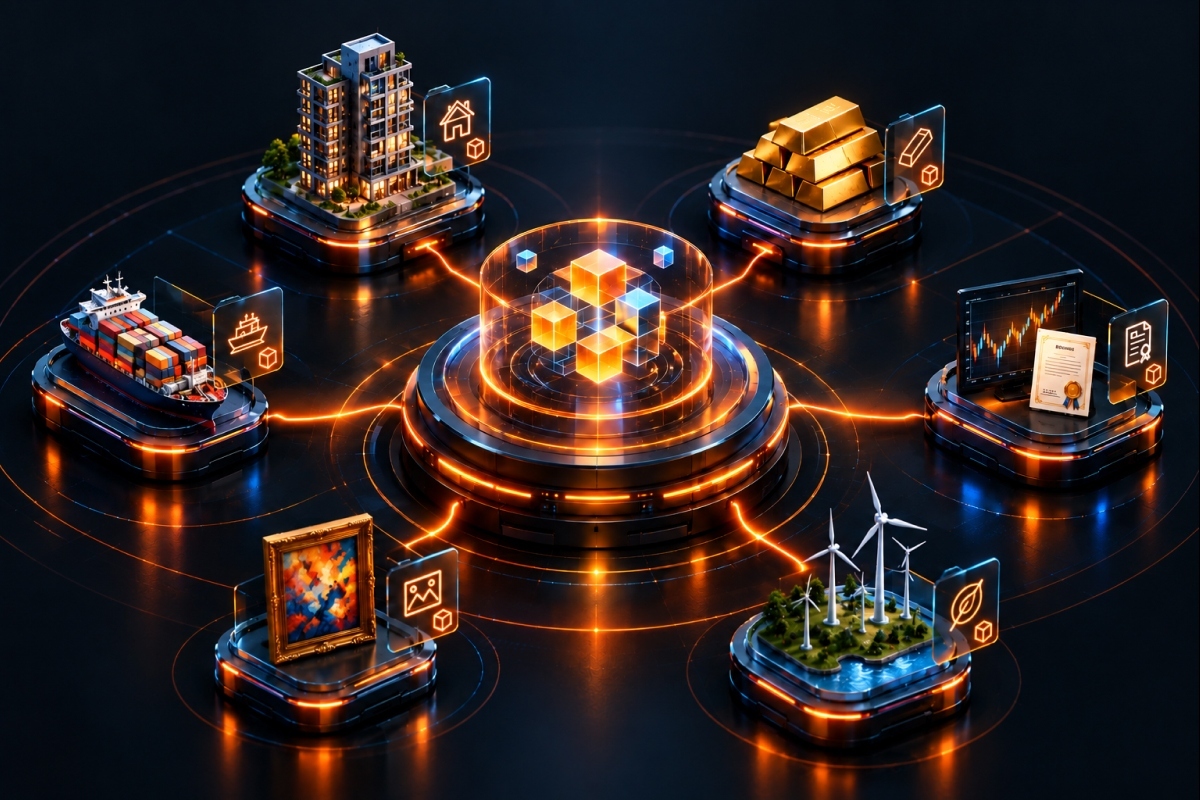
Web3 oracles are created in order to fill this gap. They serve as reliable data channels between off-chain reality and on-chain logic. Decentralized finance can only be built without oracles, insurance automation would be unfeasible, and blockchain adoption in enterprises would be largely theoretical.
Oracle infrastructure has developed since Web3 became a mature field, becoming a major component of blockchain architecture instead of a technical supplement. The world today is more than ever dependent on professional oracle development services to guarantee the safety, precision and scalability of their smart contracts.
What Are Web3 Oracles and How Do They Work?
A Web3 oracle is an intermediate system which allows smart contracts to communicate with external sources of data and in some instances external systems. Its purpose is to fetch, validate and relay off-chain data in a format that blockchain networks can rely on and deterministically handle.
On a high level, the oracle workflow is divided into a number of steps. To start with, a smart contract makes a request for data. The on chain component of the oracle receives this request and requests its off-chain infrastructure to gather the necessary data. The oracle is fed with information through APIs, sensors, and databases or other blockchain. Upon the collection, the data is verified, usually combined with data across several sources, and handed back to the smart contract in the form of a single on-chain record that cannot be changed.
The modern oracle blockchain development extends much more than mere data grabbing. State-of-the-art oracle systems use cryptographic proofs, economic incentives, reputation systems and decentralized consensus models to uphold data integrity. These mechanisms minimize the possibility of manipulation, downtime or malicious interference.
In the case of business enterprises and Web3 platforms, the engagement of a seasoned oracle blockchain service provider allows ensuring that oracle integrations do not cause any unseen holes, but instead suit both technical and business specifications.
The Oracle Problem: Trust, Accuracy, and Decentralization Challenges
One of the most popular issues in blockchain architecture is the oracle problem. It is based on the discrepancy of decentralized smart contracts and centralized sources of data. Although blockchain networks do not require trusted intermediaries, oracles tend to bring back the concept of trust (unless implemented thoughtfully).
When one oracle or data provider feeds wrong or manipulated information to a smart contract, it will still run the programmed contract. This may lead to loss of money, protocol exploits, or un-correctable mistakes. The oracle weaknesses have been demonstrated in high-profile DeFi collapses, which have shown that even well-audited smart contracts may not withstand them.
Accuracy is not the only aspect of the problem. Availability is also important. A failed oracle can simply stop the execution of smart contracts. It should also be of integrity and authenticity whereby data is not distorted or obtained via unauthorized points.
Oracle architecture The decentralized oracle architecture can be used to overcome these limitations by spreading trust among multiple autonomous nodes and data sources. Decentralized oracle networks instead of leveraging one provider aggregate data, use consensus mechanisms, and submit verified results on the chain.
This is the reason why oracle development and implementation services with decentralization, redundancy and security-by-design are becoming the priorities of businesses.
Types of Web3 Oracles Used in Smart Contract Development
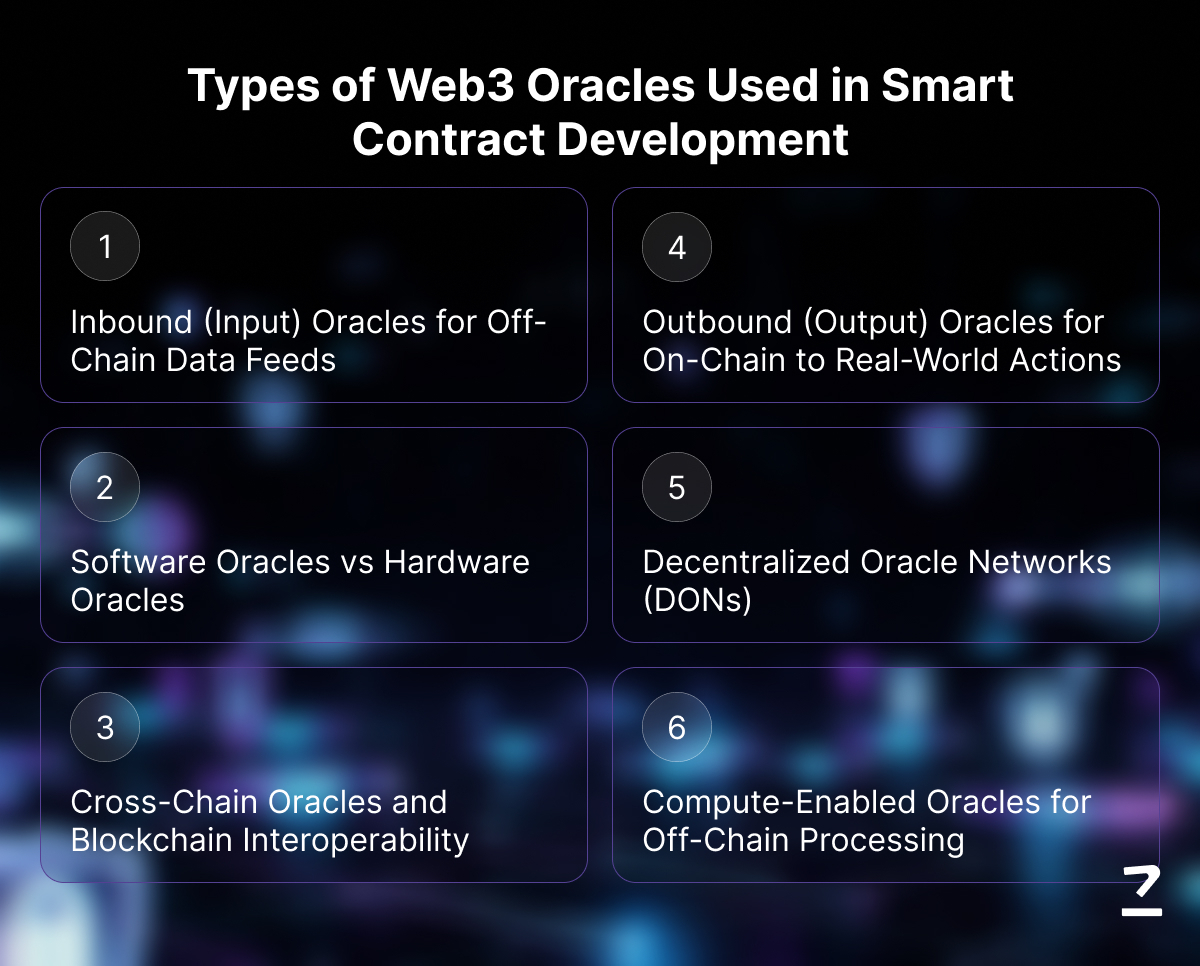
Different types of Web3 oracles are designed to handle specific data flows, trust models, and execution requirements, enabling smart contracts to securely interact with off-chain systems and multi-chain environments.
1. Inbound (Input) Oracles for Off-Chain Data Feeds
The type of Oracle that is most prevalent is the inbound oracle. They bring real-life data to blockchain settings allowing smart contracts to respond to outside factors. The most visible one is price feeds on cryptocurrencies, commodities and fiat currencies.
In decentralized finance, inbound oracles establish collateral valuations, liquidation levels, and interest rates. They offer weather information, identity checks alerts, regulatory news, and market signals in other industries.
Dependable inbound oracle architecture is the basis of oracle-based cryptocurrency services, since inaccurate information can spread throughout whole financial systems.
2. Outbound (Output) Oracles for On-Chain to Real-World Actions
Outbound oracles enable oracles in smart contract to trigger actions outside the blockchain. These actions may include sending notifications, unlocking physical assets, initiating payments in traditional systems, or updating enterprise software.
Outbound oracles are particularly important for real-world automation. For example, once an on-chain condition is met, an outbound oracle can instruct an IoT system to release goods or notify a logistics provider.
This bidirectional capability expands the practical scope of smart contracts beyond digital assets alone.
3. Software Oracles vs Hardware Oracles
Digital environments like web services, databases, and APIs are the sources of data contained in software oracles. They are typically applied in financial data, identity verification and analytics-driven applications.
The physical world is connected to hardware oracles via sensors and the attached objects. IoT oracles Hardware gathers real world data through IoT based hardware oracle like temperature, location, pressure, or machine status. They are crucial in supply chain management, industrial automation and smart infrastructure projects.
The Oracle blockchain development is usually associated with a combination of software and hardware oracles with the aim of end-to-end automation.
4. Decentralized Oracle Networks (DONs)
Oracle networks are decentralized networks that are the standard of the high-stakes applications used in the industry. DONs are not bound to a single oracle node but spread out data collection among numerous and independent operators.
Data are independent sources of nodes. The network is used to combine these inputs and then execute consensus logic and post a final verified output on-chain. There are economic incentives and penalties that will match the behavior of a node to the accuracy of data and uptime.
In the case of enterprises, DONs can greatly mitigate systemic risk, and one of the central areas of current oracle blockchain development services.
5. Cross-Chain Oracles and Blockchain Interoperability
Cross-chain oracles enable smart contracts to read and respond to events occurring on other blockchains. As Web3 ecosystems fragment across Layer 1s and Layer 2s, interoperability becomes a strategic necessity.
Cross-chain oracle infrastructure supports use cases such as multi-chain DeFi, asset bridging, governance synchronization, and liquidity optimization. Rather than moving entire states across chains, oracles transmit verified signals that trigger smart contract logic.
This approach is more scalable and secure than monolithic bridging mechanisms.
6. Compute-Enabled Oracles for Off-Chain Processing
Compute-enabled oracles perform complex calculations off-chain and submit results on-chain. This model allows smart contracts to leverage heavy computation without incurring prohibitive gas costs.
Use cases include advanced financial modeling, cryptographic verification, AI inference, and large-scale data aggregation. Compute-enabled oracles expand what smart contracts can realistically achieve while preserving blockchain efficiency.
How Web3 Oracles Power Smart Contracts Across Industries
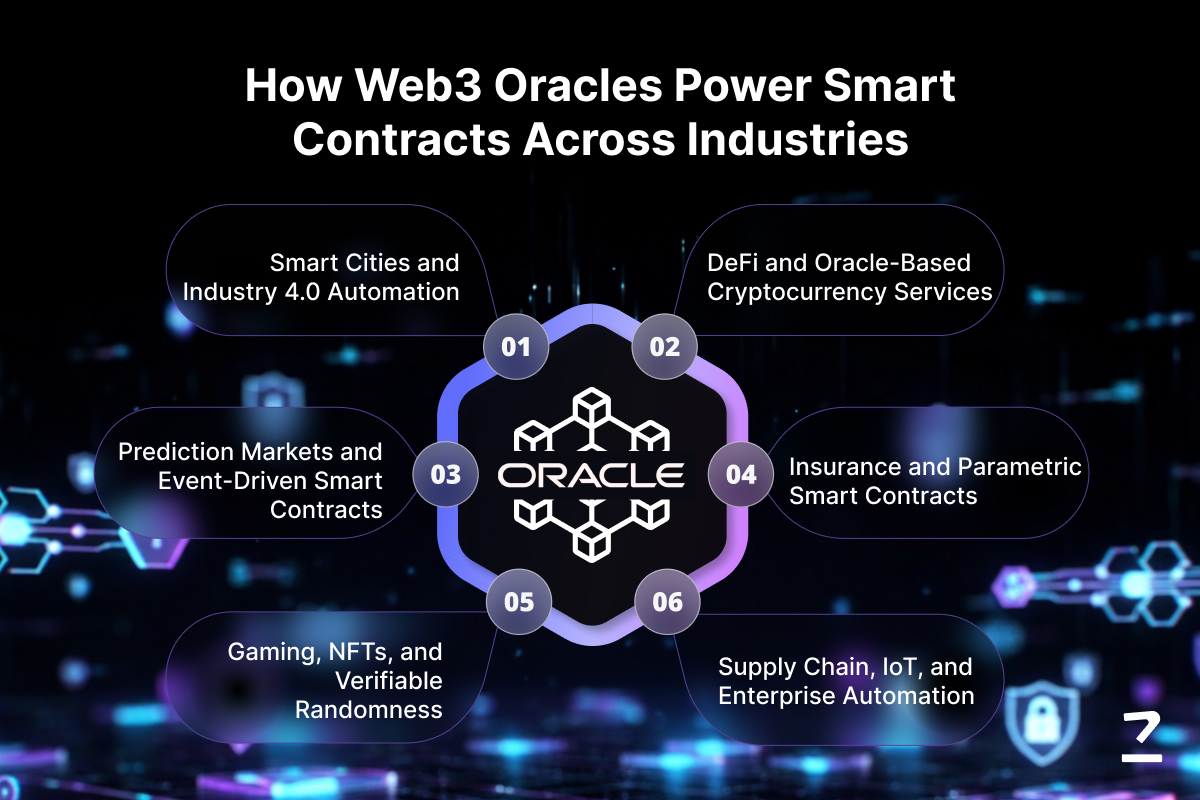
Web3 oracles enable smart contracts to react to real-world events with precision, turning isolated blockchain code into automated systems that drive finance, enterprise operations, and digital ecosystems at scale.
DeFi and Oracle-Based Cryptocurrency Services
Oracles are needed nearly in full in decentralized finance. The lending protocols, decentralized exchanges and derivatives platforms and even stablecoins all rely on real-time price feed and market information.
Cryptocurrency services on oracle guarantee correct pricing, equitable liquidations, and price manipulation. Lack of strong oracle infrastructure makes the DeFi systems weak and vulnerable.
The number of enterprise-grade oracle blockchain service providers keeps rising as the institutional involvement rises.
Insurance and Parametric Smart Contracts
Parametric insurance products are smart contract-based products that offer automated claims under predetermined conditions. Oracles provide data which can be verified like rainfall, delay in the flight, or shipment.
Payouts are run automatically when conditions are satisfied, which removes arguments and administrative costs. This model has a special success in the fields of agriculture, travel insurance, and climate risk coverage.
Supply Chain, IoT, and Enterprise Automation
Oracle integration can be advantageous to supply chains in their connection of physical events with blockchain records. Hardware oracles with IoT can check the compliance of product movement, environmental conditions, and compliance with handling.
Oracle development and implementation services are used by enterprises to integrate blockchain systems with ERP systems, inventory systems, and compliance databases. This would establish clear auditable work flows devoid of manual reconciliation.
Gaming, NFTs, and Verifiable Randomness
The Web3 gaming and NFT sectors need provable randomness and environmentally triggered functionality. Oracle has secure random number generation and statement validation. It prevents manipulation, increases trust and allows one to use dynamic in-game mechanics, NFT minting terms and rewards distribution.
Prediction Markets and Event-Driven Smart Contracts
Prediction markets would require proper resolution of outcomes. The real-world results that Oracles validate include sports scores, election results, or economic indicators. Smart contracts that are event-driven make use of these validated signals to resolve markets in a transparent and just manner.
Smart Cities and Industry 4.0 Automation
Oracles are used to integrate sensors, infrastructure systems, and governance systems in smart cities and industrial automation. Traffic optimization, energy control, and automated compliance are based on trusted information streams. With the development of Industry 4.0, the development of oracle blockchain becomes an essential part of decentralized infrastructure.
Security and Data Integrity in Oracle Blockchain Development
The characteristics of oracle design are characterized by security. A compromised oracle may compromise all the application stack. Successful oracle blockchain development services have many safety levels, such as the diversification of data sources, cryptographic demonstrations, economic incentives, and constant monitoring. Oracle security has become a core component in the risk management strategy of enterprises, and not a technical issue.
Web3 Oracles and Cross-Chain Interoperability
Cross-chain systems need stable communication between heterogeneous networks. The coordination that is made through oracles does not require chains to trust one another directly. Oracles enable interoperability that is scaling and lower attack surfaces by allowing verified signals to be transmitted, instead of entire state data. This will make them the building blocks of the next generation of Web3 multi-chain applications.
Key Benefits of Using Professional Oracle Development Services
Oracle infrastructure construction is not a plug-and-play operation, it is a risky architectural choice that has a direct influence on the security, reliability, and business performance of smart contracts. The integration of real-world data with your Web3 application is made stronger by professional oracle development services, and not its weakness.
Key benefits include:
-
Production-grade architecture designed for accuracy, availability, and fault tolerance across high-value smart contracts.
-
Security-first oracle design with multi-source data validation, cryptographic proofs, and protection against manipulation or downtime.
-
Faster and safer deployment through proven oracle frameworks, reducing time-to-market without compromising integrity.
-
Scalability and performance optimization to support high-frequency data updates and enterprise-level workloads.
-
Regulatory and compliance alignment, especially for financial, insurance, and enterprise use cases that rely on auditable data trails.
-
Reduced operational risk by eliminating single points of failure and minimizing oracle-related exploit vectors.
An experienced oracle blockchain service provider translates complex data dependencies into resilient, verifiable systems that scale with both transaction volume and business ambition.
Choosing the Right Oracle Blockchain Development Company
The selection of an oracle blockchain development firm is not a vendor selection activity, it is a strategic decision. Oracles are positioned at the crossroads of data integrity, smart contract safety and real-life implementation where provider expertise is the key to long-term success.
Key factors businesses should evaluate include:
- Depth of oracle architecture expertise: The provider should understand decentralized oracle networks, off-chain computation, data aggregation models, and oracle attack vectors.
- Smart contract and security proficiency: Experience with audits, adversarial testing, and secure contract-oracle interactions is non-negotiable for high-value applications.
- Cross-chain and interoperability experience: Modern oracle systems must operate across multiple blockchains, Layer 2s, and ecosystems without compromising data integrity.
- Real-world system integration: Strong providers demonstrate experience connecting oracles with APIs, IoT devices, enterprise platforms, and legacy infrastructure.
- Ongoing support and upgrade readiness: Oracle networks require monitoring, version upgrades, and evolving data sources as business and protocol needs change.
A capable oracle blockchain development company acts as a long-term infrastructure partner, not just an implementation vendor.
Future Trends in Oracle Blockchain Development
As Web3 moves from experimentation to real-world adoption, oracle infrastructure is undergoing a fundamental transformation. Oracles are evolving from passive data relays into intelligent, decentralized decision layers that power next-generation smart contracts.
Key trends shaping the future of oracle blockchain development include:
- AI-enhanced oracles that enable predictive analytics, anomaly detection, and intelligent data filtering before on-chain execution.
- Deeper IoT integration, allowing smart contracts to respond to real-time physical events across supply chains, energy systems, and smart cities.
- Rapid growth of cross-chain oracle frameworks to support interoperable DeFi, multi-chain governance, and shared liquidity ecosystems.
- Enterprise-grade security and compliance standards, driven by institutional adoption and regulatory scrutiny.
- Shift toward modular oracle architectures, enabling composability, scalability, and faster innovation cycles.
As these trends accelerate, oracle development and implementation services are no longer experimental tools. They are becoming strategic infrastructure investments that define how securely and intelligently Web3 systems interact with the real world.
Codezeros Delivers Secure and Scalable Oracle Blockchain Solutions
Web3 oracles are no longer optional components of blockchain systems. They are the critical infrastructure that allows smart contracts to interact with reality. From finance and insurance to enterprise automation and smart cities, oracle reliability defines real-world impact.
Codezeros delivers secure, scalable, and enterprise-ready oracle blockchain solutions by combining decentralized architectures, cross-chain expertise, and rigorous security practices. Connect now with Codezeros, a trusted oracle blockchain development company to transform smart contracts into production-grade systems that operate confidently in real-world environments.
Post Author
Deep Shah
Explore Deep's insightful blog posts that help businesses stay ahead of the curve, explore new possibilities, and unlock the full potential of blockchain technology
Frequently Asked Questions
Frequently asked questions about this article.
Transform Your Smart Contracts Oracle Development with Codezeros
Unlock the full potential of your Web3 applications with Codezeros. Our expert oracle blockchain development services deliver secure, scalable, and enterprise-ready solutions that bridge on-chain logic with real-world data. Connect with us today to ensure your smart contracts operate with accuracy, reliability, and compliance.
Blogs
Our Latest Blogs
Discover valuable industry insights and stay up-to-date with the latest updates by exploring our curated collection of recent blog posts.

Let us know your requirement
We know ideas matter, we are the product of one. We Provide Full Assistance In Your Business