SHARE THIS ARTICLE
- Copy link
11 Mar 2026
Smart Contract Auditing Techniques to Prevent Major Hacks in 2026

The importance of smart contract security has never been more important than it is now. With the smart contracts market expected to reach value at $3.94 billion in 2026, and the maturing of DeFi, cross chain bridges, tokenized real world assets (RWA) and institutional Web3 platforms, vulnerabilities in the code of smart contracts carry systemic risk.
Attacks have moved from bugs to logic to oracle manipulation and multi-vector attacks with cross-chain assets. In the first half of 2025 alone, more than 344 of these incidents caused $2.29 billion in net losses, a definite sign that businesses must be doing more than basic audits in securing digital assets.
As one of the leaders in Smart Contract Audit Company, Codezeros has adapted its approach to this new reality. In 2026, effective security demands a sustainable multi-layered audit lifecycle enabled by cutting-edge tooling, AI, human intervention and real-time detection.
This guide looks into the most up-to-date techniques in smart contract auditing, the most important vulnerabilities, and how to be prepared, how to perform and how to make security a part of your development lifecycle.
Whether you are looking into Smart Contract auditing services for the first time or seeking to level-up your security posture, this is in-depth analysis to provide you a clear roadmap to save from major hacks.
What is a Smart Contract Audit?
A smart contract audit is a comprehensive security and logic review of blockchain code designed to proactively find problems that may cause exploits, financial loss, or poor performance.
At its heart, it's a mix of static code analysis, automated scanning, manual code analysis, and business logic analysis that is focused on making sure that a contract is behaving just as desired and that it is impervious to known attack vectors against it.
Professional audits generally employ a combination of various techniques: static analysis (with tools such as Slither or Mythril), dynamic testing (e.g. fuzzing with Echidna or Medusa), manual line-by-line analysis from experienced auditors and formal verification where applicable.
Each of these layers play a part in a larger stance of security that is catching not just technical bugs such as integer overflows or unchecked external calls, but also flaws (flipping to higher order logic).
The result of this process is typically an intense report of the findings, classified according to severity and with advice on remediation.
Strong audits also aim to document other non-security related problems such as inefficient code or gas misuse (that while not vulnerabilities themselves can cause performance or cost issues if left unaddressed). How a comprehensive audit works to transform raw code into a secured product ready for public deployment.
Common Smart Contract Vulnerabilities in 2026
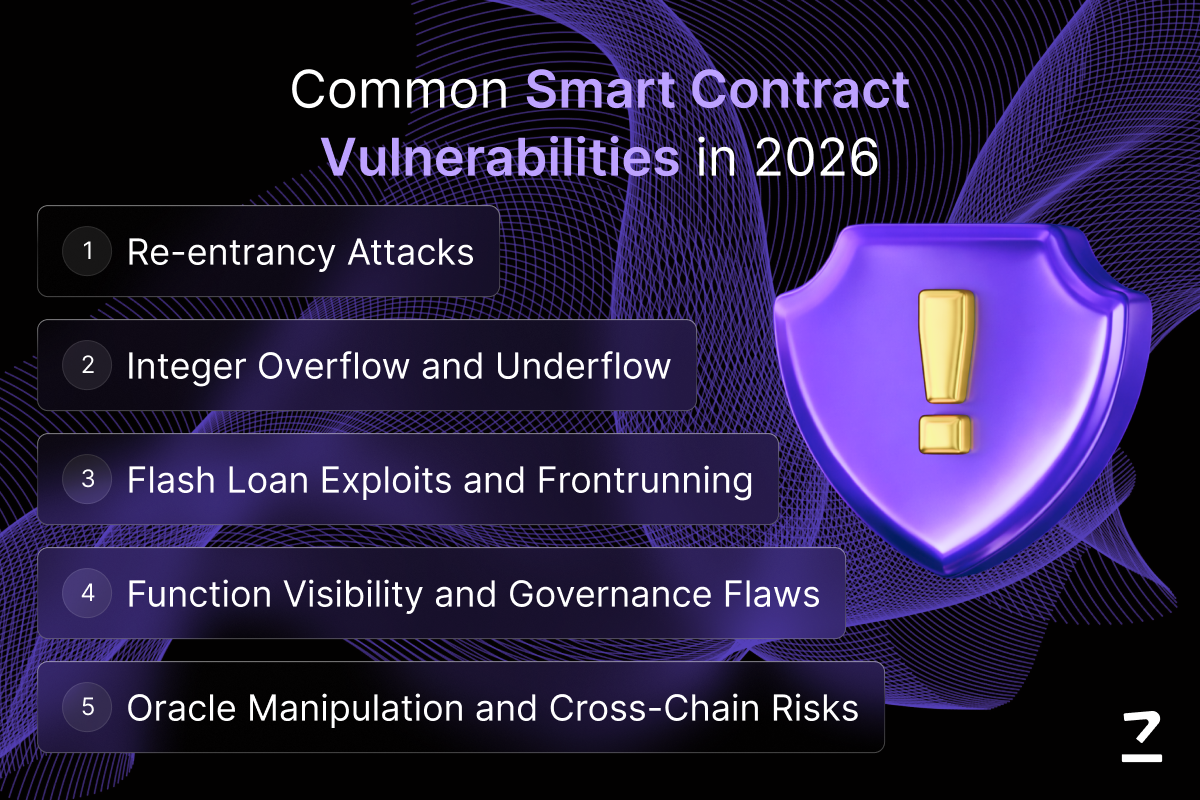
For blockchain security certain classes of vulnerabilities still continue to lead exploits, some evolved and others classic. Understanding these is crucial to secure development and effective auditing.
Reentrancy Attacks
Reentrancy is one of the worst types of vulnerabilities and even though it is well understood, since the DAO hack in 2016. It is when a contract does an external call that leaves the contract state unchanged and the external contract can revisit the function and interfere with state in an unpredictable manner. Modern audits need to find simple reentrancy, but they also need to find complex cross function and cross contract attacks that they're doing with shared state between multiple entry points.
Integer Overflow and Underflow
Even possible with modern language protections like what exist in Solidity [?]0.8.x still occur, in contexts like. Overflow and underflow bugs in custom assembly or less common virtual machines like Move. Audits utilize both symbolic execution tools as well as formal verification to weed out the following classes of errors before deployment:
Flash Loan Attacks and Frontrunning
Flash loans, temporary uncollateralized capital, are a double edged sword. They are powerful protocol building blocks but they also allow attackers to manipulate markets or use the difference in timing. Audits must have the ability to simulate these attacks and guarantee invariant conditions even in the presence of massive temporary liquidity. Frontrunning (using information in the mempool to possess the information ahead of time) is also a perpetual threat to look out for in any standard audit.
Oracle Manipulation and Cross‑Chain Risks
Smart contracts often use external data feeding (oracles) for the price or the event. Manipulated or unintuitive feeds can have disastrous results. Cross-chain bridges make everything complex again, as messages and state must be validated in disparate consensus systems. Advanced auditing methods have resulted in strict tests on oracle assumptions and bridge finality logic.
Function Visibility Errors, Centralization Risks, Compiler Issues
Errors in visibility of functions, in particular, leaving sensitive functions public causes unauthorized access. Centralized admin keys and poor governance mechanisms are points of failure. Compiling with unlocked or outdated versions of compilers can lead to subtle behavior changes, and is frequently reported during professional audits.
How to Prepare Your Smart Contract for Audit
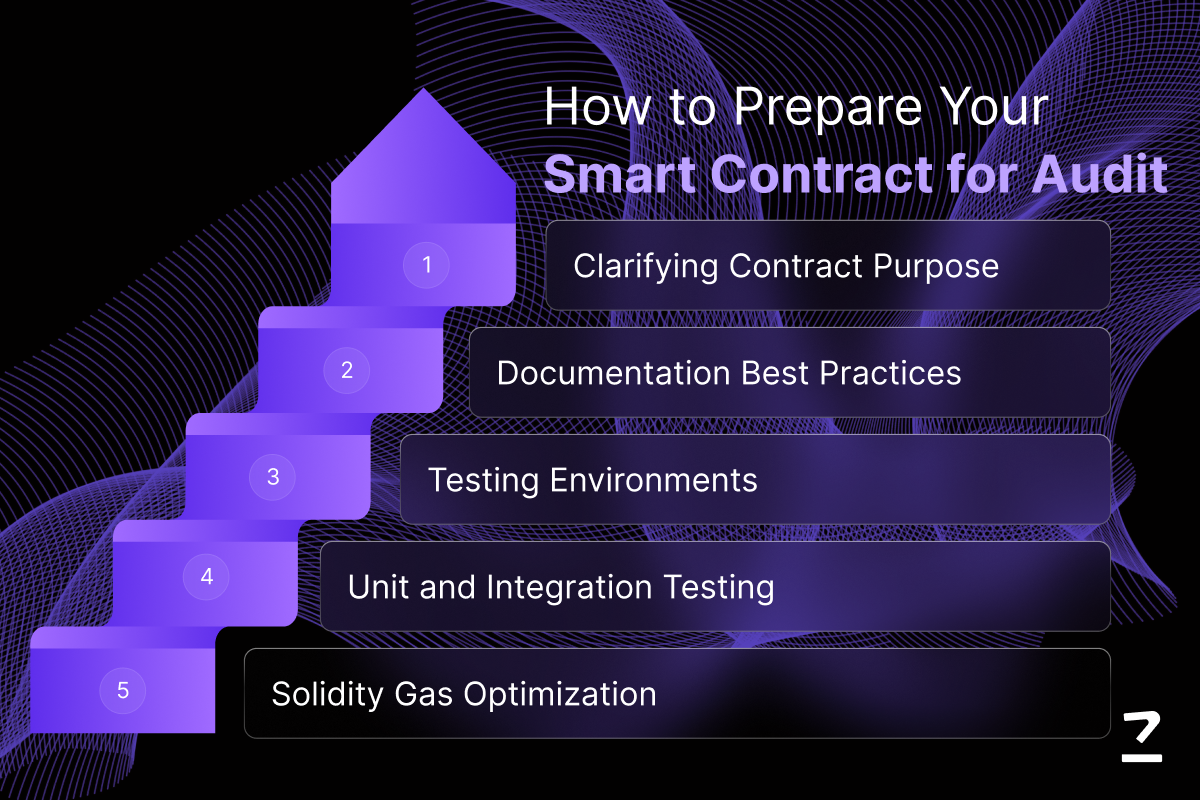
Effective auditing starts well before the auditor's equipment is rolled out. Preparation directly affects the depth and accuracy of findings and can play a major part in reducing audit time and cost.
Clarifying Contract Purpose
A clear specification of what a contract is intended to do, taking expected state transitions and edge-case behavior into account, provides auditors with a context for doing the audit that is not limited to syntax. This speeds up the process of threat modeling and there is less back-and-forth during review.
Documentation Best Practices
Good documentation includes the contract code, whitepapers, architecture diagram, dependencies and even the test scenarios. It also contains expected invariants conditions which should always be true in order for auditors to validate not only safety but correctness.
Testing Environments
Setting up a proper local environment by using frameworks such as Hardhat or Truffle allows early debugging and simulation of edge cases. Modern prep for an audit also includes setting up branch strategies and version control and the automated pipelines that include static and dynamic testing.
Unit and Integration Tests
High coverage unit tests, combined with integration tests which imitate interchanges over the protocol, catch a lot of bugs before an official audit begins. Tests should be done for common paths, failure paths, permission boundaries, and state rolls back.
Solidity Gas Optimization
While not strictly a security problem, gas inefficiencies can also result in denial of service exploitation or poor user experience. Optimization strategies include using the settings of a compiler optimizer, saving on-chain storage, caching reads and only writing where it is necessary. Auditors will normally highlight such opportunities in order to balance cost and security for teams.
Advanced Smart Contract Auditing Techniques
To counter the evolving threat landscape in 2026, including logic-based exploits, oracle manipulation, and cross-chain bridge abuse, today's auditing is a mix of the latest cutting-edge automation techniques mixed with a cyber-security staple of old-school human analysis.
AI‑Powered Security Analysis
Artificial intelligence is proving to be a necessary component in the first line of review. Advanced models scan code at scale for patterns that suggest the presence of a weakness such as reentrancy, access control problems, and unexpected state transitions in minutes instead of days.
Predictive risk assessment models, trained to real-world exploit data, can even reveal new attack vectors. Post-deployment, an AI-driven platform in the field is an invaluable layer with 24/7 continuous monitoring of live traffic to flag anomalies, since hacks tend to come well after the product 2.0 goes live.
Formal Verification and Symbolic Execution
Formal verification involves using mathematical proofs to verify that contracts comply with rigorous specifications for all potential inputs. Tools like engines of symbolic execution traverse all possible, feasible paths of execution to rule out entire classes of bugs like unauthorised withdrawals or state corruption. These techniques are especially important for high-value DeFi protocols where correctness is not negotiable.
Advanced Fuzzing and Invariant Testing
Beyond simple unit tests, with property-based fuzzers, one can generate thousands of random and unexpected inputs that will stress invariants, and reveal edge cases that static analyzers usually fail to detect. Coverage-guided fuzzing tools go down the untested code paths first, with a higher likelihood of locating deep structural bugs prior to deployment.
Collaborative Audits and Peer Reviews
Large contracts benefit from parallel, collaborative auditing in which multiple experts can review the same code in parallel. This crowdsourced approach, even audit contests on platforms with widespread participation in them, increases the number of "eyes on code," often creating deeper insights and faster turnaround.
Specialized Audits for Governance and Cross‑Chain Logic
Modern audits are now done with vectors identified in the 2026 OWASP Smart Contract Top 10. These range from oracle manipulation ensuring decentralized or multiple data sources and cross-chain message validation to proxy upgrade patterns, time-lock governance and input validation rules that guard against malformed or malicious inputs.
Lifecycle Security: CI/CD, Bug Bounties, Real‑Time Monitoring
Security is no longer a one-gate operation. Integrating static analysis into continuous integration/continuous delivery (CI/CD) pipelines means that the vulnerabilities are flagged when developers write code. Six-figure bug bounty programs give you a permanent, incentivized layer of security after the software is deployed, while real-time monitoring alerts security teams to transactional anomalies that can be completely missed by automated scan tools.
Smart Contract Audit Tools in 2026
Selecting the right tools is critical to high quality audits. While the expertise of humans will never be replaced, automated platforms offer the scale, speed, and precision to manage complex smart contract systems in 2026.
-
Slither: Static analysis of Solidity source code for finding vulnerabilities, code smells, and best practice violations
-
Mythril: Applies symbolic execution and taint analysis that identifies reentrancy, overflow, and access control of vulnerabilities in EVM bytecode.
-
Echidna: A Haskell-based fuzzer that uses property-based testing to violate smart contract invariants.
-
Aderyn: Rust based AST Analyzer offering structured reports for vulnerabilities & logical inconsistencies.
-
Tenderly: Real-time monitoring platform that provides transactions simulations, performance analytics and alerts for anomalies
-
Forta: Behavioral analysis engine for live monitoring detecting suspicious transactions and attack patterns in real-time.
These tools complement manual audits by identifying common and low-hanging vulnerabilities at a faster pace, allowing auditors to focus screen time investigating complex business logic and cross-contract interactions.
While tools shine at pattern recognition and data exhaustive testing, they lack the ability to truly understand nuanced logic errors and context-specific attack vectors. Combining the scanning automation and human expertise, both breadth and depth of coverage are ensured. Automated results can frequently feed into manual auditing, helping to supply auditors with prioritised alerts and structured reports.
Projects must customize tools based on the complexity of the contract. A single ERC-20 token may require only static analysis of a basic sort, whereas multi-chain bridges or yield aggregators need formal verification, fuzzing and runtime monitoring. Matching tool capabilities with contract requirements is the way to ensure maximum allocation of resources and security ROI.
Post-deployment tools such as Forta and Tenderly provide 24/7 surveillance where they flag suspicious behavior, unexpected token flows or abnormal gas usage. Continuous monitoring is critical, because exploits become common after contracts are live, especially in the case of DeFi or Governance systems.
How to Choose the Right Smart Contract Audit Service
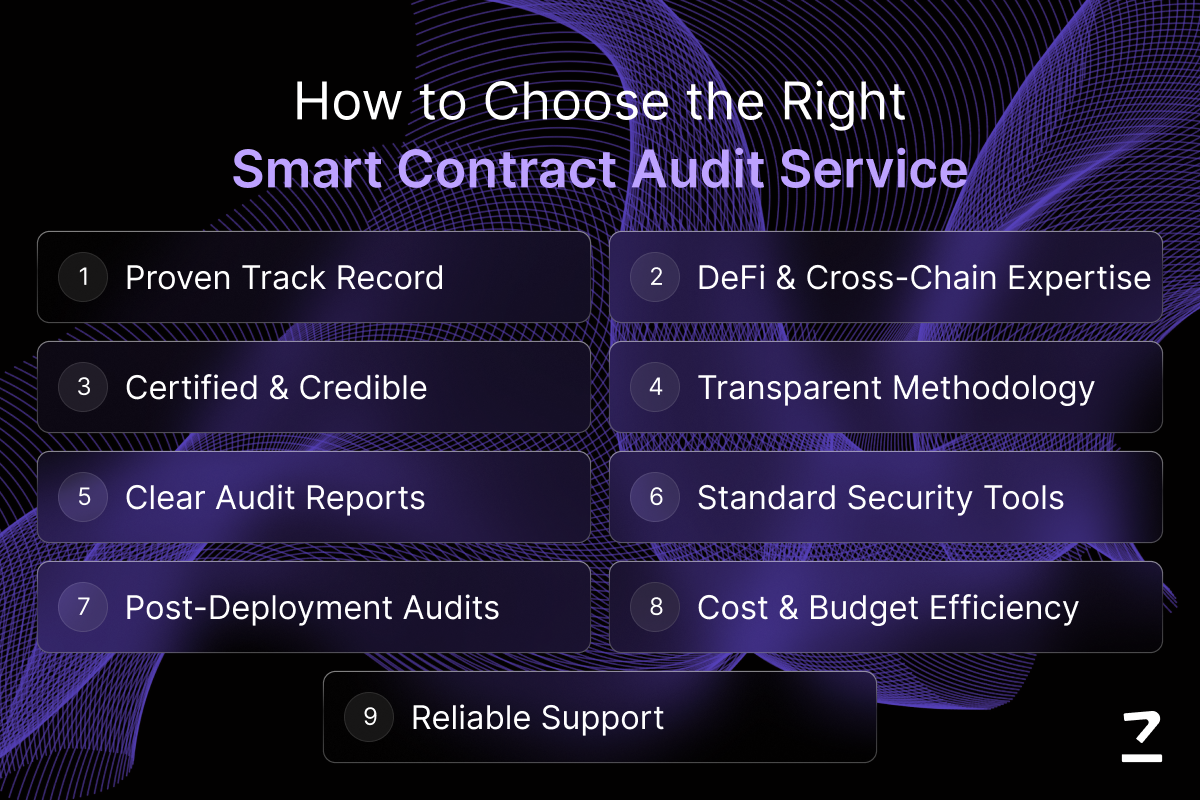
A professional audit is only as good as the auditor conducting the said professional audit. Choosing the appropriate smart contract audit service requires several factors:
-
Experience: Look for auditors who have a good history of both code review and exploit discovery.
-
Domain Knowledge: Knowledge of DeFi protocols, cross-chain bridges and governance mechanisms is critical.
-
Certifications: Certifications or endorsements from reputable organizations in the field boost credibility.
-
Methodology Transparency: Make sure the audit firm is transparent about their methodology, the tools they use, and their manual review processes.
-
Report Detail: Comprehensive reports cover severity classifications, remediation measures, and code notes.
-
Tool Usage: Make sure that the auditor is utilizing industry-standard tools such as Slither, Mythril and Tenderly, incorporating them into a thorough workflow.
Audits should not stop with their deployment. Continuous or periodic auditing, which is often integrated with CI/CD pipelines, helps to identify vulnerabilities as they emerge, and helps to ensure that new code meets best practices.
Audit fees depend on the complexity of the contracts. In the year 2026, for simple tokens, the value can range from $25,000-$50,000 whereas for large multi-chain protocols, it can be more than $250,000. Budgeting up front avoids rushed and incomplete audits which compromise security.
The best audit services offer good communication, traceable results, and follow-up auditing. This transparency helps ensure that stakeholders know about risks, remediation plans, and timelines.
Why Hire Smart Contract Auditors from Codezeros
Codezeros provides customized smart contract auditing services with a blend of profound technical expertise, enterprise guidance and post-auditing support.
-
Expert Auditors and Senior Guidance: Our team consists of senior auditors with extensive experience with Ethereum, BNB Chain, Avalanche and other EVM compatible blockchains. Their hands-on expertise makes high fidelity audits for projects of any scale.
-
Security Counseling and Enterprise Solutions: Beyond code reviews, Codezeros has security counseling services which help teams to architect secure protocols, manage keys securely, and design governance frameworks that resist threats from both internal and external actors.
-
Post-Audit Support and Confidential Reporting: The results of audits are presented in detailed and confidential reports highlighting all vulnerabilities, remediation tips and severity of the vulnerabilities. Our team is still there for verification and follow-up after fixes are made.
-
Flexible Audit Packages for Different Project Needs: Whether you require one-off audit, need regular lifecycle monitoring services or specialist audit for bridges or governance modules, Codezeros provides flexible and tailored security audit solutions.
-
Transparent Communication and Roadmap Recommendations: Our auditors provide actionable recommendations, prioritize vulnerabilities and help teams get underway with a roadmap to maintain secure, reliable and cost-effective smart contracts.
Case Examples & Success Stories
Codezeros has stopped critical exploits such as flash loan and oracle manipulation attacks by identifying the vulnerabilities before deployments. Our multilayer audit process that includes AI-backed analysis, formal verification and manual audit ensures that the contracts are resilient to adversarial attacks and conform to the security norms in the industry.
Our portfolio consists of ERC 20 tokens, DeFi yield aggregators, Cross chain bridges, and NFT marketplaces. Each project used automated tools with expert, manual audits to achieve millions in user assets while concluding over complex logic and governance risks.
Recurring vulnerabilities like the mismanagement of admin positions, inadequate input validation, vulnerabilities in proxy upgrades, etc. are systematically covered and any possible exploits that may attempt to exploit the protocols are avoided, hence ensuring optimum protocol operations.
Professional audits have ROI that is very clear: they reduce financial risk, help protect reputations and increase user trust. Many clients have prevented losses of over $10 million by the use of proactive auditing.
Continuous post-deployment audits and real-time monitoring help build confidence among investors and users. Platforms that ensure continued surveillance signal preparedness for changing threats, building stakeholder trust of and belief in platforms.
Future-Proof Your Smart Contracts with Codezeros
2026 smart contract security needs a multi-layered approach: smart contracts security: Formal verification + AI-assisted static and dynamic analysis + fuzzing + collaborative smart contract reviews + smart contract lifecycle monitoring + bug bounty programs after smart contract deployment. Abolishing these measures throughout the development lifecycle ensures resilience against evolving attack vectors.
Hiring an experienced smart contract audit company like Codezeros does not only help you secure your protocol but also helps develop a sense of confidence and regulatory credibility among the users.
By merging state-of-the-art tools with human expertise, Codezeros provides the industry's premium expert smart contract audit services to ensure that your project can stand up to the complex security landscape of 2026. Get in touch with Codezeros to fix your expert smart contract audit.
Post Author

Deep Shah
Explore Deep's insightful blog posts that help businesses stay ahead of the curve, explore new possibilities, and unlock the full potential of blockchain technology
Frequently Asked Questions
Frequently asked questions about this article.
In 2026, comprehensive audits typically range from $25,000 to $150,000, with highly complex protocols or multi-chain bridges potentially exceeding $250,000.
Duration depends on contract complexity. Simple token contracts may require 48–72 hours, while multi-module DeFi or cross-chain protocols can take several weeks.
While tools can help identify common vulnerabilities, manual review by expert auditors is essential to catch subtle logic flaws, complex cross-contract dependencies, and governance risks.
Critical issues include reentrancy attacks, flash loan exploits, oracle manipulation, function visibility errors, and proxy upgrade risks. Lesser-severity findings often involve gas inefficiencies or style inconsistencies.
Automated tools quickly identify common patterns and low-hanging vulnerabilities. Manual audits, however, evaluate business logic, contextual risks, and multi-contract interactions that tools alone cannot fully capture.
Continuous or periodic audits are recommended. Integration with CI/CD pipelines, real-time monitoring, and bug bounty programs ensures evolving threats are detected promptly.
More questions? Contact us.
Secure Your Smart Contracts with Codezeros
Protect your blockchain projects with the expert smart contract auditors of Codezeros. From AI assisted analysis to formal verification to lifecycle monitoring, we keep your contracts secure against evolving threats. Schedule your audit today and enjoy the confidence, regulatory credibility and powerful user trust it provides.
Blogs
Our Latest Blogs
Discover valuable industry insights and stay up-to-date with the latest updates by exploring our curated collection of recent blog posts.