SHARE THIS ARTICLE
- Copy link
09 Oct 2026
How to Build and Deploy a Decentralized Cross-Chain Bridge

A decentralized cross-chain bridge connects independent blockchains so users and applications can transfer assets or send messages across networks. Building one requires more than deploying contracts on two chains. The bridge must define how value or data moves, how source-chain activity is verified, how destination-chain actions are authorized, and how failures are handled.
The development process typically involves selecting a transfer architecture, designing the verification mechanism, implementing source and destination contracts, integrating the messaging layer, and building the infrastructure responsible for transaction processing and monitoring. Security testing then covers contracts, cross-chain messages, finality assumptions, keys, and operational controls.
Deployment should begin in controlled environments, progress through testnet and security validation, and move to restricted mainnet usage before the bridge expands to additional networks and higher transaction volumes.
This guide explains how to build and deploy a decentralized cross-chain bridge, covering architecture, technology choices, security, testing, deployment, monitoring, and how cross-chain bridge development services can support projects that require custom interoperability infrastructure.
What Is a Decentralized Cross-Chain Bridge?
Blockchains operate as separate networks with their own consensus mechanisms, transaction histories, execution environments and state.
A cross-chain bridge creates a mechanism for communicating between those networks. Depending on the application, that communication can involve:
-
Token transfers
-
Arbitrary messages
-
Smart-contract instructions
-
NFT transfers
-
Cross-chain governance
-
DeFi operations
The important distinction is between moving information and proving that the information is valid. Suppose a user locks tokens on Chain A and expects an equivalent representation on Chain B. Chain B cannot simply accept a message saying that the tokens were locked. It needs a mechanism for determining whether the event was genuine and whether the message is authorized.
That verification mechanism defines a large part of the bridge's security architecture. For an overview of how cross-chain infrastructure is being used across DeFi and NFTs, see How Cross-Chain Development Is Revolutionizing DeFi and NFTs.
7 Steps to Build a Secure Cross-Chain Bridge
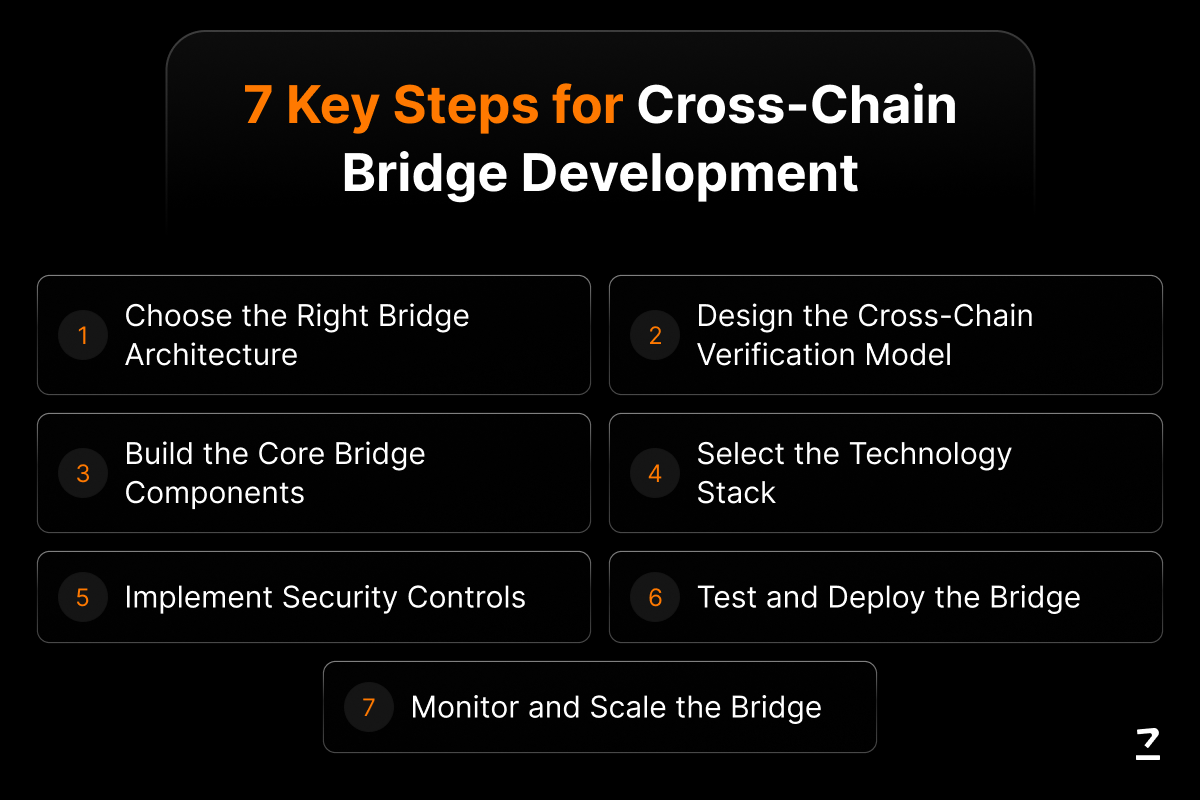
A cross-chain bridge needs more than smart contracts connecting two networks. Its architecture, verification model, messaging layer, security controls, and deployment process must work together to move assets or messages safely. Here are the 7 key steps to follow.
1. Choose the Right Bridge Architecture
The first technical decision is how assets or messages will move between networks.
Lock-and-Mint
The source-chain asset is deposited into a bridge contract and locked. The bridge then authorizes the creation of a corresponding representation on the destination chain.
The flow is: Lock → verify → message → mint
This architecture requires accurate supply accounting. If the destination representation can be created without a corresponding source-side lock, the system can become undercollateralized.
Burn-and-Mint
The asset representation is burned on one network before an equivalent amount is created on another. This approach is useful when the asset issuer controls the supply mechanism across supported networks. It can simplify supply accounting because the original representation is destroyed before another representation is created.
Liquidity-Based Bridges
Liquidity-based bridges maintain liquidity on destination networks and use that liquidity to complete transfers.
The user receives destination-chain assets from an available pool while the system settles the corresponding value across networks.
The main engineering consideration shifts from token representation to liquidity management. Pool availability, rebalancing, capital efficiency, and withdrawal mechanisms become important parts of the design.
Message-Passing Bridges
Message-passing systems transmit arbitrary data between blockchains.
Instead of focusing only on token movement, they allow one application to trigger actions on another network.
This makes them useful for:
-
Multichain DeFi
-
Cross-chain governance
-
NFT applications
-
Gaming
-
DAO operations
-
Cross-chain smart-contract calls
The architecture should therefore follow the product requirement. A token bridge and a general-purpose interoperability layer may both connect blockchains, but their technical requirements are different.
2. Design the Cross-Chain Verification Model
Once the transfer model is defined, the next decision is how the destination network will validate what happened on the source chain.
A bridge can use several approaches:
-
Validator networks
-
Guardian networks
-
Decentralized oracle networks
-
Threshold signatures
-
Light clients
-
Cryptographic proofs
-
Existing interoperability protocols
Each approach introduces different assumptions around trust, latency, infrastructure, and complexity.
Validator and Guardian Networks
A distributed group of validators or Guardians can independently observe source-chain activity and collectively attest to a message.
Wormhole's current documentation provides a practical example. Its Guardian network consists of 19 Guardians, with a 13-of-19 quorum used for standard Verifiable Action Approvals. The destination-side system verifies the resulting signatures before processing the message.
The architectural principle is more important than the specific configuration: message transport and message authorization should remain separate concerns.
Oracle-Based Verification
Cross-chain oracle infrastructure can provide authenticated information from one network to another. This approach can reduce the need for an application team to operate its own validator infrastructure, but it introduces dependency on the selected oracle and its verification model.
Light Clients and Cryptographic Proofs
A light-client approach allows one chain to verify information about another chain using cryptographic proofs. This can provide strong verification guarantees, but implementation can become more complex when supporting different blockchain architectures.
Existing Interoperability Infrastructure
Projects can also integrate established interoperability networks rather than creating their own verification system. This can reduce development complexity, but the external protocol becomes part of the bridge's security and operational assumptions. The decision should be based on what the destination chain must prove, not simply which integration is fastest to implement.
3. Build the Core Bridge Components
With the architecture and verification model established, development can be divided into distinct technical components.
Source-Chain Contract
The source contract handles the initial state transition. Depending on the architecture, this could mean locking, burning, depositing, or initiating a cross-chain message.
Typical controls include:
-
Asset validation
-
Access control
-
Nonces
-
Transfer limits
-
Replay protection
-
Event emission
The emitted event should contain an unambiguous representation of the action that needs to be verified.
Messaging Layer
The messaging layer carries authenticated information between networks.
It may include:
-
Message queues
-
Relayers
-
Verification services
-
Attestation systems
-
Executors
-
Retry mechanisms
Its role is to make the verified source event available for destination-side processing.
Destination-Chain Contract
The destination contract is responsible for validating the received message and executing the corresponding action.
It should verify parameters such as:
-
Source chain
-
Destination chain
-
Source contract
-
Message ID
-
Nonce
-
Recipient
-
Payload
-
Signatures or proof
-
Execution status
Once validation succeeds, the contract can perform the intended action, such as minting an asset, releasing liquidity, or calling another smart contract.
Indexing and Transaction State
A bridge also needs off-chain systems to track transaction progress.
An indexing service can monitor source and destination events and maintain states such as:
Initiated → Confirmed → Verified → Submitted → Executed → Completed
This creates an operational record that can be used for user interfaces, support, reconciliation, and incident investigation.
4. Select the Technology Stack
Technology choices should support the selected architecture rather than dictate it.
For EVM-based bridges, Solidity can be used for smart contracts, with established libraries such as OpenZeppelin for common contract primitives.
Foundry or Hardhat can support compilation, automated testing, deployment scripts, and local blockchain environments.
For the application and infrastructure layer, TypeScript and Node.js can handle:
-
Transaction orchestration
-
Relayer services
-
APIs
-
Background workers
-
Monitoring
-
Retry logic
A database such as PostgreSQL can maintain bridge transaction state, while Redis or another queueing mechanism can support asynchronous processing.
The infrastructure layer should also include:
-
Secure RPC providers
-
Key management
-
Centralized logging
-
Metrics
-
Alerting
-
Transaction tracing
-
Backup and recovery
The important requirement is observability across the entire transaction lifecycle. A bridge operator should be able to determine where a transfer is stuck and why.
5. Implement Security Controls
Cross-chain bridges have a wider attack surface than a single-chain application because multiple contracts, networks, verification mechanisms, and infrastructure services interact. Security controls should therefore be designed around specific failure scenarios.
Protect the Smart Contracts
Review the contracts for:
-
Reentrancy
-
Access-control errors
-
Integer and accounting issues
-
Unsafe upgrades
-
Signature-validation flaws
-
Incorrect state transitions
-
Improper input validation
Automated testing should be supported by static analysis, fuzzing, and independent security review.
Protect Cross-Chain Messages
Message validation should prevent:
-
Replay attacks
-
Forged messages
-
Wrong-chain execution
-
Unauthorized source contracts
-
Duplicate execution
-
Invalid signatures
-
Manipulated payloads
Every message should have enough domain separation and unique identification to prevent valid information from being reused in an unintended context.
Protect Administrative Operations
Privileged functions can become a major source of risk.
Protect:
-
Upgrade permissions
-
Validator configuration
-
Contract ownership
-
Treasury functions
-
Emergency controls
-
Configuration changes
Multisignature governance, timelocks, role separation, and emergency procedures can reduce the impact of a compromised administrative key.
A 2026 Messari analysis of the rsETH incident illustrates why cross-chain verification dependencies deserve particular attention. The incident involved the minting of unbacked rsETH following an exploit involving the bridge verification configuration, after which the asset was used as collateral within DeFi.
The lesson for bridge developers is clear: security review must cover the complete interoperability architecture, not only individual smart contracts.
For a detailed look at common bridge attack paths, see how cross-chain bridges get hacked.
6. Test and Deploy the Bridge
Testing should reproduce the complete lifecycle rather than validate contracts in isolation.
Test the Full Transaction Flow
A typical test sequence is:
Source transaction → event detection → finality → verification → message delivery → destination validation → execution → reconciliation
Test both successful and failed transactions.
Important scenarios include:
-
Delayed source confirmations
-
Chain reorganizations
-
Invalid signatures
-
Duplicate messages
-
Failed destination transactions
-
RPC failures
-
Relayer downtime
-
Incorrect payloads
-
Contract upgrade failures
Perform Adversarial Testing
Security testing should attempt to break the assumptions made during architecture design.
Test whether an attacker can:
-
Submit a forged message
-
Replay an old message
-
Bypass destination validation
-
Manipulate transaction ordering
-
Exploit an administrative role
-
Trigger inconsistent accounting
-
Execute a transaction twice
Testing should also include infrastructure failures because a technically correct smart contract can still be surrounded by unreliable operational systems.
Deploy in Stages
A controlled deployment can progress from:
Local development → testnet → security validation → restricted mainnet → broader production rollout
Start with controlled routes and conservative limits. Monitor the bridge's behavior before increasing transaction capacity or adding additional networks.
This creates an opportunity to identify operational problems before they affect the entire production environment.
7. Monitor and Scale the Bridge
Deployment is not the end of bridge engineering.
Production monitoring should cover:
-
Transfer completion
-
Message latency
-
Failed transactions
-
Pending messages
-
Finality delays
-
Liquidity availability
-
Reconciliation errors
-
Unusual transaction patterns
-
Validator or verifier availability
-
Infrastructure failures
Operational dashboards should connect source and destination transactions so the team can trace a transfer across its complete lifecycle.
Expand Routes Carefully
Adding another blockchain creates additional engineering and operational requirements.
The new route may require:
-
New smart contracts
-
New finality rules
-
New RPC infrastructure
-
Additional testing
-
New monitoring conditions
-
Different transaction formats
-
Additional liquidity management
For this reason, bridge scalability should be measured by reliable route coverage rather than simply the number of supported chains.
Current market activity also shows the broader importance of cross-border blockchain infrastructure. Chainalysis' 2026 Global Crypto Adoption Index reports that measured cross-border stablecoin transfers rose from $124.2 billion to $220.3 billion between January 2025 and June 2026. The report also identifies 4,708 new cross-border corridors during its measurement period.
These figures are broader than bridge activity, so they should not be interpreted as direct bridge-demand statistics. They do, however, provide current context for the growing requirement to move value across blockchain networks.
Custom Bridge vs Existing Interoperability Protocol
A project does not always need to build its own interoperability infrastructure.
|
Approach |
Best for |
Advantage |
Trade-off |
|
Custom bridge |
Specialized security, governance, or asset requirements |
Maximum control |
Greater engineering responsibility |
|
Existing protocol |
Faster interoperability integration |
Reuses established infrastructure |
External dependencies |
|
Hybrid architecture |
Specialized applications using existing infrastructure |
Balances control and reuse |
More architectural complexity |
A custom bridge gives the development team control over the verification model, contracts, governance, and operational architecture.
An existing protocol can reduce development effort and infrastructure requirements, but its trust assumptions become part of the application's risk profile.
Before selecting an interoperability protocol, review:
-
Verification architecture
-
Validator or verifier model
-
Supported networks
-
Finality assumptions
-
Upgrade controls
-
Failure handling
-
Security history
-
Operational dependencies
The decision should be based on the application's security and interoperability requirements rather than development speed alone.
How to Choose a Cross-Chain Bridge Development Company
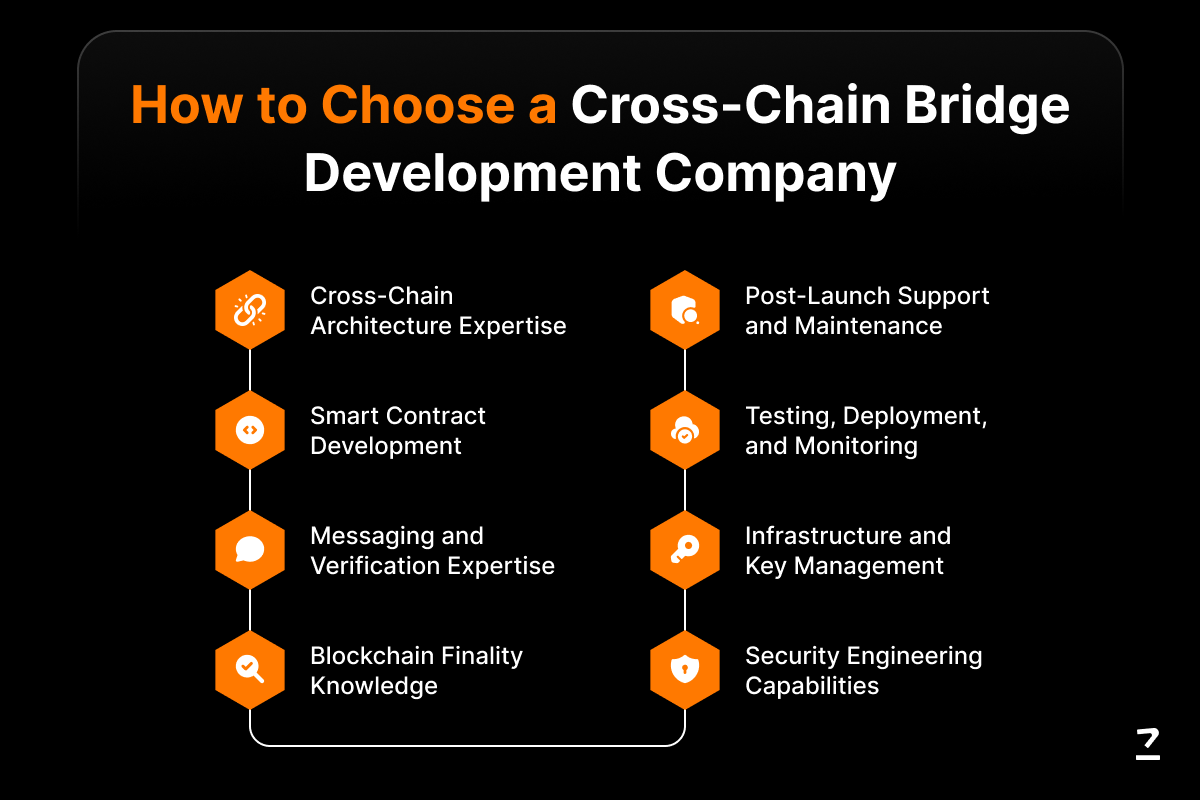
Hiring a cross-chain bridge development company requires evaluating architecture expertise alongside blockchain development capability.
A qualified team should understand:
-
Cross-chain architecture
-
Smart-contract development
-
Messaging protocols
-
Verification mechanisms
-
Blockchain finality
-
Security engineering
-
Key management
-
Infrastructure
-
Monitoring
-
Mainnet deployment
-
Post-launch maintenance
Ask the development partner to explain the proposed trust model before reviewing implementation details.
A strong technical team should be able to explain:
-
What the destination chain trusts
-
Who verifies source-chain events
-
How messages are authenticated
-
What happens when verification fails
-
How replay attacks are prevented
-
How compromised infrastructure is isolated
-
How emergency actions are governed
Codezeros provides cross-chain bridge development solutions, covering bridge architecture and development requirements for blockchain interoperability projects.
Build Your Cross-Chain Bridge With Codezeros
A successful decentralized cross-chain bridge starts with the right architecture. The transfer model determines how value or messages move; the verification model determines what the destination chain can trust; smart contracts enforce those rules; infrastructure carries and monitors transactions; and security testing validates the complete system before production.
Codezeros provides cross-chain bridge services for businesses building blockchain interoperability infrastructure. Whether the requirement is a custom bridge, an application-specific interoperability layer, or integration with an established cross-chain protocol, the architecture should be designed around the supported networks, asset model, security requirements, and long-term operating model.
Build interoperability layer around application's trust and security requirements. Connect with us to discuss your cross-chain bridge development project.
Post Author

Deep Shah
Explore Deep's insightful blog posts that help businesses stay ahead of the curve, explore new possibilities, and unlock the full potential of blockchain technology
Frequently Asked Questions
Frequently asked questions about this article.
A decentralized cross-chain bridge enables assets or messages to move between independent blockchains through a distributed or cryptographically verifiable system rather than a single centralized intermediary.
A bridge detects an event on the source blockchain, verifies the event according to its defined security model, transmits authenticated information to the destination network, and executes the corresponding destination-side action.
Common architectures include lock-and-mint, burn-and-mint, liquidity-based bridges, and general-purpose message-passing systems. The appropriate architecture depends on the asset model and application requirements.
Verification can rely on validator networks, Guardian networks, decentralized oracles, cryptographic proofs, light clients, threshold signatures, or established interoperability protocols.
They can use unique message identifiers, nonces, source and destination chain validation, source-contract validation, and execution records that prevent an already processed message from being executed again.
Finality determines when a source-chain transaction can be treated as sufficiently irreversible. Bridge execution rules need to account for the finality characteristics of each supported network.
A custom bridge may make sense when the project requires specialized verification, governance, asset logic, or security controls. Existing interoperability infrastructure may be preferable when its trust model and capabilities already fit the application.
Evaluate the team's experience in smart contracts, interoperability protocols, verification architecture, blockchain security, infrastructure, testing, deployment, and post-launch monitoring.
More questions? Contact us.
Have a cross-chain bridge project in mind?
Get a tailored decentralized cross-chain architecture and development plan covering verification, smart contracts, security, testing and deployment.
Blogs
Our Latest Blogs
Discover valuable industry insights and stay up-to-date with the latest updates by exploring our curated collection of recent blog posts.