
SHARE THIS ARTICLE
13 Aug 2026
Evaluating the Best Blockchains for Building RWA Tokenization Platforms
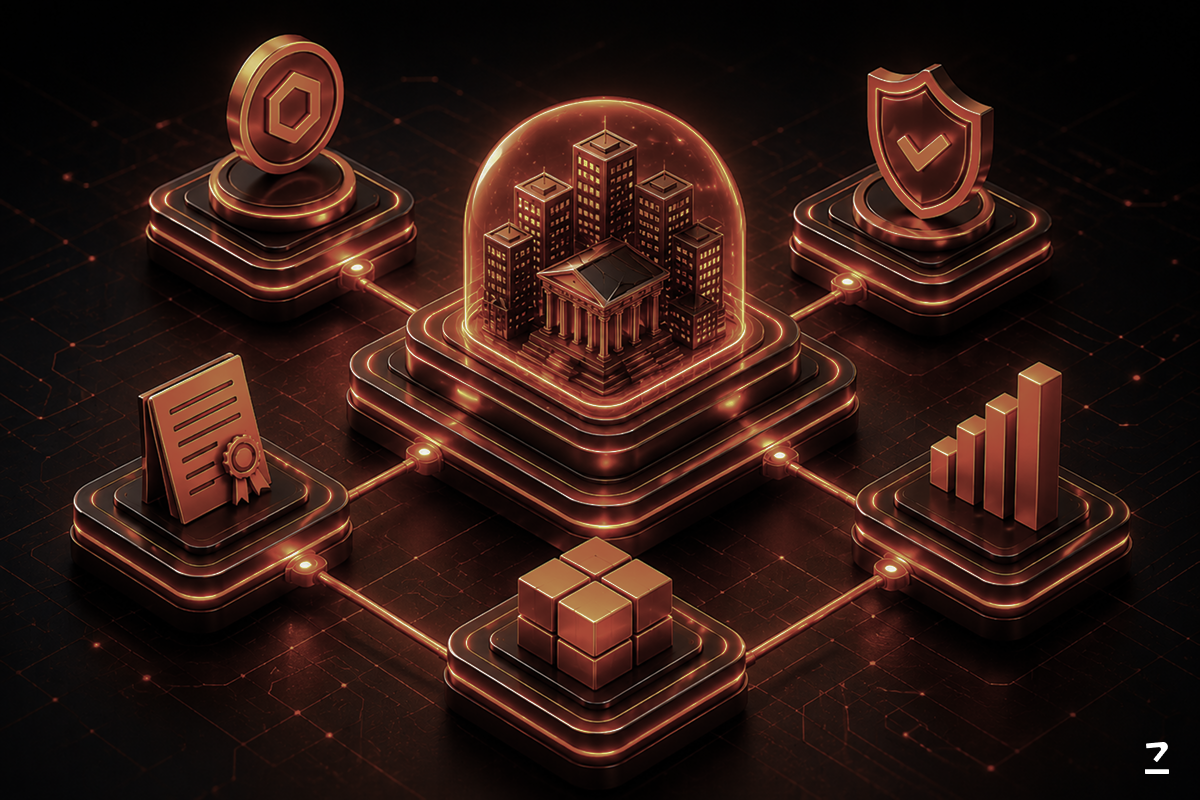
A blockchain choice can look perfect in a demo and still fail the product later.
The token deploys. The wallet connects. The first transfer works. Then the real issues appear. An investor from the wrong jurisdiction tries to buy. A custodian report needs updating. A fund NAV changes. A property payout has to be distributed. A secondary transfer needs approval. An oracle feed fails. A compliance rule changes after launch.
That is when the blockchain choice becomes more than a technical preference.
For businesses planning RWA tokenization platform development, the question is not “Which chain is fastest?” or “Which chain has the lowest fees?” The better question is:
Which blockchain can support the asset’s legal structure, investor rules, custody model, data flow, liquidity plan and operating controls after launch?
RWA Tokenization Development Company positions its RWA work around secure and compliant real world asset tokenization platforms for real estate, commodities, debt and funds. Its service scope includes smart contracts, compliance integration, investor platforms, liquidity support, fractional ownership, custody, fiat rails, oracle systems and blockchain ecosystem integration. That is the right frame for this topic because an RWA platform is a full operating layer, not only a token contract.
Start With the Asset Claim Before the Chain
Every RWA platform begins with a claim.
A token may represent a share in rental income. It may represent exposure to private credit. It may represent a fund unit, a commodity reserve, an invoice-backed receivable, a carbon credit, or a tokenized debt instrument.
The blockchain can record who holds the token. It can enforce transfer rules. It can automate selected actions. It can connect to wallets, marketplaces and settlement flows.
It cannot, by itself, prove that the asset is legally clean, correctly valued, properly custodied or available for redemption.
That is the gap serious teams need to solve.
A weak RWA project chooses a chain first and then tries to fit the asset into it. A stronger RWA tokenization development company defines the asset claim first, then chooses the chain that fits the product’s control model.
Here is the starting point:
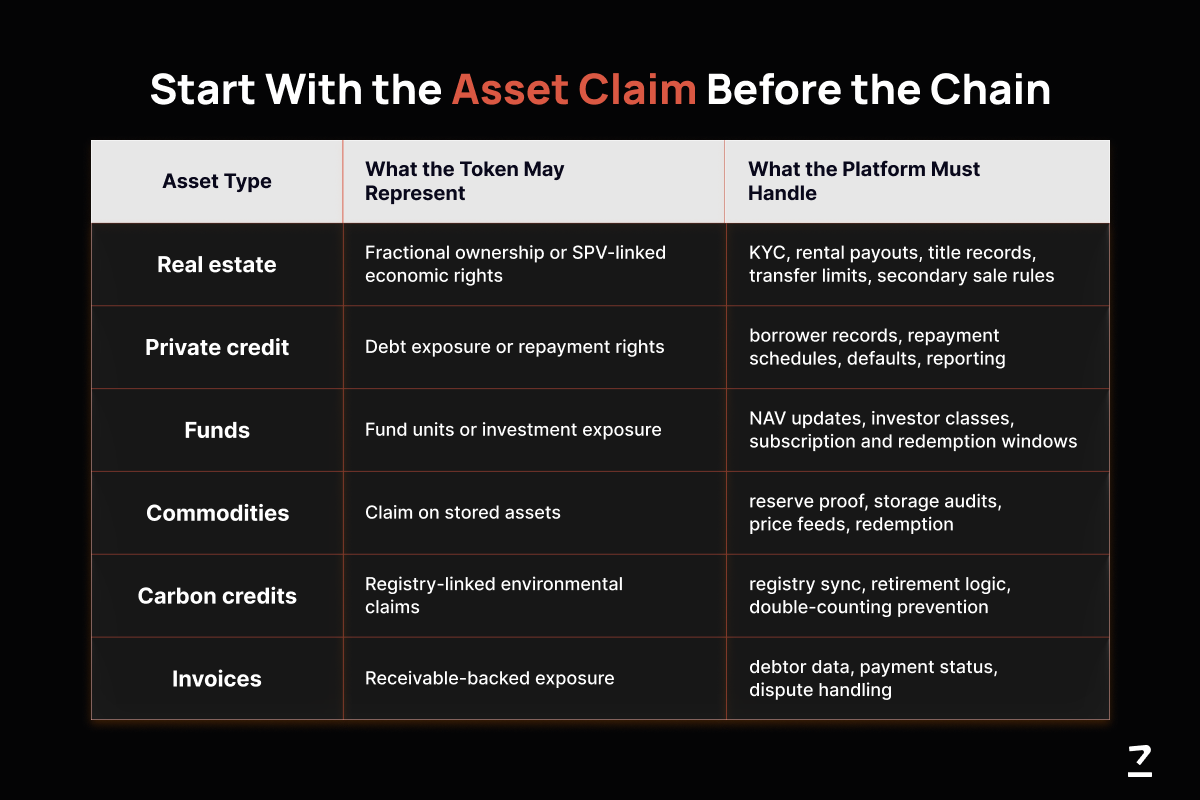
The same chain will not serve all of these equally.
A real estate platform may need lower-cost investor actions and restricted transfers. A fund platform may need institutional-grade standards and custody integrations. A commodity token may depend more heavily on proof-of-reserve and redemption logic. A private credit product may care more about borrower records and payment schedules than open DeFi access.
So the chain decision should come after the asset model, not before it.
The Real Blockchain Decision Is a Control Decision
The best blockchain for RWA tokenization is the one that gives the platform the right controls.
Those controls usually sit in five areas.
1. Investor Control
RWA tokens often cannot move like normal crypto tokens.
A tokenized fund, debt product, real estate investment or securities-style asset may need rules around who can hold, receive, transfer or redeem the token.
That can include:
-
KYC and AML checks
-
accredited investor status
-
jurisdiction filters
-
allowlisted wallets
-
blocked wallets
-
lock-up periods
-
transfer approvals
-
issuer-level freeze or recovery actions
ERC-3643 is important here because it is built around permissioned tokens for RWA tokenization. Its documentation describes transfers that execute only when investor rules and offering rules are satisfied.
This matters for chain selection. If the asset needs regulated transfers, the chain must support permissioned token logic or integrate cleanly with a compliance layer that can enforce it.
A normal token launch team may stop at minting and transfer. An asset tokenization development company has to think about who is allowed to hold the token in the first place.
2. Data Control
RWA tokens depend on real-world data.
A property token may depend on title records, SPV documents, rent collection and valuation reports. A fund token may depend on NAV data and investor class rules. A commodity-backed token may depend on warehouse records, reserve audits and redemption terms. A private credit token may depend on borrower performance and repayment status.
That means the platform needs a clear answer for:
-
where the asset data comes from
-
who can update it
-
how often it changes
-
what happens if it is wrong
-
what investors can see
-
what must remain private
-
how the platform proves the token still reflects the asset
This is where many blockchain comparison articles become thin. They compare gas fees and transaction speed while ignoring the harder question: what does the token trust outside the chain?
Codezeros’ security article discusses oracle risk, custody assumptions, transfer restriction flaws, privileged roles and third-party dependencies as major RWA concerns. Those are not side issues. They directly affect blockchain selection and platform architecture.
3. Transfer Control
Liquidity sounds attractive in every RWA pitch. The platform still needs to define what kind of liquidity is legally and operationally possible.
Some assets may support open secondary movement. Others may allow trading only between verified investors. Some may need issuer approval. Some may use redemption windows instead of open trading. Some may have lock-up periods or jurisdiction limits.
Before choosing a blockchain, the team should answer:
-
Can the token move to any wallet?
-
Can it move only to verified wallets?
-
Can it move across jurisdictions?
-
Can transfers be paused?
-
Can the issuer reverse or recover in limited cases?
-
Is secondary trading allowed?
-
Is redemption the main exit route?
-
Will liquidity happen through a marketplace, OTC process or issuer-controlled flow?
A chain with strong DeFi activity may be useful for some products. It may create risk for others.
For regulated RWAs, liquidity has to stay inside the rules. A liquid token that breaks compliance is not a better product. It is a liability.
Recent research on tokenized RWA markets also warns that tokenization and liquidity should be treated as separate outcomes. A token may exist on-chain and still have low turnover, limited holder activity or weak secondary-market depth.
4. Cost and Activity Control
Low fees matter only when they match the product’s usage pattern.
A tokenized institutional fund may have fewer transfers and larger ticket sizes. Ethereum mainnet cost may be acceptable if the product benefits from standards, custody integrations and institutional trust.
A retail-facing real estate platform may have more frequent investor actions, smaller ticket sizes, rental payouts and portfolio updates. In that case, lower-cost networks or L2s may become more important.
A commodity or payment-linked product may need frequent movement and fast settlement.
So the team should estimate activity before selecting a chain:
-
investor subscriptions
-
purchases
-
transfers
-
redemptions
-
rental or dividend payouts
-
debt repayments
-
NAV updates
-
proof-of-reserve updates
-
compliance rule updates
-
secondary-market transactions
-
reporting events
A chain that feels cheap during the prototype can become expensive at scale. A chain that feels credible may become too costly for the user flow. The cost decision should follow the product’s actual operating rhythm.
5. Operator Control
RWA platforms need a way to act when something changes.
Custodians may change procedures. Regulations may shift. An investor may lose wallet access. A valuation feed may fail. A payout may need correction. A transfer may need to be blocked. A contract may require an upgrade path.
The platform needs clear roles for:
- minting
- burning
- pausing
- freezing
- compliance updates
- redemption approvals
- oracle changes
- contract upgrades
- emergency actions
- audit logs
A basic token launch focuses on deployment. A serious RWA tokenization solution needs operating control after deployment.
This is where admin roles, multisig, timelocks, permissioned transfers, monitoring and audit trails become central to platform design.
Where the Major Blockchain Options Actually Fit
Once the product’s control model is clear, the chain comparison becomes more useful.
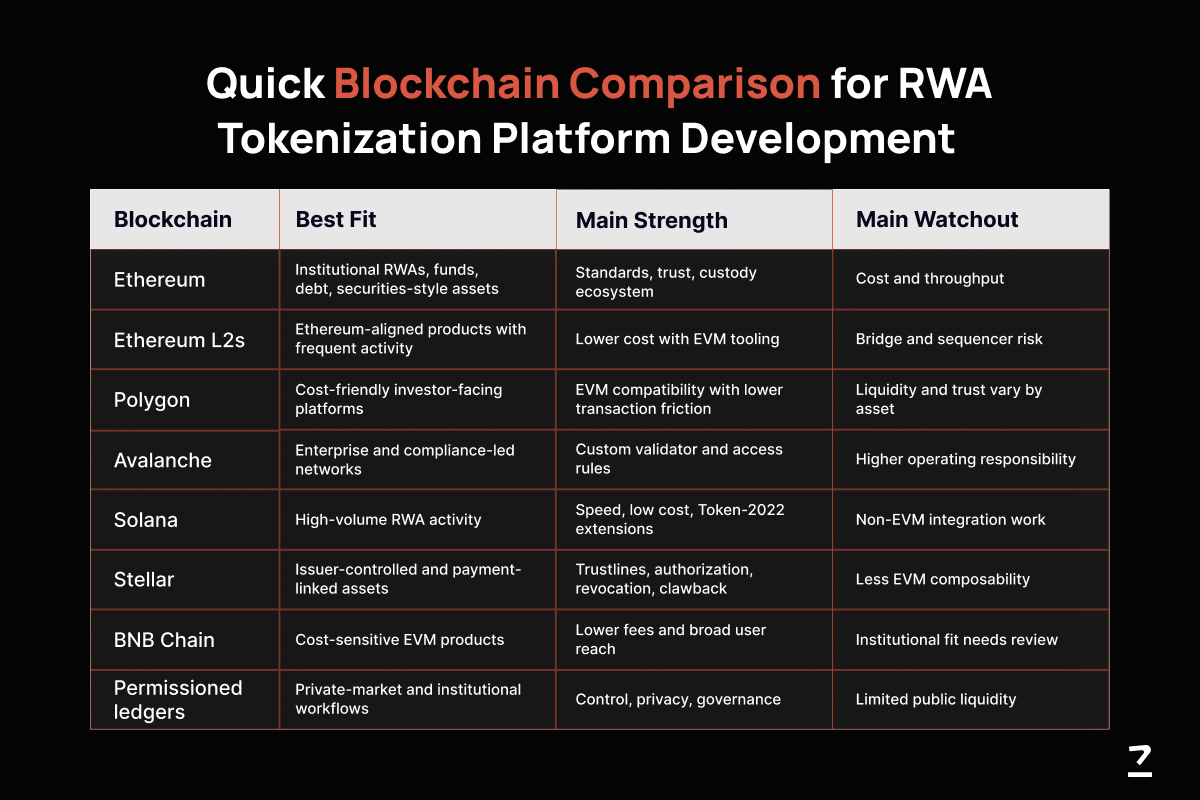
Ethereum, Ethereum L2s, Polygon, Avalanche, Solana, Stellar, BNB Chain and permissioned ledgers each have a place. The mistake is treating any of them as the default answer for every asset.
Ethereum for Trust-Heavy and Standards-Heavy RWA Products
Ethereum often becomes the first serious option for institutional RWA products because of its ecosystem maturity.
It has broad wallet support, deep developer tooling, smart contract standards, custody infrastructure, audit familiarity and institutional recognition. For tokenized funds, debt instruments, securities-style assets and Treasury-style products, those signals matter.
Ethereum can be a strong fit when the platform needs:
-
mature smart contract tooling
-
EVM-based standards
-
permissioned token logic
-
custody integrations
-
wallet ecosystem depth
-
stronger institutional familiarity
-
long-term audit and infrastructure support
The trade-off is cost. Ethereum mainnet may not suit frequent small transfers, retail-heavy flows or regular payout events. A platform may still choose Ethereum for issuance and settlement while using an L2 or connected layer for more frequent user actions.
Good fit: institutional RWA platforms, tokenized funds, debt instruments, securities-style assets.
Weak fit: high-frequency retail activity where every user action must stay low-cost.
Ethereum L2s for EVM Alignment With Lower Transaction Friction
Ethereum L2s become useful when the platform wants the EVM ecosystem but cannot run every action on mainnet.
They may fit:
-
investor dashboards
-
frequent transfers
-
distribution events
-
lower-value transactions
-
secondary-market activity
-
applications that still want Ethereum-aligned tooling
The trade-off sits in dependencies. L2s can introduce bridge risk, sequencer dependency, withdrawal timelines and cross-chain reporting complexity.
For regulated RWAs, the platform must also make sure compliance rules remain consistent across the chosen layer. A token that is compliant on one environment and uncontrolled on another can create serious operating risk.
Good fit: Ethereum-aligned RWA products with regular user activity.
Weak fit: products that cannot tolerate bridge, sequencing or cross-layer reporting complexity.
Avalanche for Enterprise Control and Compliance-Led Network Design
Avalanche becomes relevant when the network itself needs more control.
Some RWA products need custom validator rules, known participants, private workflows, jurisdiction-based controls or institution-led governance. Avalanche L1s can define their own membership rules, token economics, execution logic, fee regime and validator requirements. Avalanche documentation also notes that validators can be required to meet conditions such as country location, KYC/AML checks or licensing.
That makes Avalanche worth considering for:
-
enterprise RWA networks
-
regulated private markets
-
controlled validator setups
-
institution-led platforms
-
custom asset tokenization platform development
-
compliance-led infrastructure
The trade-off is operational responsibility. More control means the team must plan validator management, governance, monitoring, upgrades and long-term maintenance.
Good fit: enterprise RWA platforms that need custom rules, validator control or private-network design.
Weak fit: simple token issuance where a full custom network would add unnecessary complexity.
Solana for Fast and High-Volume RWA Activity
Solana becomes interesting when transaction cost and speed are central to the platform experience.
A platform with frequent investor actions, smaller transactions, high-volume transfers or payment-style movement may consider Solana. Its Token-2022 program also includes extensions such as transfer fees, interest-bearing tokens, non-transferable tokens, permanent delegate, transfer hooks, confidential transfers and pausable tokens.
That can matter for certain RWA structures where token behavior needs to go beyond a basic transfer model.
Solana may fit:
-
high-volume RWA platforms
-
commodity-linked tokens
-
payment-linked assets
-
frequent retail participation
-
products that benefit from token-level extensions
The trade-off is integration. Solana is not EVM-native, so wallet support, developer stack, custody partners, compliance tools and smart contract architecture need a separate review.
Good fit: high-activity RWA products where low-cost movement matters.
Weak fit: teams that need EVM standards, existing Solidity contracts or EVM-first custody workflows.
Stellar for Issuer-Controlled and Payment-Linked Assets
Stellar is worth evaluating when issuer control and payment movement matter more than complex DeFi composability.
Stellar’s asset model includes trustlines and issuer-level controls. Its documentation explains authorization-required flags, revocable authorization and clawback-enabled assets. Issuers can require approval before an account holds an asset and can revoke authorization to freeze asset activity in regulated cases.
That makes Stellar relevant for:
-
issuer-controlled assets
-
payment-linked RWA products
-
stable asset movement
-
regulated access models
-
simple token issuance with clear holder controls
Stellar may be less suitable for products that need deep EVM composability, complex smart contract patterns or DeFi-heavy secondary-market design.
Good fit: issuer-controlled assets, payment-linked flows and regulated access models.
Weak fit: EVM-heavy RWA products that need broad smart contract composability.
BNB Chain for Cost-Sensitive EVM Products With Broad User Reach
BNB Chain may fit RWA products that need lower transaction costs, EVM compatibility and access to a broad crypto-native user base.
It can be considered for:
-
cost-sensitive RWA platforms
-
retail-facing investor access
-
EVM-based applications
-
crypto-native participation models
-
products where lower transaction friction matters
The chain should still be evaluated carefully for regulated assets. Institutional trust, custody support, compliance tooling and market suitability matter more than ecosystem size alone.
Good fit: cost-sensitive EVM RWA platforms with broad user reach.
Weak fit: institutional RWA products where custody, compliance and trust signals point elsewhere.
Permissioned options can include:
-
Hyperledger
-
R3 Corda
-
private Ethereum networks
-
enterprise permissioned ledgers
These networks may fit:
-
closed investor groups
-
institutional settlement
-
private market workflows
-
restricted participant networks
-
internal asset registries
-
regulated financial workflows
The trade-off is market reach. Permissioned networks usually reduce open liquidity and public composability. Their value depends on the quality of the participants and governance model.
Good fit: private-market and institutional workflows where control matters more than public liquidity.-
Weak fit: products that need broad wallet access, public market participation or open composability.
Best Blockchain by Asset Type
The best blockchain for RWA tokenization becomes clearer when the asset type is known.
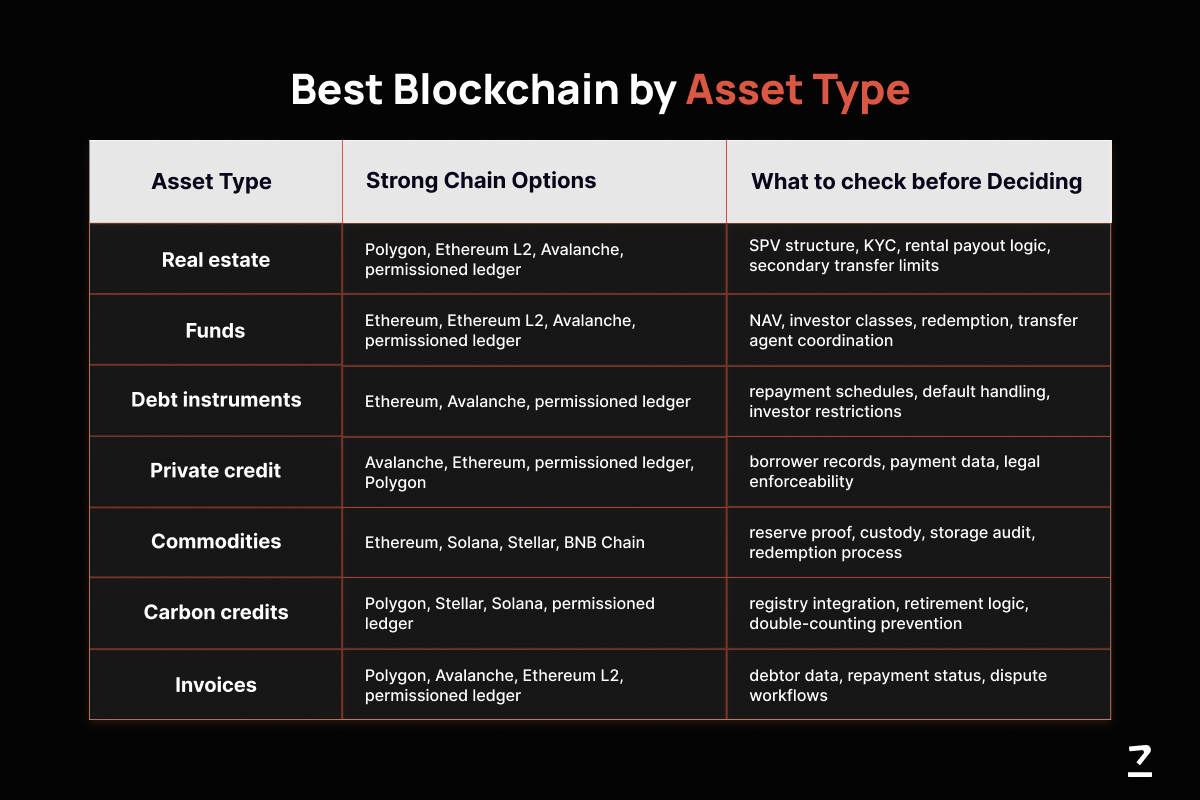
A chain comparison that ignores asset type will always remain shallow.
Security Risks Should Influence Blockchain Choice
Security in RWA tokenization is larger than smart contract auditing.
The platform may depend on custodians, oracles, KYC providers, transfer agents, admin keys, bridges, wallets, fiat rails and marketplace systems. Any weak point can damage the link between the token and the asset.
Before choosing a chain, teams should understand the major security risks in RWA tokenization, including custody assumptions, oracle failure, transfer restriction flaws, privileged roles and third-party dependencies.
A strong security review should ask:
-
Can the chain support the required transfer restrictions?
-
Can admin actions be separated by role?
-
Can emergency actions use multisig or timelocks?
-
Can oracle updates be monitored?
-
Can the platform pause activity during disputes?
-
Can the chain support audit logs and compliance review?
-
Are bridge or cross-chain dependencies adding risk?
The safest blockchain is not always the most popular one. It is the one that supports the asset’s control model with the least unnecessary exposure.
Liquidity Should Be Tested Before It Is Promised
RWA tokenization often gets sold as a liquidity story.
That can be true, but it is not automatic.
A tokenized asset can remain illiquid if there are too few qualified buyers, poor marketplace access, weak market-maker support, unclear exit routes, restrictive transfer rules or low investor trust.
Before choosing a blockchain, the team should test:
-
Who will buy the asset?
-
Can they legally hold it?
-
Where will secondary activity happen?
-
Will transfers need approval?
-
Can investors exit through redemption?
-
Is there custodian support?
-
Are market makers involved?
-
Will liquidity exist only inside a closed platform?
A chain with high activity may still be a poor fit if the asset cannot legally move through that environment. A permissioned network may look less liquid but fit a private-market product better.
The liquidity plan should shape the chain choice, not follow it.
Quick Blockchain Comparison for RWA Tokenization Platform Development
How to Choose the Best Blockchain for Your RWA Tokenization Solution
Use this decision checklist before committing to a chain.
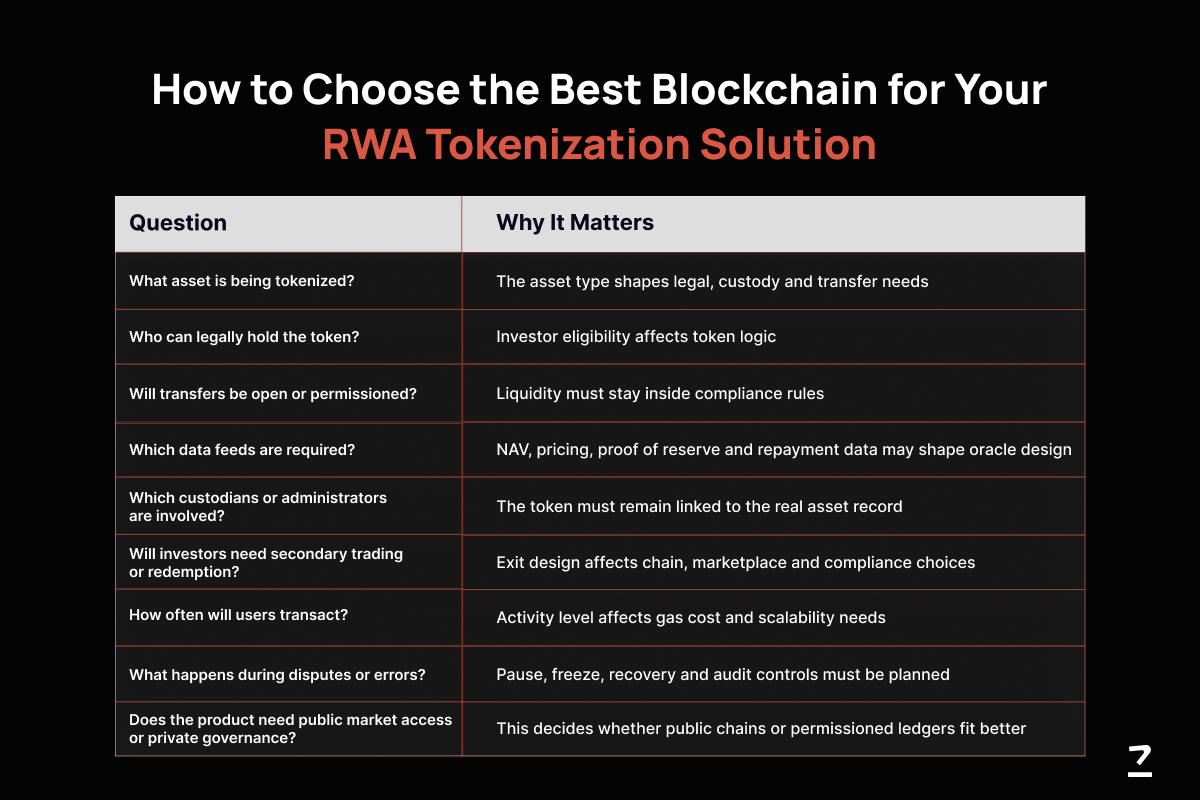
A serious RWA tokenization solution provider should help answer these questions before writing contracts.
When to Hire RWA Tokenization Developers
Hire RWA tokenization developers when the product needs more than token deployment.
A real RWA platform may need:
-
asset structuring
-
compliance workflows
-
token standards
-
investor onboarding
-
smart contracts
-
custody integrations
-
oracle systems
-
payout logic
-
redemption flows
-
dashboards
-
reporting
-
security controls
-
post-launch support
A basic token team may deploy a contract. As an experienced RWA tokenization development firm, Codezeros helps shape the platform around the asset, the investors and the operating model. Connect with us to see the difference that matters when real assets and real capital are involved.
Post Author

Jay Kapoor
With a genuine love for all things blockchain, Jay is one of the Blockchain Enthusiasts and Consultants at Codezeros. With a fresh and innovative perspective on the world of blockchain, Jay provides strategic guidance and implementation support to clients across diverse industries and helps them unlock new opportunities.
Frequently Asked Questions
Frequently asked questions about this article.
Build Around the Asset, Not the Chain
Choosing the blockchain is only one part of RWA tokenization platform development. The larger work is defining the asset structure, investor rules, compliance flow, custody model, smart contracts, liquidity route, dashboards, and post-launch controls. Codezeros helps businesses plan and build tokenization platforms around asset structure, compliance flow, investor access, smart contracts, liquidity design and post-launch operations.
Blogs
Our Latest Blogs
Discover valuable industry insights and stay up-to-date with the latest updates by exploring our curated collection of recent blog posts.
Let us know your requirement
We know ideas matter, we are the product of one. We Provide Full Assistance In Your Business