
SHARE THIS ARTICLE
27 Aug 2026
LayerZero vs Wormhole vs Axelar: Choosing the Right Cross-Chain Bridge Protocol
A contract on one blockchain cannot independently see what happened on another. If assets are locked on a source chain before value is released elsewhere, the destination side needs acceptable proof that the first event really occurred. That verification step sits at the centre of cross-chain bridge development services.
LayerZero, Wormhole and Axelar solve it with different infrastructure. The choice affects who verifies a message and what the application must configure itself. It also changes the dependencies carried into production. A cross-chain bridge development company therefore has more to examine than network coverage or SDK support.
The Bridge Inherits a Verification Model
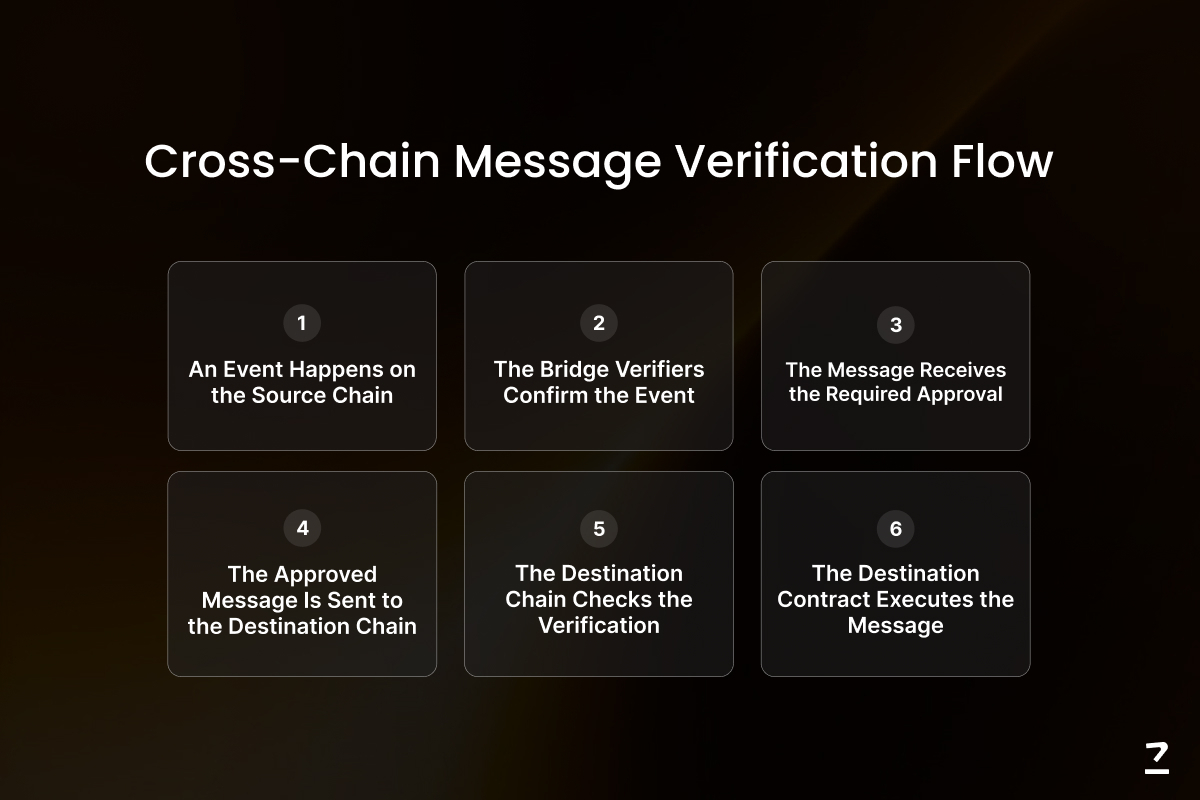
Take a simple cross-chain message. A contract records an event on Chain A and another contract on Chain B is expected to act on it.
Chain B has no native reason to trust what happened on Chain A.
The bridge protocol fills that gap.
With LayerZero V2, the receiving application can specify the Decentralized Verifier Networks that must confirm its messages. Wormhole produces signed attestations through its Guardian Network. Axelar runs cross-chain communication through a proof-of-stake network.
These are meaningful architectural differences. A failure in verification can make an otherwise correct destination contract act on information it should never have accepted.
For that reason, protocol selection should begin with the message path. Who observes the source chain? What has to happen before the destination accepts the message? Which part of that process can the application configure?
Chain support becomes useful after those answers are clear.
LayerZero V2 Puts More Security Configuration in the Application
LayerZero does not require every application to use one universal verifier set.
Its V2 Security Stack lets an OApp configure DVNs for a messaging channel. Some DVNs can be mandatory. Another group can be optional, with the application setting how many of those optional verifiers must agree.
LayerZero calls this an X-of-Y-of-N configuration. Each selected DVN checks the message payload independently. The destination Endpoint can mark the message as verified once the configured threshold has been satisfied.
The interesting part for a bridge team is not the terminology. It is the amount of responsibility that comes with the configuration.
A project can choose different security arrangements for different routes. The team may want stricter verification for a pathway carrying more value. It can also combine independent verification providers instead of depending on one verifier.
LayerZero's own documentation makes production configuration worth paying attention to. Default pathway settings are placeholders and can vary. The documentation advises production deployments to configure their Security Stack explicitly and recommends using at least one required DVN that is not operated by LayerZero Labs.
So evaluating LayerZero means looking at the actual DVN coverage available for the chains in scope, rather than assuming that integration with an Endpoint completes the security work.
Execution is another layer. Once verification requirements are met, an authorized caller such as an Executor can commit the message for destination execution. Verification and execution are kept separate in the protocol architecture.
Wormhole Centres the Message Around a VAA
Wormhole takes a different route. Its core messaging primitive is a Verifiable Action Approval, usually shortened to VAA.
Guardians observe messages published through Wormhole contracts and sign what they have observed. Once the required quorum is reached, the signatures and message data form the VAA that the destination contract can verify.
The current canonical Guardian set contains 19 members. A standard VAA requires 13 signatures.
That gives a bridge developer a defined attestation model from the start. There is no per-application DVN stack to assemble before every route can operate.
Delivery is deliberately separate. Anyone can submit a valid VAA to the destination chain. The relayer does not gain the ability to alter the message simply because it transports it. The destination checks the Guardian signatures before processing the payload.
The current Wormhole architecture has one detail that older protocol comparisons often miss.
Some chains now use delegated Guardian sets for direct observation. A subset of Guardians watches those chains and reaches a configured delegate quorum first. Canonical Guardians then continue the signing process. The VAA presented to the destination remains a standard 13-of-19 attestation.
For a bridge covering several networks, that means the observation path should be checked chain by chain. The final VAA format may be the same even though the route used to reach that attestation is not identical.
Axelar Makes the Interoperability Network Part of the Trust Model
Axelar operates its own proof-of-stake network.
Validators participate in consensus and in the processing of cross-chain requests. The Axelar whitepaper describes a validator set with stake-weighted voting power and Byzantine fault-tolerant consensus for finalizing network activity.
Its General Message Passing capability lets applications send more than tokens. Contracts can pass data across connected networks and use that message to trigger logic on the other side. Axelar therefore functions as an interoperability layer between the participating chains rather than only as a token-transfer mechanism.
For a development team, the key dependency sits at network level. The application is relying on Axelar's validator network to support the cross-chain communication path.
There is less application-level verifier assembly than with LayerZero. The review instead moves toward Axelar's validator assumptions, the supported routes and how the application will interact with its cross-chain messaging stack.
At this stage, a useful protocol shortlist should already reflect the security model the bridge is prepared to run with. Token standards, developer tooling and use-case fit can then narrow that shortlist further.
LayerZero vs Wormhole vs Axelar: Key Differences
Once token movement and contract execution enter the scope, protocol selection starts affecting the wider cross-chain bridge development architecture. The differences between LayerZero, Wormhole and Axelar become harder to ignore.
A bridge may need to move an existing asset. Another project may want one token supply available across several chains. Some applications need arbitrary messaging after the transfer itself. Each protocol exposes different primitives for those jobs.
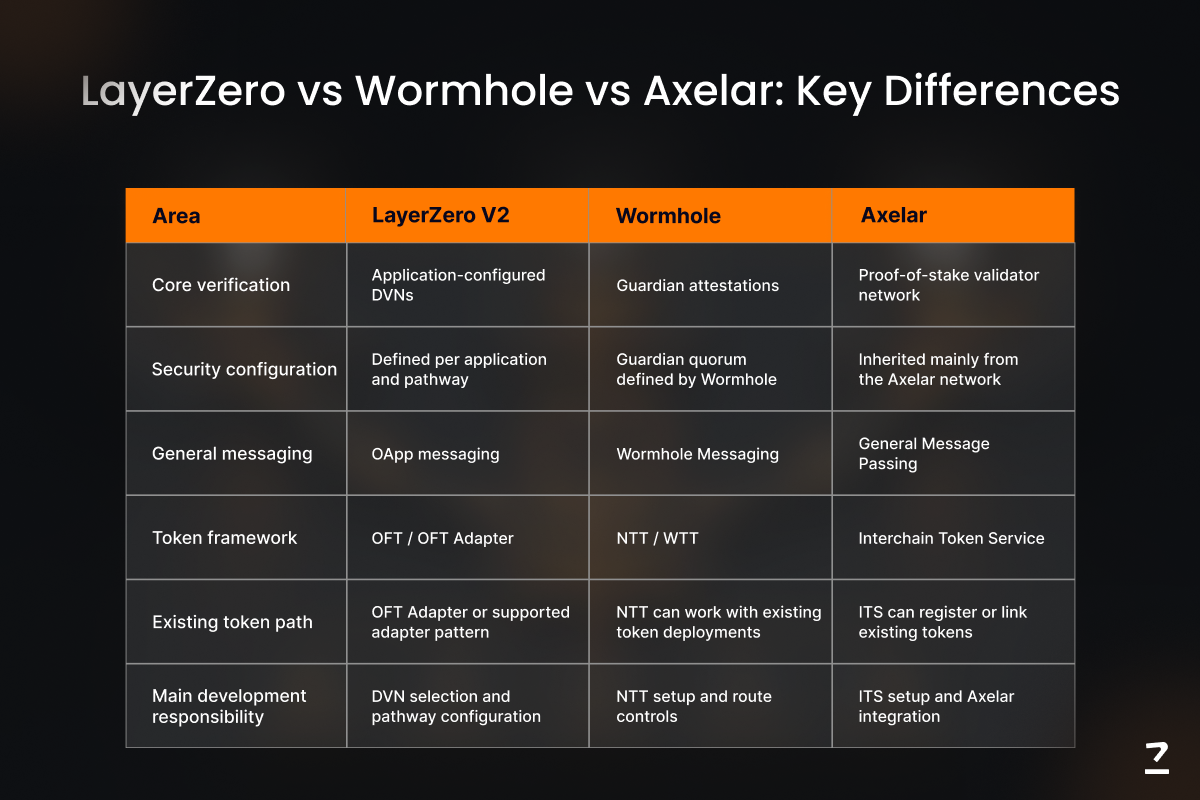
LayerZero exposes more application-level security configuration. Wormhole gives developers a defined Guardian-attestation model. Axelar places more of the interoperability logic inside its own network.
What matters is whether those characteristics fit the bridge being designed. A team providing cross-chain bridge development services has to carry those protocol assumptions into token logic, route configuration and production monitoring.
OFT, NTT and ITS Approach Multichain Tokens Differently
Token transfers deserve their own comparison because messaging alone does not answer questions around supply management.
A token issuer may want the same asset to exist across several networks without creating a generic wrapped token each time. OFT, NTT and ITS all address that problem, though their implementation models differ.
LayerZero OFT
LayerZero's Omnichain Fungible Token standard maintains token supply across connected deployments.
A transfer debits value on the source chain and credits it on the destination. The mechanism may use burn-and-mint or lock-and-unlock logic depending on the token setup.
New tokens can include OFT functionality directly.
Existing ERC-20 tokens have another route. An OFT Adapter can connect a token that cannot be modified, while other adapter patterns support contracts with suitable minting or burning controls.
OFT also inherits LayerZero's messaging configuration. The DVNs selected for a pathway remain relevant to token transfers carried over that route.
Wormhole NTT
Native Token Transfers keep more control with the token issuer.
An NTT deployment can use burn-and-mint logic or escrow existing supply. Ownership and upgrade authority remain part of the issuer's setup. Rate limits can also be applied through the NTT Manager.
The architecture separates token management from message transport.
NTT Managers handle the token-side rules. Transceivers handle cross-chain messaging. This gives the issuer room to define how the token behaves across supported networks.
Wormhole also has Wrapped Token Transfers, but NTT is the more useful comparison here because it targets issuer-controlled multichain deployments.
Axelar ITS
Axelar's Interchain Token Service handles both new token deployments and existing assets.
An ERC-20 can be registered as a canonical token. Existing deployments on different chains can also be connected through token managers.
Custom token logic does not have to disappear simply because the asset becomes multichain.
ITS runs through Axelar's interoperability network, so its token model sits directly on top of the same validator-based infrastructure used for cross-chain communication.
Protocol Choice Depends on What the Bridge Actually Needs
LayerZero deserves attention when security configuration needs to stay closer to the application.
Different DVN arrangements can be used across different messaging paths. A bridge carrying larger values on one route could adopt a stricter verification setup there without applying the same configuration everywhere.
Wormhole removes some of that application-level verifier selection.
The Guardian model is already defined at the protocol layer. NTT then gives token issuers controls around multichain deployment without requiring them to build a separate messaging layer themselves.
Axelar takes another route.
Its validator network handles the interoperability layer, while General Message Passing supports cross-chain contract calls. ITS extends the same infrastructure into token deployment.
The intended application often narrows the choice faster than a protocol feature list.
A DeFi bridge may care heavily about liquidity movement and failure exposure. NFT infrastructure may need ownership or metadata to move correctly between networks. Governance systems may send instructions without transferring an asset at all.
Multichain token launches bring a different problem again. Supply needs to remain coherent across every supported deployment.
Codezeros explores those application differences further in its guide to cross-chain development for DeFi and NFTs.
In cross-chain bridge development solutions, the actual routes and asset behaviour need to be mapped before the protocol is locked in. Security assumptions and token mechanics usually narrow the choice much faster than a generic feature comparison.
Protocol Selection Should Follow the Bridge Design
Protocol choice becomes easier once the bridge itself is clearly defined.
The source and destination chains should already be known. The team should also understand how assets will move between them. A burn-and-mint model creates different implementation requirements from a bridge that locks liquidity on one chain and releases an equivalent representation elsewhere.
Verification then becomes part of that architecture rather than a separate protocol feature.
LayerZero gives more control over the verifier configuration used on individual pathways. Wormhole introduces a defined Guardian-attestation model. Axelar places cross-chain validation within its proof-of-stake network.
Production planning also needs to account for what happens outside the successful transfer path.
Messages can arrive late. Destination execution can fail. Liquidity may become unavailable. Gas conditions can change between the source transaction and destination execution. Contract upgrades can introduce another variable while messages are still in transit.
Those conditions belong in the testing plan before real assets depend on the bridge.
Route-level details matter as well. Two networks may both be supported by a protocol while relying on different operational setups or token mechanisms. A protocol name alone does not tell the development team everything it needs to know about a specific route.
What a Cross-Chain Bridge Development Company Needs to Evaluate
A cross-chain bridge development company should be able to justify the interoperability stack before development moves into interface or wallet integration.
The first review is architectural. Which networks are being connected? What events need to cross between them? How will the destination verify those events?
Token behaviour comes next.
An existing token may require adapters or escrow logic. A new multichain asset can be designed around burn-and-mint from the beginning. Supply controls also need to remain coherent when several networks can mint, release or receive the same asset.
Other areas worth reviewing include:
-
Verification rules on each route
-
Existing smart contract compatibility
-
Message ordering
-
Replay protection
-
Transfer limits
-
Upgrade permissions
-
Failure recovery
-
Post-launch monitoring
Protocol-specific work sits underneath each of these decisions.
LayerZero integrations need deliberate DVN configuration. Wormhole projects need the Guardian model and token-transfer setup understood in context. Axelar integrations have their own relationship between application contracts and the interoperability network.
Security review cannot stop at the protocol boundary either. A bridge can integrate LayerZero, Wormhole or Axelar correctly and still contain flaws in the contracts built around that integration.
Teams looking to hire cross-chain bridge developers should therefore ask how the development team handles protocol-specific trust assumptions and failure conditions, not simply which interoperability protocols appear in its technology stack.
From Protocol Integration to a Production Bridge
A protocol integration is only one part of the finished bridge.
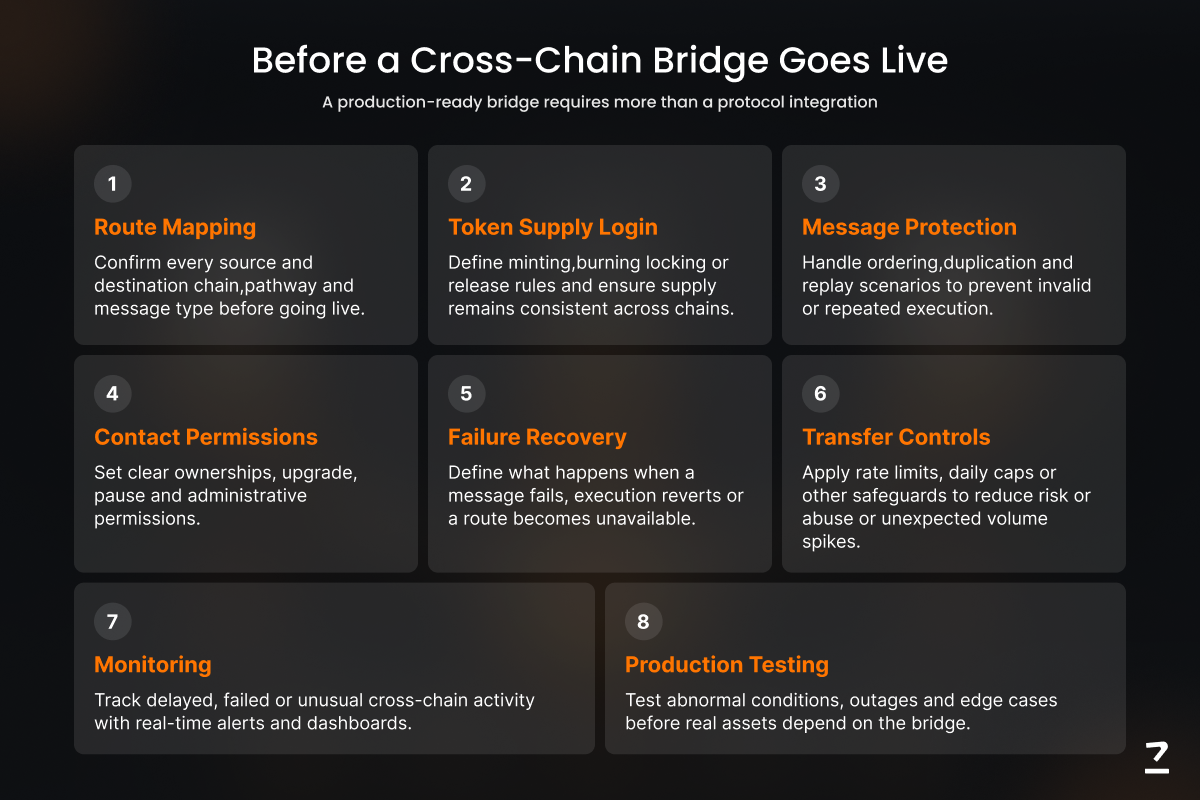
Token contracts may need adapters. Destination contracts must process incoming messages safely. Administrative permissions need clear ownership. Monitoring should surface failed or delayed transfers before they become support tickets.
This is where cross-chain bridge development services move beyond connecting an SDK.
The messaging layer has to work with the token model and application logic around it. An OFT deployment carries different responsibilities from an NTT implementation. Axelar ITS introduces its own token-management model within the Axelar stack.
Recovery behaviour deserves the same attention as successful transfers.
If a destination call fails, the application needs to know what happens to the original transaction. If a route is paused, users should not be left with an unclear asset state. Bridge operators also need enough visibility to identify where a transfer stopped.
Good cross-chain bridge development solutions make these responsibilities explicit before launch rather than discovering them through production incidents.
Choosing Between LayerZero, Wormhole and Axelar
LayerZero is worth considering when application-level control over verification is important. Its DVN model lets the team define the security configuration used on specific messaging pathways.
Wormhole takes a more standardized route through Guardian-signed attestations. NTT then adds a token framework for issuers that want greater control over multichain deployments.
Axelar moves more of the interoperability responsibility into its proof-of-stake network. General Message Passing handles cross-chain communication, while ITS supports token deployment across connected chains.
The application still decides which of those characteristics matters most.
An established token may begin with compatibility constraints. A new multichain asset can start from supply design. Governance or messaging applications may barely need token-transfer tooling at all.
Protocol selection becomes much easier once those requirements are written down.
Codezeros provides cross-chain bridge development services for teams evaluating interoperability architecture as well as those moving into implementation. The protocol can then be selected against the routes, asset model and verification assumptions the product actually requires.
Post Author

Deep Shah
Explore Deep's insightful blog posts that help businesses stay ahead of the curve, explore new possibilities, and unlock the full potential of blockchain technology
Frequently Asked Questions
Frequently asked questions about this article.
Validate the Protocol Before Bridge Development
LayerZero, Wormhole and Axelar place verification responsibility in different parts of the bridge architecture. Codezeros can assess the intended routes, token model and trust assumptions before development decisions are locked in.
Blogs
Our Latest Blogs
Discover valuable industry insights and stay up-to-date with the latest updates by exploring our curated collection of recent blog posts.

Let us know your requirement
We know ideas matter, we are the product of one. We Provide Full Assistance In Your Business