
SHARE THIS ARTICLE
18 Aug 2026
How to Launch a Perpetual Futures DEX Like Hyperliquid
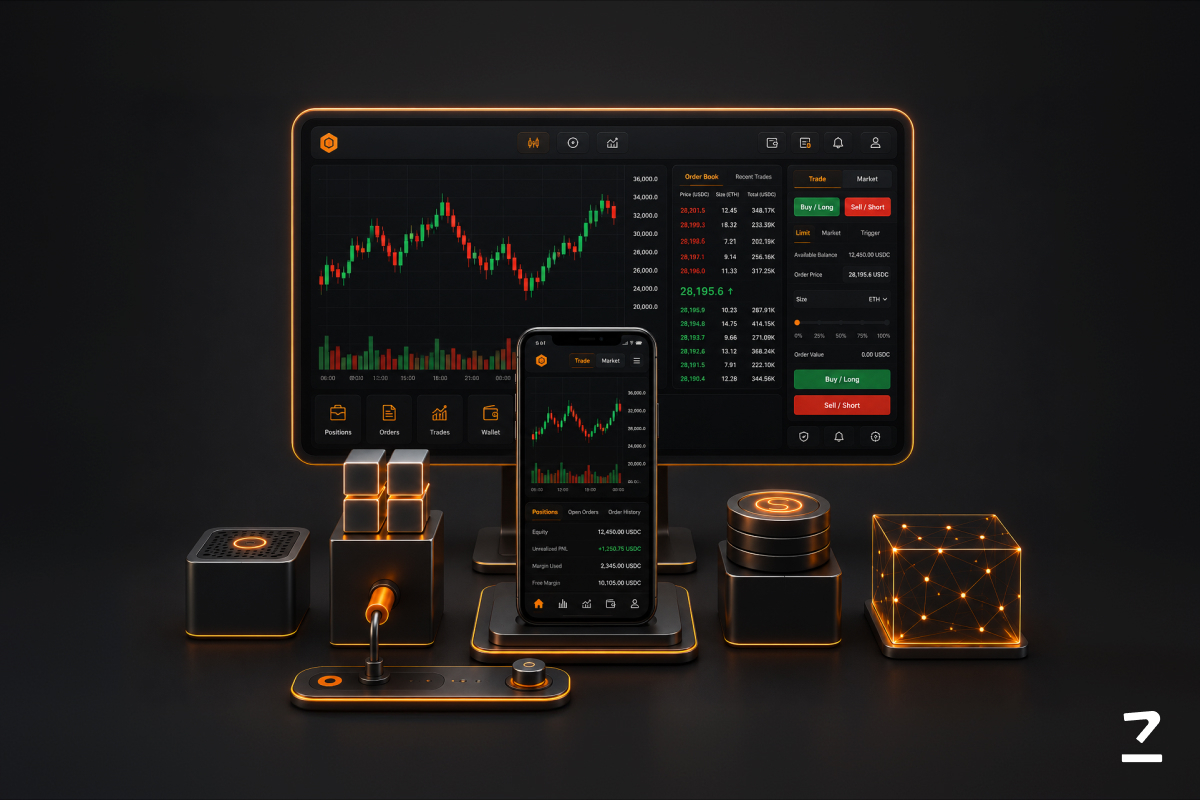
Launching a perpetual futures DEX like Hyperliquid starts with market structure, not interface design. A Perpetual DEX Development Company must define how orders will be executed. It must also decide how collateral will be assessed and what happens when positions become unsafe.
Businesses exploring Perpetual DEX Development Services must identify their target traders and opening markets. They also need to decide how much infrastructure they are prepared to operate. Those answers shape the network choice and development scope.
Hyperliquid is a useful reference because its chain was created around trading. The aim is not to copy its setup. It is to identify which parts support the proposed exchange and which would add avoidable complexity.
What Makes Hyperliquid Different?
Most decentralized exchanges run on a general-purpose blockchain. Their order flow is affected by that network’s block times, fees and available capacity.
Hyperliquid takes another route. Its blockchain contains HyperCore and HyperEVM. HyperCore manages order books, matching engine state and margin state. HyperEVM supports general-purpose smart contracts. Both operate under HyperBFT consensus.
This design places exchange activity at the centre of the network. Validator operations and node maintenance also become part of the project’s responsibility.
These trade-offs matter when assessing Perpetual DEX Development Services. A custom Layer 1 may suit an exchange with demanding execution needs. Another product may work better on a rollup or existing chain.
The comparison of Hyperliquid, Aster and Lighter shows how different architecture choices can serve the same broad market.
Define the Exchange Before Choosing the Technology
A retail-focused exchange cannot be planned like a venue for market makers. Retail traders usually expect clear margin information and simple wallet access. Professional participants pay closer attention to API reliability, execution quality and order-book depth.
The opening markets also affect the technical brief. Major crypto pairs have wider price coverage and stronger liquidity. Smaller assets may need lower leverage or tighter position limits.
Before development starts, the team should settle:
-
Target traders and permitted markets
-
Opening pairs and accepted collateral
-
Cross-margin or isolated-margin support
-
Maximum leverage for each market
-
Maker and taker fees
-
Liquidity arrangements
-
Insurance fund rules
These choices are linked. Higher leverage increases liquidation pressure. More collateral options add valuation risk. A long market list can weaken trading quality when liquidity is spread too thin.
A clear brief helps businesses that plan to Hire Perpetual DEX Developers judge whether a proposed solution fits their market. It also stops development from becoming a feature list with no coherent risk model.
Choose the Architecture Around the Trading Model
The network choice decides how much of the exchange the team must operate itself.
An established Layer 1 or Layer 2 can reduce the infrastructure burden. The project can use existing wallets, bridges and development tools. In return, it accepts the network’s block timing and transaction-ordering rules.
An application chain or rollup gives the exchange a dedicated execution environment. It can support trading-specific sequencing and fee policies. The team still needs to address sequencer reliability and bridge security.
A custom Layer 1 offers the greatest freedom. Consensus and block production can be designed around exchange actions. Hyperliquid uses this route, with trading functions treated as native parts of HyperCore.
That freedom brings a wider engineering scope. The project becomes responsible for validators, nodes and upgrades. A custom chain should solve a real execution problem. It should not be chosen simply because Hyperliquid uses one.
A hybrid model can match orders through specialised infrastructure while keeping custody or settlement on-chain. This may improve response times. The operator must still explain how trades are verified and what happens if the matching layer fails.
A specialist Perpetual DEX Development Company should compare these models against expected volume, liquidity and operational capacity. The recommendation should follow the trading model rather than lead it.
Develop the Trading and Matching Engine
The matching engine decides which orders receive priority and when a trade becomes final. Any delay or inconsistency at this layer can affect positions and account balances. It can also weaken confidence in the exchange.
A central limit order book is the common choice for perpetual futures. Traders submit buy or sell orders at selected prices. The engine matches them according to fixed rules such as price-time priority.
The exchange may need to support:
-
Market and limit orders
-
Stop-loss and take-profit orders
-
Reduce-only orders
-
Post-only orders
-
Order amendments
-
Immediate-or-cancel instructions
-
Self-trade prevention
Each market also needs its own tick size and minimum order value. Less liquid pairs may require position caps or lower open-interest limits.
Margin checks must form part of the execution flow. An account may have enough collateral when an order is submitted. That can change before the order is matched. The engine should confirm the account state again before completing the trade.
APIs are equally important. Market makers need fast access to order books and account updates. Automated traders depend on reliable order placement and trade confirmation.
Businesses looking to Hire Perpetual DEX Developers should check whether the team understands exchange execution. Smart contract experience alone does not cover order priority or account state. It also does not cover behaviour during sudden volume spikes.
Design Margin, Funding and Collateral Systems
A perpetual contract has no expiry date. Funding payments help keep its trading price close to the underlying asset.
When the perpetual price trades above the reference market, long positions usually pay short positions. When it trades below, the direction may reverse. The exact calculation depends on the exchange model.
The margin framework determines how much collateral a trader must maintain.
Cross margin uses the available balance across several positions. Isolated margin limits the collateral assigned to one position. Some exchanges may also support portfolio margin for professional users.
The model should define:
-
Initial margin
-
Maintenance margin
-
Maximum leverage
-
Position tiers
-
Collateral haircuts
-
Unrealised profit treatment
-
Withdrawal limits
Collateral selection needs careful review. Stablecoins may appear straightforward, but they still carry issuer and depegging risk. Volatile collateral requires stricter valuation rules.
Strong Perpetual DEX Development Services should treat margin design as a solvency question. The goal is not to offer the highest leverage. The goal is to keep losses contained when prices move sharply.
Develop the Oracle and Liquidation System
A perpetual DEX cannot rely only on the latest traded price. A single order in a thin market could move that price and trigger unfair liquidations.
Most exchanges use an index price based on external markets. They then calculate a mark price for margin and liquidation purposes. The mark price may combine the index with funding data or internal order-book conditions.
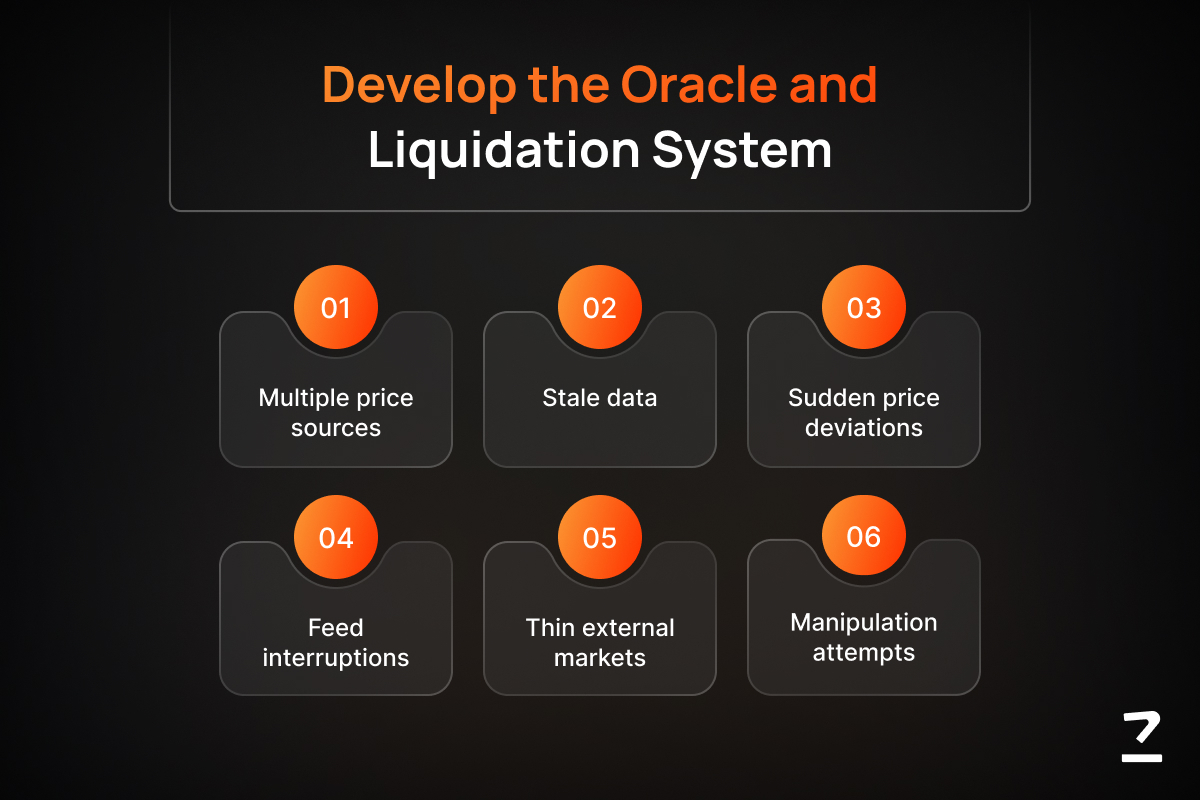
The oracle framework should account for:
-
Multiple price sources
-
Stale data
-
Sudden price deviations
-
Feed interruptions
-
Thin external markets
-
Manipulation attempts
Liquidation begins when account equity falls below the required maintenance margin. The engine may close part of the position or the full amount. The choice depends on market depth and risk policy.
An insurance fund can absorb some losses when liquidation proceeds are not enough. Auto-deleveraging may be used when the shortfall exceeds available reserves. Both mechanisms need clear rules.
A Perpetual DEX Development Company should test this logic against severe market conditions. Scenarios should include price gaps and oracle divergence. Thin order books also need to be modelled. The team should test delayed liquidations and concentrated positions as well.
Plan Liquidity Before Launch
A technically complete exchange can still fail when traders cannot enter or exit at reasonable prices. Liquidity planning must begin before mainnet.
The launch team should decide how the first markets will be supported. Options may include professional market makers and maker rebates. Protocol-owned liquidity or market-making vaults may also be considered.
The goal is not only to show volume. Traders need usable depth near the market price. Tight spreads and stable quotes matter more than activity produced through incentives alone.
Before launch, the team should define:
-
Opening pairs
-
Target spreads
-
Order-book depth
-
Market-maker commitments
-
Maximum open interest
-
Position concentration limits
-
Incentive budgets
-
API access
Markets should open gradually. Major pairs can be introduced first. Smaller assets should follow once pricing and liquidation systems have been tested under real activity.
This work is a core part of Perpetual DEX Development Services. Liquidity affects execution and liquidations. It also shapes how funding behaves. Treating it as a marketing task creates risk across the whole exchange.
A smaller launch with dependable depth will usually perform better than a broad market list with weak books.
Create the Trader Interface and Supporting Infrastructure
The trading interface should show the account’s actual condition without delay. Traders need current balances, margin usage, open positions, funding payments and liquidation prices in one place.
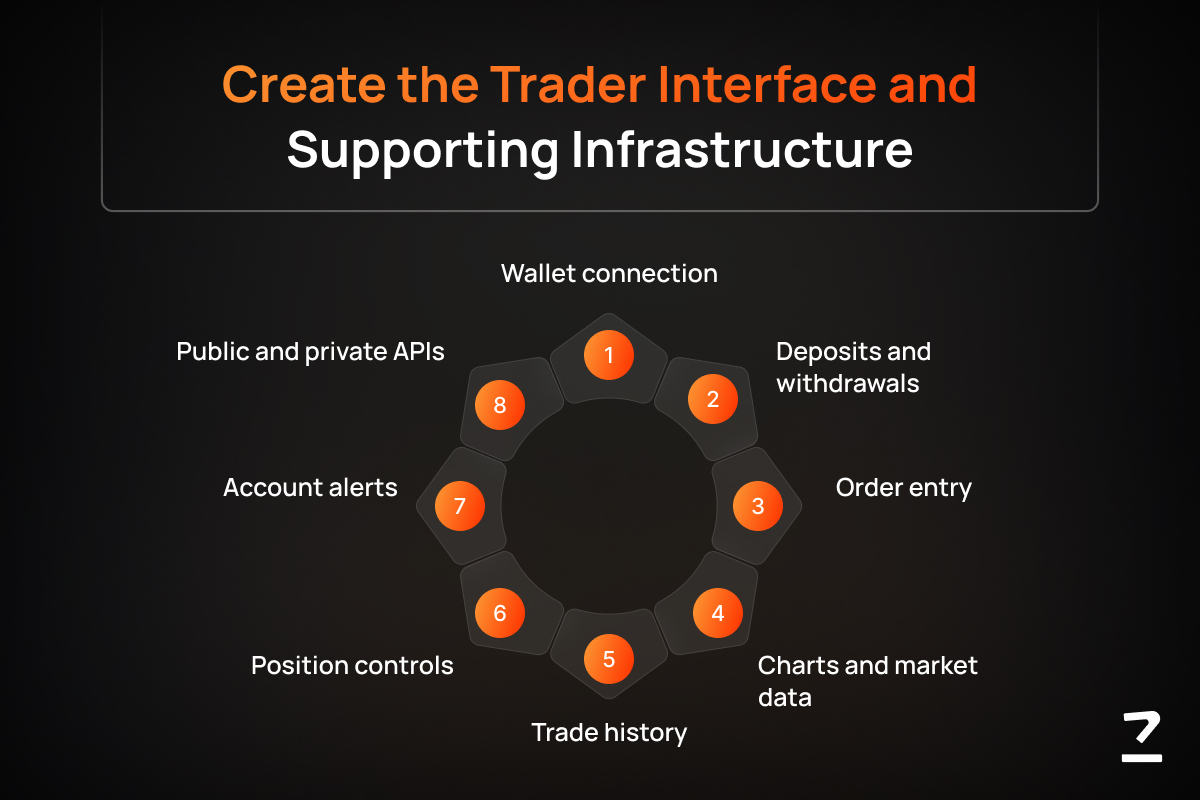
The platform should also include:
-
Wallet connection
-
Deposits and withdrawals
-
Order entry
-
Charts and market data
-
Trade history
-
Position controls
-
Account alerts
-
Public and private APIs
Reliable indexers and data pipelines are needed behind the interface. A fast matching engine loses value when balances or position data appear late.
Experienced Perpetual DEX Development Services should treat the interface as part of the trading infrastructure. It is not only a design layer.
Test Security and Market Risk
A perpetual DEX requires more than a smart contract audit. The review must cover how the exchange behaves when markets move quickly or one part of the system stops responding.
Testing should include:
-
Contract and access-control reviews
-
Oracle manipulation scenarios
-
Margin and liquidation simulations
-
Matching-engine load tests
-
Bridge and withdrawal security
-
API abuse controls
-
Frontend protection
-
Key management
-
Incident response exercises
Economic testing is equally important. The team should model sudden price gaps and thin liquidity. Insurance fund exhaustion and delayed oracle updates also need attention.
Businesses that Hire Perpetual DEX Developers should ask how the team tests exchange-wide failure scenarios. A contract may function as written while the wider risk model still fails under pressure.
Prepare for Compliance and Ongoing Operations
Perpetual futures may be treated differently across jurisdictions. The legal position depends on the markets offered and where users are located. It also depends on the operating entity.
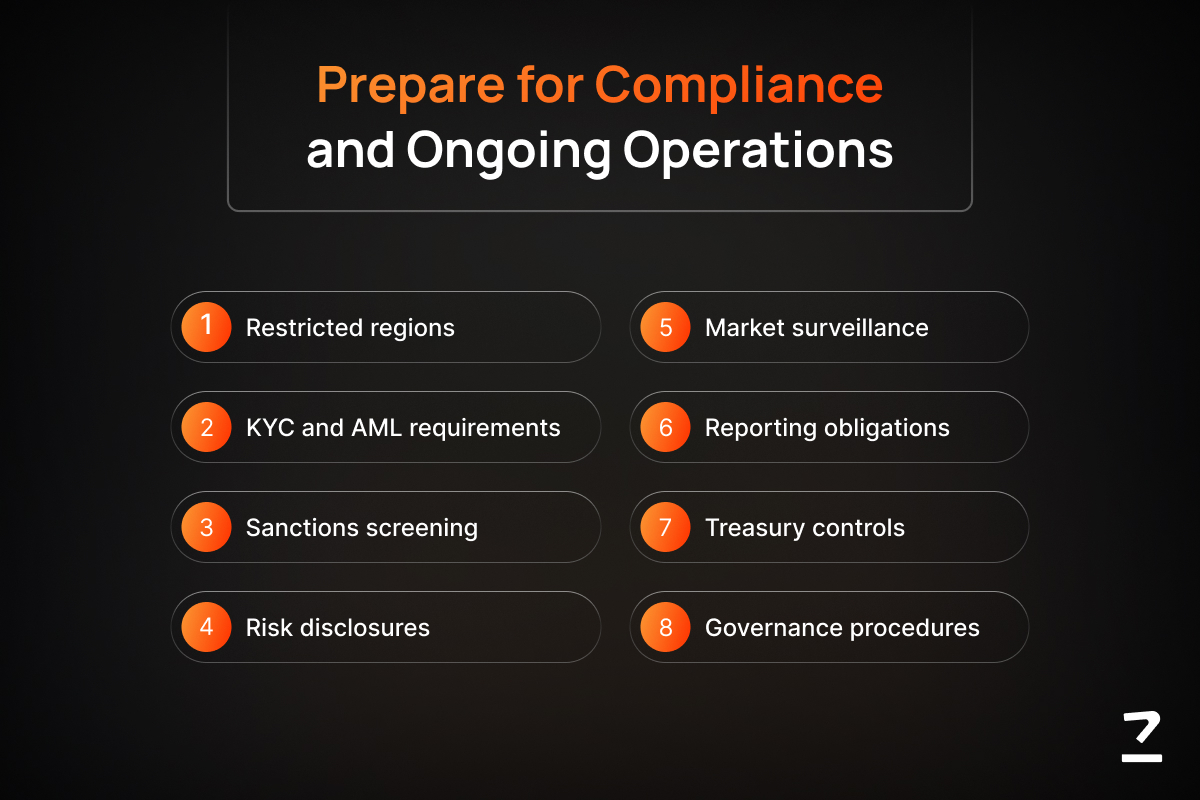
Before launch, the project should review:
-
Restricted regions
-
KYC and AML requirements
-
Sanctions screening
-
Risk disclosures
-
Market surveillance
-
Reporting obligations
-
Treasury controls
-
Governance procedures
The exchange also needs round-the-clock monitoring. Oracle feeds and liquidation queues cannot wait for business hours. Validator health and withdrawal activity require the same attention.
A Perpetual DEX Development Company should help define the operating requirements during planning. Legal advice should still come from qualified counsel in the relevant jurisdictions.
Follow a Phased Perpetual DEX Development Process
A controlled rollout reduces the chance of exposing traders to an untested market.
1. Product Discovery
Define users, markets, collateral, fees and risk limits.
2. Architecture and Risk Design
Select the network model. Design funding, margin, oracle and liquidation rules.
3. Core Development
Create the trading engine, contracts, APIs and user interface.
4. Testnet Launch
Run internal trading and market-maker trials. Test performance under heavy order activity.
5. Audit and Remediation
Review contracts, infrastructure and economic behaviour. Fix issues before mainnet.
6. Controlled Mainnet Release
Begin with selected pairs and conservative leverage. Keep open-interest limits low during the early stage.
7. Gradual Expansion
Add markets and collateral only after the opening pairs remain stable.
This staged approach should form the backbone of Crypto Perpetual Exchange Development Services. Launch speed matters, though it should not come at the cost of market stability.
Choose the Right Perpetual DEX Development Company
The development partner should understand both blockchain engineering and exchange operations.
Review its experience with:
-
Order-book and matching models
-
Margin engines
-
Funding calculations
-
Oracle integration
-
Liquidation logic
-
Trading APIs
-
Chain or rollup development
-
Security testing
-
Liquidity integrations
-
Mainnet monitoring
A provider that only discusses smart contracts may not understand the wider product. The exchange also depends on data accuracy and risk controls. Market behaviour matters just as much.
When comparing Perpetual DEX Development Services, ask how the proposed architecture supports your traders and liquidity model. The answer should be specific to the project.
Launch a Perpetual Futures DEX with Codezeros
Codezeros provides Perpetual DEX Development Services for businesses planning custom derivatives platforms.
The engagement can cover architecture planning and matching-engine development. It can also include perpetual contracts, margin logic, oracle integration and liquidation systems. Support extends to trading interfaces, testing, deployment and post-launch operations.
The process begins with the intended markets and trader profile. Codezeros then defines the infrastructure and risk model around those requirements.
Connect now to discuss your perpetual DEX idea with Codezeros to assess the right architecture and development scope.
Post Author
Paritosh Mehta
As a distinguished blockchain expert at Codezeros, Paritosh contributes to the company's growth by leveraging his expertise in the field. His forward-thinking mindset and deep industry knowledge position Codezeros at the forefront of blockchain advancements.
Frequently Asked Questions
Frequently asked questions about this article.
Plan Your Perpetual DEX with the Right Technical Foundation
Codezeros provides Perpetual DEX Development Services covering exchange architecture, matching engines, margin logic, oracle integration, liquidation systems and mainnet deployment. Discuss your target markets and trading model with our team to define the right development scope.
Blogs
Our Latest Blogs
Discover valuable industry insights and stay up-to-date with the latest updates by exploring our curated collection of recent blog posts.



Let us know your requirement
We know ideas matter, we are the product of one. We Provide Full Assistance In Your Business