SHARE THIS ARTICLE
- Copy link
21 Jul 2026
Hyperliquid vs. Aster vs. Lighter: Who Is Winning the Perpetual DEX Battle?
On-chain perpetual futures crossed $1 trillion in monthly trading volume. That number would have sounded like a rounding error two years ago. Now it is real, auditable, and reshaping where derivatives liquidity actually lives.
Three platforms are driving the shift: Hyperliquid, Aster, and Lighter. Each made a different bet on how to match a centralized exchange's speed while keeping self-custody. This post breaks down who is winning, why, and what the answer means if you are planning to build a perpetual DEX of your own.
What you'll learn in this blog: the real market share picture, how each architecture holds up under load, how fees compare at scale, where the security risks hide, and what it actually costs to build versus buy using professional perpetual DEX development services.
The Perpetual DEX Market at $1T Monthly Volume
Perpetual futures are the largest product category in crypto by volume. They dwarf spot trading by 3–5x. On-chain venues now capture roughly a quarter of all futures activity, up from single digits in 2024.
The migration is not a philosophy argument anymore. It is measurable. Post-FTX, traders stopped treating "self-custody" as a nice-to-have and started treating counterparty risk as a real line item.
Whichever platform captures this flow does not just collect trading fees. It becomes the liquidity backbone for vaults, copy trading, structured products, and trading bots built on top. That is the prize, and it is why three very different architectures are fighting for it.
Hyperliquid vs. Aster vs. Lighter: Head-to-Head Comparison
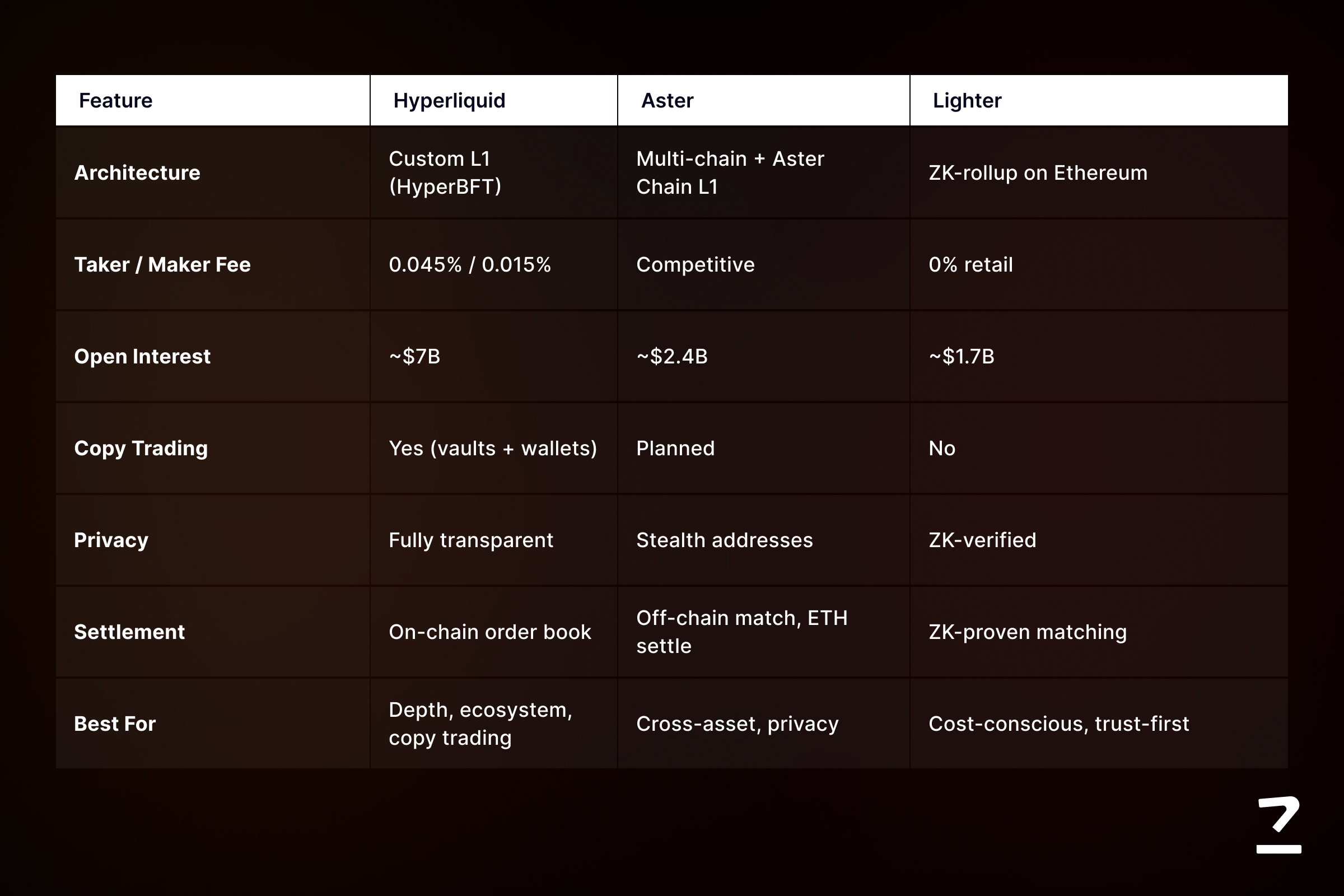
Hyperliquid leads on verifiable volume, open interest, and ecosystem depth. Aster wins on cross-asset breadth and privacy but carries a volume-integrity asterisk. Lighter wins on cost and provable fairness but trades away product breadth.
Verdict: By verifiable on-chain data, Hyperliquid is the current leader. But "leader" and "best fit for your build" are not the same question. Keep reading.
Hyperliquid: The Liquidity Leader
Most DEXs claim CEX-level speed until you route real size through them. Hyperliquid is the exception that made the claim stick.
It runs a purpose-built Layer 1 with a single job: trading. Sub-second finality. Zero gas fees. A fully on-chain central limit order book, not an AMM. The book you trade against is the real book, not an off-chain engine that settles results later.
The architecture
-
Consensus: HyperBFT, tuned for low-latency matching over general-purpose computation.
-
Model: on-chain order book handling orders, matches, funding, and liquidations.
-
Trade-off: roughly a dozen validators at launch, which raises fair decentralization questions.
The performance is real. The centralization critique is also real. You are getting a perpetual trading platform that happens to be on-chain, not a maximally decentralized chain that happens to trade.
The numbers that matter
-
~$7B open interest, the deepest verifiable pool in the category.
-
130+ perpetual markets.
-
Weekly fees consistently above $14M, cycled back through HLP buybacks and vault rewards.
-
~48% 30-day trader retention, against an industry average near 22%.
That retention figure is the tell. High retention on transparent, auditable settlement data is hard to fake. It signals organic flow from serious participants, not recycled airdrop volume.
What deepens the moat
The USDH stablecoin adds a native settlement currency with built-in buyback mechanics. HIP-3 lets anyone launch a perpetual market on Hyperliquid's rails. Builder Codes pay developers 100% of builder fees, which turns integrators into a distribution engine.
Takeaway: Hyperliquid's edge is not one feature. It is compounding liquidity plus a developer ecosystem feeding it.
Aster: The Cross-Asset Challenger
Aster is the most ambitious of the three and the most polarizing. It is trying to erase the line between crypto and traditional finance.
The headline feature is stock perpetuals. You can trade equities like Apple and Tesla as perpetual contracts, settled in crypto, with no brokerage account and no market hours. No competitor offers this at scale.
The architecture
-
Multi-chain by design: access from four networks without manual bridging.
-
Aster Chain L1: a dedicated chain for high-frequency trading with sub-second finality and zero gas.
-
Privacy default: stealth addresses and ZK cryptography hide trading activity, which counters the front-running risk that full transparency creates for large traders.
There is a design caveat worth naming. Aster performs off-chain matching without verifying matching correctness on-chain. That makes the matching engine's rules a trust assumption, closer to a CEX in spirit than Hyperliquid or Lighter.
The volume integrity question
Headline volume looks strong until you check the source. In October 2025, DefiLlama delisted Aster's volume data after detecting a near-1:1 correlation with Binance's volumes, flagging possible wash trading or mirroring. Aster had briefly claimed ~70% market share on those figures.
That does not make Aster illegitimate. It means you weight the headline number against the incentives behind it. Backed by YZi Labs and tied to the BNB ecosystem, Aster has real distribution. Judge it on the spreads you actually get, not the banner.
Takeaway: Aster owns a category nobody else does. Its growth quality is the open question.
Lighter: The Verifiable Outsider
Every exchange asks you to trust its matching engine. Lighter is the one that proves it instead.
It runs a custom ZK-rollup that settles to Ethereum. Orders match off-chain through a sequencer, then the engine generates zero-knowledge proofs that each block's transactions and state transitions are valid. The proofs get verified by an Ethereum smart contract before the state updates.
The core innovation
Lighter folds the matching process itself into the ZK proof. It proves Price-Time Priority, not just "some valid state transition happened." That is a stronger guarantee than off-chain black-box matching.
-
Fees: 0% for retail. No taker fee, no maker fee.
-
Latency: sub-five-millisecond matching, approaching CEX speed.
-
Custody: funds stay on-chain, with an escape hatch if the operator misbehaves.
-
Backing: notable venture support and reported Robinhood involvement, signaling a TradFi bridge.
Lighter: The Verifiable Outsider
Every exchange asks you to trust its matching engine. Lighter is the one that proves it instead.
It runs a custom ZK-rollup that settles to Ethereum. Orders match off-chain through a sequencer, then the engine generates zero-knowledge proofs that each block's transactions and state transitions are valid. The proofs get verified by an Ethereum smart contract before the state updates.
The core innovation
Lighter folds the matching process itself into the ZK proof. It proves Price-Time Priority, not just "some valid state transition happened." That is a stronger guarantee than off-chain black-box matching.
-
Fees: 0% for retail. No taker fee, no maker fee.
-
Latency: sub-five-millisecond matching, approaching CEX speed.
-
Custody: funds stay on-chain, with an escape hatch if the operator misbehaves.
-
Backing: notable venture support and reported Robinhood involvement, signaling a TradFi bridge.
The honest caveat
Post-TGE volume fell sharply, a drop consistent with airdrop farmers exiting. Its user base is concentrated, with the top 1% of addresses driving a large share of volume. That reads as professional quant flow, not broad retail depth.
Takeaway: Lighter is the pick when provable fairness and zero fees outrank product breadth and copy trading.
Perpetual Trading Platform Fees Compared at Scale
Fees sound trivial until you multiply them by monthly volume. A 0.045% taker fee is nothing on one trade. Across serious flow it becomes a real P&L line.
At lower trading volumes, fee differences are relatively small, around $4.50 on Hyperliquid and $3.50 on Aster for $10,000 in monthly trading, while Lighter remains free.
As volume scales to $100,000 and $1 million per month, those costs rise to approximately $45/$350 on Hyperliquid and $35/$300 on Aster, whereas Lighter continues to charge zero trading fees, making the gap increasingly significant for high-frequency traders.
Hyperliquid starts at 0.045% taker / 0.015% maker, with volume tiers and HYPE-staking discounts that can push effective fees below 0.02%. Large makers can go net-negative through rebates.
Lighter is the cheapest by a wide margin for retail-sized flow. The trade-off is fewer markets and thinner depth on tail assets. Aster sits between them, plus stock perpetuals neither rival offers.
Verdict: If fees are your only variable, Lighter wins. If you need depth and tooling, Hyperliquid's premium buys real infrastructure.
Perpetual DEX Risk Engines and Smart Contract Security
A perpetual DEX lives or dies on its risk engine, not its UI. Speed is easy to demo. Solvency under a cascade of liquidations is what actually holds up in production.
If you are evaluating designs to build on, four systems deserve most of your attention.
Cross-margin system design
Cross-margin lets a trader's whole balance back every position. It improves capital efficiency and creates correlated blow-up risk at the same time. A well-designed cross-margin system for decentralized derivatives needs:
-
Real-time portfolio-level margin calculation, not per-position checks in isolation.
-
Tiered maintenance margin that scales with position size.
-
Auto-deleveraging as a backstop when a liquidation cannot fill.
MEV-resistant order book matching
Transparent order books invite front-running. Every resting order is a signal, and searchers act on it. MEV-resistant matching protocol development typically relies on:
-
Fair-ordering or batch auctions that remove first-mover advantage.
-
Private mempools or encrypted orders until inclusion.
-
Stealth addresses, the approach Aster ships by default.
Native clearinghouse vs. ZK liquidations
The two credible models diverge here. Hyperliquid runs a native on-chain clearinghouse where liquidations settle on the trading L1. Lighter proves liquidations correct with ZK circuits, so users can verify no unfair liquidation occurred. Both remove operator trust. They just prove it differently.
On-chain liquidity pooling models
Order books need makers. When organic makers are thin, protocol-owned liquidity fills the gap. Hyperliquid's HLP vault is the reference model: pooled capital market-makes and absorbs liquidation flow, distributing yield back to depositors. Design this wrong and your pool becomes the exit liquidity for every bad liquidation.
Takeaway: A verifiable matching engine and a stress-tested risk engine are where audits should spend most of their hours.
Build vs. Buy: What It Takes to Ship Your Own Perpetual DEX
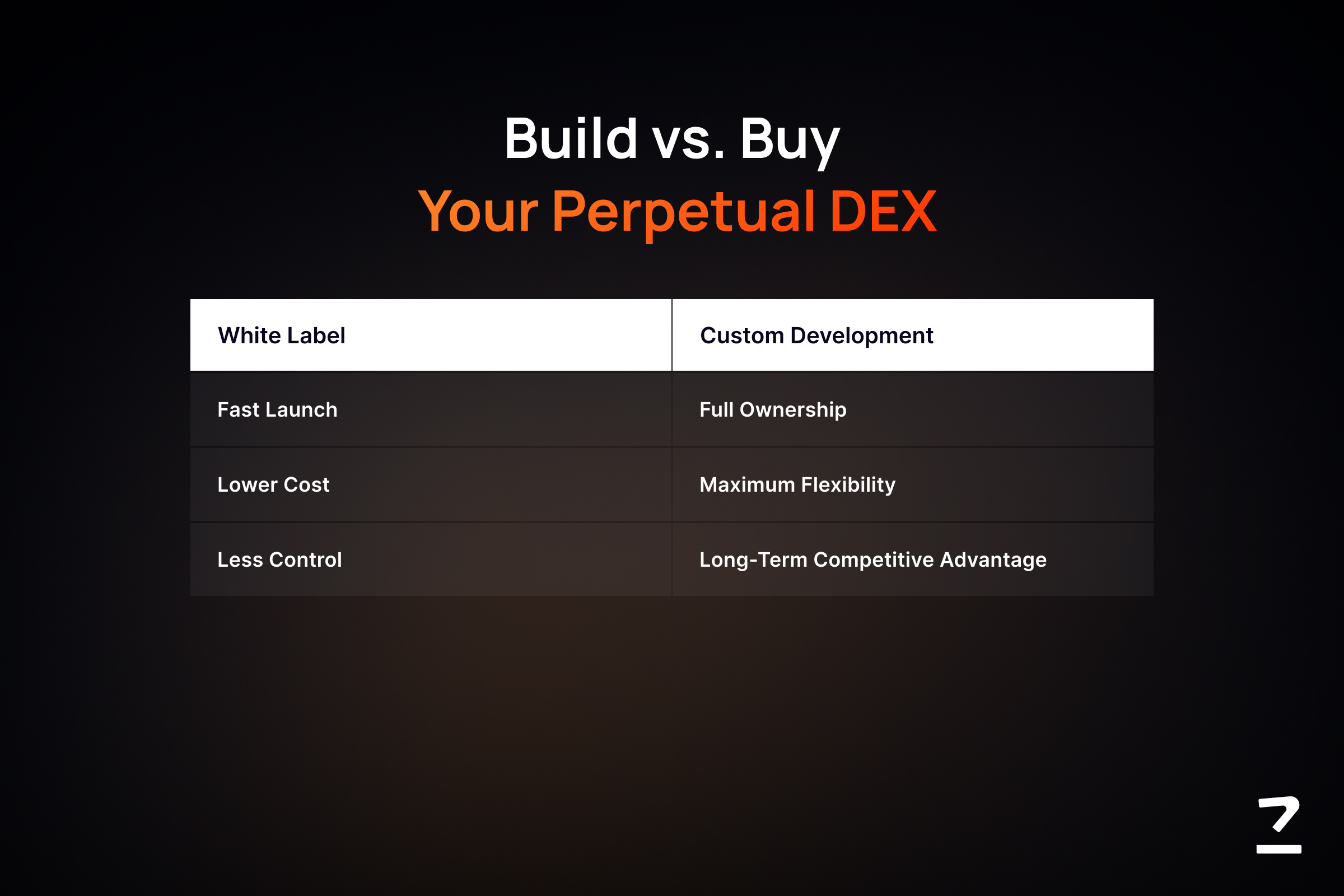
Build vs. Buy Your Perpetual DEX
White Label
Fast Launch • Lower Cost • Less Control
Custom Development
Full Ownership • Maximum Flexibility • Long-Term Competitive Advantage
Cloning a screenshot is easy. Shipping a venue that survives real size, real liquidations, and real adversaries is a different project. If you are asking how to build a perpetual DEX like Hyperliquid, start with the honest scope.
White label vs. custom
White label perpetual DEX software gets you live fast. It also caps you at someone else's fee logic, someone else's risk parameters, and shared liquidity you do not control. The white label perpetual DEX software vs. custom blockchain development decision comes down to one question: is your edge the market you serve, or the infrastructure itself?
-
White label: fastest to launch, lowest control, weakest moat.
-
Custom appchain: slowest to launch, full control, strongest long-term moat.
-
ZK-rollup path: middle ground, inherits Ethereum security, needs specialized circuit engineering.
The core build surface
Perpetual futures DEX custom architecture development is not one project. It is several systems that have to agree under load:
-
Matching engine and order book (on-chain, off-chain, or ZK-verified).
-
Risk engine, cross-margin, and liquidation logic.
-
Oracle integration for mark prices and funding.
-
Settlement layer and custody model.
-
Multi-chain routing if you want reach beyond one network.
Building a high-throughput order book DEX like Lighter means committing to ZK-circuit work most teams have never touched. Multi-chain perpetual DEX smart contract development services exist precisely because bridging liquidity across networks fragments depth if you get the routing wrong.
Cost to develop a decentralized perpetual exchange
There is no single price. The cost to develop a decentralized perpetual exchange scales with three levers:
-
Architecture: a white label frontend is a fraction of a custom L1 with its own consensus.
-
Security: multiple audits, formal verification, and an economic-attack review are not optional.
-
Liquidity: bootstrapping makers or a protocol-owned vault is a capital cost, not just an engineering one.
Verdict: Buy when speed to market is the whole strategy. Build when the infrastructure is the moat.
Partner With a Trusted Perpetual DEX Development Company
You have seen what separates the leaders from the also-rans. It is not the demo. It is the matching engine, the risk system, and the liquidity design that hold up once real capital shows up.
That is where we come in. As a Perpetual DEX Development Company, Codezeros builds the systems this article breaks down, from custom order-book L1s to ZK-verified rollups and multi-chain deployments.
Our Perpetual DEX Development Services cover the full build surface:
-
Custom architecture and consensus design for low-latency matching.
-
Cross-margin risk engines and MEV-resistant order flow.
-
ZK circuits for verifiable matching and liquidations.
-
Audited smart contracts and economic-attack review.
Whether you need Crypto Perpetual Exchange Development Services for a ground-up venue or want to Hire Perpetual DEX Developers to extend an existing stack, we ship production systems, not prototypes.
If you are weighing Crypto Perpetual DEX Solutions, connect with our team and we will map architecture, timeline, and cost to meet your requirements.
Post Author

Deep Shah
Explore Deep's insightful blog posts that help businesses stay ahead of the curve, explore new possibilities, and unlock the full potential of blockchain technology
Frequently Asked Questions
Frequently asked questions about this article.
By verifiable on-chain volume, open interest, and retention, Hyperliquid leads. Aster and Lighter are the closest challengers, though a share of Aster's headline volume was disputed after a DefiLlama delisting.
A perpetual DEX is a decentralized exchange for trading perpetual futures, leveraged contracts with no expiry, without giving custody to a centralized exchange. You trade from your own wallet and settlement happens on-chain.
Hyperliquid runs a fully on-chain order book on a custom L1 for maximum depth. Lighter runs a ZK-rollup on Ethereum that proves matching and liquidations correct and charges retail zero fees.
Yes, for retail accounts Lighter charges no taker or maker fees. API and institutional flows face premium rates, and the platform earns revenue through other mechanisms.
Treat them with caution. DefiLlama delisted Aster's volume over a near 1:1 correlation with Binance's volumes. Judge the platform by the spreads you get on your pair, not the headline figure.
Cost scales with architecture, security, and liquidity. A white label frontend is a fraction of a custom L1 with its own consensus, multiple audits, and a bootstrapped market-making vault.
Choose white label when speed to market is the whole strategy. Build custom when the infrastructure itself is your moat and you need control over fees, risk parameters, and liquidity.
A stress-tested cross-margin and liquidation engine, MEV-resistant order matching, verified oracle pricing, and audited contracts with an economic-attack review. UI polish is irrelevant to solvency.
Two credible paths exist. A custom L1 like HyperBFT gives full control over latency. A ZK-rollup gives Ethereum security with verifiable matching. The right one depends on your trust and decentralization requirements.
Yes. Codezeros provides perpetual DEX Development Services covering custom architecture, risk engines, ZK circuits, and audited contracts, and you can hire dedicated perpetual DEX developers for new builds or existing stacks.
More questions? Contact us.
Build a High-Performance Perpetual DEX with Codezeros
Whether you're building a custom Layer 1 trading engine, a ZK-powered perpetual DEX, or a multi-chain derivatives platform, Codezeros delivers secure, scalable, and production-ready solutions. Our blockchain experts help you design robust matching engines, advanced risk systems, audited smart contracts, and high-performance trading infrastructure tailored to your business goals. Connect with our team to discuss your vision and launch a perpetual DEX built for long-term growth.
Blogs
Our Latest Blogs
Discover valuable industry insights and stay up-to-date with the latest updates by exploring our curated collection of recent blog posts.