
SHARE THIS ARTICLE
13 Feb 2026
How to Build AI-Powered Web3 Crypto Wallets in 2026
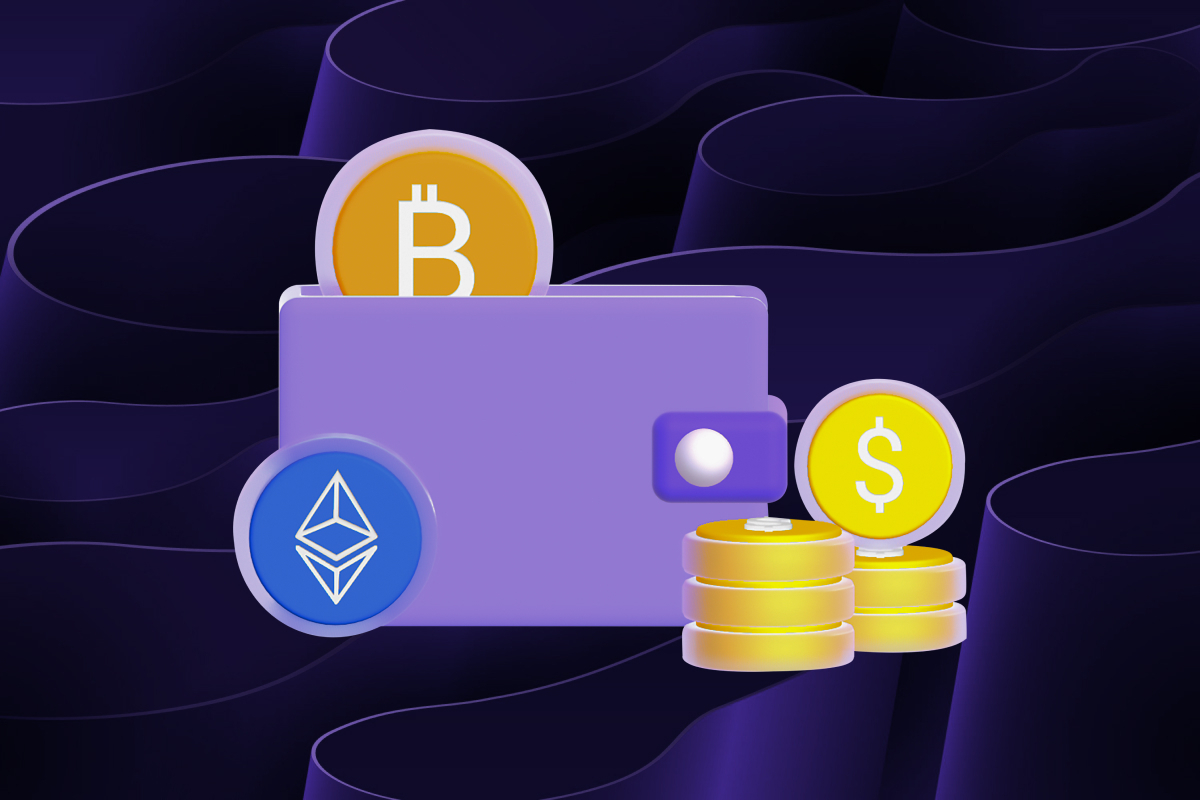
The cryptocurrency wallet space is witnessing a paradigm shift. Going forward to 2026, developing AI-driven Web3 crypto wallets is no longer about simply holding cryptocurrencies; it’s about providing intelligent, secure, and user-friendly financial services.
The global crypto wallet market is expected to reach $77.17 billion by 2033, but security breaches in 2025 resulted in losses of $2.935 billion. This is why the integration of AI is becoming the new norm, offering real-time fraud protection, automated DeFi services, and customized portfolio management.
It is expected that by 2026, about 60% of crypto wallets will use agentic AI to manage portfolios, track transactions, and improve security.
For organizations that want to tap into this opportunity, partnering with a reliable cryptocurrency wallet development company will help create scalable, secure, and technically sound solutions.
What Is an AI-Powered Web3 Crypto Wallet?
An AI-enabled Web3 crypto wallet is a combination of blockchain security and AI technology that automates financial transactions, minimizes the possibility of errors, and prevents fraud proactively.
Unlike conventional wallets, which contain private keys and support manual transactions, AI-enabled wallets analyze transaction behavior, forecast market trends, and offer recommendations.
For instance, predictive analytics may suggest rebalancing a portfolio or optimizing gas prices, while anomaly detection algorithms detect fraudulent transactions before they result in financial losses.
Such wallets can be used by retail investors, institutional investors, or platforms that support DeFi. They offer real-time analytics without requiring extensive technical expertise. In essence, AI makes it possible to have a seamless, secure, and intelligent experience, making crypto wallet development services a necessity for businesses venturing into the Web3 ecosystem.
Why Traditional Crypto Wallets Fail in 2026?
The development of blockchain technology and DeFi has revealed the shortcomings of traditional wallets. Simple wallets have the following drawbacks:
-
Passive Security: Simple wallets lack the ability to actively identify phishing attacks and fraudulent activities.
-
Manual DeFi Management: Users have to perform DeFi activities such as staking, yield farming, and swapping manually, which can be prone to errors.
-
Lack of Personalization: Traditional wallets lack the ability to personalize recommendations based on user behavior and risk tolerance.
-
High Friction Between Chains: Performing transactions between multiple chains involves manual gas calculation, network switching, and bridging, which is inefficient.
On the other hand, AI wallets are agentic. They use past and current blockchain data to make decisions and optimize user experience. Currently, companies providing wallet development services focus on AI as a competitive advantage to ensure their products stay ahead in the ever-changing landscape.
Core AI-Powered Features Defining Web3 Wallets in 2026
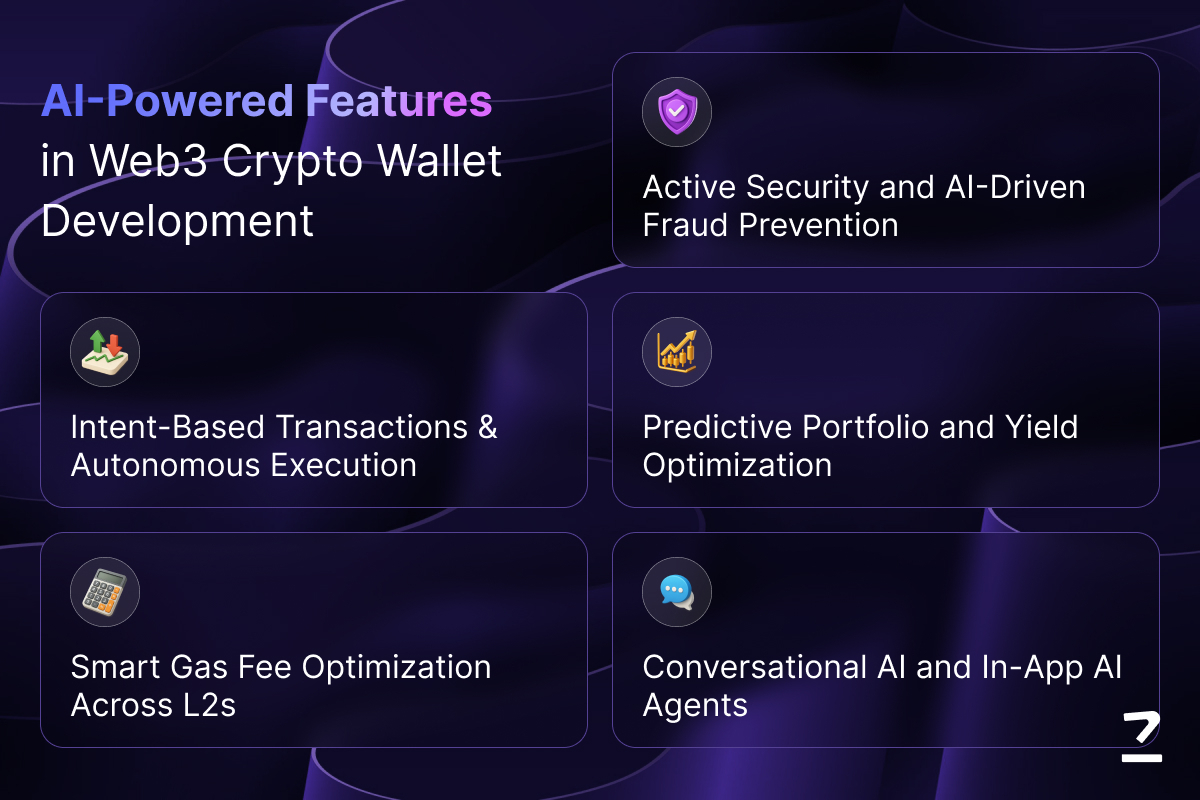
Active Security and AI-Driven Fraud Prevention
The AI wallets are also capable of monitoring transactions in real-time to identify any unusual patterns of double spending, phishing attacks, and address poisoning. The AI wallets are able to use machine learning to identify and prevent any suspicious transactions from being executed.
By incorporating all these functionalities, it is not only possible to secure the assets but also to gain the trust of the users, which is very essential for any cryptocurrency wallet development company catering to the needs of large-scale enterprises.
Intent-Based Transactions and Autonomous Execution
The next-generation wallet enables users to execute intent-based transactions using natural language processing, such as “Swap ETH for USDT on the cheapest chain.” The AI engine automatically executes the transaction, which includes gas estimation, chain switching, and bridging. This minimizes the chances of human error and maximizes the efficiency of transactions, making it easier for retail and institutional clients to work with multi-chain wallets. This feature makes cryptocurrency wallet app development services more appealing to advanced users.
Predictive Portfolio and Yield Optimization
The AI engine uses market trends, past data, and the risk profile of the user to provide suggestions on portfolio rebalancing, staking, and yield farming. The predictive model can also detect underperforming assets and optimize their allocation across chains. This enables the wallet to evolve from a passive storage device to a smart financial assistant, making cryptocurrency wallet app development services more appealing to advanced users.
Smart Gas Fee Optimization Across L2s
Gas fees are highly volatile, and this volatility is even more pronounced on Layer-2 blockchains. AI is able to forecast these changes and optimize transaction timing to ensure that crypto wallets cost the lowest possible fees. This is beneficial to users as transactions are executed automatically, and wallets perform at a competitive level.
Conversational AI and In-App AI Agents
Modern wallets come with AI agents that support natural language processing, are available 24/7, and offer transaction assistance. Users can ask about their balances, seek investment advice, or get step-by-step instructions on DeFi transactions. Conversational AI is beneficial in making the wallet more accessible to beginners and increasing engagement for power users.
AI Architecture Behind Modern Web3 Crypto Wallet Development
The technical backbone of an AI-powered wallet includes multiple components:
-
Client-side AI models for behavioral analytics and predictive recommendations.
-
Backend AI engines for fraud detection, transaction monitoring, and intent-based execution.
-
Blockchain integration layers for Ethereum, Solana, or other chains.
-
Multi-Party Computation (MPC) or account abstraction frameworks to eliminate single points of failure in key management.
-
Real-time data pipelines for on-chain event monitoring and risk scoring.
This architecture ensures scalability, security, and adaptability, making wallet development company partnerships crucial for successful execution.
Step-by-Step Guide to Build an AI-Powered Web3 Crypto Wallet
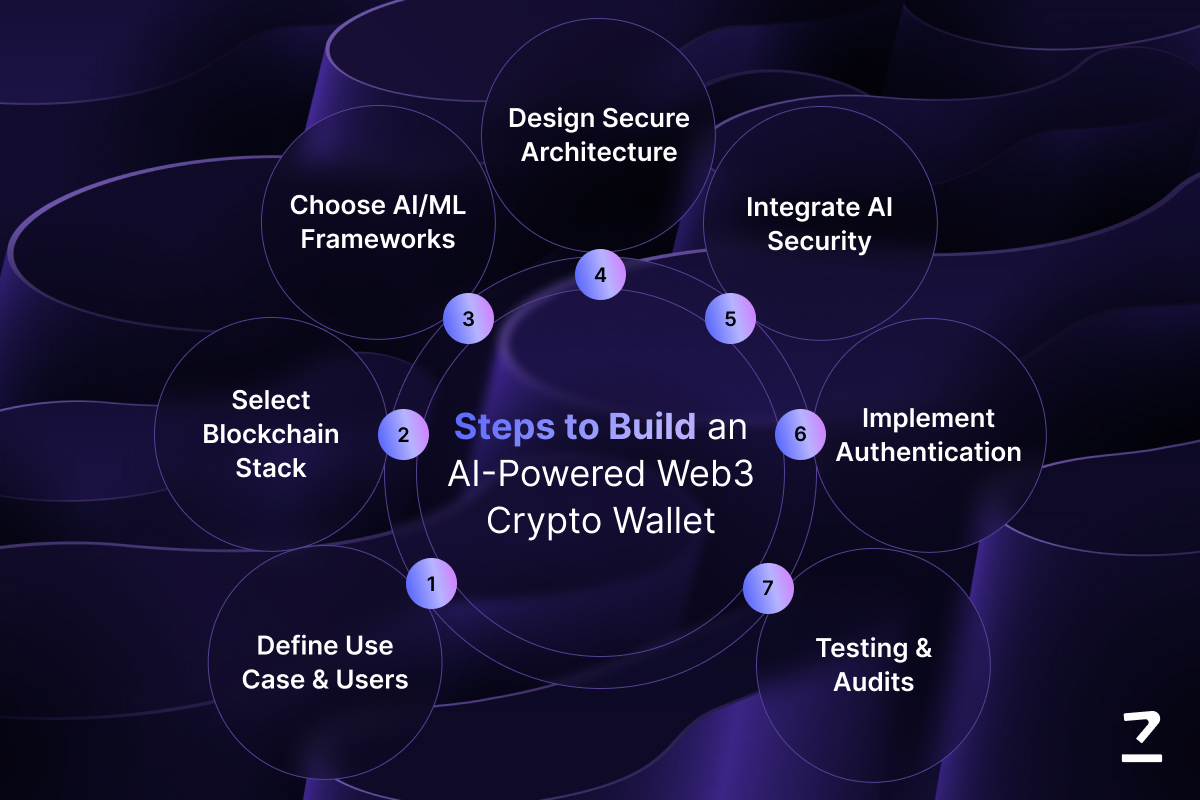
Defining the Wallet’s Core Use Case and Target Users
Start by identifying whether the wallet will focus on retail investors, NFT collectors, DeFi traders, or institutional clients. Defining core features, user experience goals, and the degree of AI integration ensures development efforts remain aligned with business objectives.
Choosing the Right Blockchain and Network Stack
Select chains that offer speed, scalability, and cost efficiency. Ethereum remains the default for DeFi interoperability, Solana excels in high-throughput operations, and Base provides modular L2 options.
Selecting AI and Machine Learning Frameworks
TensorFlow and PyTorch are industry-standard frameworks for predictive modeling, anomaly detection, and automation algorithms. For conversational AI, integrate NLP engines capable of handling natural language intent.
Designing Secure Wallet Architecture (MPC & Account Abstraction)
Use MPC to split key ownership across multiple parties, removing single points of failure. Account abstraction allows programmable wallets with flexible access rules, enabling features like social recovery and gasless transactions.
Integrating AI Models for Security and Automation
Embed ML models for fraud detection, transaction anomaly detection, predictive portfolio management, and gas fee optimization. Ensure models continuously retrain on new blockchain and user behavior data.
Implementing Advanced Authentication and Monitoring
Use biometric authentication (face, fingerprint, or voice), multi-factor authentication, and AI-driven transaction monitoring to prevent unauthorized access. Combine this with real-time alerts to increase operational safety.
Testing, Audits, and Adversarial Simulations
Conduct end-to-end testing, including performance, stress, and security simulations. Third-party smart contract audits validate the wallet’s resilience against exploits, ensuring regulatory compliance and building investor confidence.
Technology Stack for AI-Powered Crypto Wallet App Development
The tech stack for AI-driven crypto wallet app development needs to be carefully selected to ensure scalability, performance, and security.
-
For the mobile interface, React Native or Flutter allows for cross-platform development with native performance.
-
Web-based interfaces utilize React.js with a Node.js server for dynamic UIs and wallet management.
-
Smart contracts on the blockchain are developed in Solidity for Ethereum and Rust for Solana to securely manage on-chain operations.
-
The backend environment utilizes Golang, Docker, and Kubernetes for robustness, scalability, and efficient service orchestration.
-
AI and ML functionality utilize TensorFlow, PyTorch, or JAX for predictive analytics, anomaly detection, and automation.
-
Security is implemented through MPC (Multi-Party Computation), account abstraction, biometric authentication, and encrypted local storage.
A well-crafted tech stack will ensure a fast, stable, and competitive crypto wallet in the 2026 Web3 environment.
Security-First Design: How AI Wallets Prevent Losses Before Execution
AI wallets are designed to avoid losses in a proactive manner, as opposed to reacting to an attack.
-
Real-time anomaly detection and behavioral analysis continuously assess transactions for anomalies.
-
Predictive fraud analysis uses both past and real-time data to detect potential threats before they occur.
-
Multi-level authentication, such as geolocation and biometric authentication, enhances security.
-
High-risk transactions can be automatically blocked, ensuring that no malicious activity is executed.
By integrating these AI security features, wallets not only secure user funds but also mitigate risks, thus trust becomes a fundamental aspect of new Web3 wallets.
Regulatory and Compliance Considerations for AI-powered Wallet Development in 2026 and Beyond
Compliance must be integrated into the architecture of AI-powered Web3 wallets from inception. Any service providing custody, on/off-ramp, or exchange services is considered a VASP and must implement AML/KYC, transaction monitoring, and AI-generated audit trails. The regulatory community is concerned with the use of crypto wallet app development services, meaning semi-decentralized wallets must also implement compliance engines to remain legal.
Identity and privacy require sophisticated KYC systems incorporating liveness detection, geo-verification, and bank validation, while decentralized identity (DID) systems enable users to prove identity without revealing too much. Secure and compliant wallets are ensured through MPC-based key management, AI-powered risk scoring, and hardware security. Stablecoin and real-world asset wallets are subject to rigorous audit, reserve, and whitelist requirements.
Cross-border compliance is necessary, with standards such as CARF and MiCA (EU), CLARITY (U.S.), and DPDP (India) enforcing local data storage and transaction regulations. The incorporation of RegTech, chain abstraction, and decentralized development enables the creation of secure, compliant, and scalable AI-powered wallets for 2026 and beyond.
Cost to Build an AI-Powered Web3 Crypto Wallet in 2026
The cost of building a custom AI-based Web3 crypto wallet in 2026 would normally fall between $80,000 and $250,000, depending on the complexity of the functionality and the technical requirements.
The cost may be affected by factors such as multi-chain functionality, AI-based automation, and DeFi functionality such as staking, lending, and yield farming. The team composition of full-stack developers, AI developers, blockchain developers, and security experts also affects the cost.
Other factors that play a key role include UX/UI design for various user groups and blockchain infrastructure costs, such as native L1 chains versus cross-chain L2 solutions.
Key Market Trends Shaping Web3 Crypto Wallet Development
Looking ahead to 2026, the following trends are emerging in AI-driven Web3 wallets. The adoption rate of AI agents is projected to hit 60%, allowing for self-directed portfolio management, predictive suggestions, and automated transactions.
There is a need for multi-chain support for convenient management of assets across chains, and the growing DeFi sector is set to make wallets the central platforms for staking, lending, yield farming, and NFT management.
Security has emerged as a major point of differentiation, with fraud analysis, anomaly tracking, and transaction risk assessment impacting adoption. Lastly, personalization through AI-based predictive analytics is fueling engagement, retention, and satisfaction with wallets of all sizes.
Common Challenges in Building AI-Integrated Crypto Wallets and How to Solve Them
Several issues must be addressed by developers in building AI-enabled wallets.
-
The problem of data quality, which is caused by noisy on-chain data, needs sophisticated preprocessing.
-
The accuracy of the model needs to be constantly enhanced by retraining the model to adapt to market volatility.
-
Compliance with regulations is essential. The use of automated audit logs and legal knowledge is important in ensuring that the wallet is compliant with KYA, AML, and GDPR regulations.
-
Building trust with users can be achieved by using explainable AI, risk warnings, and a user-friendly UX.
-
The complexity of multi-chain support is addressed by using modular design and fallback systems to avoid operational failures while ensuring smooth user experiences.
How to Choose the Right Cryptocurrency Wallet Development Company
It is crucial to select the appropriate partner for crypto development. The following are the necessary steps to consider when you decide to hire crypto wallet developers:
-
Check Proven Experience: Check the portfolio of the company for the successful completion of Web3 crypto wallet projects, AI integration, and multi-chain implementation. Check the case studies of the company to see if they have successfully implemented DeFi, NFT, or enterprise wallets.
-
Check Technical Expertise: Check if the company has experience in AI/ML frameworks, smart contract development, blockchain infrastructure, and mobile and web app development. It is important to have in-depth knowledge of security protocols such as MPC, account abstraction, and encrypted storage.
-
Check Security Practices: Check if the company follows multi-layer verification, real-time transaction monitoring, and anomaly detection.
-
Check Regulatory Knowledge: They should know about KYA, AML, GDPR, and other local regulations like MiCA or the CLARITY Act. They should be able to set up automated engines for compliance and audit-ready logs.
-
Check Scalability and Support: Your development partner should be able to scale your wallet solution from MVP to enterprise-ready with ongoing support, updates, and retraining of AI models for new market conditions.
-
Request Transparent Communication: Clear, frequent communication ensures alignment on timelines, budgets, and deliverables, preventing costly misunderstandings during development.
Codezeros - Your Trusted Partner for AI-Powered Web3 Crypto Wallet Development
At Codezeros, we have expertise in developing AI-enabled Web3 crypto wallets according to business requirements. Starting from predictive portfolio management and self-executing transactions to proactive fraud detection, our solutions integrate the latest AI technology with the security of blockchain.
We provide scalable, compliant, and user-friendly wallets, ensuring quick adoption, resilience, and uniqueness in the market. Connect now with Codezeros today and future-proof, secure, and intelligent crypto wallets to succeed in the 2026 crypto environment.
Post Author

Paritosh Mehta
As a distinguished blockchain expert at Codezeros, Paritosh contributes to the company's growth by leveraging his expertise in the field. His forward-thinking mindset and deep industry knowledge position Codezeros at the forefront of blockchain advancements.
Frequently Asked Questions
Frequently asked questions about this article.
Build Smarter AI Crypto Wallets with Codezeros
Work with Codezeros to develop AI-driven Web3 crypto wallets that protect assets, automate DeFi, and deliver intelligent portfolio management. Our crypto wallet development solutions monitor transactions in real-time, optimize multi-chain operations, and provide personalized recommendations for every user. Future-proof your wallet and give your users a seamless, secure, and intelligent crypto experience.
Blogs
Our Latest Blogs
Discover valuable industry insights and stay up-to-date with the latest updates by exploring our curated collection of recent blog posts.

Let us know your requirement
We know ideas matter, we are the product of one. We Provide Full Assistance In Your Business