
SHARE THIS ARTICLE
10 Feb 2026
Best Blockchain for Token Development in 2026: Ethereum, Solana, or Polygon CDK
The process of token development will no longer be an easy game of executing a smart contract as at 2026; it is a core business choice, which determines a cost hierarchy, user experience, on-chain economics, governance, compliance with regulation, and sustainability.
As a founder, product leader or enterprise innovator considering the tokenization blockchain services, the chain you select determines all aspects of total cost of ownership to liquidity and network effects.
Ethereum remains the largest in terms of economy and ecosystem richness, Solana is performance-optimized, and Chain Development Kit (CDK) of Polygon is a framework that can be used to build a new custom token environment. The trends are of interest to not only the decentralized developers but also to businesses that require reliable token development services.
In 2026, the question of blockchain to choose will be the alignment of technical possibilities with the economy along with the design of the business with the real results rather than the pursuit of raw throughput or short-term hype.
Ethereum for Token Development
Ethereum is the leading platform in the development of tokens because it has a huge developer base, is highly liquid, and has well-established tooling. The first option is used to provide mission-critical tokens, financial primitives, and sophisticated decentralized applications, which require high security and interoperability.
Market and Ecosystem Leadership
In the context of decentralized finance (DeFi), non-fungible tokens (NFTs), decentralized autonomous organizations (DAOs), and institutionalized tokenization of assets, Ethereum is the back-bone of on-chain economic infrastructure.
Ethernet has the highest Total Value Locked (TVL) in DeFi of approximately 80-83 billion significantly more than Solana (~$12 billion) and Polygon (~$1.2-1.5 billion). This domination is indicative of large liquidity-pools, wide institutional involvement, and enduring integration into the large financial infrastructure.
Technical Foundation and Standards
Ethereum’s smart contract ecosystem is powered by the Ethereum Virtual Machine (EVM), which gives it extensive developer tooling and compatibility advantages. The network supports established token standards such as:
-
ERC‑20 for fungible tokens
-
ERC‑721 and ERC‑1155 for NFT standards
-
ERC‑4626 for tokenized vaults
These standards are recognized across wallets, exchanges, and DeFi platforms, making ERC‑20 tokens a default choice for utility, governance, and asset‑backed tokens.
Ethereum’s transition to Proof‑of‑Stake (PoS) drastically reduced energy consumption and improved security posture, enabling sustainable scaling with broader institutional support.
Developer Ecosystem and Tooling
Ethereum’s developer community dwarfs other blockchain ecosystems in both size and maturity. Active developer contributions measured by commits and developer count significantly outpace competitors, reinforcing continuous innovation and protocol improvement.
This ecosystem advantage translates into extensive libraries, frameworks, security auditing tools, and production‑grade deployments that make Ethereum an optimal choice for enterprise‑grade token development and DeFi‑centric projects.
When to Choose Ethereum
Choose Ethereum when security, liquidity access, composability across protocols, and institutional confidence matter most especially for high‑value DeFi tokens, governance frameworks, and real‑world asset (RWA) tokens that depend on ecosystem breadth rather than lowest fees.
Solana for Token Development
Solana has rapidly positioned itself as a performance‑first blockchain optimized for high throughput and ultra‑low fees characteristics that are particularly attractive for consumer‑scale token applications, gaming economies, and high‑frequency interaction tokens.
High Throughput and Low Costs
Solana uses a hybrid Proof‑of‑Stake (PoS) and Proof‑of‑History (PoH) consensus mechanism that enables thousands of transactions per second at minimal execution costs. According to network analysis, Solana’s practical throughput frequently exceeds 4,000–4,500 transactions per second, with latency often measured in milliseconds and fees around $0.00025 per transaction.
This performance profile is ideal for tokens that must handle heavy usage without imposing steep fees such as gaming tokens, micropayments, social interactions, event tickets, and instant reward systems.
Real‑World Usage and Projects
Solana’s ecosystem has seen significant adoption in decentralized exchanges, NFT platforms, and DeFi applications. Although still smaller than Ethereum’s economic footprint, Solana’s TVL (~$12B) shows meaningful engagement in high‑velocity markets.
In addition, layer‑2 scaling solutions like Solaxy are emerging to further reduce transaction costs and expand usable throughput, indicating ongoing innovation.
Challenges to Consider
Although performance is positive, Solana has previously experienced infrequent network failures and congestions. Although the upgrades, such as the rewrite of the finality and propagation layer as the Alpenglow upgrade (planned in 2026) will focus on enhancing finality and stability, projects need to operate on the assumption of operational readiness and eventual volatility.
The developer ecosystem of Solana is expanding with large numbers of developers being on-boarded in recent years however is smaller than that of Ethereum.
When to Choose Solana
The reason why Solana is most compelling in projects with speed and cost efficiency is largely due to its utility in consumer-facing tokens, gaming economies, social tokens, and applications that demand real-time interactions, in which user experience and predictability in the cost of gas have direct influence on adoption.
Polygon CDK for Token Development
The Polygon Chain Development Kit (CDK) offers a different value proposition: the ability to build your own custom blockchain or Layer‑2 network while retaining compatibility with Ethereum’s tooling and security assumptions. Rather than deploying a token on a shared chain, projects can create bespoke environments optimized for their unique tokenomics and compliance requirements.
Customization and Enterprise Use Cases
Polygon CDK is designed to support modular chains, enabling developers to specify gas models, governance rules, validator sets, and upgradeability patterns that fit enterprise or regulated use cases. This flexibility is especially attractive for projects requiring robust governance controls, privacy options, or compliance frameworks that public chains don’t readily provide.
Real‑world adoption of Polygon CDK is expanding with custom chains powering sectors such as supply chain tokens, regulated finance, and real‑world asset markets, some with privacy controls and compliance mechanisms that are difficult to implement on shared rollups.
Ecosystem and Interoperability
The wider ecosystem of Polygon such as zkEVM rollups, AggLayer interoperability protocols, and CDK chains is becoming more appealing to projects that require an Ethereum based security that has better performance and cross-chain connectivity. AggLayer is an attempt to standardize liquidity and support asset and state flow, solving multi-chain fragmentation issues with token strategies.
When to Choose Polygon CDK
Polygon CDK is best suited for token projects that require full control over network parameters, custom governance models, and enterprise‑grade compliance particularly in regulated industries or where unique tokenomics engineered by experienced tokenomics advisory services are required.
How Top Developers Approach Token Performance, Costs, and Control
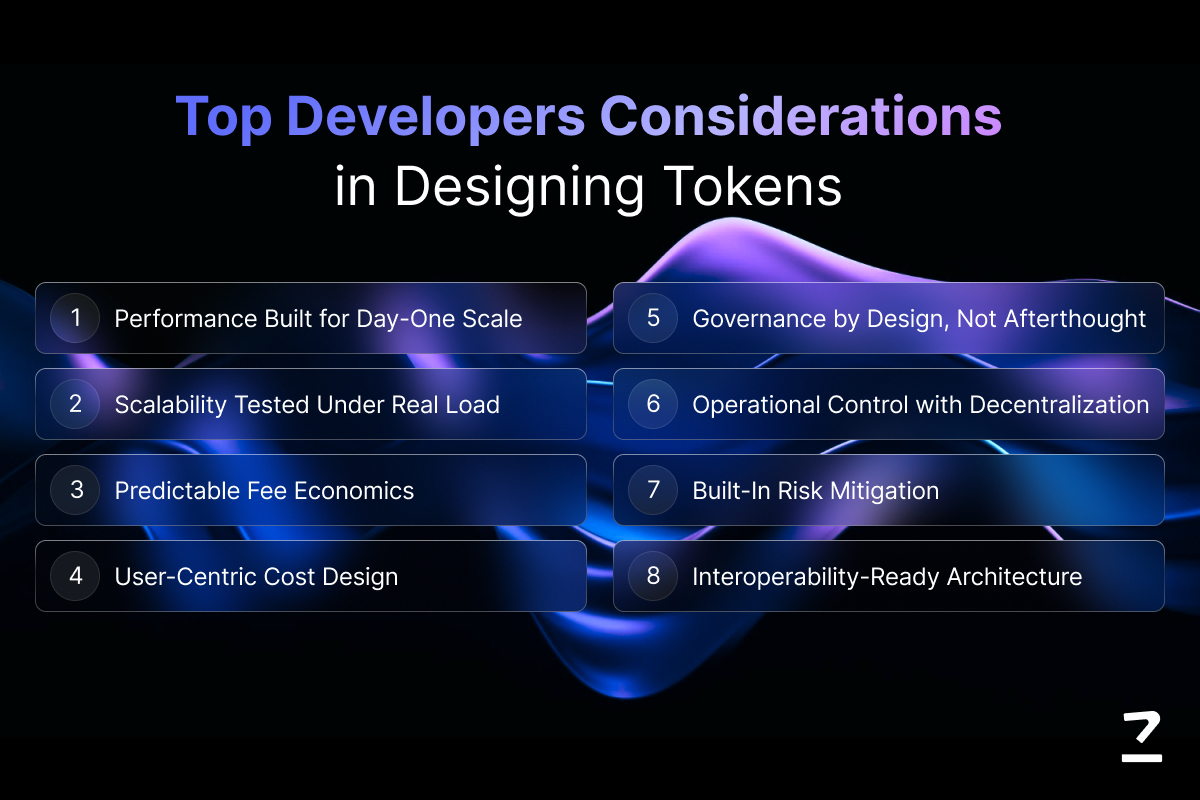
By 2026, experienced blockchain developers will start reconsidering the design of tokens in systemic terms. The token performance, cost structure and governance structures are no longer considered as an afterthought to the product design.
Performance and Scalability Planning
Millions of daily transactions and high-frequency interactions are intended since the first day of development. Solutions such as Solana and modular CDK enable projects to specify performance parameters that are suitable for expected use. The engineering departments are focused on:
-
Benchmarking transaction throughput and fee curves
-
Identifying bottlenecks under peak demand
-
Ensuring rollout paths for future scaling
Cost Efficiency and Predictability
Gas fees profoundly influence user adoption and retention. Teams now model long‑term fee trajectories across chains and Layer‑2s rather than focusing on instantaneous costs. Predictable fee structures reduce friction for users, especially when tokens support micro‑transactions or frequent interactions.
Control and Governance
Token governance mechanisms are critical not only for community engagement but also for compliance and upgradeability. Projects increasingly use frameworks that enable controlled upgrades, role‑based permissions, and on‑chain voting tied to business logic all while balancing decentralization with operational control.
Experienced token developers also build MEV protection, data storage minimization, and multi‑chain interoperability into the core design to prevent common pitfalls and maximize user trust.
Key Factors That Define the Best Blockchain for Token Development
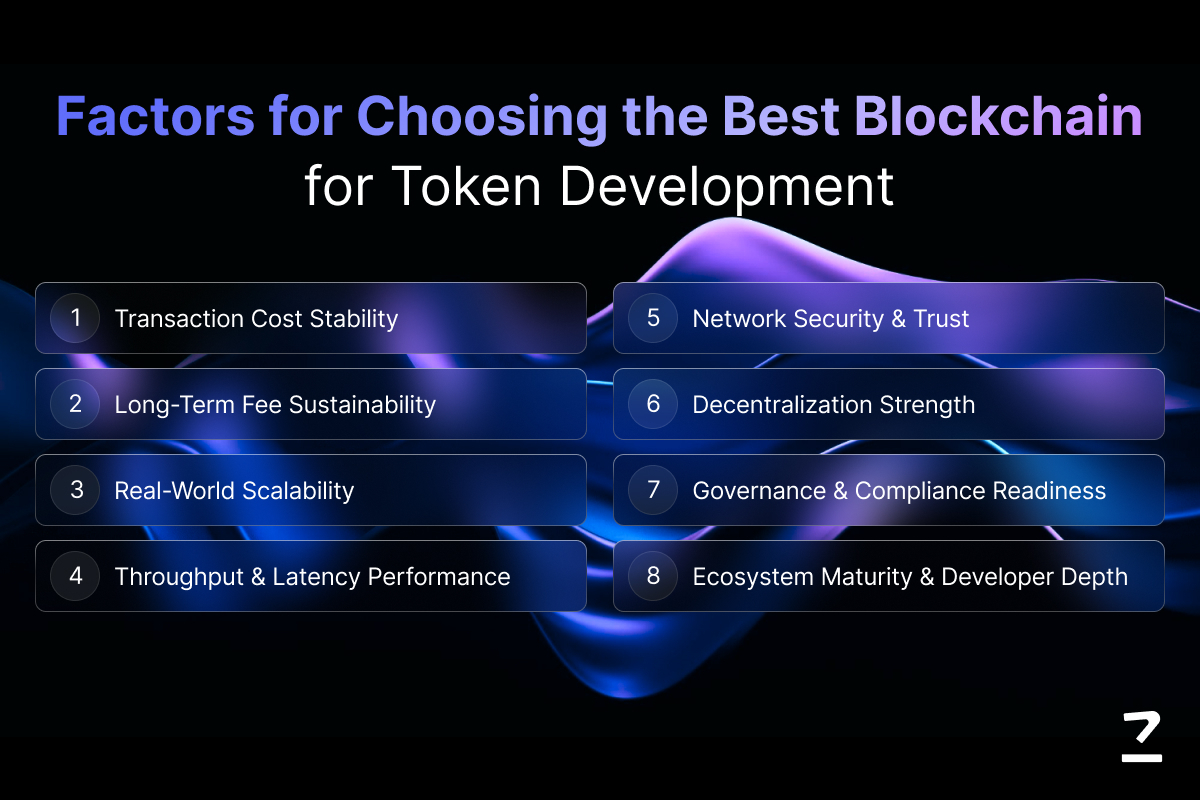
The selection of the appropriate blockchain in 2026 will involve consideration of several factors that will affect the sum of money, performance, network effects, and viability in the long term.
Transaction Costs and Long‑Term Fee Sustainability
High transaction fees can erode user engagement and increase churn. Chains with low and predictable fees such as Solana’s sub‑cent execution lower barriers for end‑users, while Ethereum and its Layer‑2s balance costs with security and liquidity. Evaluating long‑term fee models helps forecast sustainable adoption.
Scalability, Throughput, and User Experience
Scalability isn’t just raw TPS; it’s about experienced responsiveness under load. Polygon’s zkEVM and CDK stacks aim to provide scalable infrastructure that mirrors EVM behavior, while Solana pushes throughput limits on mainnet.
Security, Decentralization, and Trust
Security guarantees and decentralization directly affect investor and institutional confidence. Ethereum’s broad developer base and long track record make it a default choice for high‑trust tokens, while emergent chains must demonstrate reliability and robust validation.
Governance, Compliance, and Upgradeability
Many jurisdictions now require attributes like address freezes, KYC integrations, and responsive controls. Polygon CDK’s customizability supports richer governance models, while public chains may constrain such features without additional engineering overhead.
Ecosystem Maturity and Developer Availability
A vibrant ecosystem accelerates innovation. Ethereum’s developer community remains the largest, reflecting extensive tooling, documentation, and third‑party services. Solana continues to attract new developers, and Polygon’s EVM alignment draws builders looking for custom chain flexibility.
How Blockchain Choice Impacts Tokenomics and Long‑Term Sustainability
Blockchain choice directly shapes tokenomics, which is the economic behavior of a token across its lifecycle. Chain‑specific factors like fee models, liquidity access, governance flexibility, security assumptions, and cross‑chain interoperability determine how easily a token can:
-
Maintain price stability
-
Attract liquidity providers
-
Support governance incentives
-
Scale with user growth
For example, high fees can disrupt layering of incentives in DeFi systems, while poor interoperability can fragment liquidity pools and hurt price discovery. Chain selection should align with both tokenomics strategy and business goals.
Launch Your Token on the Right Blockchain with Codezeros
In 2026, making the right blockchain choice for your token is a strategic decision that impacts economics, user experience, regulatory alignment, and long‑term viability. Ethereum is the go‑to for security and liquidity, Solana excels in performance and cost efficiency, and Polygon CDK delivers customizable networks for enterprise grade and regulated token ecosystems.
Working with an experienced token development company like Codezeros ensures that your architecture, governance model, and tokenomics design align with your business goals.
Contact us for a rigorous selection process grounded in real data, user behavior, and technical performance can save millions in costs and future migrations, while positioning your project for scalable success.
Post Author

Deep Shah
Explore Deep's insightful blog posts that help businesses stay ahead of the curve, explore new possibilities, and unlock the full potential of blockchain technology
Frequently Asked Questions
Frequently asked questions about this article.
Start Your Token Development Journey with the Right Architecture
Choosing the wrong blockchain can lock your token into high fees, scalability limits, or costly migrations. At Codezeros, we help founders and enterprises make data-driven blockchain decisions backed by deep tokenomics advisory services and real-world deployment experience. Our team designs secure, scalable token architectures aligned with your business goals, regulatory requirements, and long-term growth strategy. Talk to our token development company experts to validate your blockchain choice and launch with confidence.
Blogs
Our Latest Blogs
Discover valuable industry insights and stay up-to-date with the latest updates by exploring our curated collection of recent blog posts.
Let us know your requirement
We know ideas matter, we are the product of one. We Provide Full Assistance In Your Business