
SHARE THIS ARTICLE
05 Jan 2026
Watch Out Web3 Security Trends That Will Dominate in 2026

Web3 is no longer a concept on the horizon, it is reshaping how we interact with the digital world. Unlike the centralized Web 2.0 systems where people gave up their data and trust to a handful of large companies, Web3 provides a world where people regain control, ownership, and value from the internet. Through the use of blockchain people can control their data, and manage their digital identities and assets on a decentralized network.
As 2026 becomes closer, the rate of adoption is rapidly growing. Many businesses are no longer playing around. They are committed to investments in the Web3 wallet development and blockchain based services. Developers, investors, and businesses alike, it is indisputable that this is a vital year. The ecosystem continues to progress, the regulations are becoming more refined, and the focus is shifting more and more from the buzz to actual use. Companies that are unable to adjust to this new reality will quickly find themselves in a world of Web3 where scalable, safe, and compliant solutions are the new standard.
For businesses, the issue is no longer “if” Web3 will change the course of the business, but rather “how” can it do so in the safest manner? From wallet development services to decentralized applications solutions, the Web3 economy is being built on the pillars of transparency, trust, and security.
Understanding Core Principles of Web3 Development
To use the advantages Web3 offers, businesses need to know the fundamental concepts of Web3. Web3 integrates decentralization, blockchain, and artificial intelligence. Web3 has a focus for the user. With decentralization, there will be no more single points of control, as well as no censorship and no data monopolies. With blockchain, there will be no transactions, contracts, and no identities. There will also be no accountability and no transparency. With artificial intelligence, there will be operational intelligence but also no loss of control, no decentralization, and no optimization for decision making.
The technologies will help create an internet where users will have control over their assets and data. Businesses using new Web3 technologies will have greater security and reduced operational risks and more streamlined processes. For instance, a blockchain integrated supply chain will enable real-time tracking of assets while also authenticating assets and reducing the need for multiple middlemen. A tokenized loyalty program will also help businesses engage customers more while giving customers control over their loyalty tokens.
The principles of Web3 are important for long-term success. Blockchain consulting services will help businesses with the right and legal integration of blockchain technologies and align these technologies with the business goals. Hire Web3 developers, especially those familiar with secure smart contracts, wallet integration, and decentralized systems, will give businesses a competitive advantage.
Major Web3 Trends Emerging in 2026
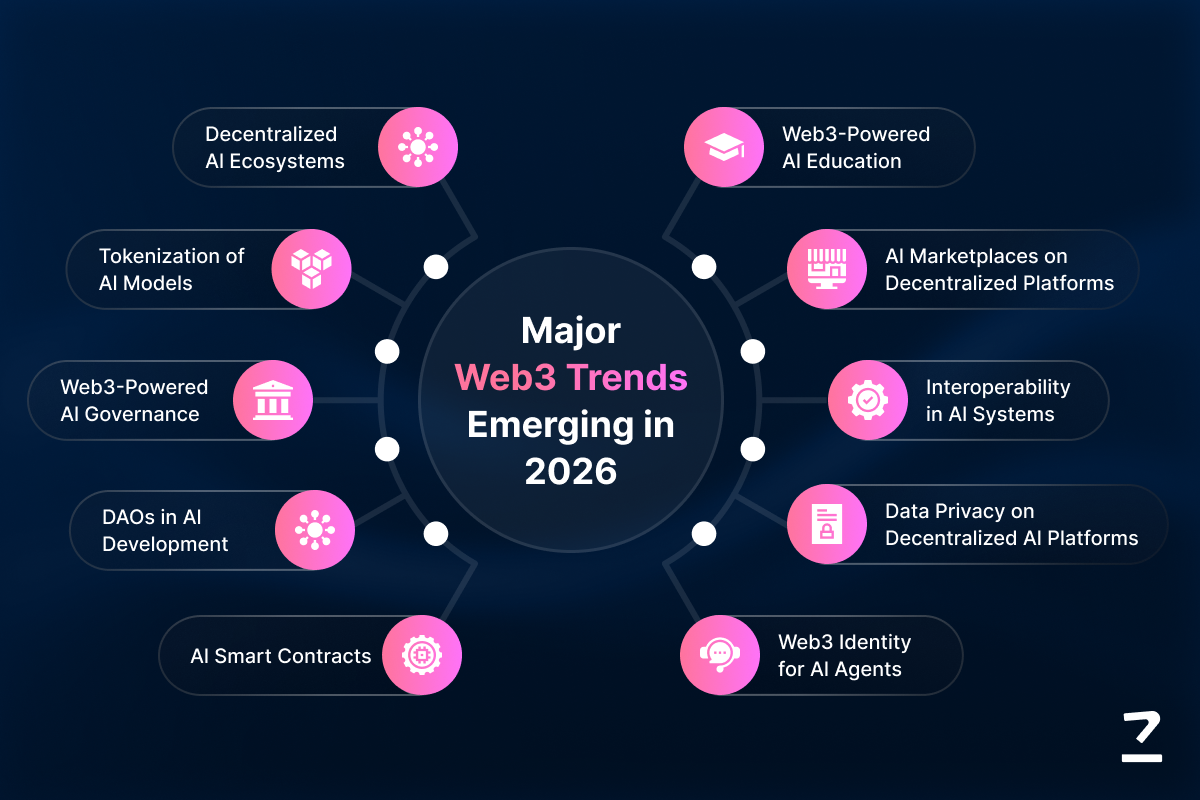
Web3 adoption has crossed the experimental phase and is moving towards real-world implementation, and businesses, investors, and developers must identify trends that are going to prevail in 2026 and beyond. These trends will shape the technological landscape and define the skills, tools, and partnerships that businesses will need to invest in.
1. Decentralized Finance and Exchanges (DEXs):
DEXs have integrated fully into revolutionary financial services. DEXs have fully removed financial middlemen in the trading of digital currency, and have made buying, trading, and holding digital assets cheaper, safer, and more transparent. Financial synthetics, yield-bearing currencies, and collateralized liquidity tokens are becoming popular, and are changing the way institutions lose and acquire programmable capital. The adoption of DEXs requires the implementation of Web3 wallet development and smart contracts to guarantee the safety of assets.
2. Decentralized Social Media Networks (DeSoc):
The adoption of Web3-based social media networks is the first challenge to centralized social media networks. These social networks allow users to not just own their personal data and accounts, but allow them to monetize their content. The networks of DeSocs allow users to data and content ownership, monetization, and account control through wallet logins, content-compressed encryption, and privacy through DeSoc control the data. DeSocial networks that utilize monetization-based community governance and token ownership tools, fellow social users can be incentives to become active community builders.
3. NFTs Moving Beyond Digital Art:
NFTs used to be digital collectibles. Now NFTs can represent digital and physical loyalty cards, tickets to events, access to gated digital content, video game virtual goods, and even financial contracts. There are many use cases and potential innovations in the NFT space. Wallets used to transfer NFTs have to be secure and smart contracts must be audited. Businesses can offer NFTs on multiple blockchains, which can improve user adoption and liquidity.
4. Metaverse Experiences and Immersive Platforms:
Integrating virtual and augmented reality with the metaverse is changing how brands interact with consumers, digital sales, and collaboration in businesses. Users can own digital tokens and smart contracts can automate payment processes, rights, and royalties. Users can be authenticated through secure systems to help control access to digital wallets, and transaction histories can be stored and monitored for audits. Users can collaborate on virtual spaces with the help of Web3 wallet development services to keep their digital assets safe.
5. Decentralized Physical Infrastructure Networks (DePIN):
DePIN networks let users earn rewards when they provide resources like storage, bandwidth, and processing power. This encourages the creation of new, distributed, and resilient infrastructures to reduce reliance on centralized systems. Fraud and node shortcomings are some of the issues that can arise and need to be addressed. Managing a DePIN network can help businesses improve their operational efficiency in a cost-effective way.
6. Real-World Asset (RWA) Tokenization:
Investment markets are beginning to see the tokenization (a blockchain technology that promotes fractional ownership) of more traditional (and tangible) assets such as real estate, commodities, and private credit. This promotes liquidity and accessibility while bridging the gap between traditional finance and blockchain technology. Investor trust will be maintained with the use of secure smart wallets and compliant contracts. For companies, the use of blockchain technology to tokenize assets means providing transparency, auditability, and accessibility to the market (both retail and institutional) on a more cost-effective basis.
7. Modular Blockchain Architecture Adoption:
Layered blockchains separate execution, settlement, and data availability, enabling specialized, scalable solutions. Modular achieves optimization and the reduction of bottlenecks. From a security point of view, the bridging, integrity of the consensus, and transaction verification across the layers will need to be examined. Modular systems with Web3 wallet development will provide users with secure access while achieving scalability.
8. AI and Web3 Technology Convergence:
AI technology adoption is leading the development of Web3. Smart contracts powered by AI, predictive trading and risk reduction through on-chain analytics, and enhanced process efficiency are all the result of AI. Enterprises need to ensure that they employ capable Web3 developers with the appropriate knowledge of AI to be able to use those tools securely. Operationally and in terms of security, the use of AI for automated content generation, tailored content for individual users, and the analysis of outlier behaviours improve overall system performance.
9. On-Chain Identity and Reputation Systems:
Soulbound tokens and verifiable credentials are creating trust metrics in decentralized ecosystems. Users’ reputation becomes quantifiable, supporting lending, staking, governance, and access control. Wallet security is paramount, as compromised keys can lead to irreparable identity or reputation loss. Enterprises can integrate these systems to strengthen trust, prevent fraud, and foster engagement.
10. Sustainability and ESG Initiatives:
Environmental, social, and governance (ESG) considerations are now core to blockchain adoption. Carbon-neutral consensus mechanisms, energy-efficient protocols, and regenerative finance (ReFi) projects attract institutional investors and satisfy regulatory expectations. Transparent reporting, wallet-level tracking, and proof-of-impact metrics strengthen credibility and adoption.
11. Token-Gated Communities and Ownership Models:
Community-driven governance is becoming the norm. DAOs and token-gated platforms enable users to participate in decision-making, access exclusive content, and benefit from rewards. Multi-signature wallets, treasury transparency, and secure voting mechanisms prevent misuse. Enterprises adopting token-gated models strengthen loyalty, retention, and long-term community growth.
These trends collectively reflect a move from speculation to real-world adoption. Organizations integrating these technologies with wallet development services, AI-driven solutions, and secure blockchain solutions will position themselves as leaders in the 2026 Web3 ecosystem.
Ensuring Web3 Security Best Practices
When it comes to security, there is no room for debate. While Web3 engagement grows, smart contracts, multi-layer security, and AI audits are becoming everyday staples. The arrival of new modular blockchains and cross-chain solutions has caused an influx of new risk factors. Businesses will need to monitor, implement new incident responses, and revise their governance policies to manage risk.
Web3 wallet development is crucial to achieving security. The incorporation of multi-factor authentication, cross-chain wallets, and streamlined encryption interoperability, is designed to prevent security breaches. Reductions of security-related issues can be achieved through formal verification, testing in simulated environments, and audits. Security and risk management will be the linchpins of maintaining regulatory compliance and user trust.
Business Applications Of Web3 Technology
Businesses can now interface directly with the Web3 layer of customer engagement. Developing customer engagement through data ownership, protocol interoperability, and operational efficiency with decentralized applications is now possible. The adoption of blockchain technology is visible in automated governance, transparent supply chain management, secured financial transactions, and tokenized loyalty programs.
The importance of blockchain technology consulting has been exemplified in case studies. Tokenized asset integration reduced transaction fees and improved transparency in financial service companies, while NFT loyalty programs increased customer engagement in retail. Enterprises are now able to provide secure, seamless engagement with Web3 wallet development across all decentralized apps.
Marketing Strategies For Web3 Projects
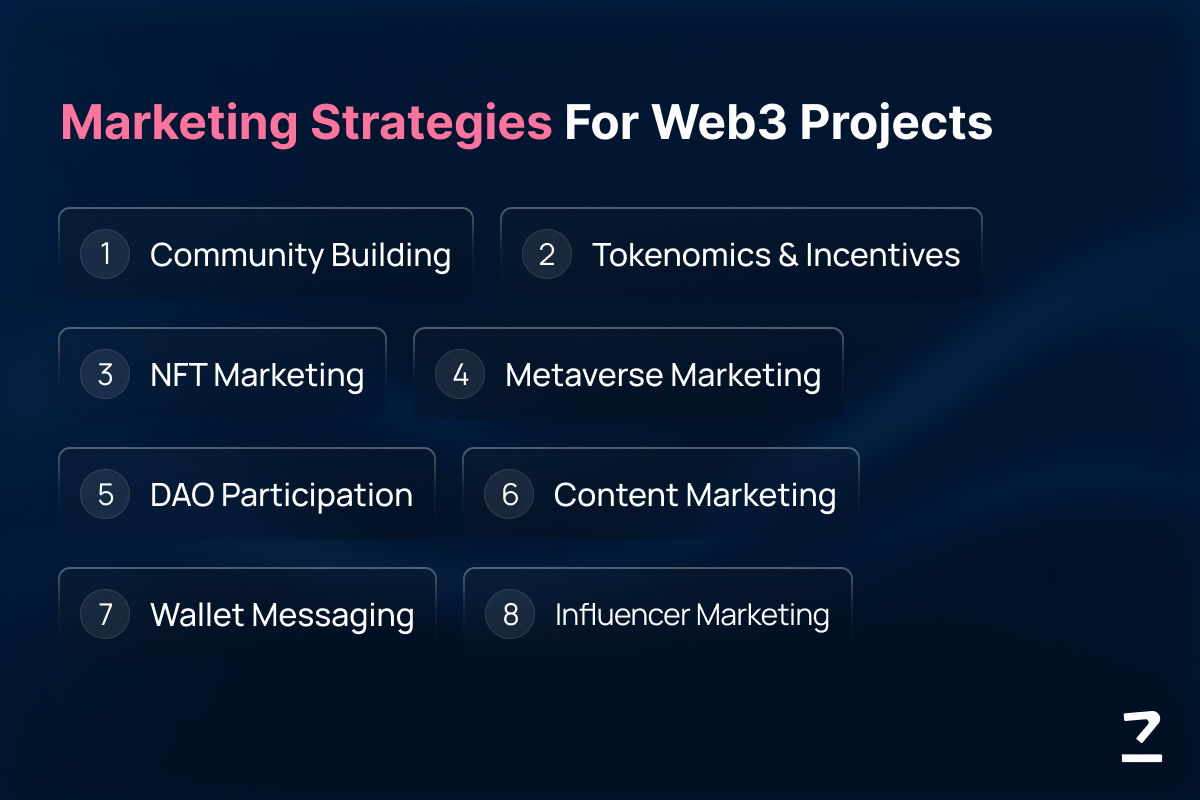
Simply put, Web3 marketing has changed. It is no longer about generating hype, but instead focuses on establishing trust, educating potential users and driving engagement. Those projects that demonstrate real utility and educate customers on how to use tokenized resources and foster real and meaningful communities win. Using Creators and KOLs are great ways to get important and valuable rational and emotional messages to specific recipients and using multiple platforms increases the probability of reach.
There are various community driven methods like participation in governance, community reward token systems, and community driven educational programs that create soft and hard trust and loyalty in the community and to the project as a whole. Engagement, adoption, and even meaningful conversions are valuable metrics to track as opposed to simplistic view metrics that don’t provide real value. When an enterprise describes their projects in terms of security, transparency, and compliance they are typically increasing their credibility and the willingness of their customers to adopt their projects.
Regulations And Compliance Requirements for Web3
When there is innovation, new regulations, and rules are likely to follow. The frameworks such as MiCA, KYC/AML compliance and enforcement of standard security laws from the various jurisdictions continue to shape the adoption of enterprises. Companies have to determine regulations for each jurisdiction, adjust regulations on smart contracts, and maintain systems that are ready to be audited.
There is also a strategic and tactical intersection when it comes to security and compliance. Regulatory compliant block solutions allow enterprises to operate safely and also have institutional adoption. Enterprises that are looking to be ahead of the curve in 2026 will need to have compliance built into the whole structure from Web3 wallet development to decentralized applications.
Preparing Your Business For Web3
Making the move to Web3 requires more than experimentation. Enterprises need a clear adoption roadmap to ensure a secure and seamless transition. This starts with identifying high-impact use cases, designing security-first architectures, establishing governance frameworks, and building the right Web3 talent capabilities.
With custom tooling, enterprise-grade wallets, and experienced blockchain consulting, organizations can reduce operational risk and accelerate adoption. Companies that invest in structured implementation, robust security, and continuous enablement are better positioned to unlock real value from DeFi, tokenized assets, and AI-driven smart contracts without compromising control or compliance.
Partner With Codezeros For Web3 Success!
Codezeros helps businesses adopt Web3 safely and strategically. Our expertise spans wallet development services, smart contract security, and enterprise-grade blockchain solutions. We provide end-to-end guidance for building secure, scalable, and compliant decentralized platforms.
Partnering with Codezeros ensures that enterprises stay ahead of 2026 Web3 security trends. From Web3 wallet development to AI-integrated DeFi systems, we empower organizations to innovate confidently. Secure your digital assets, improve trust, and lead in the decentralized era by working with Codezeros.
Contact Codezeros today and future-proof your enterprise with our Web3 expertise.
Post Author

Deep Shah
Explore Deep's insightful blog posts that help businesses stay ahead of the curve, explore new possibilities, and unlock the full potential of blockchain technology
Frequently Asked Questions
Frequently asked questions about this article.
Build Secure Web3 Solutions Today!
Partner with Codezeros to develop robust Web3 applications and wallets with end-to-end security. Our blockchain consulting services ensure your projects are compliant, scalable, and future-ready. Leverage expertise of our Web3 developers to stay ahead in 2026’s decentralized world.
Blogs
Our Latest Blogs
Discover valuable industry insights and stay up-to-date with the latest updates by exploring our curated collection of recent blog posts.



Let us know your requirement
We know ideas matter, we are the product of one. We Provide Full Assistance In Your Business