

SHARE THIS ARTICLE
14 Aug 2026
How Cross-Chain Bridges Get Hacked: 10 Common Attack Vectors Explained

Cross-chain bridges are commonly hacked through smart contract vulnerabilities, forged or incorrectly verified messages, compromised validator keys, multisig failures, replay attacks, access-control flaws, malicious upgrades, oracle or RPC manipulation, and cross-chain state inconsistencies. The biggest lesson from recent incidents is that bridge security cannot stop at smart contract audits. A secure bridge must protect the entire verification and message-delivery pipeline while continuously checking whether assets released on one chain correspond to legitimate state changes on another.
The April 2026 KelpDAO/LayerZero incident showed how attackers can target the infrastructure responsible for verifying blockchain state rather than directly exploiting a bridge's smart contracts. Approximately $292 million in rsETH was released against a non-existent burn after compromised RPC infrastructure fed false information into a single-verifier setup. The transactions themselves looked valid on-chain, exposing a critical lesson: a bridge can execute perfectly and still be operating on false information.
For companies planning to build cross-chain infrastructure, the implication is clear. An expert cross-chain bridge development services provider believes that security needs to be part of the architecture from day one not an audit performed just before launch.
What Is a Cross-Chain Bridge?
A cross-chain bridge is a protocol or infrastructure layer that enables assets, tokens, messages, or data to move between separate blockchain networks.
For example, a user may want to move an asset from Ethereum to an L2 or another blockchain. Because the two networks maintain separate states and consensus mechanisms, the destination chain cannot automatically know whether the user's asset was legitimately locked, burned, or transferred on the source chain.
The bridge solves this interoperability problem by establishing a verification mechanism between the two networks.
Depending on its architecture, cross-chain bridge development services may use:
-
Smart contracts
-
Validator networks
-
Multisignature wallets
-
Threshold signatures
-
Relayers
-
Oracles
-
Light clients
-
Cryptographic proofs
-
Zero-knowledge proofs
-
Decentralized verification networks
The exact architecture matters because every additional component introduces a potential security assumption.
Ethereum's current bridge documentation makes this trade-off explicit. Bridges can introduce smart contract risk, counterparty or custodial risk in trusted designs, and systemic risk associated with wrapped assets. Ethereum also notes that some of the largest blockchain hacks have involved bridges.
The core question behind every bridge is therefore simple: How does the destination chain know that the claimed event actually happened on the source chain? The answer determines much of the bridge's security model.
Why Are Cross-Chain Bridges Such Attractive Targets?
Cross-chain bridges are attractive to attackers for one obvious reason: they often control or have access to significant pools of assets.
But the bigger problem is architectural. A normal smart contract operates within one blockchain environment.
A cross-chain bridge must coordinate multiple environments with potentially different:
- Consensus mechanisms
- Finality guarantees
- Transaction models
- Block structures
- Network assumptions
- Upgrade mechanisms
- Governance systems
This creates a larger attack surface. A systematic study of cross-chain bridge architectures analyzed 60 bridges and 34 exploits and identified 13 architectural components connected to eight categories of design flaws. Another security study identified 12 potential attack vectors and classified historical cross-chain attacks into 10 distinct types.
The takeaway is important: There is no single "cross-chain bridge hack." Attackers can target the code, the verification process, the keys, the infrastructure, or the assumptions connecting two blockchains.
How Cross-Chain Bridges Work
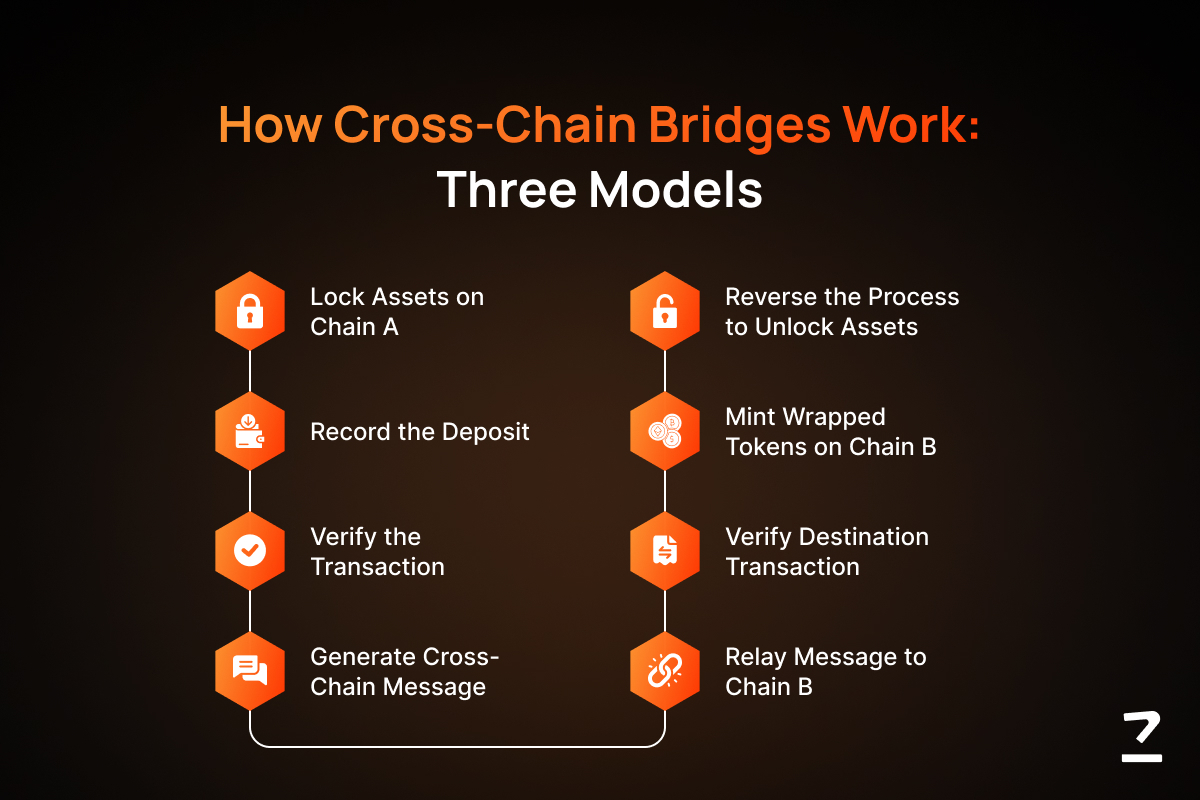
A simplified lock-and-mint bridge might work as follows:
- A user deposits tokens into a bridge contract on Chain A.
- The bridge records the deposit or lock event.
- A verification system confirms that the event is legitimate.
- A cross-chain message is generated.
- The message is relayed to Chain B.
- The destination contract verifies the message.
- Equivalent wrapped or representation tokens are minted on Chain B.
When the user moves the asset back, the process is reversed.
The representation token may be burned on Chain B, after which the bridge verifies the burn and releases the original asset on Chain A. This creates a fundamental security invariant:
Assets released or minted on one chain should correspond to legitimate assets locked or burned on another chain. If that relationship breaks, the bridge can become insolvent. That is why cross-chain bridge security is fundamentally a state-verification problem.
The bridge must not only determine whether a transaction is valid. It must determine whether the transaction represents a legitimate state transition across two independent blockchain systems.
10 Common Cross-Chain Bridge Attack Vectors
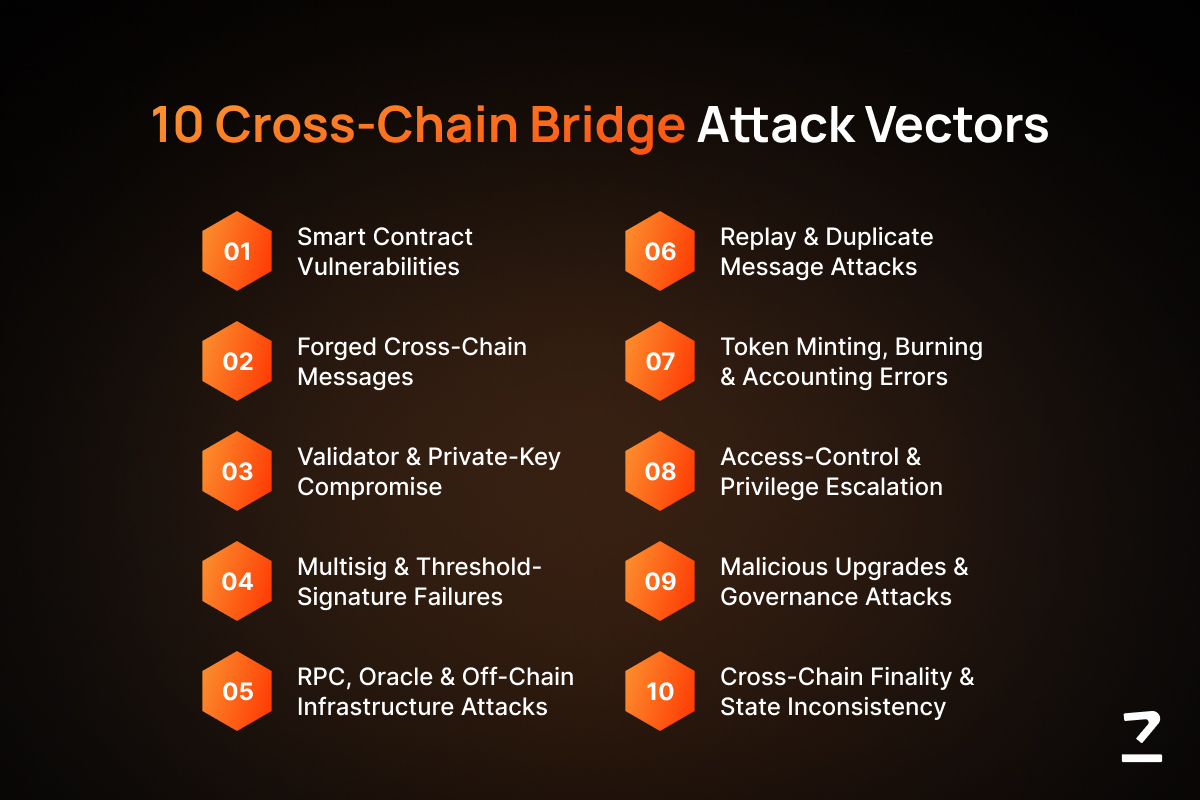
1. Smart Contract Vulnerabilities
Smart contracts remain one of the most obvious bridge attack surfaces. A bridge may have multiple contracts handling:
- Asset deposits
- Token locking
- Token minting
- Token burning
- Asset release
- Message verification
- Validator management
- Upgrade controls
A vulnerability in any critical function can potentially compromise the bridge. Common weaknesses include:
- Reentrancy
- Missing access controls
- Improper input validation
- Signature verification errors
- Unsafe external calls
- Integer or accounting errors
- Incorrect state transitions
- Logic flaws
- Unprotected administrative functions
The danger is amplified because bridges often hold large amounts of capital. A vulnerability in a small DeFi application may affect a limited pool. A vulnerability in a bridge can potentially affect the assets backing an entire ecosystem of wrapped tokens.
The Wormhole exploit illustrates the scale of this risk. Ethereum's documentation cites the 2022 incident in which approximately 120,000 wETH, valued at roughly $325 million at the time, was stolen.
How to reduce the risk:
Secure Cross-Chain Bridge Development should include:
- Manual code review
- Automated security testing
- Fuzz testing
- Formal verification where appropriate
- Multiple independent audits
- Invariant testing
- Extensive testnet deployment
An audit from a trusted cross-chain bridge development company is necessary. It is not sufficient.
2. Forged or Incorrectly Verified Cross-Chain Messages
Every bridge relies on messages. A message may effectively state:
"A specific amount of tokens was burned on Chain A."
The destination chain then acts on that information. The attack occurs when the bridge accepts a message that is not supported by genuine source-chain state.
Attackers may exploit:
-
Weak proof validation
-
Incorrect signature verification
-
Missing source-chain validation
-
Incorrect chain IDs
-
Improper domain separation
-
Faulty Merkle proof verification
-
Invalid nonce handling
-
Message-format vulnerabilities
If the destination chain accepts a fraudulent message, the attacker may trigger unauthorized minting or asset release. This is one reason cross-chain message verification needs to be treated as a dedicated security layer rather than simply another smart contract function.
How to reduce the risk:
A secure bridge should independently validate:
-
Source chain
-
Destination chain
-
Source contract
-
Destination contract
-
Message ID
-
Nonce
-
Sender
-
Receiver
-
Payload
-
Cryptographic proof
-
Finality status
Every message should have an unambiguous execution context.
3. Validator and Private-Key Compromise
Some bridges rely on a group of validators or signers to confirm cross-chain transactions. This introduces another major attack surface: private keys.
Attackers may obtain validator keys through:
-
Phishing
-
Social engineering
-
Malware
-
Credential theft
-
Cloud infrastructure compromise
-
Insider attacks
-
Weak key storage
-
Poor operational security
The Ronin Bridge incident demonstrated how a bridge can be compromised through validator key infrastructure rather than a traditional smart contract bug. The incident became one of the most prominent examples of how key compromise can defeat a bridge's authorization model.
The critical question is therefore not:
"How many validators does the bridge have?"
It is:
"How independent and secure are those validators?"
If multiple validators share infrastructure, cloud providers, operational teams, or key-management practices, compromising one environment may compromise the effective quorum.
How to reduce the risk:
-
Hardware-backed key storage
-
Threshold signatures
-
Geographically distributed validators
-
Independent infrastructure
-
Strict access controls
-
Key rotation
-
Continuous signer monitoring
-
Emergency key revocation
4. Multisig and Threshold-Signature Failures
Multisignature systems reduce dependence on a single private key, but they do not eliminate trust. A bridge using a 2-of-3 multisig requires two signers to authorize an action. That sounds secure until two keys are compromised. The deeper issue is correlated risk. Three signers may appear independent but could all:
-
Use the same cloud provider
-
Store keys using the same custody service
-
Share the same operational team
-
Use identical security policies
-
Depend on the same infrastructure
An attacker does not necessarily need to compromise every signer. They only need enough control to reach the authorization threshold.
How to reduce the risk:
Bridge architecture should consider:
-
Higher signing thresholds
-
Genuine signer independence
-
Hardware security modules
-
Geographical distribution
-
Separate operational ownership
-
Key rotation
-
Transaction limits
-
Time delays for high-value transfers
The goal is to reduce both direct compromise and correlated failure.
5. RPC, Oracle, and Off-Chain Infrastructure Manipulation
This is one of the most important bridge attack vectors in 2026. Many cross-chain systems rely on off-chain infrastructure to observe source-chain events and communicate them to a verification layer.
That infrastructure may include:
-
RPC nodes
-
Oracles
-
Relayers
-
Indexers
-
Event listeners
-
APIs
-
Verification networks
If an attacker manipulates the data being consumed by the verifier, the bridge may act on false information. The 2026 KelpDAO incident is a critical example.
According to Chainalysis, attackers compromised two internal RPC nodes used by the LayerZero Labs DVN and simultaneously disrupted an external RPC path. The resulting 1-of-1 verification setup accepted fabricated source-chain data showing a token burn that never happened. The Ethereum-side contract then released approximately 116,500 rsETH, worth around $292 million at the time.
The key lesson is profound: The smart contract did exactly what it was programmed to do. The failure occurred because the system fed it false information.
How to reduce the risk:
-
Use multiple independent RPC providers
-
Avoid single-verifier architectures for high-value systems
-
Use multiple independent verification networks
-
Cross-check source-chain state
-
Monitor RPC integrity
-
Detect conflicting node responses
-
Maintain tamper-resistant infrastructure logs
-
Use cross-chain invariant monitoring
This is where modern cross-chain bridge security is moving: from transaction-level monitoring to system-state monitoring.
6. Replay Attacks and Duplicate Message Execution
A replay attack occurs when a legitimate cross-chain message is reused to trigger the same action multiple times. Suppose a bridge receives a valid message authorizing a 100-token transfer. If the bridge does not properly track execution, an attacker may attempt to replay the same authorization.
Effective replay protection typically relies on:
-
Unique message IDs
-
Nonces
-
Processed-message mappings
-
Chain-specific domains
-
Contract-specific domains
-
Expiration mechanisms
Replay protection becomes particularly important when the same bridge logic is deployed across multiple networks. A message that is valid for Ethereum should not automatically be valid for another chain or another bridge deployment.
How to reduce the risk:
Every cross-chain message should have a unique identity tied to its:
-
Source chain
-
Destination chain
-
Source contract
-
Destination contract
-
Nonce
-
Message payload
The system should also permanently record successful execution where appropriate.
7. Token Minting, Burning, and Accounting Errors
A bridge must maintain a reliable relationship between assets locked, burned, minted, and released.
Consider a simplified model.
If 1 million tokens are locked on Chain A, the bridge should not allow more than the corresponding authorized representation to exist on Chain B.
If 500,000 representation tokens are burned, the bridge should not release 1 million underlying tokens.
This sounds obvious. But cross-chain accounting becomes complicated when systems support:
-
Multiple token representations
-
Different decimal standards
-
Rebasing tokens
-
Native assets
-
Wrapped assets
-
Liquidity-based bridges
-
Multiple destination chains
An accounting error can create unbacked assets. Ethereum identifies systemic risk associated with wrapped assets as one of the broader concerns surrounding bridge architecture.
How to reduce the risk:
Build automated invariants that continuously verify:
Locked assets ≥ corresponding issued representation
and
Burned representation ≥ corresponding released underlying assets
The exact invariant depends on the bridge architecture, but the principle remains the same: supply must remain economically and cryptographically accountable.
8. Access-Control and Privilege Escalation
Bridge contracts often contain highly privileged functions. Administrators may be able to:
-
Add validators
-
Remove validators
-
Change verification parameters
-
Upgrade contracts
-
Pause transfers
-
Change supported tokens
-
Modify governance
-
Change bridge configuration
If these privileges are poorly protected, an attacker may not need to exploit the core bridge logic. They can simply take control of the administrative layer.
Common weaknesses include:
-
Incorrect role configuration
-
Unprotected initialization
-
Overpowered administrator keys
-
Weak upgrade authorization
-
Poor governance controls
-
Missing timelocks
How to reduce the risk:
Use:
-
Role-based access control
-
Least-privilege principles
-
Multisig administration
-
Timelocked upgrades
-
Emergency pause mechanisms
-
Independent governance review
The administrative layer should be treated as a critical security boundary.
9. Malicious Upgrades and Governance Attacks
Upgradeable contracts create flexibility. They also create a powerful attack surface. If an attacker compromises the upgrade mechanism, they may replace legitimate bridge logic with malicious code.
Governance can face similar problems. Potential attacks include:
-
Governance key compromise
-
Malicious proposals
-
Low voter participation
-
Governance manipulation
-
Compromised multisig
-
Immediate execution without a delay
A bridge that controls hundreds of millions of dollars is an attractive target for governance attacks because control over the rules can be more valuable than directly attacking the assets.
How to reduce the risk:
Consider:
-
Timelocked upgrades
-
Transparent proposals
-
Multi-party approvals
-
Independent security reviews
-
Emergency rollback mechanisms
-
Upgrade monitoring
-
Restricted emergency privileges
The objective is to make unauthorized changes difficult and detectable.
10. Cross-Chain Finality and State Inconsistency
This is one of the most complex categories because blockchains do not all finalize transactions in the same way.
Different networks have different:
-
Consensus mechanisms
-
Confirmation requirements
-
Finality models
-
Reorganization risks
-
Transaction ordering rules
A bridge may observe an event and act before the source chain has reached sufficient finality. If the source chain reorganizes, the event the bridge relied upon may disappear.
Other failures can occur when:
-
RPC nodes disagree
-
A chain experiences congestion
-
A network temporarily forks
-
Finality is delayed
-
A source transaction is reverted
-
Destination execution succeeds before source confirmation
This creates a difficult engineering problem: How long should a bridge wait before trusting an event? Waiting too long hurts user experience. Waiting too little increases security risk.
How to reduce the risk:
Bridge developers should define explicit finality policies for every supported blockchain.
The architecture should account for:
-
Confirmation depth
-
Reorg detection
-
Finality thresholds
-
Message expiration
-
Failed message recovery
-
Replay protection
-
Chain-specific verification rules
There is no universal confirmation policy that works equally well for every chain.
What Recent Bridge Hacks Teach Us
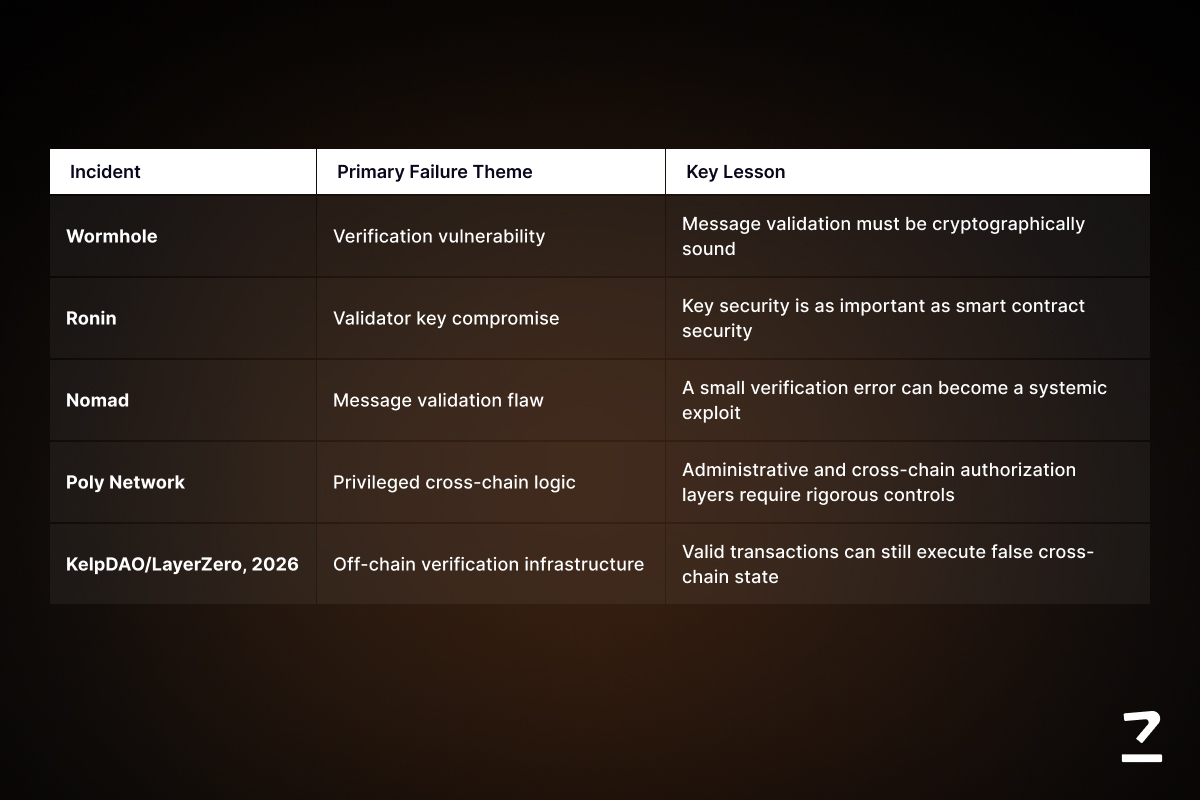
Looking at major bridge incidents reveals a consistent pattern: the weakest component is often not where developers initially expect it to be.
The common thread is trust concentration. Every bridge has assumptions about what it trusts. That trust may be concentrated in:
-
A validator set
-
A multisig
-
A single oracle
-
A verification network
-
An RPC infrastructure layer
-
An administrator
-
A governance system
The more value a bridge controls, the more important it becomes to identify and minimize those trust bottlenecks.
The 2026 KelpDAO Exploit: When Valid Transactions Execute False State
The KelpDAO incident deserves special attention because it represents a particularly instructive bridge-security failure.
The attacker did not exploit a classic reentrancy vulnerability. They did not simply steal a private key from the bridge contract. Instead, the attack targeted the infrastructure used to determine what happened on another blockchain.
The compromised RPC infrastructure supplied false information to a single-verifier setup. That verifier then approved a message representing a token burn that had never occurred.
The destination chain processed the message correctly. From the perspective of the destination contract:
-
The message was valid.
-
The signature was valid.
-
The transaction was correctly executed.
But the underlying cross-chain event was false. This distinction matters. Traditional transaction monitoring might ask:
"Was this transaction valid?"
Cross-chain security needs to ask:
"Was the state transition represented by this transaction actually true across both chains?"
Chainalysis reported that Kelp's response included pausing relevant contracts, blocking a further attempted drain, and monitoring the resulting cross-chain invariant break. The incident demonstrates why modern bridge security requires both transaction monitoring and continuous verification that assets released on one chain correspond to legitimate events on another.
For future bridge architecture, this should be treated as a core design principle. A bridge should never rely on a single source of truth when the value at risk is substantial.
How to Build More Secure Cross-Chain Bridge Solutions
A secure bridge begins with architecture. Before development starts, teams should determine:
-
What assets will move?
-
Which blockchains will be supported?
-
What messages need to cross chains?
-
Who or what verifies those messages?
-
What happens if a verifier fails?
-
What happens if a validator is compromised?
-
What happens if the source chain reorganizes?
-
What happens if the destination chain is unavailable?
A strong Cross-Chain Bridge Development Solution should incorporate multiple layers of defense.
Defense Layer 1: Secure Smart Contracts
Implement strict access controls, explicit state transitions, safe upgrade patterns, replay protection, and robust input validation.
Defense Layer 2: Independent Verification
Avoid unnecessary dependence on one verifier, signer, oracle, or RPC provider.
Defense Layer 3: Strong Key Management
Use secure custody, hardware-backed protection, threshold signing, key rotation, and independent operational controls.
Defense Layer 4: Cross-Chain Invariant Monitoring
Continuously compare source-chain and destination-chain state.
Defense Layer 5: Anomaly Detection
Monitor:
-
Large withdrawals
-
Unexpected minting
-
Supply discrepancies
-
Validator anomalies
-
Suspicious upgrades
-
Failed message patterns
Defense Layer 6: Containment
Assume that something will eventually fail.
Design:
-
Rate limits
-
Withdrawal caps
-
Emergency pauses
-
Circuit breakers
-
Timelocks
-
Recovery mechanisms
Security is not only about preventing every exploit. It is also about limiting how much damage an exploit can cause.
Secure Cross-Chain Bridge Development Process
A security-first Cross-Chain Bridge Development Process should typically include the following stages.
1. Requirements and Threat Modeling
Define the assets, chains, users, trust assumptions, and attack scenarios.
2. Bridge Architecture Design
Select the appropriate interoperability model, verification mechanism, validator architecture, and messaging framework.
3. Smart Contract Development
Develop source-chain and destination-chain contracts with secure state management and explicit authorization rules.
4. Cross-Chain Messaging Layer
Implement reliable message generation, verification, delivery, nonce management, and replay protection.
5. Validator and Infrastructure Security
Secure nodes, RPC providers, relayers, signers, and monitoring systems.
6. Testing and Simulation
Perform:
-
Unit testing
-
Integration testing
-
Fuzz testing
-
Adversarial testing
-
Failure simulation
-
Reorg testing
-
Load testing
7. Independent Security Audits
Use external auditors to examine smart contracts, bridge logic, cryptographic verification, and infrastructure assumptions.
8. Testnet Deployment
Run the system in realistic environments before handling significant value.
9. Monitoring and Incident Response
Deploy real-time monitoring and define clear procedures for pausing, investigating, and recovering from abnormal activity.
10. Continuous Security
Bridge security does not end at launch. New chains, new contracts, new dependencies, and new attack techniques can introduce new vulnerabilities.
Cross-Chain Bridge Security Checklist
Before launching a bridge, ask:
-
Can one compromised key authorize a transfer?
-
Can a compromised validator quorum drain funds?
-
Is there a single verifier?
-
Is there a single RPC dependency?
-
Can messages be replayed?
-
Are chain IDs validated?
-
Are source and destination contracts authenticated?
-
Can assets be minted without legitimate collateral?
-
Can assets be released without a verified burn?
-
Are cross-chain invariants monitored?
-
What happens during a chain reorganization?
-
How are upgrades authorized?
-
Are upgrades timelocked?
-
Can suspicious transfers be paused?
-
Are emergency controls protected?
-
Are validators operationally independent?
-
Are RPC providers independent?
-
Is there a tested incident-response plan?
If the answer to these questions is unclear, the bridge's security model is not sufficiently defined.
How Codezeros Approaches Cross-Chain Bridge Development
Building a bridge is not simply a matter of connecting two blockchain networks. It requires designing a secure interoperability layer that can verify cross-chain events, manage assets, process messages, and remain resilient when individual components fail.
As a trusted Cross-Chain Bridge Development Company, Codezeros can help businesses plan and develop custom interoperability infrastructure based on their blockchain ecosystem and business requirements.
Its Cross-Chain Bridge Development Services can be aligned with use cases involving:
-
Multi-chain asset transfers
-
Token bridging
-
Cross-chain messaging
-
Blockchain ecosystem expansion
-
Cross-chain wallet integration
-
Custom blockchain interoperability
Depending on the requirements, a custom bridge architecture may include smart contracts, validator or relayer infrastructure, message verification, token locking and minting mechanisms, cross-chain wallet integration, monitoring, and security controls.
For organizations evaluating Cross-Chain Bridge Development Solutions, the most important decision is not simply which chains to connect. It is how the bridge will verify truth across those chains and what happens when part of the system fails.
That is why security architecture, threat modeling, testing, monitoring, and incident response should be considered from the beginning of the Cross-Chain Bridge Development Process.
If you're evaluating a cross-chain infrastructure project, Codezeros can help you assess the architecture, interoperability requirements, and security considerations needed to move from concept to production.
Planning to build a cross-chain bridge? Talk to Codezeros about designing a secure, scalable interoperability solution for your Web3 ecosystem.
Final Takeaway: Build a Cross-Chain Bridge That Is Secure by Design
Cross-chain bridges are essential to the multi-chain Web3 ecosystem, but connecting blockchains is only part of the challenge. The real challenge is building an interoperability layer that can verify cross-chain state, protect assets, and remain resilient when individual components or trust assumptions fail.
As the attack vectors discussed in this guide show, bridge security goes far beyond smart contracts. Attackers can target verification logic, validator keys, multisig systems, RPC infrastructure, oracles, relayers, governance, upgrade mechanisms, accounting, and finality assumptions. The 2026 KelpDAO incident is a clear reminder that even a correctly executed transaction can become dangerous when the underlying cross-chain state is based on false information.
For businesses planning to build a cross-chain bridge, security must be considered from the architecture stage—not added as an afterthought. The right approach combines secure smart contracts, robust message verification, independent infrastructure, strong key management, cross-chain monitoring, and effective failure-containment mechanisms.
As a Cross-Chain Bridge Development Company, Codezeros helps businesses design and develop secure, scalable interoperability solutions tailored to their blockchain ecosystem and business requirements.
Planning to build a cross-chain bridge or expand your Web3 ecosystem across multiple networks? Talk to Codezeros experts to explore a secure cross-chain bridge architecture built for your specific use case.
Post Author

Paritosh Mehta
As a distinguished blockchain expert at Codezeros, Paritosh contributes to the company's growth by leveraging his expertise in the field. His forward-thinking mindset and deep industry knowledge position Codezeros at the forefront of blockchain advancements.
Frequently Asked Questions
Frequently asked questions about this article.
Build Secure Cross-Chain Bridge Solutions With Codezeros
Planning to build a cross-chain bridge or strengthen an existing interoperability solution? Codezeros helps businesses design and develop secure, scalable cross-chain infrastructure with robust message verification, smart contract security, validator architecture, cross-chain monitoring, and failure-containment mechanisms. Talk to our blockchain experts to discuss your bridge architecture and security requirements.
Blogs
Our Latest Blogs
Discover valuable industry insights and stay up-to-date with the latest updates by exploring our curated collection of recent blog posts.


Let us know your requirement
We know ideas matter, we are the product of one. We Provide Full Assistance In Your Business