
SHARE THIS ARTICLE
16 Apr 2026
How Blockchain Technology Builds Trust and Transparency in AI Systems
Artificial intelligence is reshaping industries, automating complex processes, and generating valuable insights at unprecedented scales. Yet as organizations deploy AI systems in critical applications from healthcare diagnostics to financial decision-making, a fundamental challenge persists: how do we trust AI decisions we cannot fully understand or verify?
This is where blockchain technology becomes indispensable. Blockchain's immutable ledger system combined with transparent verification mechanisms creates an unprecedented opportunity to build verifiable, accountable AI systems. When blockchain and artificial intelligence converge, organizations gain the ability to create comprehensive audit trails, ensure data integrity, enforce compliance automatically, and prove to regulators and stakeholders exactly how AI decisions were made.
The integration of blockchain technology with AI is not merely a technical advancement, it represents a fundamental shift in how enterprises approach digital trust. Businesses operating in regulated industries like financial services, healthcare, and government are increasingly recognizing that blockchain-backed AI solutions offer the transparency and accountability required for responsible AI deployment.
For top blockchain development companies, this convergence presents a strategic opportunity to help enterprises solve real problems: building AI systems that are trustworthy, auditable, and compliant with evolving regulations. Whether you're exploring blockchain development services, understanding how these technologies work together is essential for making informed decisions about your digital transformation journey.
What is Blockchain Technology and How It Works
Before exploring how blockchain enhances AI trust, it's important to understand what blockchain is and why its technical features matter for enterprise applications.
Blockchain is a distributed ledger technology (DLT) that records transactions across a network of independent computers, with each participant maintaining an identical copy of the ledger.
Unlike traditional databases controlled by a single authority, blockchain distributes control across multiple nodes, creating a decentralized system where no single entity can unilaterally modify historical records.
Key Technical Features of Blockchain
Decentralization: Rather than storing data in a central database managed by one organization, blockchain distributes data across a network. This eliminates single points of failure and removes the ability of any one party to tamper with records without the consensus of the network.
Immutability: Once data is recorded on a blockchain, it becomes extremely difficult to alter. Each new block contains a cryptographic hash of the previous block, creating a chain that cannot be broken without being immediately detected. This ensures historical accuracy and prevents retroactive tampering.
Transparency: Every participant in the network can view all transactions and data (though privacy protections can limit who sees what). This radical transparency enables verification without requiring a trusted intermediary, a critical feature for building confidence in AI systems.
Smart Contracts: These are self-executing programs stored on blockchain that automatically execute predefined actions when specific conditions are met. Smart contracts eliminate intermediaries, reduce execution costs, and ensure that agreed-upon rules are enforced consistently without human intervention.
For enterprise blockchain development services, these technical capabilities translate into practical benefits: verifiable records, automated compliance, transparent operations, and dramatically reduced fraud risk.
Why Blockchain is Essential for Building Trust in AI Systems
Modern AI systems face a critical credibility problem known as the "black-box" challenge. Even AI developers struggle to explain exactly why their models make specific decisions. When an AI system denies a loan application, rejects a medical diagnosis, or recommends a hiring decision, stakeholders reasonably demand to know: how was this decision made? What data influenced it? Can we trust it?
This transparency gap creates serious consequences. Regulators impose fines for unexplainable AI decisions. Customers distrust opaque algorithms. Healthcare providers cannot use AI systems they cannot verify. Financial institutions face legal liability when AI decisions cannot be justified. These challenges demand more than better explanations—they require verifiable, tamper-proof evidence of how AI systems operate.
How Blockchain Solves the Trust Problem
Blockchain creates an immutable record of every input, decision, and output in an AI system. When AI algorithms process data stored on blockchain, the source data is cryptographically verified and timestamped. The algorithm's decisions are recorded in blocks that cannot be altered retroactively. The entire decision chain becomes auditable, traceable, and verifiable.
Consider a healthcare AI system that recommends treatment options. On a traditional system, administrators might ask: which patient data was analyzed? When? What medical records informed the recommendation? Traditional databases can be edited, logs can be modified, and historical accuracy is difficult to prove.
On a blockchain-backed system, every piece of patient data is cryptographically linked to specific timestamps. Every decision is recorded in an immutable block. Regulators can trace the exact decision path and verify that it complies with medical protocols. Healthcare providers can confidently explain recommendations to patients.
This is the fundamental power of blockchain for AI: it transforms vague algorithmic processes into verifiable, auditable decision-making systems. For organizations deploying blockchain development solutions, this capability addresses the most pressing barrier to enterprise AI adoption—the trust problem.
Applications of Blockchain in AI Across Industries
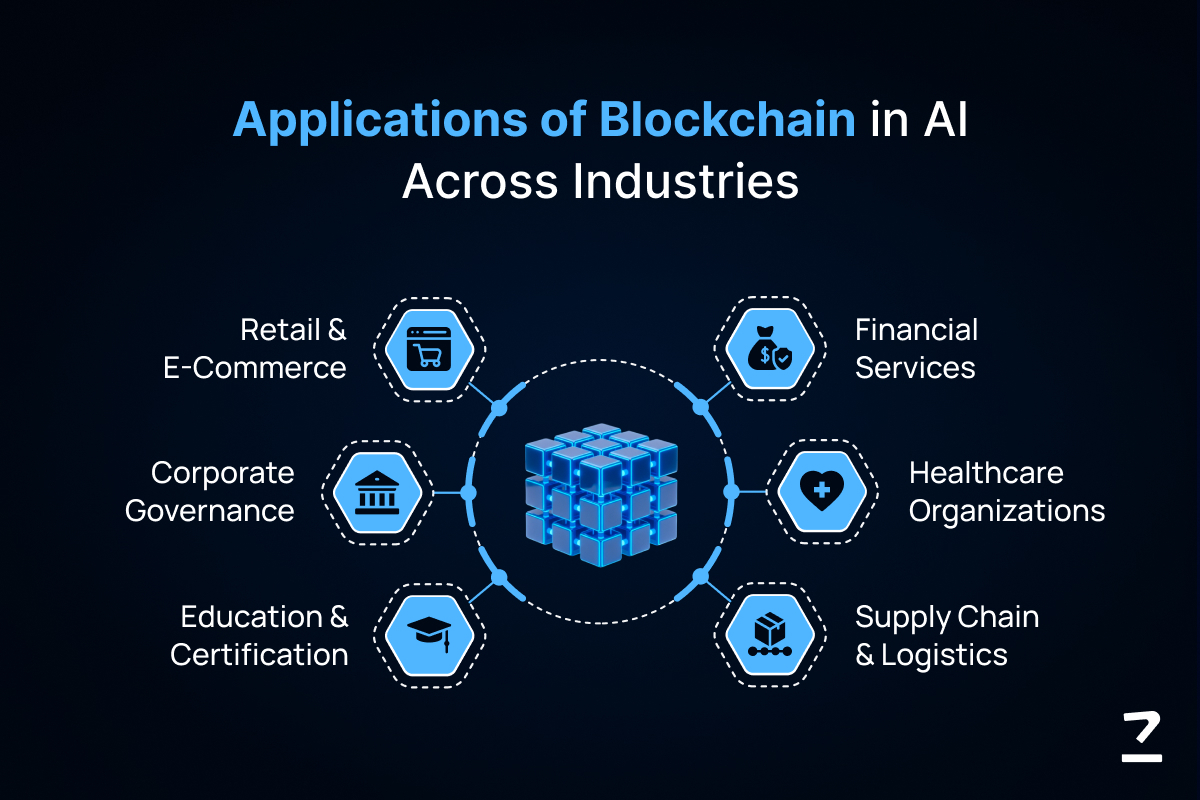
The convergence of blockchain and AI creates transformative opportunities across nearly every industry. Here's how organizations are applying these technologies together:
Financial Services: Fraud Detection and Secure Smart Contracts
Financial institutions process trillions of transactions daily, relying increasingly on AI for fraud detection, credit risk assessment, and market analysis. Blockchain-backed AI systems enhance these capabilities dramatically. Transaction data stored on blockchain cannot be manipulated, ensuring that AI fraud detection models operate on verified, trustworthy data. Smart contracts automatically enforce lending agreements, execute trades, and process claims based on AI analysis—without intermediaries, without delays, without human error.
Banks deploying blockchain development services report dramatic improvements in fraud prevention, settlement speed, and customer transparency. When customers question a denied transaction, banks can point to immutable blockchain records showing exactly how the AI system analyzed the data and why it flagged the transaction.
Healthcare: Patient Data Protection and Verifiable Insights
Healthcare organizations struggle with a painful contradiction: AI can dramatically improve diagnosis and treatment, but many hospitals cannot deploy AI systems because they cannot guarantee data privacy or explain AI recommendations.
Blockchain solves both challenges. Patient data stored on blockchain is encrypted, with access controlled by smart contracts. Patients retain ownership of their medical records and can grant temporary access to specific analyses. When AI systems generate insights—diagnostic recommendations, treatment suggestions, clinical trial matches—those recommendations are recorded on blockchain with complete traceability.
Regulatory compliance becomes automated: smart contracts verify that AI analysis complies with HIPAA, GDPR, and other regulations before results are released. Healthcare providers can confidently deploy AI systems that improve patient outcomes while maintaining regulatory compliance and patient privacy.
Supply Chain & Logistics: Traceable AI-Powered Operations
Supply chain complexity creates enormous opportunities for AI optimization—route planning, demand forecasting, quality prediction, and fraud detection. However, supply chains span multiple organizations, making it difficult for participants to trust AI recommendations when they lack visibility into underlying data. Blockchain creates that visibility. Product movement, supplier data, quality metrics, and shipment details are recorded on a shared ledger that all participants can see and verify.
AI algorithms operating on this blockchain-verified data gain credibility. When the system recommends changing a supplier, rerouting shipments, or flagging quality issues, all participants trust the recommendation because they can see the underlying data and verify the algorithm's logic. Enterprise blockchain development companies report that supply chain clients achieve faster decision-making, reduced fraud, and stronger supplier relationships through blockchain-backed AI systems.
Education & Certification: Verifiable Credentials
Educational institutions and employers struggle with credential fraud and difficulty assessing skill validity. Blockchain-backed AI systems address both problems. Educational records stored on blockchain cannot be forged. AI assessment systems that evaluate student learning and competency automatically issue blockchain-verified credentials that employers can trust. This creates a transparent, fraud-proof system where educational achievement can be instantly verified and transparently explained.
Corporate Governance: Transparent Board-Level Decision Making
Executive decisions increasingly rely on AI analysis of business data. However, boards demand transparency about how AI recommendations influence major decisions. Blockchain records every analysis, every algorithm update, every decision influenced by AI insights. This creates accountability, enables oversight, and documents decision-making processes for regulatory review.
Blockchain for Transparent Governance and Accountability in AI
Regulatory bodies worldwide are tightening AI governance requirements. The European Union's AI Act, SEC guidance on algorithmic trading, and emerging healthcare AI regulations all demand that organizations demonstrate how AI systems make decisions and prove compliance with rules. Blockchain-based governance frameworks address these demands directly.
Immutable Audit Trails
Every AI decision, model update, training data modification, and output is recorded on blockchain with cryptographic proof. Regulators can examine the complete history without worrying about logs being altered or records being deleted. This immutable audit trail satisfies even the most stringent regulatory requirements and simplifies compliance audits.
Smart Contracts for Automated Compliance
Rather than relying on manual monitoring, smart contracts automatically enforce AI policies. If regulatory rules require that AI systems cannot use certain data types, smart contracts reject any algorithm attempting to access that data. If compliance requires that all recommendations over a certain threshold must undergo human review, smart contracts route those decisions to appropriate personnel. Rules become automated, consistent, and verifiable.
Real-Time Regulatory Access
Blockchain enables regulators to access live data about AI system performance without disrupting operations. Regulators can monitor model accuracy, decision distribution, and compliance metrics in real-time. This shifts regulatory oversight from periodic audits to continuous monitoring, dramatically improving regulatory effectiveness and enabling faster response to emerging problems.
Top Benefits of Integrating Blockchain with AI Systems
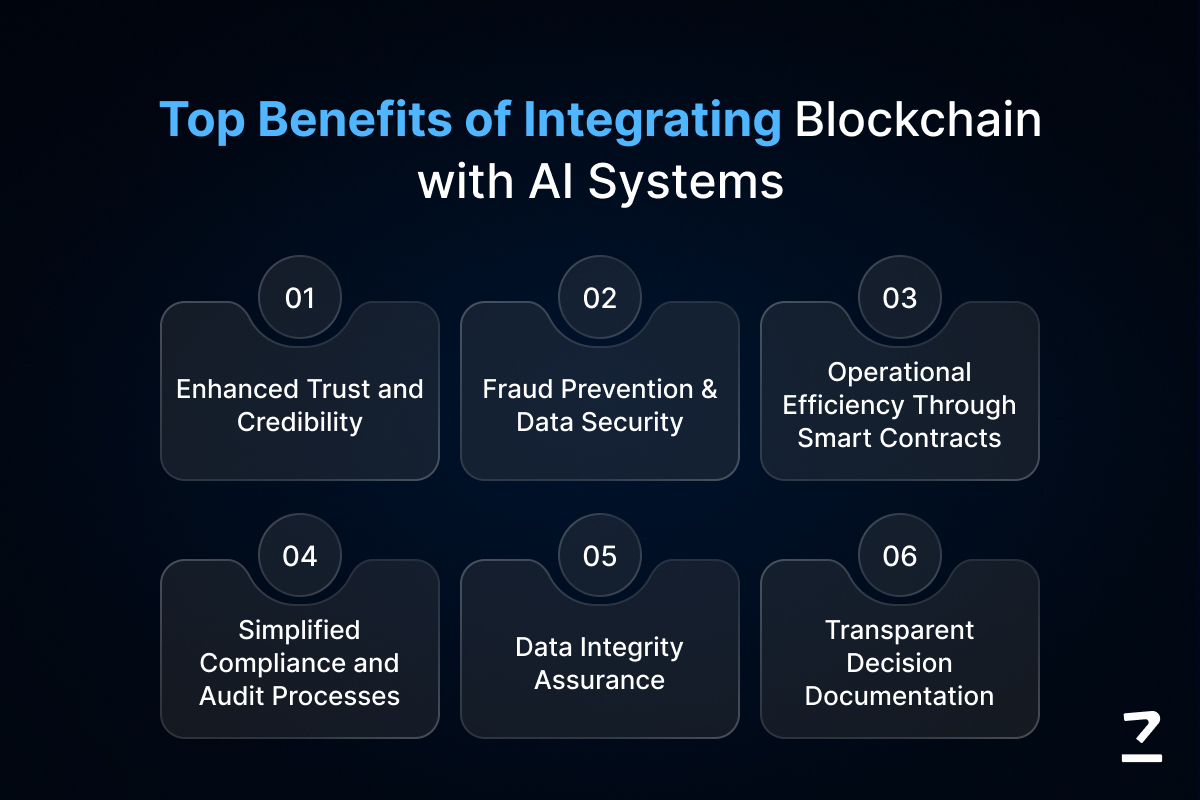
Enhanced Trust and Credibility: Immutable records of AI decisions enable stakeholders, regulators, and customers to verify exactly how AI systems operate. This addresses the fundamental trust problem that limits AI adoption.
Fraud Prevention and Data Security: Blockchain's cryptographic security and distributed architecture make data tampering virtually impossible. AI systems trained on verified blockchain data are inherently more trustworthy.
Operational Efficiency Through Smart Contracts: Automated execution of complex business rules eliminates manual processes, reduces errors, and accelerates decision-making. Organizations report 30-50% improvements in processing speed.
Simplified Compliance and Audit Processes: Immutable records and automated smart contract enforcement transform compliance from a costly, manual process to an automated, continuous operation. Audit cycles that previously required weeks can be completed in hours.
Data Integrity Assurance: Blockchain's tamper-proof architecture ensures that data AI systems analyze has not been modified. This is essential for applications where data accuracy directly impacts critical decisions.
Transparent Decision Documentation: Every AI decision is linked to the data that informed it, creating complete decision traceability. Organizations can explain any AI recommendation to customers, regulators, or stakeholders.
Reduced Intermediation Costs: By eliminating intermediaries and automating trust through blockchain, organizations dramatically reduce transaction costs and execution times.
Challenges and Risks in Blockchain-Based AI Implementation
While blockchain-backed AI systems offer tremendous benefits, successful implementation requires carefully navigating significant challenges. Enterprise organizations considering blockchain development services should understand these obstacles:
Scalability and Performance Considerations
Blockchain networks process transactions more slowly than centralized databases. Bitcoin processes about 7 transactions per second; Ethereum handles roughly 30 per second; enterprise blockchain platforms manage hundreds. For organizations processing millions of AI decisions daily, this performance gap creates practical challenges. Enterprise blockchain development solutions address this through layer-2 solutions, sidechains, and permissioned blockchain networks that sacrifice some decentralization for dramatically higher throughput. However, these architectural choices involve trade-offs between performance and transparency.
Cost of Implementation and Operation
Blockchain infrastructure, smart contract development, and network participation incur ongoing costs. Organizations must invest in blockchain expertise, network nodes, and security measures. For smaller organizations or those with limited budgets, these costs can be prohibitive. Blockchain consulting services help organizations evaluate whether blockchain benefits justify these costs for their specific applications.
Technical Expertise Requirements
Building blockchain-backed AI systems requires expertise in both domains—rare skills that command premium compensation. Organizations struggle to find experienced blockchain developers, security specialists, and architects who understand both blockchain and AI deeply. Partnering with specialized blockchain development companies addresses this gap, providing expertise that would be difficult and expensive to build internally.
Regulatory Uncertainty
Regulations governing blockchain and AI are still evolving. What is compliant today may face regulatory restrictions tomorrow. Organizations implementing blockchain solutions must stay informed about emerging regulations and design systems flexible enough to accommodate regulatory changes.
Privacy Versus Transparency Trade-offs
Blockchain's transparency creates tension with privacy requirements. The EU's GDPR, healthcare regulations, and data protection laws often conflict with blockchain's public-by-default design. Advanced enterprise blockchain development solutions address this through privacy-preserving technologies like zero-knowledge proofs and encrypted data, but these add complexity.
Future of Blockchain AI: Trends to Watch in 2026 and Beyond
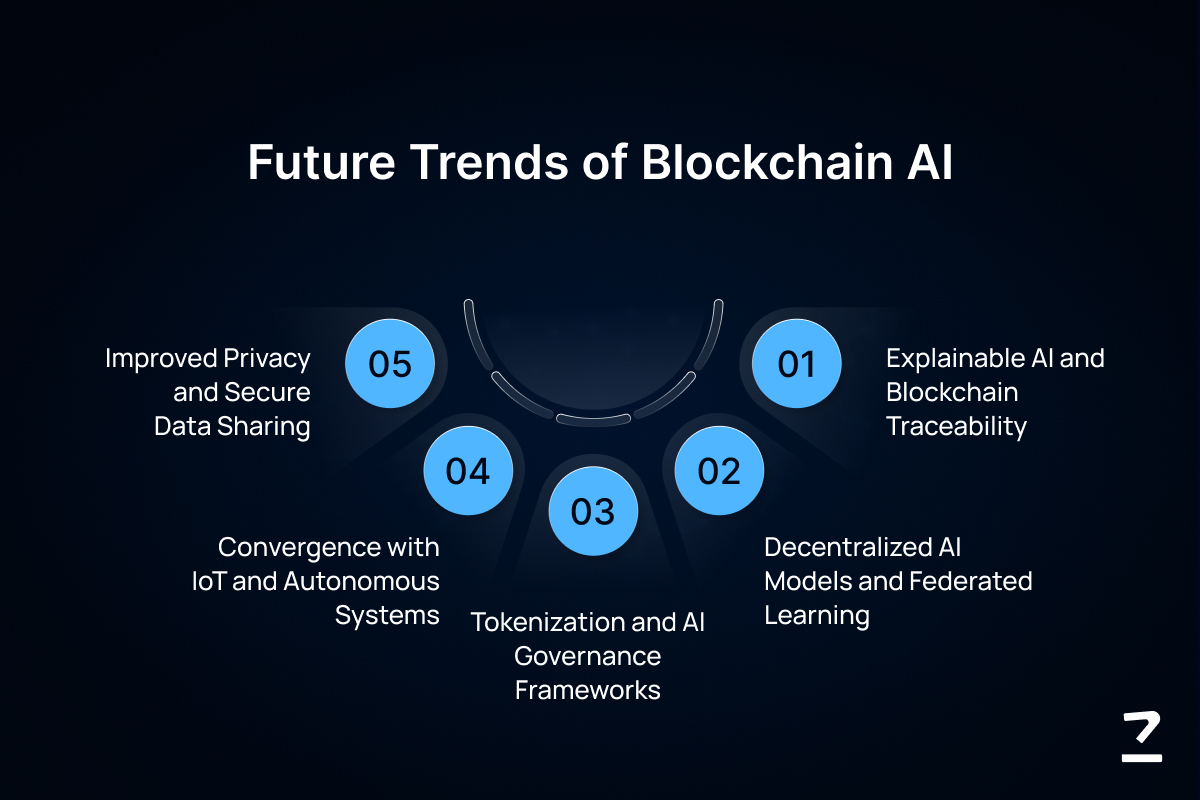
The convergence of blockchain and AI is accelerating, with several important trends emerging:
Explainable AI (XAI) and Blockchain Traceability
Organizations are investing heavily in explainable AI—AI systems that can justify their decisions in human-readable terms. When combined with blockchain, XAI becomes extraordinarily powerful: not only can the system explain why it reached a decision, but that explanation is permanently recorded and cryptographically verified. This creates AI systems that are truly trustworthy and auditable.
Decentralized AI Models and Federated Learning
Rather than centralizing AI training in single organizations, blockchain enables decentralized, federated learning where multiple organizations contribute data to train shared models without revealing proprietary information. This dramatically expands the possibilities for collaborative AI development while protecting competitive secrets and proprietary data.
Tokenization and AI Governance Frameworks
Organizations are exploring tokenized governance models where stakeholders hold governance tokens that grant voting rights on AI system updates, parameter changes, and resource allocation. This creates truly decentralized AI governance where all stakeholders have proportional influence over system evolution.
Convergence with IoT and Autonomous Systems
IoT devices generating massive data streams benefit tremendously from blockchain verification and smart contract automation. When combined with AI, blockchain-based IoT systems enable autonomous decision-making—smart systems that collect data, analyze it with AI, execute smart contracts, and operate without human intervention—while maintaining complete traceability and auditability of every decision.
Choosing the Right Blockchain Development Company for AI Solutions
Organizations seeking to implement blockchain-backed AI systems face a critical decision: which blockchain development company can successfully deliver on this complex mandate? The right partner increases implementation success, while the wrong choice wastes significant time and resources.
Essential criteria for selecting a blockchain development partner:
Proven Experience in Your Industry: Blockchain development solutions that work brilliantly in one industry may fail in another. Look for partners with demonstrated experience in financial services, healthcare, supply chain, or your specific vertical. They should understand industry-specific regulations, operational requirements, and stakeholder expectations.
Deep Consulting Expertise: Implementation begins long before coding starts. The right blockchain consulting services include strategy development, technology assessment, ROI analysis, risk evaluation, and roadmap planning. Your partner should help you determine whether blockchain truly solves your problem better than alternatives, not simply assume it does.
Full-Stack Development Capabilities: Blockchain-backed AI systems require expertise across multiple technology domains: blockchain architecture, smart contracts, AI systems, data management, cybersecurity, and cloud infrastructure. Look for enterprise blockchain development companies that offer comprehensive services rather than specialists in single technologies.
Proven Track Record with Enterprise Systems: Early-stage blockchain is littered with failed projects. Choose partners whose previous projects have successfully launched to production, operated reliably at scale, and delivered measurable business value. Request detailed case studies, customer references, and performance metrics.
Security and Compliance Expertise: Blockchain systems handling sensitive data require world-class security. Your partner should have demonstrated expertise in cryptographic security, smart contract auditing, compliance frameworks, and risk management. They should be able to explain exactly how they ensure system security.
Key services to look for:
Blockchain Development Services: End-to-end development of blockchain infrastructure, smart contracts, and application layers. Quality partners follow secure coding practices, conduct thorough testing, and deliver production-ready systems.
Blockchain Consulting Services: Strategic guidance on technology selection, architecture design, regulatory compliance, implementation planning, and change management. Expert consultants help you avoid costly mistakes and ensure solutions align with business objectives.
Enterprise Blockchain Development Solutions: Purpose-built solutions addressing specific business problems rather than generic platforms. Whether addressing supply chain transparency, healthcare data management, or financial compliance, specialized solutions deliver faster implementation and better outcomes than attempting to adapt general platforms.
Questions to ask potential partners:
- How many production blockchain systems have you deployed in our industry?
- Can you provide references from organizations with similar requirements?
- How do you approach security and smart contract auditing?
- What is your process for ensuring AI system explainability and traceability?
- How do you manage regulatory compliance across different jurisdictions?
- What is your experience with smart contract governance and updates?
- How do you handle scalability and performance requirements?
- What support and maintenance do you provide post-launch?
Build a Trust-First Digital Future with Blockchain Development Services!
Artificial intelligence is transforming business, but only organizations that can demonstrate trustworthiness, transparency, and accountability in AI decision-making will fully realize AI's potential. Blockchain technology provides the foundational architecture for building that trust: immutable records, verifiable decisions, automated compliance, and transparent operations.
The convergence of blockchain and AI is no longer speculative—it's a practical necessity for regulated industries and organizations handling sensitive data. Forward-thinking enterprises are already implementing blockchain-backed AI systems to meet regulatory requirements, build customer confidence, and operate more efficiently.
Whether you're exploring blockchain consulting services to assess strategic fit, seeking blockchain development services to implement solutions, or looking for an enterprise blockchain development partner to guide your journey, contact us now. The organizations that master blockchain-backed AI systems will establish competitive advantages that become increasingly difficult for competitors to replicate.
The future belongs to enterprises that build trust first. Blockchain development solutions make that possible.
Post Author

Deep Shah
Explore Deep's insightful blog posts that help businesses stay ahead of the curve, explore new possibilities, and unlock the full potential of blockchain technology
Frequently Asked Questions
Frequently asked questions about this article.
Blockchain creates immutable records of every input, process, and output in AI systems. This enables complete decision traceability, allowing organizations to prove how AI recommendations were generated, what data influenced them, and whether they comply with regulatory requirements. Rather than AI decisions being opaque "black boxes," blockchain transforms them into verifiable, auditable processes that stakeholders can trust.
Smart contracts are self-executing programs that automatically enforce rules without human intervention. In AI governance, smart contracts can automatically verify that AI decisions comply with policies, route high-stakes decisions to appropriate human reviewers, audit algorithmic bias, and enforce compliance with regulations. This transforms governance from a manual, expensive process into automated, consistent, provably-fair operations.
Industries with strict regulatory requirements benefit most: financial services, healthcare, government, insurance, and highly regulated supply chains. These sectors face the greatest pressure to demonstrate AI transparency and decision auditability. However, any industry handling sensitive data or making critical decisions can benefit from blockchain-backed AI's transparency and trust-building capabilities.
Blockchain cannot prevent initial data corruption, but it can detect tampering with high certainty. Once data is recorded on blockchain, any subsequent alteration is immediately detectable because it breaks the cryptographic chain. This ensures that AI systems operate on verified, untampered data. For maximum security, data should be validated before blockchain recording.
AI provides intelligent decision-making; blockchain provides transparent, verifiable decision documentation. Together, they create systems that are both smart and trustworthy. Stakeholders see exactly how intelligent decisions are made, can verify compliance with rules, and can audit historical decisions. This combination directly addresses the fundamental barrier limiting AI adoption: the trust problem.
Primary risks include scalability challenges (blockchain processes transactions slowly), implementation costs, requirement for specialized expertise, regulatory uncertainty, and privacy-transparency trade-offs. Successful implementation requires careful planning, experienced partners, and realistic assessment of whether blockchain genuinely solves your specific problem better than alternatives.
Evaluate potential partners on industry experience, consulting depth, full-stack development capabilities, proven track records with production systems, security expertise, and commitment to explaining their approach thoroughly. Request case studies, customer references, and detailed explanations of how they ensure security and regulatory compliance. The right partner becomes a strategic advisor, not just a vendor.
The future involves increasingly sophisticated convergence: explainable AI combined with blockchain traceability creates AI systems that not only make intelligent decisions but can justify them in auditable, transparent terms. Decentralized AI models, federated learning on blockchain networks, autonomous IoT systems with smart contracts, and tokenized governance frameworks will expand possibilities for collaborative, transparent, trustworthy AI operations at scale.
More questions? Contact us.
Transform Your AI Systems with Blockchain Technology!
Partner with experienced blockchain development professionals who understand both blockchain architecture and AI systems. From strategic consulting to full-scale implementation, Codezeros help enterprises build transparent, auditable, trustworthy AI systems. Contact our blockchain consulting team today to discuss your specific requirements and explore how blockchain-backed AI can drive your digital transformation.
Blogs
Our Latest Blogs
Discover valuable industry insights and stay up-to-date with the latest updates by exploring our curated collection of recent blog posts.


Let us know your requirement
We know ideas matter, we are the product of one. We Provide Full Assistance In Your Business