SHARE THIS ARTICLE
- Copy link
22 Oct 2026
How Much Does It Cost to Build an RWA Tokenization Platform?
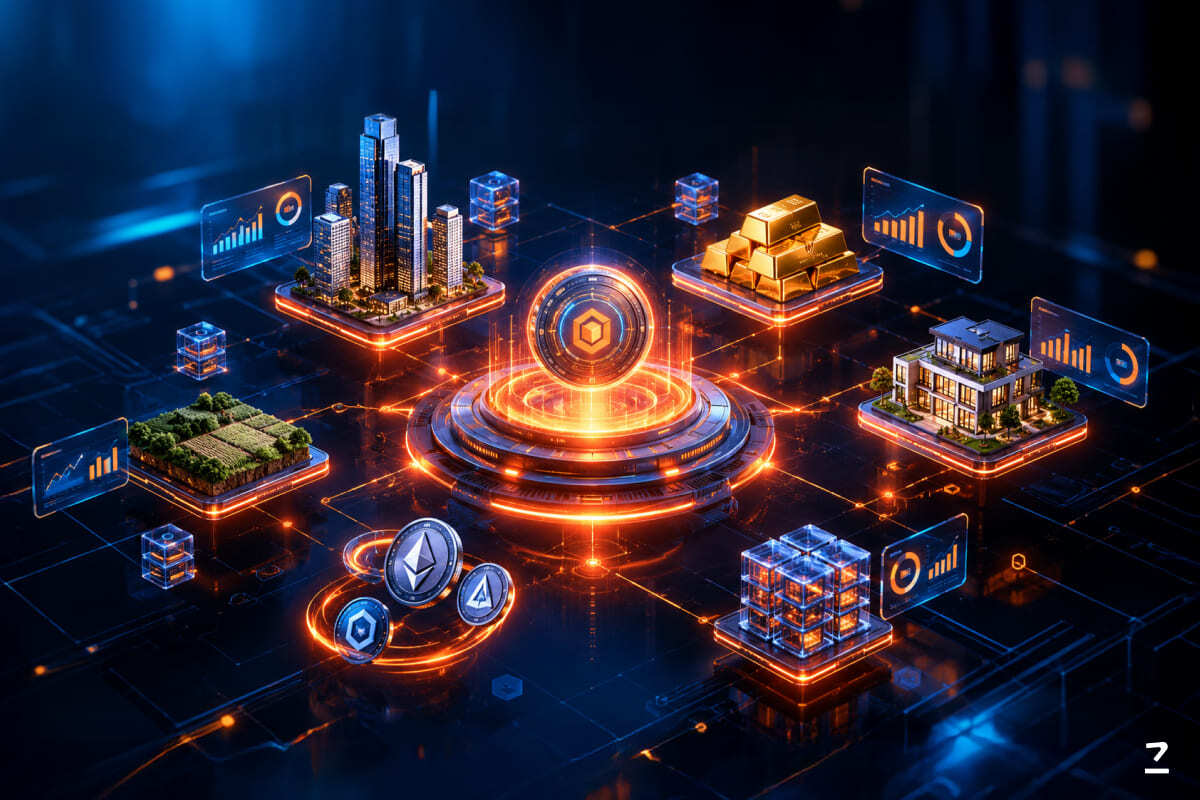
Building an RWA tokenization platform could cost anywhere from $35,000 to $500,000. The wide price range is prominent. So, what exactly accounts for it?
Let’s find out.
The cost of building an RWA tokenization platform depends on what you're building and how far you want to take it. A basic issuance platform has very different requirements from an institutional-grade system handling investor verification, custody, compliance, and asset management. That's why choosing the right RWA tokenization development company matters, particularly when you're trying to establish a realistic budget from the outset.
So what should you budget for? We’ll look at published cost ranges, then follow the money through the actual build. We’ll also separate software costs from legal, custody and operating expenses, because those figures tend to get mixed together.
How Much Does RWA Tokenization Platform Development Cost in 2026?
A low quote often involves one asset, standard token contracts and very little beyond issuance. At the other end are platforms built around numerous assets, intermediaries and investor rules. The table gives you a starting range for software development, not an all-in launch price or a Codezeros rate card.
|
Platform scope |
Indicative cost |
Typical functionality |
|
Focused MVP |
$35,000–$75,000 |
One asset, one network, issuance and basic investor views |
|
Mid-level |
$75,000–$150,000 |
Investor checks, transfer rules, administration and reporting |
|
Enterprise |
$150,000–$350,000 |
Several asset workflows, custody integrations and advanced controls |
|
Institutional-grade |
$350,000–$500,000+ |
Complex integrations, multi-jurisdiction operations and possible trading connectivity |
Don’t let the MVP label fool you into thinking that the development costs will always be low. An MVP built for a small group of investors might be relatively inexpensive, but the budget can climb considerably if it requires custody integrations, complex transfer restrictions, compliance checks and distribution mechanisms.
Where Does the RWA Platform Development Budget Go?
Let's take a mid-level RWA tokenization platform with an estimated development budget of $120,000. How would that money be distributed across the build?
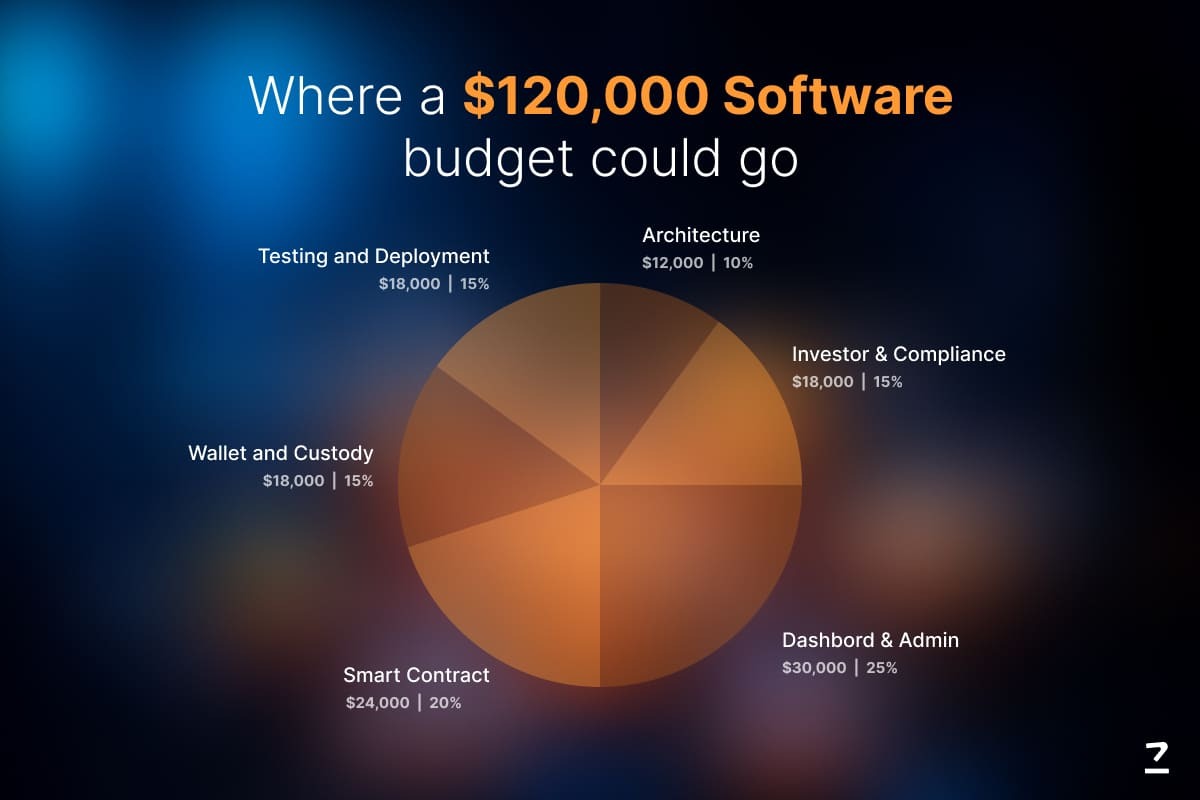
Here's a breakdown of how that $120,000 could be allocated across the platform's major development components.
-
Asset records and smart contracts
Before a developer writes a mint function, someone has to answer a legal question: what does the token holder own? Shares in a company holding a building are not the same as direct title to the building. That answer shapes the records, transfers and redemption rules the software must support. The contracts come after that decision, not before it.
-
Investor checks, custody and payments
Imagine a buyer passes KYC in January, but their eligibility changes in March. Can they still receive a restricted token? What if they send it to a different wallet? These are application and contract questions as much as verification questions. Then there is custody: who signs, who approves and how do failed or disputed payments get reconciled? The role of custody and oracles in RWA tokenization becomes especially important when the platform must connect blockchain transactions with the assets and records maintained off-chain.
-
Applications, reporting and testing
A functioning dashboard is one thing. Making sure it shows accurate information is another. Investors need a clear view of their holdings, while issuers need to track subscriptions and payments. Administrators, meanwhile, must be able to review transactions and account activity. The real work lies in connecting these interfaces with smart contracts, payment systems and asset records, then testing whether everything works as intended.
What Makes One RWA Platform More Expensive Than Another?
-
The asset and the rights behind it
Consider two very different products: a property investment that distributes rental proceeds quarterly and a private-credit instrument that pays principal and interest to a schedule. They may use the same blockchain, yet their accounting and servicing flows will be different. The asset’s commercial terms, not its buzzword category, are what drive the work.
-
Blockchain and token standards
Adding chains multiplies the places where things can fail: wallet connections, custody support, transaction handling and testing. Starting on one network is often a practical choice. ERC-3643 can help with identity-aware transfer restrictions, but it does not supply the identity checks, legal rules or operating procedures on its own.
-
Investor locations and transfer conditions
The minute you serve investors in more than one country, the onboarding journey can branch. Different eligibility rules may apply, and some transfers may be prohibited altogether. Those conditions need legal sign-off before anyone can sensibly build them into the platform.
-
Outside services and trading
Outside providers have their own failure modes. A custody API can time out. A verification status can expire. A bank payment can arrive without matching an investor record. Every exception needs handling. Add a secondary market and there are more decisions about permissions and intermediaries. A token being transferable does not mean there is an available, lawful market for it.
What Usually Sits Outside the Development Quote?
The development quotation may be perfectly accurate and your launch budget may still be wrong. Why? Because the engineering vendor can price the application without pricing the legal structure, third-party checks or ongoing operation. Keep these costs separate from the start.
|
Cost category |
What to clarify |
|
Legal structuring |
Asset rights, issuer structure and offering documents |
|
Licensing and regulatory processes |
Applicable approvals, registrations or regulated partners |
|
Independent security audits |
Third-party contract review, penetration tests and remediation |
|
Third-party services |
KYC, custody, payment, data and infrastructure fees |
|
Post-launch operations |
Maintenance, servicing, support and recordkeeping |
Security expenses also depend on contract complexity and audit scope. Our guide to smart contract auditing techniques looks at the reviews and testing approaches used to identify vulnerabilities before deployment.
There is another distinction worth keeping in view. A tokenized security is still subject to the securities rules that apply to it. Writing a smart contract does not replace the legal work. For financial planning, ask for two totals: software delivery, and everything required to launch and operate the offering.
White-Label vs Custom RWA Tokenization: Which Costs Less?
White-label sounds attractive for a reason: you are paying to configure software that already exists. If the product supports your asset, your investor rules and your custodian, that can be a sensible starting point. The trouble comes when a seemingly small requirement falls outside the vendor’s configuration options. Then an inexpensive package can become a long list of change requests.
|
Decision point |
White-label |
Custom development |
|
Upfront effort |
Lower when needs fit existing features |
Higher because workflows are built for the product |
|
Flexibility |
Bound by the vendor’s available options |
Designed around specific operating needs |
|
Integration choices |
Provider-dependent |
More freedom, with additional engineering |
|
Long-term costs |
License fees and customization charges |
Maintenance and ongoing engineering |
|
Best fit |
Straightforward first releases |
Complex or distinctive asset workflows |
A custom build takes more engineering up front, but it can follow the asset’s actual servicing model instead of forcing that model into a template. Neither approach wins by default. Compare code ownership, provider restrictions, license costs, data export and what changes will cost in year two. That is the comparison that matters.
How Can You Reduce RWA Tokenization Development Costs?
The trick is to not get too ambitious. Your roadmap can make the first release expensive. Needlessly, if you will.
So, what can you do?
Start with one asset type, a defined investor group and the functions required to issue and service that asset. Pick one chain unless a second one solves a genuine launch problem. If the legal structure is still unsettled, settle it before the contract architecture hardens.
For businesses working with a limited initial scope, building and RWA tokenization MVP offers a practical way to test the issuance model before committing to a larger platform.
Use existing identity and custody services where they fit, rather than rebuilding mature infrastructure. Put trading, multiple networks and elaborate analytics on the later roadmap unless they are essential to the business case. But keep proper testing, access controls and security assessment in the first budget. Those are not extras.
What Should You Check Before Hiring an RWA Tokenization Development Company?
Here is a better vendor test than asking how many blockchains the team supports. Walk them through a transfer that should be rejected. Then ask what happens if an investor’s verification expires, a payout cannot be completed or the off-chain asset register disagrees with the token balance. Watch whether they can explain the operating response, not just the contract function.
An RWA tokenization development company should be able to explain what it will build, which third-party services it will integrate and who will be responsible for maintaining the platform after deployment. If you choose to hire RWA tokenization developers for individual modules instead, make sure someone takes responsibility for bringing everything together and ensuring the platform works as intended.
A useful proposal is specific enough for you to say: yes, that is our first release. Vague promises of an end-to-end platform are harder to price and much harder to hold anyone to.
Getting Your RWA Development Budget Right
There's no single price tag for developing an RWA tokenization platform. The final cost comes down to the assets you're tokenizing, the features you need, and the requirements your platform must meet.
Before settling on a budget, be clear about what needs to be built now and what can wait. A well-defined scope makes it easier to compare development proposals, account for additional expenses, and avoid spending on features your business doesn't yet need.
The goal is to get the right platform built within a budget that makes sense for your business. Planning an RWA tokenization platform? Get in touch with Codezeros to discuss your project requirements and get a development estimate based on what you're looking to build.
Post Author
Paritosh Mehta
As a distinguished blockchain expert at Codezeros, Paritosh contributes to the company's growth by leveraging his expertise in the field. His forward-thinking mindset and deep industry knowledge position Codezeros at the forefront of blockchain advancements.
Frequently Asked Questions
Frequently asked questions about this article.
A narrow MVP may be quoted in the $35,000–$75,000 band in 2026 vendor guides. But check what “MVP” means. Basic issuance and a dashboard are quite different from custody, compliance, servicing and redemption. The estimate may also leave out legal and third-party fees.
A few months can be possible for a tightly defined MVP. Complex projects take longer, particularly when legal decisions, custody providers or an external audit are on the critical path. Ask for the milestones and dependencies, not only a promised date.
Not as a rule. A property offering may have complex ownership records and distributions. A credit instrument may have far more involved repayments. The specific rights, payments and restrictions tell you more about development effort than the asset class alone.
You cannot assume so. A development quote may cover a KYC integration and internal code tests without including verification charges, legal advice or an independent audit. Have every item listed as included, excluded or supplied by a third party.
It may be a good fit if your asset and investor rules match the product already on offer. Before committing, check what you can customize, where your records live, whether you can export them and what future changes will cost.
Start with what the token represents and who is allowed to buy it. Then specify jurisdiction, custody, payment method, chain and what the platform must do after issuance. That is far more useful than a long feature wishlist.
More questions? Contact us.
Build the RWA Platform Your Business Actually Needs
The first token is only the beginning. The more expensive work often happens in making the records, permissions, payments and servicing reliable enough to operate the product month after month. Codezeros provides RWA tokenization development services for token issuance, smart contracts, investor applications and integrations. Bring your asset model, investor requirements and intended launch scope to the discussion. Those details are the starting point for a quote that means something.
Blogs
Our Latest Blogs
Discover valuable industry insights and stay up-to-date with the latest updates by exploring our curated collection of recent blog posts.