SHARE THIS ARTICLE
- Copy link
29 Oct 2026
Cross-Chain Bridge Development Cost: Complete Pricing Breakdown

Cross-chain bridge development costs depend on the networks being connected, the transfer mechanism and the infrastructure used to verify transactions. A bridge that integrates an established interoperability protocol generally involves less custom engineering than one with its own verification system. Depending on scope, cross-chain bridge development budgets can range from approximately $25,000 to $250,000 or more.
That range needs context. Two bridges may offer similar transfer functionality but differ considerably in smart contract work, audit requirements and operating expenses. Businesses comparing cross-chain bridge development services should understand what the initial quotation covers and which costs will continue after deployment.
This article breaks down indicative pricing by project scope and technical component, then examines the factors that affect the budget and the questions worth asking before development begins.
How Much Does Cross-Chain Bridge Development Cost?
A limited protocol integration might be budgeted at $25,000–$60,000. A custom two-chain bridge can require more work, particularly when contracts and transfer handling are written for the project. Multi-chain functionality and independent verification infrastructure can take spending above $120,000 and, in specialized cases, beyond $250,000. The table below separates these scopes. None of the figures represents a fixed market rate or a Codezeros quote.
Cross-Chain Development Budget by Scope
|
Project Scope |
What It Includes |
Estimated Development Budget |
|
Protocol-Based Bridge Integration |
Existing messaging protocol, limited supported routes and standard token transfers |
$25,000–$60,000 |
|
Custom Two-Chain Bridge |
Custom transfer contracts, chain-specific integration and expanded testing |
$60,000–$120,000 |
|
Multi-Chain Bridge |
Multiple chains, routing or liquidity functionality, broader operational controls |
$120,000–$250,000 |
|
Specialized Verification Infrastructure |
Custom verifiers or relayers and demanding security or chain requirements |
$250,000+ |
The price bands describe software work, and proposals may include different items. Before comparing two figures, check whether either vendor has allowed for an independent audit and post-audit corrections. Ask about relayer setup as well. Liquidity funding is another line to keep separate: money deposited to serve transfers is capital committed to the bridge, rather than an engineering fee.
Cross-Chain Bridge Development Cost Breakdown by Component
A component estimate should answer a fairly ordinary question: which parts are being written specifically for this project? Otherwise, a bundled figure leaves you guessing whether you're paying for original contract work or the configuration of software that already exists.
-
Smart Contracts
Start with the contracts that actually move or account for the asset. A lock-and-mint design needs custody on one chain and controlled issuance on another. With burn-and-mint, supply changes across both networks must be reconciled. Different runtimes may call for separate codebases. That's a meaningful cost difference, even if the transfer interface looks identical.
-
Messaging and Transaction Verification
Messaging is easy to underestimate because it does not have much of a visible interface. Yet a destination contract acts on information it cannot independently observe. If the project uses an established protocol, engineering will focus on integrating and configuring its verification path. A custom arrangement means writing more of that path and taking responsibility for its operation.
-
Liquidity and Settlement
A liquidity-backed route needs enough tokens waiting on the receiving side to pay transfers. If activity flows mainly in one direction, balances can become uneven. Software can track that problem or assist rebalancing, but the operator still needs a capital plan. A developer's fee for pool logic should therefore be quoted apart from the funds put into the pools.
-
User Interface and Wallets
A useful bridge interface should tell the user whether the source transfer is confirmed and whether the destination action has executed. Those are separate states. Wallet connection and transaction signing can often use existing providers. Cross Chain Wallet Development adds work only when the brief calls for proprietary wallet features rather than ordinary integration.
-
Security Reviews and Testing
Consider a message that reaches the destination twice. The second attempt must not release a second payment. Auditors also need to inspect assumptions around finality and privileged functions. A review confined to the source contract could miss problems elsewhere in the transfer path, so audit scope matters as much as the quoted fee.
-
Deployment and Operations Setup
Deployment is complete only when there is a workable response to failed transfers. Identify who receives alerts, where relayer activity can be inspected and who holds emergency permissions. If the operator has to rely on the developer every time a message stalls, that support obligation should appear in the commercial agreement.
How Bridge Architecture Affects Development Costs
Two projects using the same chains can incur very different costs. A wrapped-token bridge maintains custody and issued representations; a liquidity bridge pays from reserves already available on the destination. How messages are authenticated adds another architectural choice, separate from the asset movement method.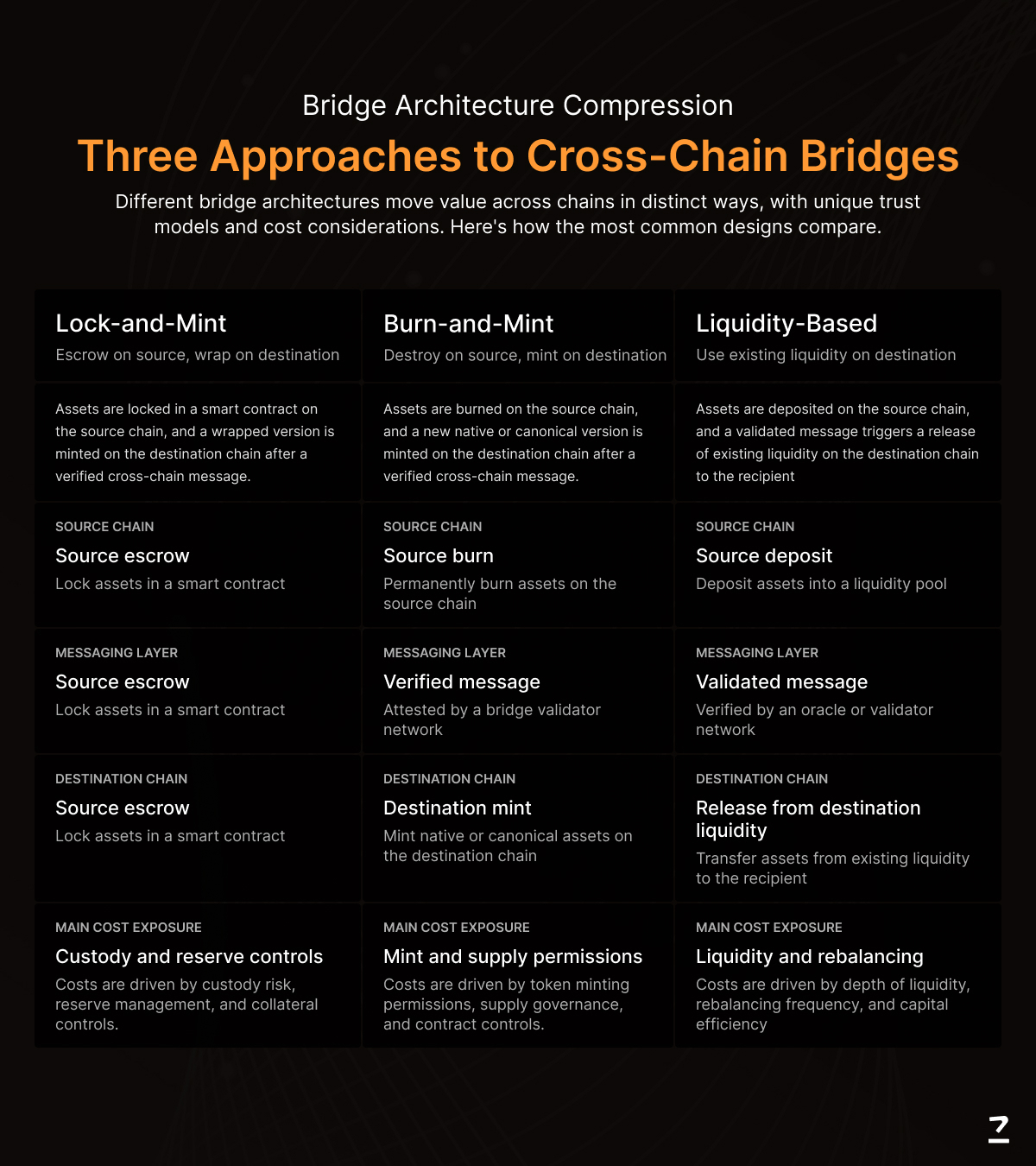
Lock-and-Mint and Burn-and-Mint
With lock-and-mint, an original token stays in escrow while a wrapped version is issued elsewhere. The amount circulating as wrapped supply has to remain consistent with the backing. Burn-and-mint instead adjusts supply on both chains. That approach requires permission to burn and mint the token in question.
This matters when the project does not own the token contract. A business may want burn-and-mint transfers but lack the right to mint the token on the destination network. In that case the architecture has to change. Discovering the constraint before estimation can prevent a costly redesign.
Liquidity-Based Bridges
Liquidity bridges need sufficient inventory on the destination chain. A busy route may drain one pool while assets accumulate elsewhere. Rebalancing can involve additional transfers and fees. For this type of bridge, the size and direction of expected transfer volume can be as important to the budget as the contract count.
Custom Infrastructure Versus Established Protocols
Existing messaging protocols are worth evaluating before commissioning a verifier network. Chainlink CCIP, LayerZero and Wormhole differ in how messages are verified and delivered, which routes they support and the fees involved. In LayerZero V2, for instance, DVNs verify messages separately from execution. Those choices affect integration and operating work.
There may be good reasons to develop custom verification infrastructure when a project has security requirements or network needs that an existing protocol cannot meet. Before settling on that approach, compare the available options. Codezeros covers the differences in its guide to LayerZero, Wormhole and Axelar.
Key Factors That Influence Cross-Chain Bridge Development Costs
The number of chain logos on a proposal says little about the actual workload. Two EVM-compatible networks may share a substantial amount of contract logic. Moving into a different runtime could require another implementation, testing environment and specialist reviewer.
- Network compatibility: Compare execution environments before counting routes as equivalent work. Supporting a non-EVM chain may require a different specialist team.
- Asset rules: A fungible token transfer and an NFT transfer raise different questions. For an NFT, the bridge must preserve ownership and token identity across networks. An issuer-controlled token introduces supply permissions instead.
- Verification: Ask whether the quote covers protocol configuration, an external attestation service or verification implemented in the destination contract. They are substantially different assignments.
- Recovery: Who can retry an incomplete message? Can a failed destination action be resumed? The answers depend on the protocol and may require application-specific logic.
- Operations: Transfer limits and emergency controls need proper permissions. The team must also define who can use those controls and how decisions are recorded.
- Expected traffic: High activity changes recurring gas or messaging costs. It can also increase the amount of liquidity needed on busy routes.
What Are the Ongoing Costs of Operating a Cross-Chain Bridge?
Each completed transfer can carry more than one fee. There may be gas on the sending chain, a messaging charge and a destination execution cost. CCIP, for example, calculates fees using the route and execution configuration. An operating forecast should use the expected transaction mix rather than one assumed price per transfer.
A team running relayers will also need someone to watch for messages that are delayed or missed. Chain upgrades may force changes to the integration. Liquidity-based bridges have a separate expense in the funds they keep available, plus any rebalancing activity needed to replenish a route.
Ask vendors to model a normal month and a busy month. The useful output is a range of likely transaction and support costs with the assumptions stated. A flat monthly maintenance figure hides how much of the bill changes with activity.
Cross-Chain Bridge Development Process: Where the Budget Goes
The cross-chain bridge development process begins with a defined transfer. Write down the asset, its source contract, the destination representation and the conditions under which the recipient gets paid. That specification is the basis for both the architecture and the estimate.
For a detailed look at the technical implementation, read our guide on how to build and deploy a decentralized cross-chain bridge
- Define the routes. Record supported chains, token contracts and any restrictions on transfers.
- Agree on the verification rules. Decide what counts as a final source event, who checks it and what the destination contract accepts as proof.
- Integrate the messaging route and write the missing contracts. Keep third-party protocol functions separate from custom custody or settlement logic in the project scope.
- Make transfer states visible. The interface should distinguish awaiting source confirmation from waiting for destination execution.
- Test failures before launch. Try duplicate messages, unavailable relayers and paused routes. Give auditors the actual contract and verification scope.
- Deploy with operating procedures. Name the people responsible for alerts, privileged keys and recovery decisions.
Testing can send the plan back to engineering. An issue with message validation, for example, may require changes on both chains. The timeline needs enough room for those corrections and any necessary re-audit.
How Can Businesses Optimize Cross-Chain Bridge Development Costs?
A first release may need just two routes and a narrow token list. That makes the audit scope easier to define and reduces the number of unusual transfer cases to test. It also lets the team observe actual usage before paying to add more chains.
Custom routing and automated rebalancing may be worthwhile once volumes justify them. Before adding either to the first release, ask what would happen without it. For lower-volume operations, documented manual intervention may be workable in some cases, provided the security and recovery procedures are sound.
Keep security reviews and permission controls in the initial scope. If the budget needs cutting, defer a nonessential route or interface feature instead.
What Should You Evaluate Before Hiring a Cross-Chain Bridge Development Company?
Give a prospective cross-chain bridge development company a failed-transfer scenario. Say the source transaction has settled but the recipient has not been paid. Ask what the operator can inspect and whether retrying the message could cause a duplicate payout. An engineer who understands the design should be able to trace that case.
The contract should identify who holds pause and upgrade privileges after handover. It should also distinguish the software quotation from audit fees, liquidity capital, protocol charges and continuing support. Without those boundaries, two offers can appear comparable when they are not.
A credible proposal for cross-chain bridge solutions should explain the limits of the chosen architecture, including its external dependencies. If you're evaluating development partners, talk to our team about your bridge requirements, technical scope and estimated development costs.
Post Author

Deep Shah
Explore Deep's insightful blog posts that help businesses stay ahead of the curve, explore new possibilities, and unlock the full potential of blockchain technology
Frequently Asked Questions
Frequently asked questions about this article.
A two-chain integration using a supported messaging protocol is a smaller undertaking than writing a new verification mechanism. Timelines also depend on how quickly independent reviewers are available and whether their findings require contract changes. Get a schedule tied to the actual scope and review stages.
Often. Integrating an existing protocol removes the need to create its messaging network. However, the resulting bridge still needs application contracts, testing and an operating plan. Protocol charges and route restrictions should be included when comparing the long-term cost.
Request a quote for the exact contracts and verification path involved. Reviewing a token escrow contract is a different engagement from testing a bridge across two chains. Audit costs can run into tens of thousands of dollars or higher, and follow-up work may be billed separately.
Usually, although compatibility makes a difference. A related EVM chain may require configuration changes and further testing. A chain with another execution model might need new contracts. Every additional route also creates something else to monitor and maintain.
Yes. Existing wallets can handle the connection and signature stages of a bridge transaction. If the brief also calls for wallet accounts, custom signing or multichain wallet infrastructure, price that work separately so the bridge estimate stays understandable.
More questions? Contact us.
Plan Your Cross-Chain Bridge Development Budget With Codezeros
The quickest way to get a useful estimate is to identify the routes, assets and verification approach you need. With those details, it becomes possible to separate essential work from features that can wait. Codezeros provides cross-chain bridge development services for businesses planning these integrations. Share the networks and token contracts involved, along with how you expect transfers to settle, to discuss the likely implementation scope.
Blogs
Our Latest Blogs
Discover valuable industry insights and stay up-to-date with the latest updates by exploring our curated collection of recent blog posts.