

SHARE THIS ARTICLE
09 Apr 2026
Top DApp Development Frameworks and Tools For Developers in 2026

Decentralized applications (DApps) have shifted from niche experiments to mainstream drivers of digital transformation across finance, gaming, supply chains, healthcare, and real estate. Businesses are increasingly relying on DApp development to build secure, efficient, and transparent digital solutions that enhance enterprise operations and user trust. The global DApp ecosystem continues to expand, with blockchain adoption accelerating and enterprise use cases multiplying.
According to industry reports, the enterprise blockchain market is projected to grow at a CAGR of nearly 18.9% through 2030, reflecting both investor confidence and increasing business demand for blockchain solutions. This growth has elevated the importance of selecting the right DApp development framework, as the choice directly affects development speed, security, cross-chain compatibility, and long-term scalability.
In this comprehensive guide, we explore the top frameworks and tools for DApp development in 2026, key strategic considerations for enterprises, and actionable insights for leveraging DApp development services to deploy scalable, secure, and production-ready decentralized applications.
The Importance of DApp Development Frameworks
DApp development frameworks are specialized toolkits, libraries, and platforms designed to streamline the creation, deployment, and management of decentralized applications on blockchain networks.
Unlike traditional web frameworks, which target centralized architectures, DApp frameworks provide abstractions for smart contract development, blockchain node interactions, and integration with distributed ledger technologies.
By leveraging these frameworks, developers can focus on business logic while relying on tested, secure modules for blockchain operations.
For enterprise leaders, the choice of framework impacts critical business outcomes: speed to market, security, scalability, developer productivity, and regulatory compliance.
A mature framework can reduce prototyping and deployment time by months, enabling a first-mover advantage in highly competitive markets.
Security is paramount; frameworks with audited smart contract libraries and built-in vulnerability checks mitigate financial and reputational risks.
Scalability is another major consideration, especially as DApps increasingly handle millions of users or high-frequency transactions. Layer-2 networks and multi-chain support are becoming essential features of modern frameworks.
Developer productivity is also a key factor. Frameworks offering robust debugging tools, integrated testing, CI/CD pipelines, and extensive documentation reduce onboarding time and prevent technical debt accumulation.
Compliance is non-negotiable in regulated industries like finance and healthcare. Frameworks that support permissioned networks, auditable deployment logs, and role-based access control ensure alignment with industry regulations such as GDPR, HIPAA, and financial compliance standards.
By partnering with a top-tier DApp development company, businesses gain access to frameworks that align technical capabilities with strategic objectives.
How Framework Choice Impacts Enterprise Outcomes
Different industries have unique requirements for DApp frameworks. In decentralized finance (DeFi), the combination of Hardhat for testing and OpenZeppelin for security has become the industry standard, enabling secure, composable smart contracts.
Healthcare projects benefit from frameworks like Embark, which integrate decentralized storage protocols such as IPFS, ensuring HIPAA-compliant and auditable data sharing across clinics.
Logistics providers increasingly use Truffle and Ganache for supply chain transparency, reducing fraud by creating immutable transaction records.
Real estate tokenization leverages frameworks supporting ERC-721 and ERC-1155 standards to automate escrow and fractional ownership, lowering costs and legal overhead.
Public sector projects, including digital identity verification and transparent voting systems, often rely on Substrate to build permissioned blockchains with custom governance features.
Framework choice is therefore not just technical; it is a strategic lever for innovation, risk management, and operational efficiency.
Connecting with DApp development company ensures that the selected frameworks align with enterprise goals, scale efficiently, and remain maintainable as the application evolves over time.
Key Criteria for Evaluating DApp Frameworks in 2026
When evaluating frameworks, enterprises must consider more than feature lists. Security, scalability, developer experience, extensibility, and ecosystem support are essential for long-term success.
Security and Auditability: A framework should include automated vulnerability scanning, integration with SAST tools, and a community that actively audits and reports issues. Platforms like Tenderly offer real-time monitoring of smart contracts, enabling proactive interventions.
Multi-Chain and Cross-Platform Support: The future of DApps is multi-chain. Frameworks must enable deployment across Ethereum, Polygon, Solana, or private blockchains without rewriting contracts. Cross-chain SDKs like Moralis and Alchemy facilitate seamless integration and data indexing.
Smart Contract Language & Extensibility: Compatibility with Solidity, Vyper, or Rust is essential, but extensibility is critical for long-term viability. Plugin-based frameworks like Hardhat or modular architectures like Substrate ensure adaptability to emerging Web3 standards.
Developer Experience & Tooling: Debugging, integrated testing, and CI/CD capabilities are key to rapid development. Stack traces in Hardhat or Pytest integration in Brownie significantly reduce errors and speed up development cycles.
Enterprise Readiness: Permissioned network support, legacy system integration, and governance features are essential for regulated sectors. Tools must facilitate role-based access control, multi-sig wallets, and integration with ERP/CRM systems.
Ecosystem & Community: A rich ecosystem and active developer community reduce development friction. Extensive documentation, plug-ins, and third-party integrations ensure that the framework remains viable as technology evolves.
Top DApp Development Frameworks in 2026
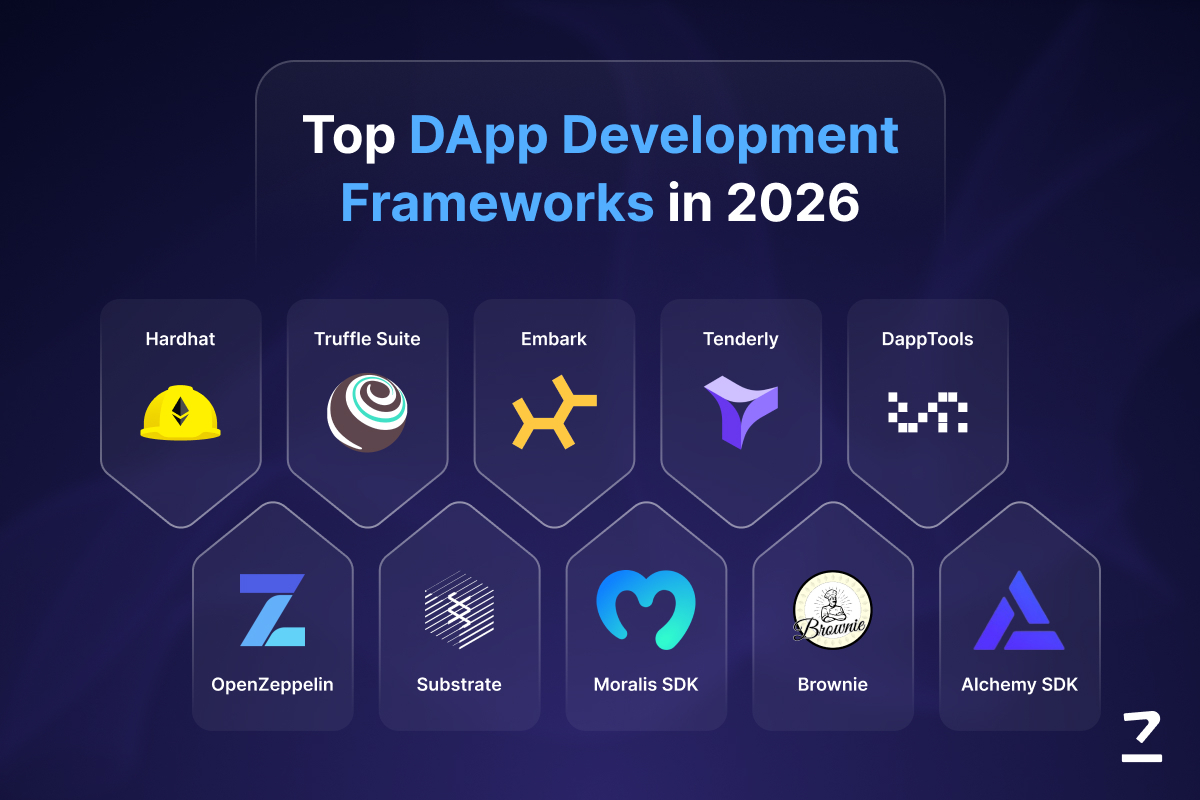
The leading frameworks in 2026 balance security, scalability, and enterprise-readiness while enhancing developer productivity.
Hardhat: This Ethereum-focused framework is favored for professional projects due to its flexible environment, plugin ecosystem, advanced debugging, and integration with TypeScript. Its local Hardhat Network allows rapid testing and iteration.
Truffle Suite: A mature framework supporting Ethereum development, Truffle simplifies contract lifecycle management with migrations, Ganache simulation, and Truffle Boxes for boilerplate templates. It is particularly valuable for enterprise supply chain and DeFi projects.
Embark: Offering a full-stack DApp solution, Embark integrates smart contracts, front-end frameworks (React, Vue), and decentralized storage like IPFS. Its real-time dashboard and automatic contract deployment streamline complex project management.
Tenderly: Essential for monitoring and debugging smart contracts in production, Tenderly provides live error tracking, gas analytics, and forked simulations to prevent costly downtime.
DappTools: A CLI-driven framework for complex DeFi deployments, DappTools emphasizes control and precision, offering tight Solidity/Vyper integration and scriptable workflows for automated testing and deployment.
OpenZeppelin: Industry-standard security libraries provide audited contracts and upgradeable frameworks. OpenZeppelin Defender automates governance and monitoring operations, making it indispensable for regulated applications.
Substrate: Parity’s modular blockchain framework enables creation of custom chains, app-chains, and Polkadot parachains. Its Rust-based architecture and pallet system provide flexibility for consortium or private blockchains.
Moralis SDK: Acting as a “Firebase for Web3,” Moralis simplifies backend infrastructure, supports cross-chain indexing, and accelerates dApp integration with minimal setup.
Brownie: Python-based and ideal for quantitative trading or research-heavy projects, Brownie supports test-driven development with Pytest and provides a Pythonic interface for interacting with Ethereum.
Alchemy SDK: Provides reliable, scalable multi-chain infrastructure with APIs for NFT data, analytics, and high-uptime network connectivity, essential for high-volume DeFi or NFT applications.
The Concept of Multi-Chain Development and Infrastructure Considerations
In 2026, DApps must be designed for multi-chain deployment to achieve true flexibility and scalability. Limiting a DApp to a single blockchain can create bottlenecks, restrict user adoption, and prevent integration with emerging networks. Developers should plan for cross-chain architecture early in the design phase, using tools like Moralis or Alchemy SDKs to abstract chain-specific logic and simplify development.
Layer-2 solutions, zero-knowledge rollups, and high-throughput blockchains such as Polygon and Solana reduce gas costs while maintaining decentralization. These innovations enable complex financial applications, NFT marketplaces, and gaming projects to handle millions of users efficiently.
Integration with major exchanges like Bitget, Coinbase, and Binance ensures liquidity for DeFi protocols and smooth asset flows for gaming and NFT platforms. Account abstraction standards (ERC-4337) simplify user onboarding by removing the need to hold native tokens for gas fees, while AI-assisted IDEs streamline development through instant audits and vulnerability detection.
By joining hands with a Blockchain DApps development company, enterprises can implement multi-chain strategies effectively, ensuring scalable, secure, and user-friendly applications.
Best Practices for Enterprise DApp Deployment
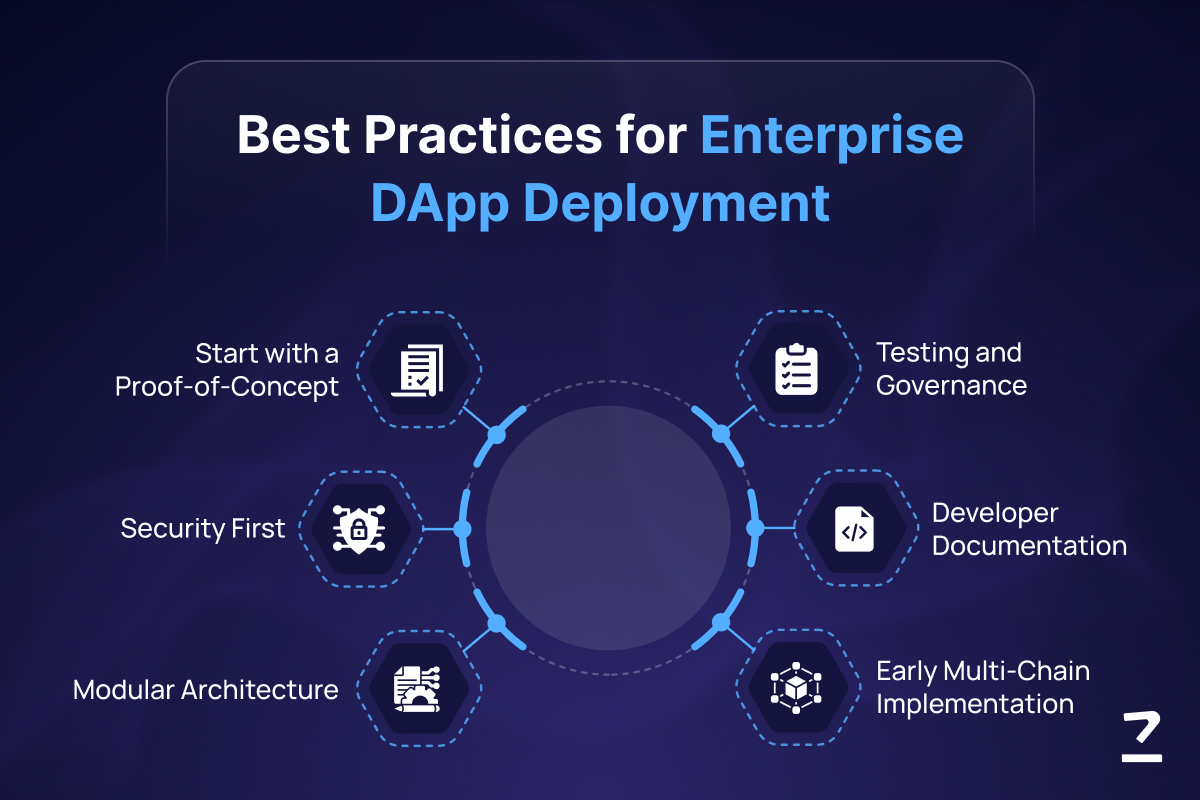
Deploying enterprise-grade DApps requires prioritizing security, scalability, and maintainability. Following industry best practices can minimize risk and maximize ROI:
1. Start with a Proof-of-Concept (PoC):
Test core assumptions on a local network such as Hardhat Network or Ganache. This mitigates risk, validates business logic, and allows iterative development without expensive mainnet deployments.
2. Security First:
Mandate the use of OpenZeppelin libraries for smart contract standards, integrate static analysis tools like Slither or MythX, and continuously monitor contracts in production using Tenderly. Security should be embedded from the first line of code.
3. Modular Architecture:
Design DApps using plug-and-play components. Frameworks like Substrate pallets or Truffle Boxes enable future-proof architectures that simplify upgrades and reduce technical debt.
4. Early Multi-Chain Implementation:
Integrate Moralis or Alchemy SDKs early in development to prevent costly refactoring for multi-chain support. Ensuring cross-chain readiness from the start streamlines scaling and integration with Layer-2 solutions.
5. Developer Documentation:
Maintain detailed onboarding guides, API references, and architecture documentation. A well-documented project ensures smooth team scaling and reduces reliance on tribal knowledge.
6. Testing and Governance:
Conduct professional smart contract auditing, utilize upgradeable proxy contracts, and perform comprehensive automated testing with 100% branch coverage. Implement multi-signature wallets to govern critical actions and maintain operational security.
Partnering with a Custom DApp Development Services provider ensures these best practices are implemented effectively, delivering secure, scalable, and enterprise-ready DApps.
Enterprise DApp Use Cases Across Key Industries
Explore how leading enterprises across finance, healthcare, logistics, real estate, and government are leveraging custom DApps development services to drive security, transparency, and operational efficiency in 2026.
Finance (DeFi/CeFi):
Use Hardhat for local testing, OpenZeppelin for secure contract deployment, and Tenderly for real-time monitoring. This combination enables rapid iteration while maintaining full auditability and compliance with regulatory standards.
Healthcare:
Embark, combined with IPFS and Moralis SDK, allows secure, HIPAA-compliant cross-clinic data sharing. Decentralized storage ensures immutability and auditability of patient records.
Logistics:
Frameworks like Truffle with Ganache enable tamper-proof supply chain visibility. Enterprises can reduce fraud by up to 25% and improve traceability across multiple stakeholders.
Real Estate:
Using ERC-721 and ERC-1155 smart contracts, DApps can automate escrow processes, fractional ownership, and property transfers. This reduces legal overhead and accelerates transactions.
Government:
Substrate enables permissioned chains with customized governance for voting, digital identity platforms, and transparent public-sector operations. This ensures compliance, security, and citizen trust.
Future Outlook of DApp Development
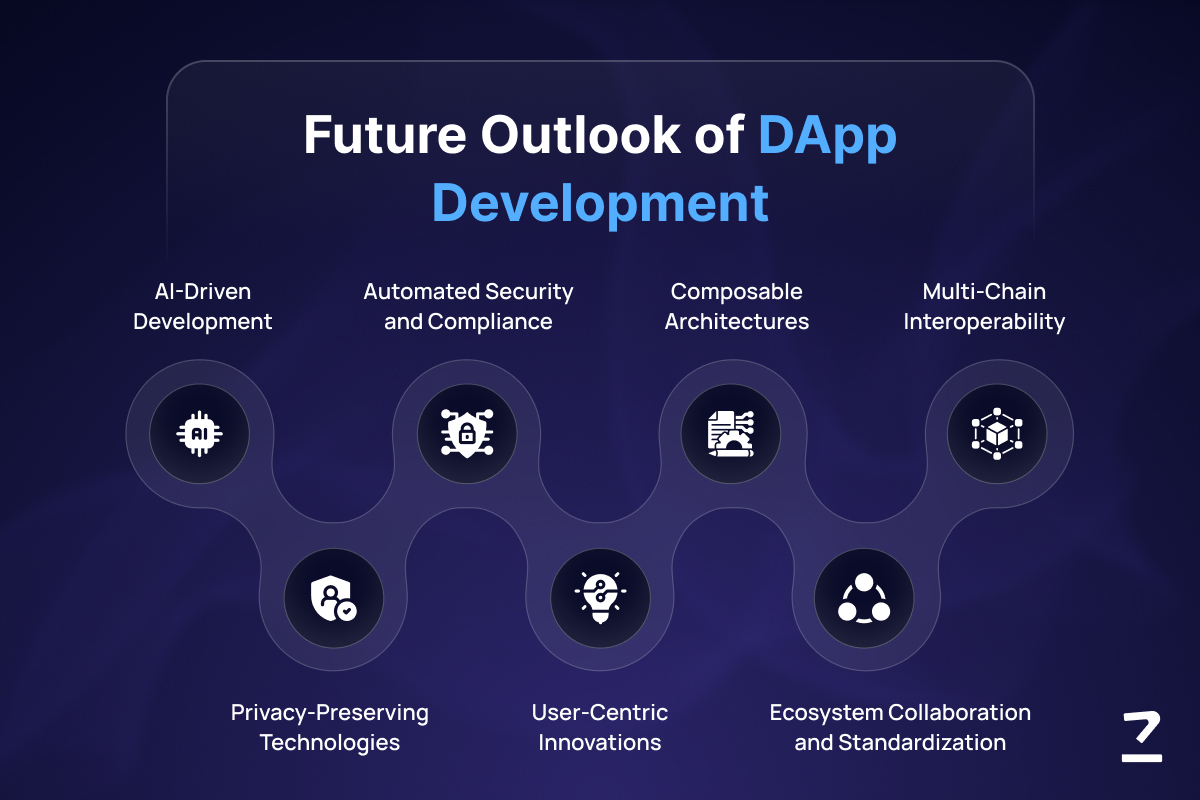
The DApp landscape is evolving rapidly, and the next few years will redefine how decentralized applications are built and scaled:
AI-Driven Development:
AI agents in IDEs now provide real-time code audits, optimizations, and vulnerability detection. Predictive analytics help anticipate performance bottlenecks and guide multi-chain architecture decisions.
Automated Security and Compliance:
Automated auditing tools such as Slither, MythX, and Tenderly simulate attack vectors across multiple chains. Compliance-focused frameworks will automatically enforce GDPR, HIPAA, and financial regulations in real-time.
Composable Architectures:
Future frameworks will focus on modularity, allowing plug-and-play smart contracts, front-end components, and storage modules. Substrate pallets, Hardhat plugins, and Embark modular components ensure long-term flexibility and maintainability.
Multi-Chain Interoperability:
Cross-chain communication protocols, Layer-2 rollups, and interoperability SDKs will become standard. Applications will operate seamlessly across Ethereum, Polygon, Solana, and emerging L2/L3 solutions, supporting global accessibility and liquidity.
Privacy-Preserving Technologies:
Zero-knowledge proofs and tools like Noir and Circom will allow enterprises to validate transactions and user credentials without exposing sensitive data, opening new use cases in finance, healthcare, and government sectors.
User-Centric Innovations:
Account abstraction (ERC-4337) and simplified wallet experiences will remove friction for mass adoption. Integration with high-liquidity platforms like Bitget, Coinbase, and Binance ensures smooth asset flows and enhances user experience for millions of users.
Ecosystem Collaboration and Standardization:
Cross-industry standardization of smart contracts, multi-chain data structures, and UI frameworks will reduce redundant development efforts and foster a more mature decentralized ecosystem.
Enterprises that adopt AI-driven, privacy-preserving, modular, and multi-chain-ready frameworks will gain a competitive edge. The DApps they deploy will be secure, scalable, and adaptable to evolving regulatory and technical environments, positioning them as leaders in the next wave of Web3 adoption.
Turn Your DApp Vision Into a Scalable Product with Codezeros
Selecting the right DApp development framework is now a strategic imperative. From Hardhat’s developer-focused tools to Substrate’s modular custom chains, and from Moralis’ backend simplification to OpenZeppelin’s security-first libraries, each framework offers unique advantages.
Aligning technical capabilities with business goals, regulatory compliance, and developer expertise ensures your DApp is scalable, secure, and future-proof.
Partnering with a top DApps development company allows organizations to combine technical mastery with strategic execution. Codezeros team delivers measurable business outcomes, seamless user experiences, and enterprise-grade performance.
Connect now with our blockchain experts to evaluate the best framework for your project and transform your DApp vision into a production-ready solution.
Post Author

Paritosh Mehta
As a distinguished blockchain expert at Codezeros, Paritosh contributes to the company's growth by leveraging his expertise in the field. His forward-thinking mindset and deep industry knowledge position Codezeros at the forefront of blockchain advancements.
Frequently Asked Questions
Frequently asked questions about this article.
Partner with WebClues for Custom Deep Learning Solutions
Accelerate your AI initiatives with WebClues’ deep learning expertise. We deliver custom deep learning solutions tailored to your business goals, from neural network design to deployment and monitoring. Reduce risk, cut time-to-market, and maximize ROI with a team that combines technical depth and consultative guidance. Consult us today and transform your data into actionable intelligence.
Blogs
Our Latest Blogs
Discover valuable industry insights and stay up-to-date with the latest updates by exploring our curated collection of recent blog posts.



Let us know your requirement
We know ideas matter, we are the product of one. We Provide Full Assistance In Your Business