

Rust Development
Company
About Rust
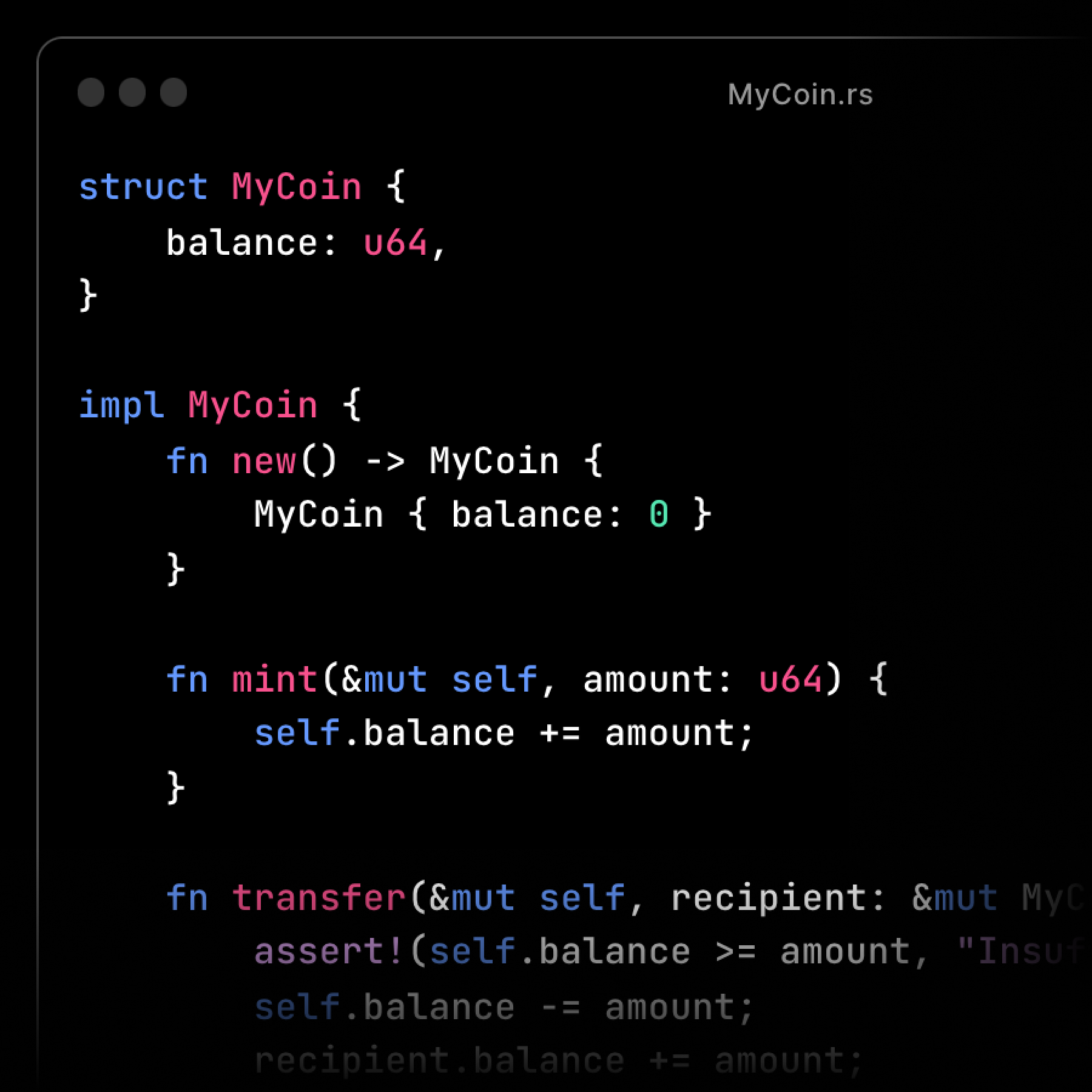
Rust is a statically-compiled language with a comprehensive type system and ownership model that is extremely fast and memory economical. Rust is often used for system programming, but thanks to its high-level capabilities, it doubles as a functional programming language. The syntax of Rust is comparable to that of C and C++, although many of its features are influenced more by functional programming languages.
Rust’s goal is to allow concurrent systems development, which has inspired a feature set that prioritizes safety, memory layout management, and concurrency. Memory safety, type safety, and the absence of data races are all guaranteed in Rust. Our developers employ this statically typed, high-level, general-purpose, multi-paradigm programming language's safety, speed, concurrency, and efficiency to create best-in-class decentralized programs for a wide range of commercial use cases.
BENEFITS
Benefits of Rust Language
Active developer community
Rust was built by Mozilla, the non-profit organization that produced Firefox. Mozilla's developers investigated the issues with their code and sought a better solution. Finally, they settled on Rust. Rust is presently used by companies like Microsoft, Meta, Dropbox, Arm, Google, Amazon, and others.
The best alternative to C++
Rust is a contemporary alternative to C++, addressing issues like null usage. It offers comparable compiling speeds, continually enhanced through LLVM advancements. Unlike C++, Rust eliminates the need for recompilation after code changes. Additionally, it includes Cargo, a built-in package manager that verifies dependencies and prevents unnecessary recompilation. These features make Rust efficient and developer-friendly.
Superior memory management
With Rust, you have complete control over memory allocation and deallocation. When you create a variable, a smart pointer is created to help with memory management. De-allocation occurs if the smart pointer exits the scope. This method provides our developers with total control and enables them to utilize many smart pointers that share the same data.
PROCESS
Steps to Hire our Rust Developers
Experience a hassle-free hiring process as we walk you through the essential steps of selecting and hiring our top-notch Rust developers.

Inquiry
Tell us about your project needs and goals. We keep your information confidential.
Select Candidates
We provide a list of pre-verified candidates based on your requirements.
Take Interviews
Interact with the candidates through a phone/video call.
Onboarding the Developer
Add the selected developer to your team and orient them according to your project.
Forge ahead with Rust!
Hire our top-notch Rust developers and level up your projects. Don't wait, seize the opportunity now!

WHY US
Why choose us for Rust Development Services?
We have the knowledge and skills to create the greatest Rust-based blockchains, dApps, and other unique Web 3.0 solutions, such as metaverse platforms, to help you take your business to the next level. We can leverage Rust for the following engineering perks:
Build cross-platform applications
The Codezeros team knows how to leverage Rust for its cross-platform compatibility. We know how to compile Rust codebases for execution on a diverse range of platforms, including desktop, mobile, and embedded systems.
Implement low-level programming
Rust is a low-level programming language that grants our developers direct access to hardware and memory. Our software engineers see Rust’s potential as a great solution, not just for blockchain, but operating systems and microcontroller applications.
Secure Web 3.0 solutions
Our blockchain experts are able to leverage Rust’s memory safety to design safe and stable Web 3.0 solutions for your business. Rust allows us to implement SQL injections, cross-site scripting, etc.
Skilled in Substrate
Our Rust developers are skilled in Substrate, a framework developed by Parity, a blockchain infrastructure provider, explicitly for building custom blockchain systems with rich features and functionalities.
Let us know your requirement
We know ideas matter, we are the product of one. We Provide Full Assistance In Your Business

The most common questions
Do you have any queries? Allows us to dispel any doubts you may have before you hire our Rust software development services.
Rust was designed to help system-level programmers who create byte-tweaking programs. It provides raw bit access and expects programmers to utilize it. The language is intended to coexist with most of the legacy C or assembly language code found at lower levels of operating systems and network stacks. Real programmers desire that access in order to create the finest, most responsive stack possible. Rust comes through.
The Rust programming language offers its own memory management mechanism that is not as extensive as regular GC but can be more powerful. A competent developer can achieve excellent speed by utilizing Rust's memory model, but they must first know the type system and atomic reference counting. Hands-on memory management is a feature that die-hard Rust aficionados like. They'd rather handle it themselves, even if it entails managing many threads and ensuring the code is responsive. Rust, for better or worse, places power in your hands.
When C and C++ were designed decades ago, programmers could not have predicted modern cyber-attacks. Because it is difficult to change the security concept of an existing language, the solution was to create a new one that emphasized modern demands. So, if you ask what Rust is used for, the answer is memory safety. Rust is touted as a "memory-safe" language because it is designed to prevent programs from mistakenly reading data from a computer's memory. Even inexperienced programmers may be certain that they have not introduced any memory-safety issues into their code by building new applications in Rust instead.
Although Rust appears to be very similar to C, it is heavily influenced by the ML family of languages. (Languages in this family include OCaml and F#.) Rust characteristics, for example, are essentially Haskell-type classes, and Rust has extremely sophisticated pattern-matching capabilities. Rust does have greater mutability than most functional programmers are used to. Consider this: both Rust and FP aim to prevent shared mutable states. While FP is concerned with avoiding mutable states in general, Rust is concerned with avoiding the shared part of the danger. Rust also lacks several features that would enable functional programmings, such as tail call optimization and robust support for functional data structures.
Rust allows for simple scalability and parallelism, making it ideal for developing large applications to match the modern world's expanding technological expectations. It employs a logical and functional grammar that enables developers to manage low-level programming for Internet of Things (IoT) applications. The older Rust programs are compatible with the language's later versions. Rust also features an asynchronous processing mechanism that enables developers to write and run distinct functions that may subsequently be combined.
First off, Rust offers abstractions that make it simple to manually control memory. Additionally, it features a dependable method of communicating with memory that prevents segmentation issues. Additionally, Rust offers an automated demonstration of how to correct compilation issues. A builder and package manager, as well as tools for testing and producing documentation, are all included with the compiler. Finally, Rust code complies with procedural, parallel, and OOP programming principles in addition to functional programming principles. As a result, it is a good language for creating blockchain systems.