

Haskell Development
Company

About Haskell
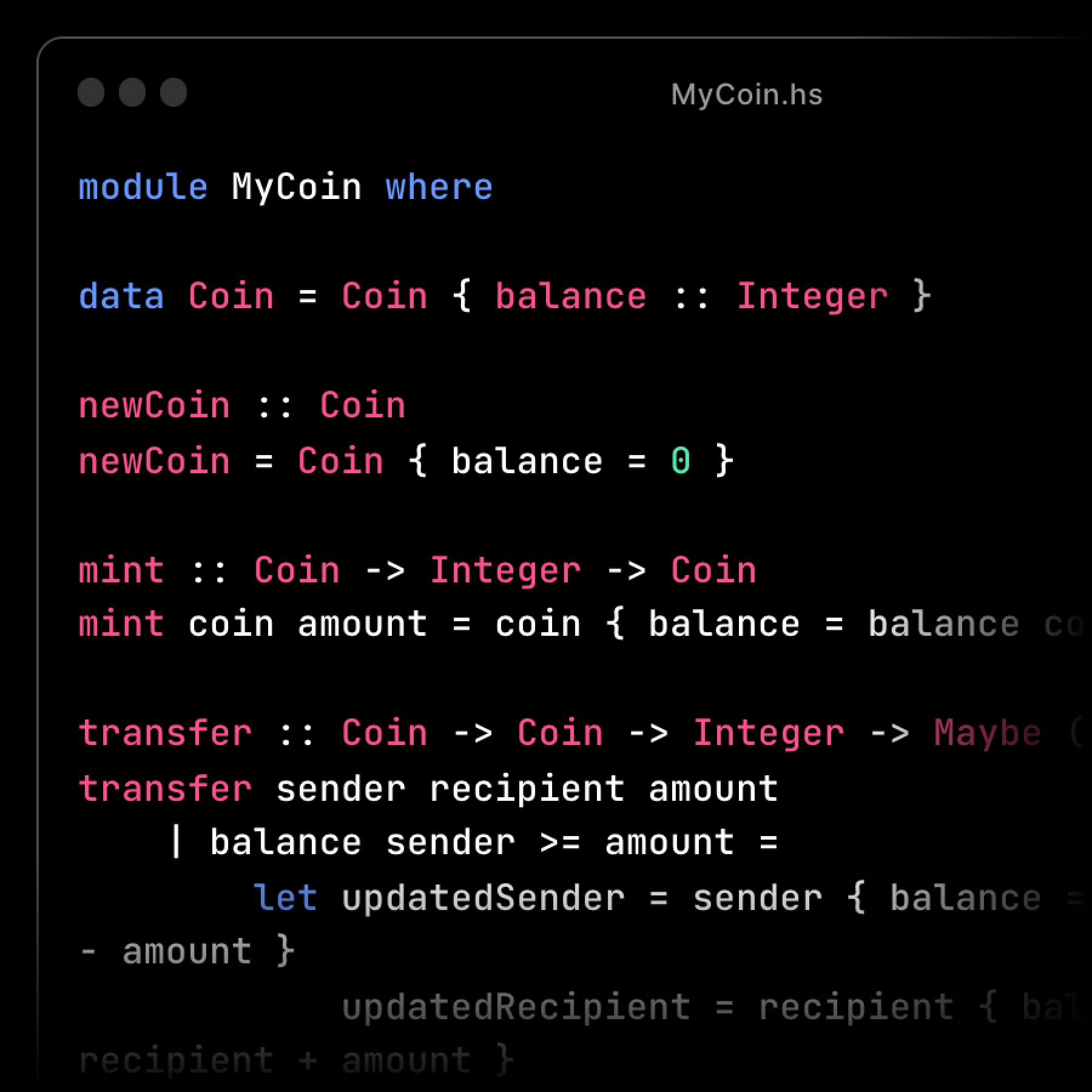
Haskell is a completely functional programming language with type inference and lazy evaluation that is statically typed. Haskell is a programming language designed for education, research, and industrial applications. It pioneered a number of computer language innovations such as type classes, which enable type-safe operator overloading, and monadic IO. The Glasgow Haskell Compiler (GHC) is Haskell's primary implementation. It is named after Haskell Curry, a logician.
The semantics of Haskell are historically based on those of the Miranda programming language, which served to focus the early Haskell working group's efforts. The language's latest official specification was issued in July 2010, and GHC work continues to improve Haskell through language extensions.
BENEFITS
Benefits of Haskell Language
Haskell is concurrent
Concurrency is supported by the Haskell programming language. Concurrency refers to the use of many I/O-performing threads to accomplish a program. While a concurrent Haskell program can run on multiple machines, the primary goal of using concurrency is not to improve performance but rather to write the program in the simplest and most direct way possible.
Memory safety
In C and C++, manual memory management frequently results in buffer overflows, use-after-free, memory leaks, and other memory-related issues. This creates security flaws. Because of autonomous memory management, software developed in Haskell is unlikely to display such difficulties. Memory safety is a feature shared by many modern languages, including Java, Python, Go, JavaScript, Rust, and others, and it is critical for developing secure software.
Garbage collection
Memory safety may be achieved in two ways: garbage collection (the more prevalent method) and static lifespan verification (the Rust method). While garbage collection makes Haskell unsuitable for real-time systems such as computer games, it is less restrictive than lifetime checking, allowing for better abstractions and higher developer productivity.
PROCESS
Steps to Hire our Haskell Developers
Checkout our streamlined hiring process for bringing on board our exceptional Haskell developers. Below are the steps to follow in order to successfully hire the best talent for your team.
Experience a hassle-free hiring process as we walk you through the essential steps of selecting and hiring our top-notch Haskell developers.

Inquiry
Tell us about your project needs and goals. We keep your information confidential.
Select Candidates
We provide a list of pre-verified candidates based on your requirements.
Take Interviews
Interact with the candidates through a phone/video call.
Onboarding the Developer
Add the selected developer to your team and orient them according to your project.
Ready to harness the power of Haskell?
Contact us immediately for a quote on your Haskell game development or Web 3.0 development requirements.

OUR APPROACH
Why choose us for Haskell app development?
Our team excels in the realm of Haskell web development, crafting dynamic and high-performance web solutions that push the boundaries of innovation. We rely on Haskell for the following technical benefits:
Native coders
With Haskell, we know how to compile ahead of time to native machine code which allows us to leverage Haskell for developing apps that require high performance, such as high-throughput data processing.
Debugging using static types
Haskell features a type-checker that helps us check code during development. This allows our developers to identify any issues early in the development cycle and examine the data model expressed in static types.
Code purity
Haskell programming is based on pure functions and immutable data which is critical to our developers' ability to write code-reliable software, manage global states, and prevent side effects.
Memory-safe applications
Haskell's memory safety makes it difficult for an attacker to remotely execute code by stopping us from making mistakes that result in garbage data being put into memory.
Let us know your requirement
We know ideas matter, we are the product of one. We Provide Full Assistance In Your Business

The most common questions
Do you have any concerns? This section lets us allay any fears you may have about using our Haskell software development services.
Haskell, like Java among object-oriented languages, promotes general-purpose code allowing us to create web 3.0 applications (eg: in the Cardano blockchain), test programs, construct and monitor system management routines, and much more. People frequently utilize Haskell for numerous mathematical research purposes. It is based on Lambda Calculus and excels at representing mathematical functions. These functions never have any secondary or unintended consequences. Each function used with the same input always produces the same result and never changes the status of a program.
The Haskell programming language is a cutting-edge programming language that provides developers with unrivaled productivity, efficiency, and security capabilities, making it a game changer in the blockchain technology scene. Haskell’s new high-level programming language is meant to generate safe, stable, and simple smart contracts. Haskell, in contrast to other languages such as Solidity, was designed with simplicity in mind. This allows developers to read, create, and comprehend code without specialized knowledge or a high learning curve.
Haskell is a sluggish language. It does not evaluate expressions until absolutely necessary. This typically helps our programs to save time by eliminating superfluous calculations, but it puts them in greater danger of memory leakage. When we don't want lazy evaluation, we can introduce strictness into our programs.
Haskell is unique among programming languages in that it is entirely functional. Its distinctions from languages based on the imperative programming paradigm are particularly notable: Programs developed in imperative languages carry out instruction sequences. The state of these instructions might change during execution, for example, by altering variables. Control flow structures make it possible for commands to be performed many times.
At Codezeros, our highly professional developers make every attempt to meet your Haskell software development job request. We do research on numerous elements of your organization in order to provide appropriate solutions. Our employees are skilled and knowledgeable in this programming language. We employ cutting-edge tools and technology to create a website for your company. We work on both new and existing software projects. Our professionals ensure that you receive high-quality Web 3.0 solutions for your company.
Haskell is a good choice for blockchain programming because it allows for the creation of solid and reliable code, especially when used in combination with formal techniques. Haskell is a functional programming language that works well for programs that need a lot of formal verification and high-assurance code. As a result, Haskell serves as the foundation for both Marlowe, Cardano's domain-specific language for smart contracts, and Plutus, the company's smart contract programming language. Cardano uses Haskell for both its on-chain and off-chain code, allowing it to benefit from the extensive body of research that already exists within the Haskell ecosystem rather than starting from scratch with a brand-new and untested smart contract language.